
Why Storing Several Vials Is a Different Problem
Storing one vial is easy: it has one label, one spot in the fridge, and nothing to confuse it with. The moment you add a second vial, and especially when you reach three, four or five, a loose pile in the fridge door stops working.
Here's what typically happens: five barely labeled vials roll around the door shelf. Two are 3 mL, two are 10 mL, and one is a sterile water bottle. Two of them look identical: clear liquid, same size, similar stoppers. It's early, you're in a hurry, and you grab the wrong one. Or a roommate reorganizes the fridge and a vial ends up somewhere it was never meant to be.
None of that is bad luck. It's what predictably happens when a multi-vial kit has no storage system built for it. This guide gives you that system: labels, zones, and a case with one home for every vial.
Design a case for every vial in your kit
Add each vial size and how many you keep, and the builder lays out a compact case with a fitted pocket for every one.
The Core Rules for Any Multi-Vial Kit
These principles apply no matter what your vials hold:
Rule 1: Follow Each Product's Own Storage Instructions
Different products can carry different storage directions, so never assume one rule covers the whole kit. Follow the storage instructions on each product label or from your pharmacist or provider, and organize around them. A hard case is a protective organizer, not a cooler: it keeps vials upright, separated and easy to find, and it can sit inside a fridge or a cooler wherever your label says the vials belong.
Rule 2: Label Every Vial the Moment It Arrives
Label vials when they come into your home, not later. At minimum, write what the vial holds and the date you received or opened it, and keep the original pharmacy or product label readable. A vial with two letters in marker on it is not an adequate label once you have several that look alike. Our complete vial labeling guide covers materials, placement and systems for kits with several vials.
Rule 3: Separate In-Use Vials from Backup Stock
In-use vials and unopened backups should never share the same loose space. When backup stock sits next to open vials, sooner or later one gets mistaken for the other. Give each group its own case or its own clearly marked row, and store each wherever its label directs.
Rule 4: Give Every Vial a Fixed Home
The single biggest upgrade is a fixed position: the same vial in the same pocket every time. An empty pocket tells you instantly that something is missing.
Pro Tip: Keep a dry-erase marker and a small whiteboard (or a card in the case lid) listing what sits in each pocket and the date each vial was opened. It takes seconds and ends the guessing game.
Two-Vial Kits: Keeping Look-Alike Vials Apart
The most common starting kit is two vials that look exactly the same: same size, same clear contents, similar caps. Storage itself is simple, but visual confusion is the real risk.
- Label both vials with what they hold and the date opened.
- Use a different color for each, either a colored label, a colored dot, or a color-coded cap, so you can tell them apart at a glance.
- Keep them in adjacent, fixed pockets, always in the same order (for example, left to right in the order you use them).
With two in-use vials and two backups, you need at least four pockets. Room for a sterile water bottle and a spare makes six, which still fits in a compact case.
Three-Vial Kits: Different Sizes and Light
Once you hold three or more products, sizes start to vary: a 3 mL vial next to a 10 mL vial next to a taller bottle. In a flat-bottomed box the short vials sink out of sight and the tall ones tip. Fitted pockets sized for each vial keep everything upright and visible.
Some products are packed in amber vials or come with a "protect from light" note. Wherever that applies, store the vial in its carton or a closed case so it isn't sitting in the light every time the fridge door opens. Our guide to amber vs clear vials explains what to look for, and 3 mL vs 10 mL vials covers how the two sizes differ in a case.
A three-product kit with backups usually means six to nine vials on hand. That needs one larger case, or two cases (in-use and backup) so the two groups can never get swapped.
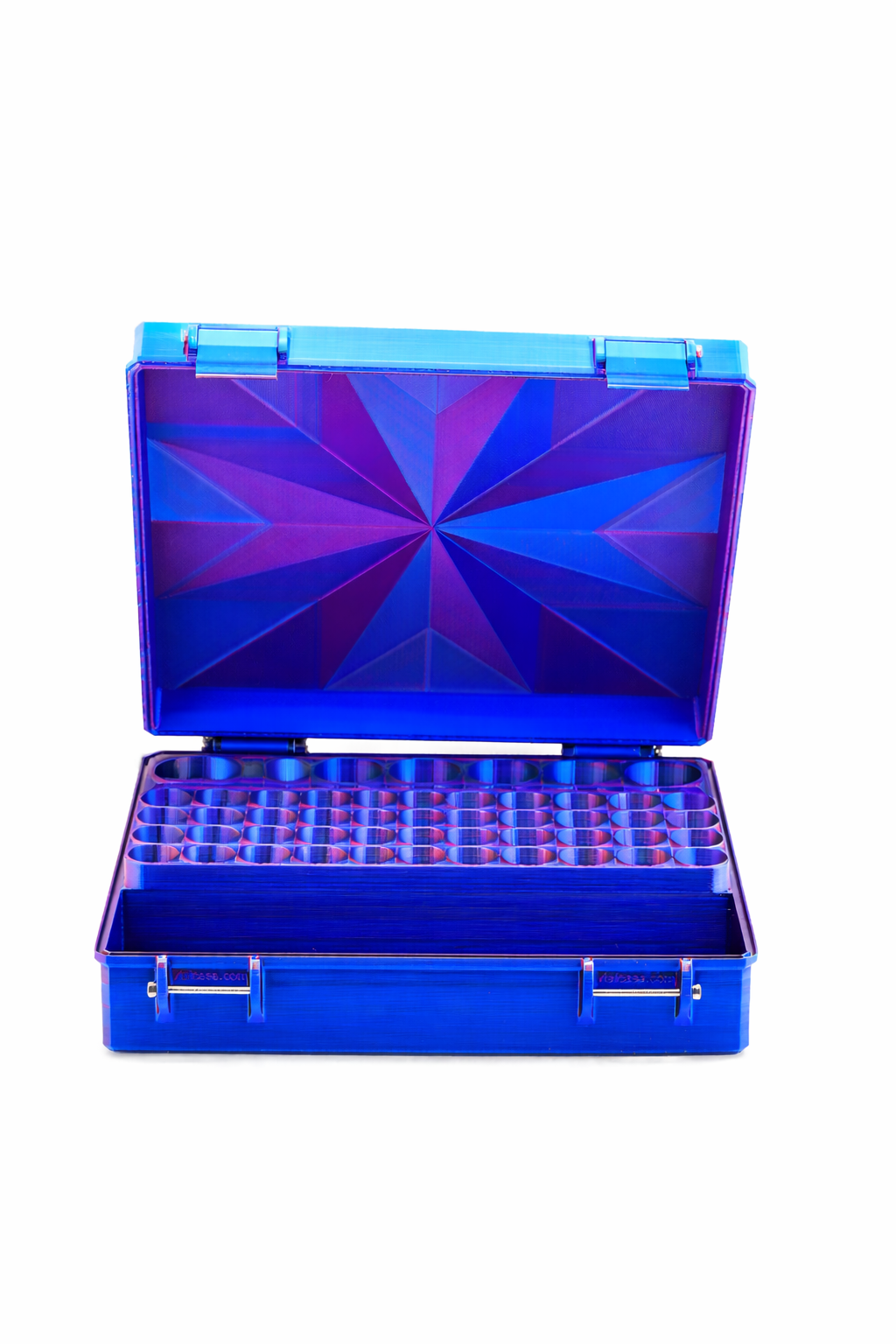
Four or More Vials: A Color-Coded System
With four in-use vials that all look similar, a two-layer labeling system is non-negotiable:
- Assign a color to each product (for example red, blue, green and yellow).
- Mark the cap of each vial in its color with a colored dot, a colored marker, or a color-coded cap.
- Write the full label (what it holds and the date opened) on a small adhesive label on the side of the vial.
- Keep a reference card in your case listing each color, what it stands for, and the date each vial was opened.
Color gives you quick identification in low light; the written label gives you the full information. Together they end confusion even when you're in a hurry. The vial labeling guide goes deeper on materials for every vial size.
Color-code your vials
Custom snap-on caps for 3 mL or 10 mL vials, with a cap color plus an icon or letters. Sets from 25 caps.
Fridge Organization: Active Vials vs. Backup Stock
The most common failure is treating the refrigerator as one zone for everything. A tidy setup has two distinct areas:
Zone 1: Active Vials (a Dedicated Case)
Keep every in-use vial in one dedicated case. It should have individual pockets so vials can't clink together and break, a lid that closes securely, and enough room for your whole kit plus a sterile water bottle. Put the case on an interior shelf toward the back rather than in the door, where it gets bumped every time the fridge opens, and keep food away from it.
Zone 2: Backup Stock (a Separate Case)
Unopened backups get their own case or clearly labeled container, stored wherever their labels direct. When you open a new vial, move it from the backup case to the active case and label it right away.
For a complete setup, see our peptide fridge organization guide and our guide to organizing several vials.
Choosing the Right Case for Your Kit Size
Case size depends on how many vials you keep on hand at once:
- Two products: about six pockets, enough for two in-use vials, a sterile water bottle and a few backups.
- Three products: eight pockets or more for daily use, or a second case for backups.
- Four or more products: ten to twelve pockets, or one case for in-use vials and a second for backups.
Whatever the size, look for fitted pockets that hold each vial upright without rattling, an opaque shell, and a secure latch that won't pop open in the fridge or in a bag. Pill organizers and zip bags don't meet those criteria.
Build your own custom case for a peptide stack
Ready-made cases come in fixed slot counts, so a kit of two 10 mL vials, three 3 mL vials and a sterile water bottle usually ends up with empty holes or a vial with nowhere to go. The PeptideCase™ builder works the other way around. Start with an empty case, tap "Add item," and pick what you keep: 3 mL vials, 10 mL vials, peptide vials, other size vials, a BAC water bottle, syringes, alcohol pads or a pen, and how many of each.
Every item becomes fitted pockets or an open bay sized for that count, and Auto-arrange finds the most compact layout. The tallest item sets the case height; shorter vials stand on a raised floor so every top lines up at the rim, and every space has a finger scoop. Add a line of text to the lid ("Daily kit" or your name) printed in a second color, pick Black or RGB Metallic, and check the top, lid and 3D views before it's printed to order in the US. Build a case around your kit
What Happens When Vials Get Confused
It's worth being direct, because this is the main reason to take labeling and organization seriously:
- You grab the wrong vial. If two vials look alike and live in the same loose pile, it's only a matter of time.
- You lose track of which vial is which. If a label smudges or falls off, set that vial aside and check with your pharmacist or provider rather than guessing.
- A vial ends up in the wrong place. When backups and in-use vials share space, one eventually gets stored contrary to its label.
- A vial breaks. Loose glass in a fridge door chips and cracks; a fitted pocket stops vials from knocking together.
Each of these costs money and time. The labeling and organizing system in this guide takes about ten minutes to set up and prevents all of them.