
Your Fridge Has Temperature Zones
Most people assume their refrigerator holds one temperature throughout. It doesn't. Different areas run noticeably warmer or colder, which matters when your product label gives a specific storage range. Follow the range on your label or from your pharmacist or provider, and use a fridge thermometer to find a spot that actually holds it.
- Back of middle shelves: Usually the coldest, most stable area, with the least swing when the door opens. This is where your vials should live.
- Front of shelves: Warmer and more variable. Every time the door opens, warm air hits the front first.
- Door shelves: The worst location. The temperature swings up and down many times a day. Door shelves are designed for condiments — not medication.
- Crisper drawers: Steady, but humid. Condensation on cold vials can smear handwritten labels and make a mess.
- Top shelf (back): Often the second-best location. Cold air tends to flow down the back wall.
The Rule: Back of middle shelf. Every time. If you remember nothing else from this article, remember this: push your vial case to the back wall of the middle shelf. That's the sweet spot.
Design a case for your fridge shelf
Add the vials and pens you keep cold, let Auto-arrange lay them out, and check the exact case size against your shelf before you order.
The Case-in-Fridge System
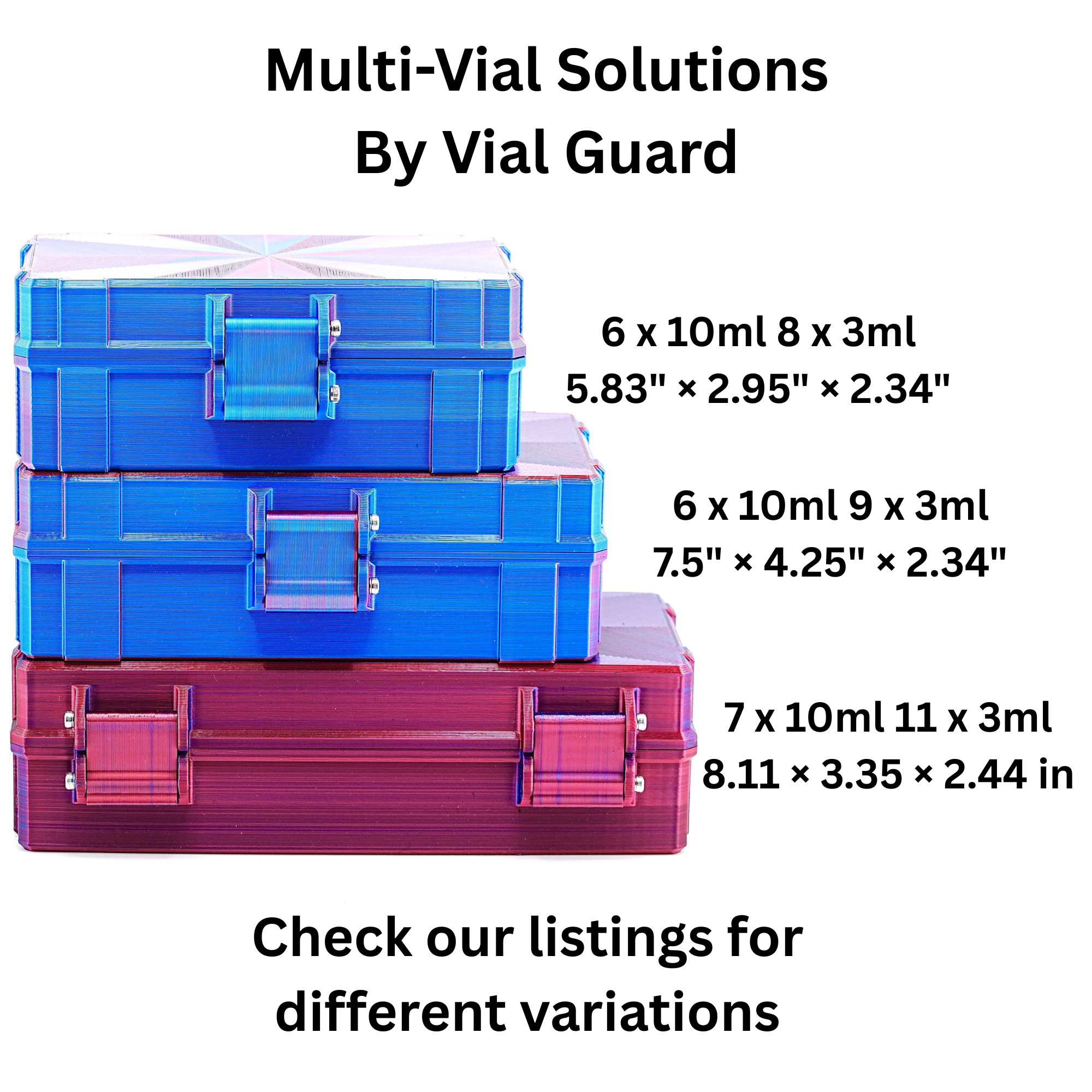
The most effective approach is a "case-in-fridge" system — your vials live inside a storage case, and the case lives inside the fridge. This creates two layers of protection:
- The case provides: light blocking (the fridge light never reaches the vials), impact protection (nothing falls on them), organization (a set place for each vial), cleanliness (isolated from food spills and drips)
- The fridge provides: temperature control, a stable environment, consistent cold
When you need a vial, you pull the case out, open it, take what you need, close the case and return it to the fridge. Out-of-fridge time: a minute or two. Your vials never sit on the counter, never sit under room light, and never get lost behind the leftover pizza.
Organizing Multiple Peptides
If you keep more than one product, organization becomes critical. Here's a system that works:
By Status
- Vials in use: Front of the case, easy to reach. These are the vials you pull from most often.
- Unopened backup vials: Back of the case, or wherever your label says they belong. These don't need to be handled regularly.
- BAC water bottle: A dedicated spot in the case, so it's never mistaken for a vial.
By Product
- Left side: Peptide vials
- Right side: GLP-1 vials or pens
- Center: Larger vials, such as TRT
The exact layout doesn't matter — what matters is that it's consistent. When you reach into the case at 6am, muscle memory should tell you exactly which slot to pull from.
Color Coding
If your vials have removable colored caps, assign a color to each product:
- Blue cap = your first peptide vial
- Green cap = your GLP-1 vial
- Red cap = your TRT vial
- Yellow cap = unopened backups
Not all vials come with colored caps. A small piece of colored tape works just as well — or design a set of caps with your own colors, icons or letters.
Color-code your vials
Custom snap-on caps for 3 mL or 10 mL vials, with a cap color plus an icon or letters. Sets from 25 caps.
Labeling System: At minimum, every vial you've opened should carry two pieces of information: what's in it and the date you opened it. Short codes are enough — "PEP A 4/1" tells you everything you need to know. Use a fine-tip permanent marker; it won't rub off in fridge moisture. More ideas in our guide to labeling peptide vials.
Fridge Hygiene for Peptides
Your vial storage area should be the cleanest part of your fridge:
- No raw meat nearby. Raw meat juices that drip onto your case or vials are a real contamination risk.
- Wipe down the shelf monthly. A clean surface stops grime building up under your case.
- Keep food sealed. Strong-smelling foods (onions, garlic, fish) don't affect sealed vials, but smells can linger in foam inserts over time.
- Don't overstuff the fridge. Overpacking blocks air circulation, creating warm spots. Leave some space around your case.
Freezer vs. Fridge: What Goes Where?
This one is set by your product, not by us. Follow the storage instructions on your product label or from your pharmacist or provider:
- Fridge: Whatever your label says to refrigerate — usually the vials and pens you're using now.
- Freezer: Only what your label specifically says may be frozen.
- Never guess: If the label says do not freeze, keep it out of the freezer and away from the coldest, freezer-side spots in the fridge.
Either way, a hard case is an organizer, not a cooler. Its job is to keep vials upright, separated and labeled on whatever shelf they belong on.
Shared Fridge Situations
Roommates, family members, or partners sharing fridge space? Here's how to handle it:
- A case keeps your vials discreet. Not everyone needs to know what you keep in there. A closed case on a shelf looks like any other container.
- Claim your shelf space. Designate a specific area for your case. A consistent location stops your things getting moved or knocked around.
- Keep it clean. If your housemates are messy, your case protects your vials from spills, falling objects, and general fridge chaos.
- Label the case, not just the vials. A simple "MEDICAL — DO NOT MOVE" label on the lid stops well-meaning roommates from rearranging your storage.
The 5-Minute Fridge Setup
Here's a quick routine to set up your fridge for vial storage:
- Clear the back of your middle shelf. Move food forward or to another shelf to create space.
- Wipe down the area with a clean cloth.
- Place your vial storage case against the back wall, centered on the shelf.
- Organize vials inside the case — vials in use up front, backups behind, the BAC water bottle in its own spot.
- Check your fridge temperature against the range on your product label. If it's off, adjust the thermostat. A fridge thermometer is a worthwhile investment.
Make Your Own Custom Case for Your Fridge
The case-in-fridge system works best when the case is shaped for both your vials and your shelf. With the PeptideCase™ builder you start with an empty case, tap "Add item" and pick exactly what lives in your fridge — 3 mL vials, 10 mL vials, peptide vials, TRT vials, a GLP-1 pen or injector pen, pen cartridges, a BAC water bottle — and how many of each. Each item becomes fitted pockets or an open bay sized for that many, and Auto-arrange packs them into the most compact layout.
The builder shows the case's length x width and height, so you can measure the back of your middle shelf first and make sure it fits. Shorter vials stand on a raised floor so every top lines up at the rim, and every space has a finger scoop. Sharing the fridge? Add one or two lines of text to the lid, like "MEDICAL — DO NOT MOVE," printed in a second color.
Build a case for your fridge shelf
Bottom Line: Your fridge is your vials' long-term home — not a temporary parking spot. Back of the middle shelf, inside an opaque case, labeled and organized. Five minutes of setup keeps everything clean, findable and protected for months.
Supplies referenced in this article: Bluetooth fridge thermometer