
Once one more vial joins a peptide kit, storage stops being about a single bottle and starts being about a system. Five, six or eight vials, each opened on a different date, each with its own label, is where loose vials on a fridge shelf turn into hunting, guessing and the occasional broken bottle.
The rule for temperature is simple: follow the storage instructions on each product label or from your pharmacist or provider. The rest — protecting the glass, keeping vials in the dark, and knowing at a glance which is which — is what a good case and a consistent layout solve.
Design a case for your whole vial kit
Add every vial, bottle and supply you keep, and the builder lays out one hard case with a fitted slot for each and a top view as your slot map.
Capsules vs. Vials: Only One Belongs in the Case
Not every product in a wellness routine needs the same storage. Before you organize anything, sort what you have:
- Capsules and powders in tubs: these usually live in a cool, dry cabinet or drawer, sealed, following their own label. No vials, no case needed.
- Vials: small glass bottles with rubber stoppers. These are the ones that break, get confused with each other and often carry a refrigerate instruction. They belong together, in one case, in fixed slots.
Keeping the two groups apart is the first step. Capsules in the cabinet; every vial in the case.
Temperature and Light: Follow Each Label
Different vials can have different storage instructions, including different instructions before and after opening. We don't publish ranges for any product; read each label, follow it exactly, and ask your pharmacist or provider if anything is unclear. If your labels differ from one another, don't assume they can share a shelf — check first.
Two habits help whatever your labels say. First, a min/max fridge thermometer, so you know the spot you chose holds the range on your labels. Second, an opaque case that closes fully, so vials stay in the dark every time the fridge door opens. A case is a protective organizer, not a cooler — it lives in the fridge, or in a cooler with ice packs when you travel.
The Organization Challenge of a Six-Vial Kit
Running five to eight vials at once creates complexity that grows faster than the vial count. It's not just "more vials" — it's more opened dates, more use-by dates, more chances to grab the wrong one, and more to track in your head.
A typical larger kit looks something like this:
- Vial A — opened 4/10, use-by date from its pharmacy label
- Vial B — opened 4/5
- Vial C — opened 4/12
- Vial D — opened 4/12
- Vial E — opened 4/1
- BAC water bottle — opened 4/1
Six vials, six different dates. Loose in the fridge, you're reading labels every single time. In a dedicated multi-slot case with each product in its assigned position, you reach for the right vial by habit and confirm with a glance.
Building Your Fridge Setup: Three Zones
A tidy multi-vial setup has three zones:
- The active case: every vial you're using now, one per slot, at the back of the middle fridge shelf, away from the door.
- Backups: unopened vials stored wherever their labels say, clearly separate from the active case, so you never open a new one by accident.
- Supplies: syringes, alcohol pads and a BAC water bottle, either in their own bays in the case or in a pouch right next to it, so your whole setup is in one place.
The key principle: every item has exactly one home. When you finish, everything goes back to its spot. The system only works if it's consistent. Our fridge organization guide covers shelf placement in detail.
Pro Tip: If you reach for one vial far more often than the rest, consider a two-case system: a small case for that vial at the front of the shelf, and a larger case for everything else. The main case stays closed and undisturbed most of the time.
Labeling a Multi-Vial Kit
With six similar bottles, labels and color do most of the work:
- Label the glass, not the cap. Caps come off. A small label on the vial body with a short code and the date you opened it stays put.
- Copy the use-by date from the pharmacy label onto your small label, so it's visible inside the case.
- One color per product. Colored caps or stickers let you tell vials apart before you read a word.
- Keep a slot map. A card in the lid or a phone note listing what lives where, until the layout is second nature.
More ideas in our guide on how to label peptide vials.
Color-code your vials
Custom snap-on caps for 3 mL or 10 mL vials, with a cap color plus an icon or letters. Sets from 25 caps.
Traveling With a Full Kit: Six Vials vs. Two
Two vials and a cold pack are manageable almost any way you pack them. Six vials are not — improvised packing starts creating real risk.
- All vials in your carry-on. Checked bags get lost and sit on hot or freezing ramps.
- A hard-shell case is essential. Six glass vials in a zip bag won't survive security trays, overhead bin shifts or a dropped backpack.
- Size the cooler to the trip. If your labels call for refrigeration, pack the case in a cooler or insulated bag with a gel pack big enough for your whole door-to-fridge travel time, and check each label for how long the product may be out of the fridge.
- Check the hotel fridge. Hotel mini-fridges vary a lot. Check yours with a thermometer on arrival; if it doesn't hold your labels' range, ask for a different fridge.
Our TSA travel guide covers the airport side.
Make Your Own Custom Case for a Multi-Vial Kit
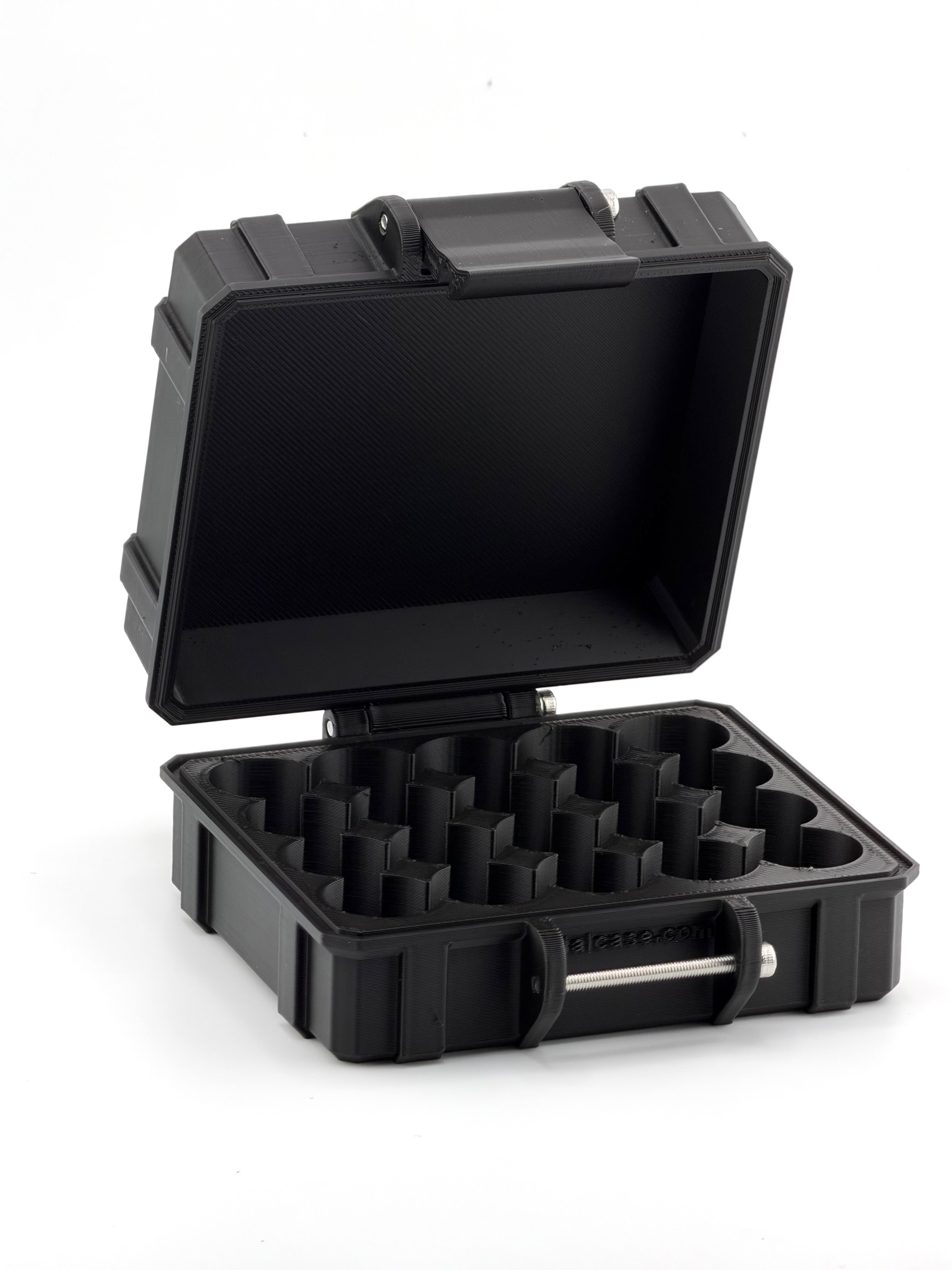
Off-the-shelf cases rarely match a six- or eight-vial kit: too few slots, the wrong sizes, nowhere for the BAC water bottle or the syringes. In the PeptideCase™ builder you start with an empty case, tap "Add item" and add exactly what you keep — peptide vials, 3 mL or 10 mL vials, glutathione vials, other size vials, a BAC water bottle, syringes, alcohol pads (flat or standing) — with the quantity for each. Every item becomes fitted pockets or an open bay sized for that many.
Auto-arrange packs it all into the most compact layout, and the builder shows the case size, height and a top view of where everything sits — your slot map, before the case even exists. Shorter vials stand on a raised floor so every vial top lines up at the rim, with a finger scoop on every space. Big cases get a 5-knuckle hinge and two latches.
Build a case for your whole kit
Why a Case Makes Sense for a Full Kit
The more vials you keep, the more a case is worth. One dropped bag can break several vials at once; one grab of the wrong bottle can waste a vial or worse. A hard case with a fixed slot for every product turns a crowded fridge shelf into a system you can trust at a glance — and pack for a trip in a minute.