
Some vials arrive in amber glass and some in clear. Amber blocks most UV light but still lets visible light through; clear glass blocks almost nothing. So the real answer to "amber or clear?" is that neither one keeps a vial fully in the dark: a closed, solid case does.
Here is what each glass type actually blocks, how the fridge light fits in, and what to do if your vials only come in clear glass.
Design a closed case for your amber or clear vials
Add the vials you keep in any size. The builder sizes a fitted pocket for each one and shows the finished case in 3D.
Why Light Protection Comes Up at All
Some medicines and compounds are sensitive to light. That is why many product labels say "protect from light" or "store in the original carton," and why pharmacies so often dispense into amber glass.
Your product label, pharmacist or provider is the authority on how a particular vial should be stored. If the label says to protect it from light, the practical question becomes how much light each container actually stops. Light comes in two broad ranges that matter here:
- UV light (roughly 200 to 400 nm): invisible, present in sunlight and some indoor lighting.
- Visible light (roughly 400 to 700 nm): everything you can see, including the LED in your fridge.
Different glass handles those two ranges very differently.
Amber Vials: What They Block (and What They Don't)
Amber glass gets its color from iron and sulfur compounds added during manufacturing. Those additives absorb certain wavelengths:
- UV blocking: amber glass blocks the large majority of UV light. That is its whole job.
- Visible light: amber still lets a meaningful share of visible light through, depending on thickness and wavelength. It isn't opaque: hold an amber vial up to a lamp and you can see the liquid inside.
- Standards: USP Type I amber glass meets pharmaceutical standards for light-resistant containers.
The key point: Amber glass is a big improvement over clear, but it isn't a complete solution. It blocks most UV and still transmits visible light, including the light that comes on every time you open the fridge.
Clear Vials: The Zero-Protection Problem
Clear (flint) glass provides essentially no light protection. It lets most UV and visible light straight through. Clear vials are common anyway, mainly because:
- They are cheaper to make.
- You can see the contents, including fill level and clarity.
- Packagers assume the end user will keep the vials somewhere dark.
The problem is that most people don't. Clear vials end up standing on an open fridge shelf, lit up every time the door opens, for as long as they are in use. If the label says protect from light, that isn't following it.
The Real Comparison
| Factor | Clear vial | Amber vial | Closed opaque case |
|---|---|---|---|
| UV light | Mostly passes through | Mostly blocked | Blocked when closed |
| Visible light | Mostly passes through | Partly passes through | Blocked when closed |
| Direct sunlight | No protection | Partial | Full, when closed |
| Fridge light | No protection | Partial | Full, when closed |
| Impact protection | None | None | Hard shell |
Which Vials Need the Most Light Protection?
The ones whose label says so. Light sensitivity varies from product to product, and the label (or your pharmacist) is the only reliable source for any particular vial. Don't rely on a ranking from the internet.
The simplest habit is to treat every vial as if its label said "protect from light." Keeping all of your vials in a closed case costs you nothing, and it means you never have to remember which ones needed it.
The Fridge Light Problem
Here is a scenario most people never think about: your fridge light turns on every time you open the door. A typical household opens the fridge 15 to 20 times a day, and each time, any vial standing on an open shelf gets lit up.
Most household fridges use LED bulbs that put out light across the visible range. That is exactly the range amber glass only partly blocks and clear glass doesn't block at all. Day after day, those short bursts add up to a lot of time in the light.
This is precisely the problem a closed, opaque case solves. Your vials stay in the dark no matter how often someone opens the fridge for a snack.
What About Wrapping Vials in Foil?
Some people wrap clear vials in aluminum foil as a DIY light block. Does it work?
- Light blocking: yes. Foil blocks light when it fully covers the vial.
- Practical problems: foil tears easily, needs rewrapping after every use, hides the label and the contents, gives no impact protection, and looks odd at a security checkpoint.
- Verdict: better than nothing, but not a real solution. It is the duct tape of vial storage: functional, far from ideal.
The real answer: The amber-versus-clear debate misses the point. Neither glass type keeps a vial fully in the dark. Store your vials, amber or clear, inside a closed, solid hard case and the glass color stops mattering.
What If Your Vials Only Come in Clear Glass?
Many pharmacies and makers only use clear glass. That doesn't mean your vials are doomed; it means keeping them out of the light is your job. Steps to take:
- Move them into a case as soon as they arrive. Don't let vials sit in a shipping box by a sunny window.
- Store the case where the label says. If that is the fridge, the case goes on a shelf, never vials loose on an open shelf.
- Keep time outside the case short. Take a vial out, use it, put it back, close the lid.
- Travel in a closed hard case. Clear vials in a zip bag inside a suitcase get hours of light every time the bag is opened.
Summary: Amber vs. Clear vs. Case
- Clear vials: no meaningful light protection. They need a closed container right away.
- Amber vials: strong UV protection, partial visible-light protection. Better, but not complete.
- Closed opaque case (any vial): keeps light out when closed, adds impact protection and gives every vial a fixed spot. The complete solution.
Bottom line: Amber beats clear, but neither keeps vials fully in the dark for as long as they sit in a lit fridge. A closed hard case removes the light variable entirely, whatever color your vials are. Stop worrying about the glass and control the storage instead.
Make your own custom case for amber or clear vials
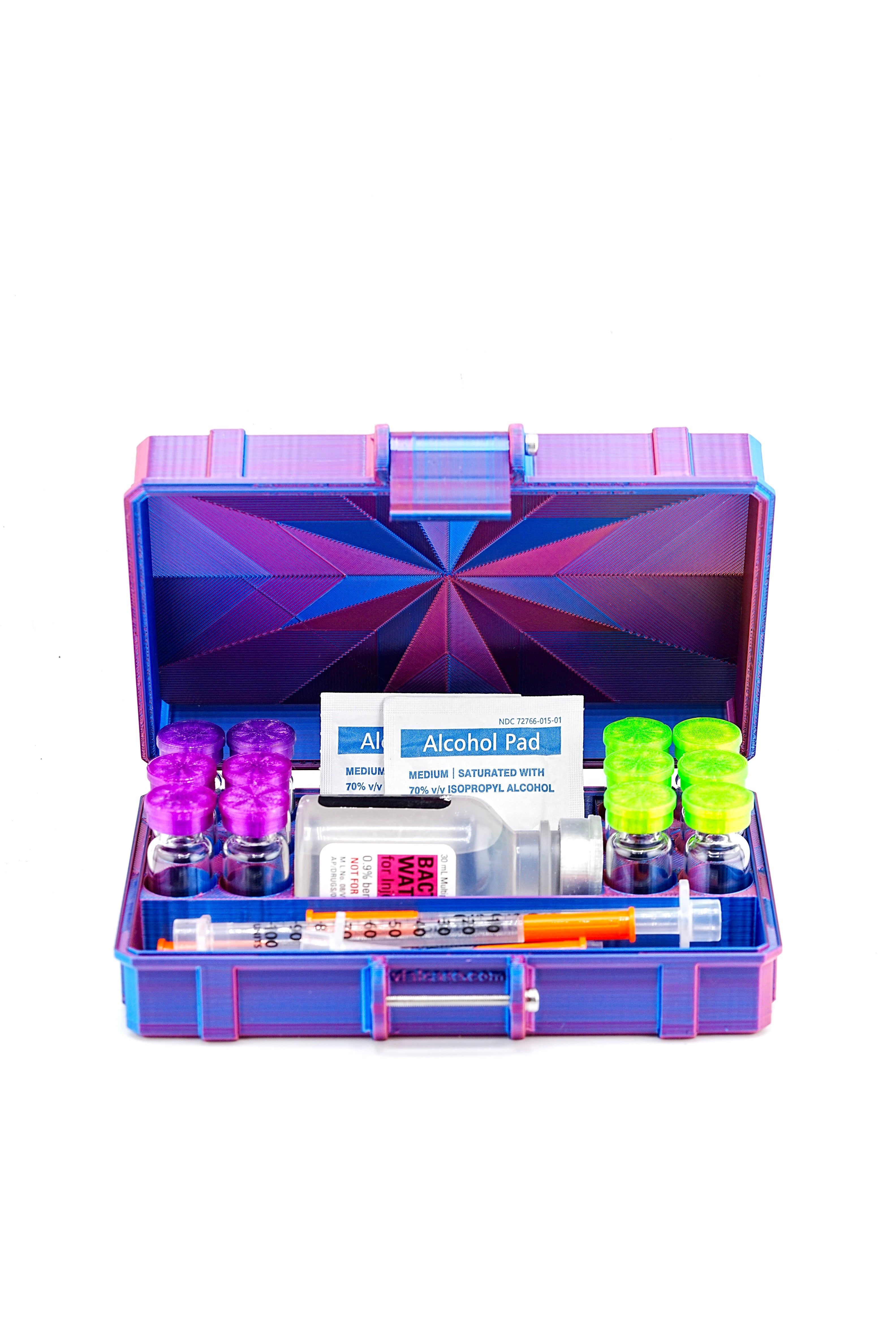
A case only solves the light problem if your vials actually fit in it, and amber and clear vials come in different sizes. The PeptideCase™ builder starts with an empty case: tap "Add item" and choose 3 mL vials, 10 mL vials, peptide vials, TRT vials, glutathione vials or other size vials, plus a BAC water bottle or syringes if you keep them together. Each item becomes fitted pockets or an open bay sized for that count, and every space has a finger scoop.
The lid closes over every vial. The tallest item sets the case height, and shorter vials stand on a raised floor so all the tops line up at the rim, easy to grab and quick to put back. Auto-arrange finds the most compact layout, and you see the case size with a top view, a lid view and a 3D view before you order. Pick Black or RGB Metallic; the case is printed to order in the US and sits on a fridge shelf or in a cooler. Build a case that keeps your vials in the dark