
Why Vial Size Matters
Walk into any peptide forum and you'll see the same question every week: "My vials just arrived and they don't fit in my case." The problem is almost always a size mismatch. Peptide vials come in two common sizes, 3 mL and 10 mL, and they are not interchangeable when it comes to storage cases. A slot made for a 3 mL vial is too narrow for a 10 mL vial, and a 10 mL slot leaves a 3 mL vial rattling around loose.
Before you choose a case, you need to know exactly what's in your collection. Here's the breakdown.
Design a case for both vial sizes
Add your 3 mL and 10 mL vials and the builder sizes a pocket for each, with every vial top lined up at the rim.
The 3ml Vial: The Research Peptide Standard
The 3 mL vial (sometimes listed as 2 mL or 3 cc) is the standard container for most lyophilized (freeze-dried) research peptides. These are the small, slim vials with a rubber stopper and an aluminum crimp cap, and they're what most people picture when they hear "peptide vial."
You'll typically find 3 mL vials holding:
- Freeze-dried research peptides, which are almost always packed in 3 mL glass
- Blends that combine two peptides in one small vial
- Small-volume vials from labs and pharmacies that don't need more room
The 3 mL vial is approximately 16 mm in diameter and 35 mm tall (not counting the stopper). They're small, fragile and easy to lose in a drawer, which is exactly why dedicated storage matters.
The 10ml Vial: BAC Water, GLP-1, and Compounded Peptides
The 10 mL vial is the larger format, roughly 23 mm in diameter and 50 mm tall. You'll run into 10 mL vials in several places:
- BAC water (bacteriostatic water): almost always sold in 10 mL or 30 mL bottles
- GLP-1 vials: some compounded GLP-1 medications come in 10 mL vials meant to be used over time
- Compounded peptides from pharmacies: compounding pharmacies often use 10 mL vials for larger preparations
- Pharmacy-dispensed vials in general: a lot of what comes from a pharmacy, rather than a lab, arrives in the larger format
Pro Tip: Even if all your peptides are in 3 mL vials, you almost certainly have at least one 10 mL bottle of BAC water. Make sure your storage system holds both sizes.
Pharmacy and Travel Vials: What to Expect
If your vials come from a pharmacy, expect the larger format. Compounding pharmacies typically dispense compounded GLP-1 and other preparations in 10 mL vials, while freeze-dried research peptides usually stay in 3 mL vials. Many people end up with some of each.
This matters for two reasons:
- Case sizing: if most of what you keep comes from a pharmacy, you likely need 10 mL pockets, or a case that holds both sizes.
- Travel protection: driving or flying with glass vials calls for crush-resistant storage. A hard-shell case prevents breakage in luggage, and an organized case is quick to inspect. Keep vials in their original labeled packaging where you can, carry your prescription or paperwork, and check the current rules for your airline and destination.
Read our complete guide to flying with peptides for TSA screening tips.
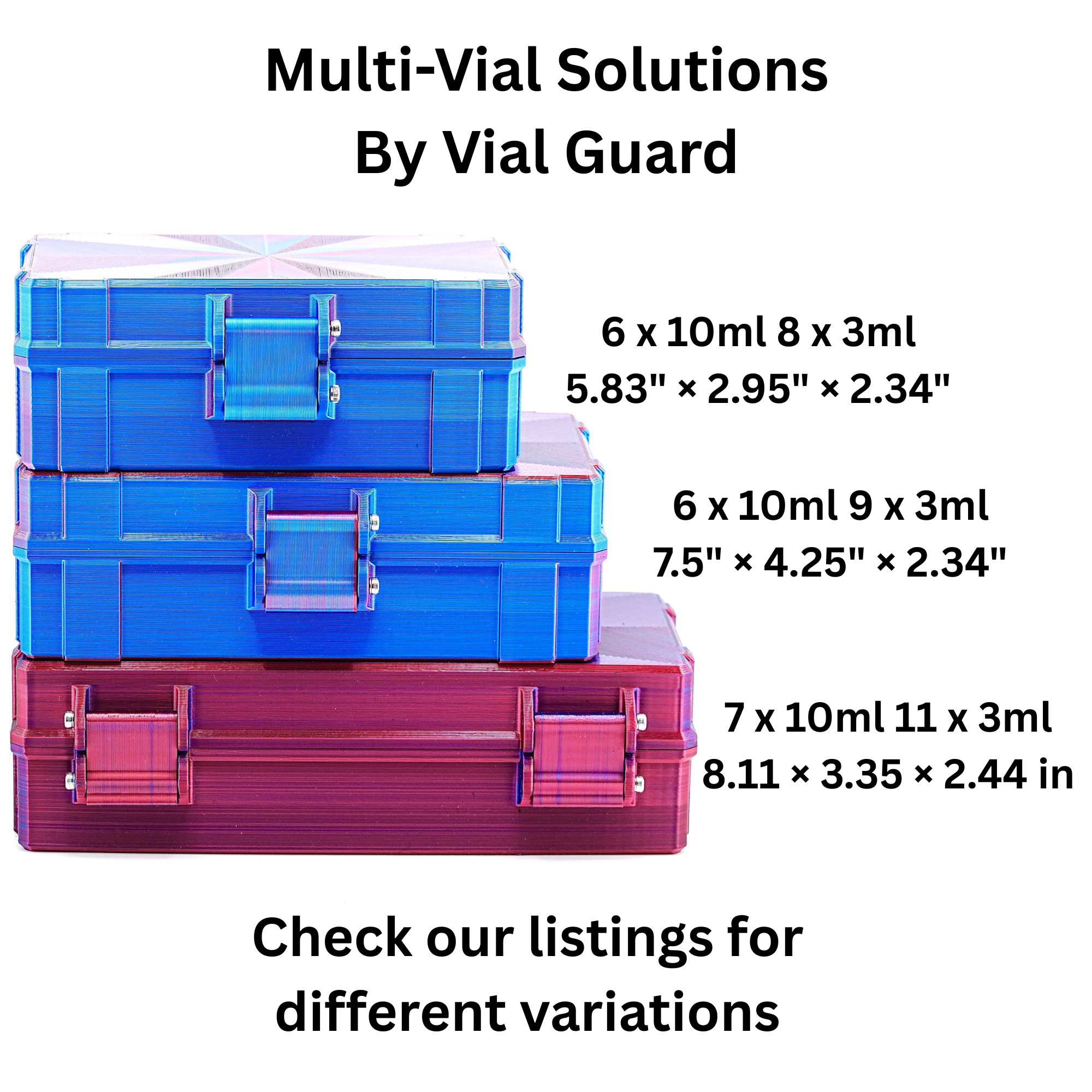
Collections With Both Sizes: Why Most People Need Both
In practice, very few people keep only one vial size. A typical collection might include:
- 3–4 vials of one peptide (3 mL), an in-use vial plus spares
- 2 vials of a second peptide (3 mL)
- 1 blend vial (3 mL)
- 2 bottles of BAC water (10 mL)
- 1 compounded GLP-1 vial (10 mL)
That's six vials at 3 mL and three at 10 mL. A case designed for only one size won't work. You need either a case built for both sizes or two separate cases.
How Vial Size Affects Your Case Choice
When choosing a peptide storage case, match the case to your collection:
- All 3 mL vials: a dedicated 3 mL case gives you the tightest fit and the most vials per square inch.
- All 10 mL vials (compounded / pharmacy): look for a 10 mL case, or one with wider pockets.
- Both sizes: the most common situation. You want separate pockets for each size so nothing rattles.
- Large collections: if you keep 10–20+ vials at a time, consider a bigger case with a travel-grade shell, or one everyday case plus one for spares.
Pro Tip: Measure your vials before ordering a case. Use calipers or a ruler to check the outer diameter. 3 mL vials are typically 15–17 mm across, while 10 mL vials run 22–24 mm. Some 3 mL vials run slightly wider than others, so measure the ones you actually have.
Color-code your vials
Custom snap-on caps for 3 mL or 10 mL vials, with a cap color plus an icon or letters. Sets from 25 caps.
Make your own custom case for 3 mL and 10 mL vials
The neatest answer to a collection with both sizes is a case designed around it. In the PeptideCase™ builder you start with an empty case, tap "Add item" and choose 3 mL vials, 10 mL vials, peptide vials or other size vials, plus how many of each. Add a BAC water bottle, syringes or alcohol pads if they travel with you. Every item becomes fitted pockets or an open bay sized for that many.
Here's the part that solves the size problem: the tallest item sets the case height, and shorter vials stand on a raised floor, so every vial top lines up at the rim, easy to grab. Every storage space has a finger scoop. Auto-arrange packs it all into the most compact layout, and the builder shows the case length, width and height, what it holds, and top, lid and 3D views. Pick Black or RGB Metallic, a Wide or Deep shape and one latch or two, and it is printed to order in the US at exactly the size shown.
Design a case for both vial sizes
Buying the Right Case for Your Vials
Here's a simple decision tree:
- Count your vials by size: how many 3 mL? How many 10 mL?
- Plan for growth: if you're adding a GLP-1 vial or a pharmacy vial, account for 10 mL pockets.
- Consider travel: if you fly or drive long distances, prioritize hard-shell crush resistance and a latch that stays shut.
- Check the pocket dimensions: with a ready-made case, confirm the slot size; with the builder, the pockets are sized for the vials you add.
Most people find that a mid-size case with 10–20 pockets across both sizes hits the sweet spot. If you keep five or more kinds of vials, or a large supply of spares, design a larger custom case or split your kit into an everyday case and a spares case.
Still not sure? Our peptide storage guide walks through the full decision process, from organization to travel.