1. Understanding Why Peptides Degrade
To store peptides correctly, you need to understand what is actually destroying them. Peptide degradation is not random — it follows predictable chemical pathways, each triggered by a specific environmental stressor. Eliminate the stressor, eliminate the degradation. There are four primary mechanisms at work in every storage failure.
Heat Breaks Peptide Bonds
Peptide bonds (the amide linkages that connect amino acid residues) are thermolabile. That is a technical way of saying heat breaks them. The relationship between temperature and degradation rate follows the Arrhenius equation: for every 10°C increase above optimal storage temperature, the rate of chemical breakdown roughly doubles. At 4°C (ideal fridge temperature), a reconstituted peptide might retain full potency for six weeks. At 25°C (room temperature), that same peptide may lose 30–50% potency within 48 hours. At 40°C — the temperature inside a car on a warm day — meaningful denaturation begins within hours.
Hydrolysis is the primary thermally-driven reaction. Water molecules cleave the peptide backbone at vulnerable sites, particularly near aspartic acid residues (Asp-X bonds), breaking the chain into shorter fragments that no longer bind to their target receptors with the same affinity. This process is invisible: the solution remains clear, the vial looks identical, but the compound is partially or fully inactive.
UV Light Oxidizes Amino Acid Residues
Ultraviolet and near-UV visible light (280–400 nm) is absorbed preferentially by aromatic and sulfur-containing amino acid residues: tryptophan (Trp), tyrosine (Tyr), phenylalanine (Phe), methionine (Met), and cysteine (Cys). The absorbed photon energy drives photooxidation reactions that alter the electronic structure of these residues, changing their shape and charge distribution. The result is a peptide that no longer fits its receptor the way a key fits a lock.
Crucially, this damage is irreversible. You cannot un-oxidize a photooxidized residue. And because the degradation is cumulative, even 30 seconds of light exposure per day adds up to 15 minutes per month — enough to measurably reduce potency in light-sensitive compounds like BPC-157, GHK-Cu, and Melanotan-2.
Freeze-Thaw Cycles Shatter Reconstituted Structure
Once a peptide has been reconstituted in aqueous solution, freezing it is one of the fastest ways to destroy it. As water freezes, ice crystals form and expand. These crystals exert mechanical stress on peptide chains, physically breaking bonds and denaturing tertiary structure. Each freeze-thaw cycle causes incremental, irreversible damage. A peptide subjected to five freeze-thaw cycles may retain only 40–60% of its original biological activity. This is why the rule — never freeze reconstituted peptides — is absolute, not advisory.
Contamination Introduces Proteases
Proteases are enzymes that catalyze the hydrolytic cleavage of peptide bonds — essentially, they do to your peptide exactly what heat does, but faster and at room temperature. Bacteria produce proteases as part of their normal metabolism. If bacteria enter your reconstituted solution through a contaminated needle, a non-bacteriostatic solvent, or poor injection technique, protease activity can degrade your compound within days. This is why bacteriostatic water (with its 0.9% benzyl alcohol preservative) is not optional — it is the chemical barrier between your compound and microbial contamination.
2. The Two Storage States: Lyophilized vs. Reconstituted
Every research peptide exists in one of two states during its useful life, and these two states have almost completely different storage requirements. The single most common beginner mistake is applying the same storage logic to both, typically refrigerating lyophilized powder when it should be frozen, or — worse — freezing reconstituted solution when doing so destroys it.
Lyophilized (Freeze-Dried) Powder
Lyophilization removes water from the peptide under vacuum, leaving behind a dry, stable powder. Without water, most degradation pathways are dramatically slowed. Hydrolysis cannot proceed without a water molecule. Bacterial growth cannot sustain without moisture. The powder form is the peptide at its most stable.
The correct long-term storage temperature for lyophilized peptides is −20°C (standard home freezer). At this temperature, most peptides remain fully viable for 12–36 months, sometimes longer for exceptionally stable sequences. Short-term storage (3–6 months) is acceptable at refrigerator temperature (2–8°C) if the peptide will be used soon. Room temperature storage of lyophilized powder, while sometimes tolerated for a few weeks, accelerates degradation and is never recommended for preserving long-term potency.
Reconstituted Solution
The moment you add solvent to lyophilized powder, you reintroduce water and reactivate most of the degradation pathways that lyophilization suppressed. The peptide is now operating against the clock. Temperature control becomes critical, light exposure becomes dangerous, and contamination becomes an active risk with every subsequent injection.
The correct storage temperature for reconstituted peptides is 2–8°C — standard refrigerator temperature. This is not a range where colder is better. Below 0°C, you enter ice-crystal territory and begin destroying the compound. The target is cold enough to dramatically slow degradation without crossing into freezing. See the peptide storage temperature chart for compound-specific guidance.
Key distinction: Lyophilized powder belongs in the freezer (−20°C). Reconstituted solution belongs in the fridge (2–8°C). These are opposite rules. Confusing them is the highest-cost storage mistake in peptide research.
3. Best Temperature Practices
Temperature management is the foundation of every effective peptide storage protocol. The following guidance is specific, evidence-based, and organized by storage state.
Lyophilized Powder: Temperature Targets
- −20°C (standard freezer) — Long-term storage: Optimal for any peptide you will not reconstitute within the next 3–6 months. Most compounds remain fully viable for 12–36 months at this temperature. Store in a sealed bag or dedicated case inside the freezer to prevent moisture ingress when you remove and replace vials. Let the vial equilibrate to room temperature for 15–20 minutes before opening — this prevents condensation from forming inside the vial. For more on freezer protocols, see our guide on freezer storage for peptides.
- 2–8°C (refrigerator) — Short-term pre-reconstitution storage: Acceptable for compounds you plan to use within 3 months. The back of the middle shelf is coldest and most thermally stable. Avoid the fridge door entirely.
- Room temperature — Transit only: Brief exposure during shipping is unavoidable and typically tolerated by lyophilized compounds. Do not store powder at room temperature. Refrigerate or freeze upon receipt.
Reconstituted Solution: Temperature Targets
- 2–8°C (refrigerator) — The only correct option: Store all reconstituted peptides at this temperature without exception. The back of the middle shelf, inside an opaque hard-shell case, is the ideal location. A purpose-built fridge organization system keeps all vials in this zone consistently.
- Room temperature excursion limit — 30 minutes maximum: Brief excursions for dosing preparation are unavoidable. Beyond 30 minutes at room temperature, measurable degradation begins in most reconstituted peptides. Return vials to cold storage immediately after use.
- Never below 0°C: Freezing reconstituted peptides causes irreversible ice-crystal damage. This is an absolute rule, not a preference. If you accidentally freeze a reconstituted vial, assume it is compromised and do not use it for research where potency matters.
Compound-Specific Temperature Notes
GLP-1 receptor agonists (semaglutide, tirzepatide, retatrutide) are particularly temperature-sensitive in reconstituted form. Research on pharmaceutical-grade GLP-1 compounds confirms that excursions above 30°C for as little as 24 hours can reduce peptide integrity by 15–25%. For complete GLP-1 storage guidance, see the GLP-1 storage guide. BPC-157 and TB-500 are similarly sensitive. See the dedicated BPC-157 storage guide for protocol-specific temperature management.
4. Best Light Protection Practices
Light protection is the most underestimated factor in long-term peptide potency. Most researchers know to keep vials cold. Far fewer understand that light degradation is happening every time the refrigerator door opens.
Why Amber Vials Are Not Enough
Amber glass filters UV wavelengths below approximately 450 nm, which addresses a portion of the photooxidation risk. However, amber glass does not block all damaging wavelengths — it attenuates them. For long-duration storage (4–6 weeks for reconstituted peptides), partial attenuation is not sufficient protection. Residual transmission through amber glass at 400–450 nm is typically 20–40%, meaning a meaningful fraction of damaging photons reach the solution with every light exposure event.
Amber vials are better than clear vials, but they are not a complete solution. The only complete solution is storing vials inside an opaque container that transmits zero light. For a detailed comparison, see our amber vs. clear vials guide.
Why an Opaque Case Is the Only Real Solution
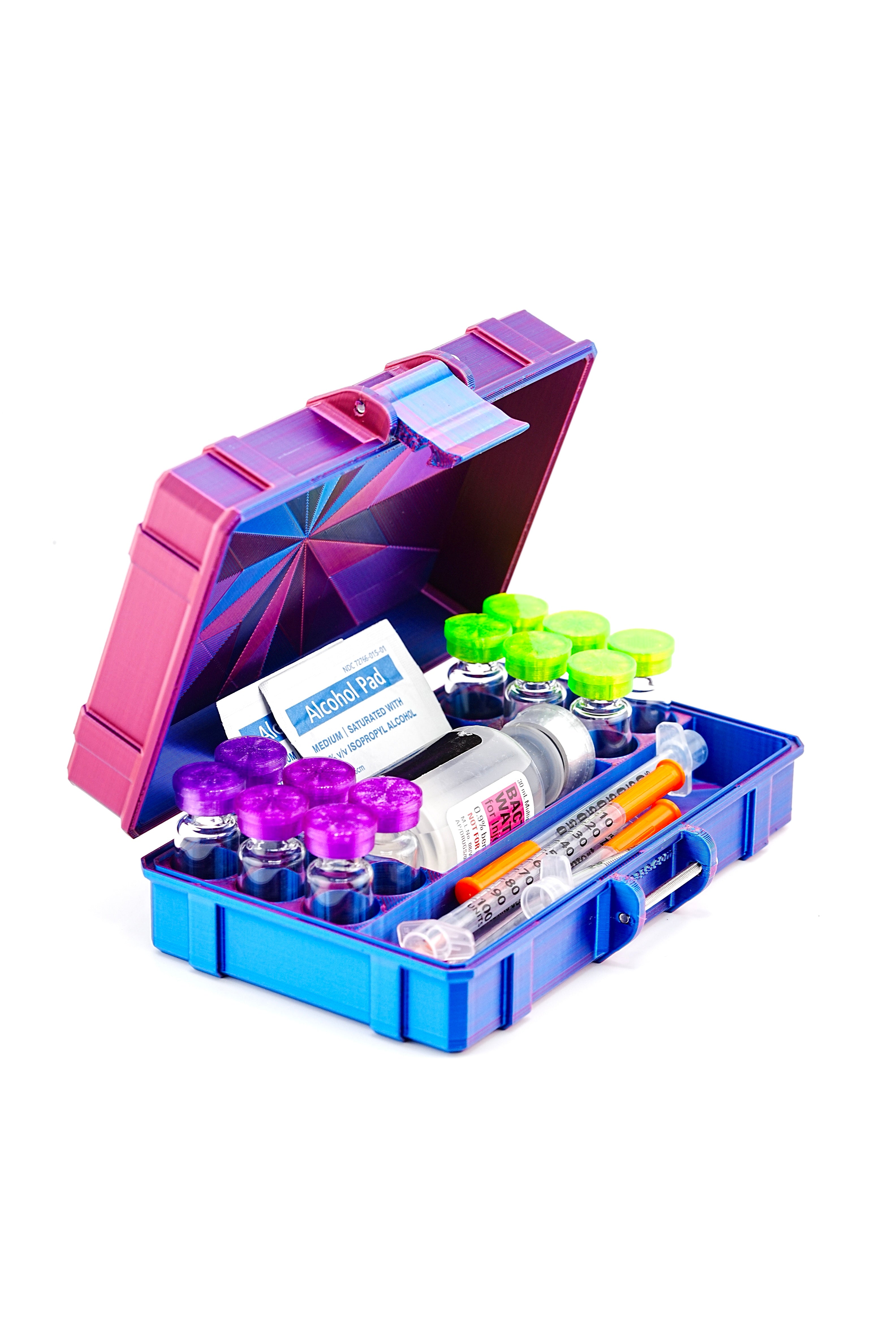
A purpose-built opaque hard-shell case eliminates 100% of light exposure every time the refrigerator is opened. The vials are inside the case; the case is closed; no light reaches the peptides, ever. This is the difference between partial mitigation and complete protection.
The compounding effect over a 6-week reconstituted shelf life is significant. If your fridge opens 15 times per day and each opening takes 3 seconds, that is 45 seconds of daily light exposure per vial sitting on an open shelf — or roughly 19 minutes per month, or 28 minutes over a 6-week protocol. For compounds like BPC-157 and GHK-Cu, this level of cumulative light exposure causes measurable potency reduction. Browse our top 10 peptide storage cases or check the best peptide case for 2026 for opaque case recommendations.
Compounds with Extreme Photosensitivity
While all peptides benefit from light protection, the following compounds are particularly vulnerable and should be treated as high-priority for opaque storage:
- BPC-157: Contains proline and glycine sequences with moderate photosensitivity, but its research context (gut, tendon, and neurological applications) makes potency preservation critical. Even minor degradation compromises experimental outcomes.
- GHK-Cu (copper peptide): The copper ion complex in GHK-Cu is particularly vulnerable to photooxidation. Light-induced dissociation of the copper-peptide bond produces a biologically inactive fragment. Opaque, light-blocking storage is not optional for GHK-Cu.
- Melanotan-2 (MT-2): One of the more photosensitive compounds in common research use, despite its melanin-stimulating mechanism being light-dependent in vivo. The peptide itself oxidizes rapidly under UV exposure. Opaque storage is mandatory.
5. Best Reconstitution Practices
Reconstitution is the moment of highest risk in a peptide's life cycle. A mistake here — wrong solvent, wrong technique, wrong labeling — cannot be undone. Follow this protocol exactly.
Choosing the Right Solvent
Solvent selection is one of the most consequential storage decisions you will make. There are three primary options:
- Bacteriostatic water (BAC water) — Default choice for most peptides: 0.9% benzyl alcohol inhibits bacterial growth from repeated needle punctures. Shelf life after reconstitution: 4–6 weeks refrigerated. Appropriate for GLP-1 peptides, growth hormone peptides (CJC-1295, Ipamorelin), healing peptides (BPC-157, TB-500), and most research compounds. This is the correct solvent for the majority of protocols. See the complete BAC water reconstitution guide.
- Sterile water — Short-term only: No benzyl alcohol preservative means no protection against bacterial contamination from repeated needle access. Shelf life: 5–7 days. Only appropriate if the entire vial will be used within one week.
- 0.6% acetic acid — For insoluble peptides: Some peptides, particularly copper peptides (GHK-Cu) and certain growth hormone fragments, do not dissolve readily in water-based solvents. Dilute acetic acid provides the slight acidity needed for complete dissolution. Bacteriostatic. Shelf life: similar to BAC water. Mix with sterile water or saline after reconstitution to reduce acidity before use.
Step-by-Step Reconstitution Protocol
- Remove the lyophilized vial from the freezer. Let it equilibrate to room temperature for 15–20 minutes with the cap on. Do not shake or tap the vial.
- Calculate your target concentration before opening anything. Divide the vial's total peptide content (in mg) by the volume of solvent you plan to add (in ml) to determine mg/ml concentration. Write this number down.
- Wipe the rubber stopper of both the peptide vial and the BAC water vial with a fresh alcohol swab. Let dry for 30 seconds.
- Draw the calculated volume of BAC water into a fresh insulin syringe. Insert the needle into the peptide vial at a 45-degree angle and direct the stream of BAC water down the inner wall of the vial — not directly onto the powder. Directing liquid directly onto lyophilized powder can create mechanical stress that fragments the peptide.
- Gently swirl (do not shake) the vial until the powder is fully dissolved. Most peptides dissolve within 30–60 seconds of gentle rotation. If the solution remains cloudy after 2 minutes, the peptide may require a different solvent or slightly warmer liquid.
- Label the vial immediately, before you put it down. See Section 6 for the complete labeling protocol.
- Store immediately at 2–8°C in an opaque case.
Never shake a peptide vial. Vigorous agitation creates air-liquid interfaces that denature peptides through a process called interfacial denaturation. The mechanical energy at a bubble surface is enough to unfold peptide chains. Swirl gently; never shake. If you see foam forming in the vial, you have already caused some degradation.
6. Best Organization Practices
Poor organization is responsible for a category of storage failures that temperature and light controls cannot prevent: wrong dose, double dose, expired compound, and mixed-up vials. A systematic organization protocol eliminates all of these.
The Complete Labeling System
Every vial that has been reconstituted must be labeled with four pieces of information, applied the moment reconstitution is complete:
- Compound name — full abbreviation or full name (BPC-157, not just "B"; Semaglutide, not just "S")
- Date reconstituted — month/day/year (not just "April 3" — the year matters if a vial gets buried)
- Concentration — mg/ml (e.g., "5 mg/ml" or "2 mg/2 ml = 1 mg/ml")
- Expiry date — reconstituted date plus 4–6 weeks (depending on compound and solvent used)
Use a permanent marker and fine-tipped label tape, or purpose-made vial label dots. For a complete labeling guide with templates and examples, see how to label peptide vials.
Zone Separation: Active vs. Stock
Maintain two physically distinct storage zones:
- Active zone (refrigerator): Currently reconstituted vials only. These are vials in active use. Everything in this zone has a label, a known expiry date, and a dose log entry.
- Stock zone (freezer): Lyophilized powder vials. Sealed, labeled with compound name and arrival date. Not yet reconstituted. Treated as long-term inventory.
Never mix lyophilized stock into your active refrigerator zone. The visual similarity between an unlabeled powder vial and a reconstituted vial is high enough that mixed zones create real confusion risk. See the complete guide to organizing your peptide protocol for zone-setup diagrams and checklists. The guide to peptide fridge organization covers the active zone in detail.
The Cost of Mixing Protocols
If you are running more than one peptide protocol simultaneously — a common situation for researchers using both a GLP-1 and a healing peptide, for example — keep vials from different protocols in separate labeled slots or compartments within the same case. Cross-contamination from reusing needles between vials is a real risk when vials from different protocols are stored adjacent and unlabeled. An accidental injection from the wrong vial, or a mixed-up dose log, can compromise months of research data.
The common mistake is treating the fridge as a general holding area where any vial can go anywhere. The correct approach is treating each slot in your storage case like a reserved parking space — one compound per slot, same slot every time, labeled clearly. Review the top peptide storage mistakes to understand how often organizational failures cause potency loss.
7. Best Travel Storage Practices
Travel is one of the highest-risk events in a peptide's storage history. Temperature control is intermittent, handling is rough, and regulatory screening introduces uncertainty. A systematic travel protocol eliminates most of these risks.
Carry-On Only — Never Checked Baggage
Checked baggage cargo holds are not temperature-controlled to pharmaceutical standards. At altitude, cargo hold temperatures can drop well below 0°C, freezing reconstituted peptides and destroying them. On hot tarmacs during boarding delays, temperatures in cargo holds can exceed 40°C. Carry-on storage keeps your peptides in the cabin, where temperature is controlled and the vials are under your observation at all times. This is a non-negotiable rule for air travel.
Cold Pack Protocol
For flights up to 4 hours, a gel ice pack or flexible cold pack in your carry-on case will maintain temperatures of 2–10°C without difficulty. For longer flights:
- Use two cold packs in an insulated pouch, oriented so vials are not in direct contact with the packs (contact freezing risk)
- Place a layer of folded paper towel between vials and cold packs
- Consider a small insulated travel case designed for medication (available at most pharmacies)
- For multi-day travel, plan to source ice or refrigerator access at your destination before departure
For detailed guidance on packing, cold pack selection, and what to do if cold packs fail mid-trip, see the complete peptide travel checklist and our guide on traveling with peptides through TSA.
Hard Case for Impact Protection
Glass vials are fragile. A hard-shell storage case protects against the impact forces that occur in overhead bins, during turbulence, and in taxis and rental cars. Foam-lined cases provide additional shock absorption. A purpose-built vial case with individual compartments also prevents vials from rattling against each other — which can cause microfractures in glass and stopper displacement. Review the best peptide case for 2026 for case options rated for travel durability.
What TSA Actually Checks
TSA screening focuses on liquid volume rules (3-1-1 rule applies to liquids over 100ml per container), prohibited items, and security threats. Peptide vials in small quantities (3ml and 10ml vials) are not specifically targeted. Carry a copy of any relevant prescriptions or research documentation if the peptides are for personal medical use. Do not attempt to conceal vials — place them in the top of your carry-on for easy inspection access. The vast majority of researchers travel with peptide vials without incident. For international travel, research destination country regulations in advance.
8. The Storage Setup That Covers Everything
Every principle in this guide can be reduced to a single complete storage system. This is the setup that protects against every major degradation pathway simultaneously.
Component 1: Dedicated Refrigerator Zone
Designate the back half of the middle shelf in your refrigerator exclusively for research peptides. This is the coldest, most thermally stable location in a standard refrigerator. Nothing else goes in this zone. No food, no beverages, no other medications. This dedicated zone prevents accidental temperature excursions from high-traffic fridge use and ensures your peptides are never displaced to a warmer spot.
Component 2: Purpose-Built Opaque Hard-Shell Case
A purpose-built vial case sits in the dedicated refrigerator zone and does four things simultaneously: blocks 100% of light, provides individual compartments for each vial (preventing contact and confusion), protects against vibration and minor impacts, and keeps all vials in one place so you always know exactly where they are. The case should have separate slots for 3ml and 10ml vials, fit within standard refrigerator shelf dimensions, and be made from materials safe for food-contact temperature ranges. Browse the top 10 peptide storage cases for recommendations across price ranges.
Component 3: Labeling Protocol
Every reconstituted vial is labeled before it goes into the case (compound, date, concentration, expiry). Every lyophilized stock vial in the freezer is labeled with compound name and arrival date. No unlabeled vials exist anywhere in the system. This takes 60 seconds per vial and prevents the kind of dosing error that can compromise weeks of research.
Component 4: Dose Log
A dose log — physical notebook or digital note — records: compound name, date dosed, dose amount, vial remaining, and notes on any protocol changes. The log serves three functions: it prevents double-dosing, it tells you when you are running low on a compound (allowing time to order replacements), and it provides the data record needed to evaluate research outcomes accurately.
The complete system in one sentence: Freeze lyophilized stock at −20°C, store reconstituted vials at 2–8°C in an opaque hard-shell case on the back of the middle fridge shelf, label every vial immediately, and log every dose. That is it. Everything else in this guide is detail on why these four rules exist and how to execute them correctly.
Power Outage Protocol
A refrigerator maintains temperature for approximately 4 hours with the door closed after power loss. If power is out for longer than 2 hours, transfer reconstituted vials to an insulated bag with ice packs. Know your compound's room-temperature limit (most reconstituted peptides can tolerate up to 8 hours at 25°C before significant degradation; GLP-1 peptides are more sensitive). After 8 hours without cold storage, treat the vials as potentially compromised. The detailed protocol is covered in the peptide power outage guide.
Putting It All Together
The researchers who see the most consistent results from their peptide protocols are not necessarily using the most expensive compounds or the most sophisticated dosing regimens — they are the ones who treat storage with the same rigor they apply to dosing. A perfectly reconstituted, correctly dosed peptide that loses 40% potency due to poor storage is effectively a 40% dose reduction that never shows up in the protocol.
Storage is the variable most researchers underestimate and most vendors underexplain. This guide exists to close that gap. For a quick overview of the most impactful storage improvements, see the best way to store peptides overview, or the peptide shelf life guide for compound-by-compound expiry data.
Disclaimer: This article is intended for informational and educational purposes only. The compounds discussed are research chemicals. Nothing in this guide constitutes medical advice, clinical guidance, or a recommendation for human use. Always consult a qualified healthcare professional before using any peptide compound. Regulations governing research peptides vary by jurisdiction — ensure compliance with applicable local laws.