The Short Answer: What Destroys Peptides
Peptides are chains of amino acids held together by peptide bonds. Three things break those bonds and destroy potency:
- Heat — accelerates chemical degradation exponentially. Every 10°C above optimal storage temperature roughly doubles the rate of breakdown.
- Light — UV and visible wavelengths oxidize specific amino acid residues (tryptophan, methionine, cysteine). Even ambient fridge light during door-opening causes cumulative damage.
- Moisture (before reconstitution) — lyophilized powder is vacuum-dried for a reason. Humidity causes clumping and accelerated degradation before you even add water.
Every storage rule below exists to eliminate one of these three threats. Once you understand the "why," the rules become obvious.
Lyophilized (Powder) Peptides: Long-Term Storage
Lyophilized peptides arrive as a white or off-white powder in a sealed glass vial. This is the stable form — think of it as the peptide in standby mode. In this state, with proper storage, most peptides remain viable for 12–36 months.
- Best option: Freeze at -20°C — standard home freezer temperature. This is optimal for long-term storage (6–24+ months). Keep vials in a sealed bag or case inside the freezer to prevent moisture exposure when removing and replacing.
- Good option: Refrigerate at 2–8°C — acceptable for 3–6 months if you'll be using the peptide soon. The back of the fridge (not the door) is coldest and most stable.
- Never: Room temperature or above — even sealed powder degrades measurably at room temperature over weeks.
Freezer tip: Let frozen vials come to room temperature before opening. This prevents condensation from forming inside the vial when warm air meets cold glass — moisture in your powder is the enemy. Leave the cap on until the vial reaches room temp.
Reconstituted Peptides: The Critical Rules
Once you add solvent to the powder, the clock starts. Reconstituted peptides are far more fragile than powder form and require strict refrigeration.
- Always refrigerate at 2–8°C — no exceptions. Room temperature exposure beyond a few hours causes measurable degradation.
- Never freeze reconstituted peptides — ice crystals physically shear peptide bonds. Frozen liquid peptide = destroyed compound. This is the single most expensive mistake beginners make.
- Use bacteriostatic (BAC) water — the 0.9% benzyl alcohol preservative prevents bacterial contamination and extends shelf life to 4–6 weeks. Sterile water provides no protection and limits shelf life to 5–7 days.
- Store upright — keep the stopper dry. Liquid sitting against the rubber stopper accelerates leaching of stopper compounds into your solution.
- Block light completely — amber vials filter some wavelengths but not all. Store inside an opaque case. Even the brief light exposure during a 2-second fridge door opening adds up over 6 weeks.
Where in the Fridge to Store Peptides
Not all parts of your refrigerator are equal. Temperature varies significantly depending on location:
- Back of the middle shelf — most consistent temperature, closest to 4°C, least affected by door opening. This is the ideal spot.
- Door shelves — worst option. Every time the door opens, door shelf temps spike. Over weeks, this repeated thermal cycling degrades your peptides.
- Top shelf — warmer than middle. Avoid for sensitive peptides.
- Crisper drawers — acceptable backup if middle shelf is crowded. Tends to be stable but slightly more humid.
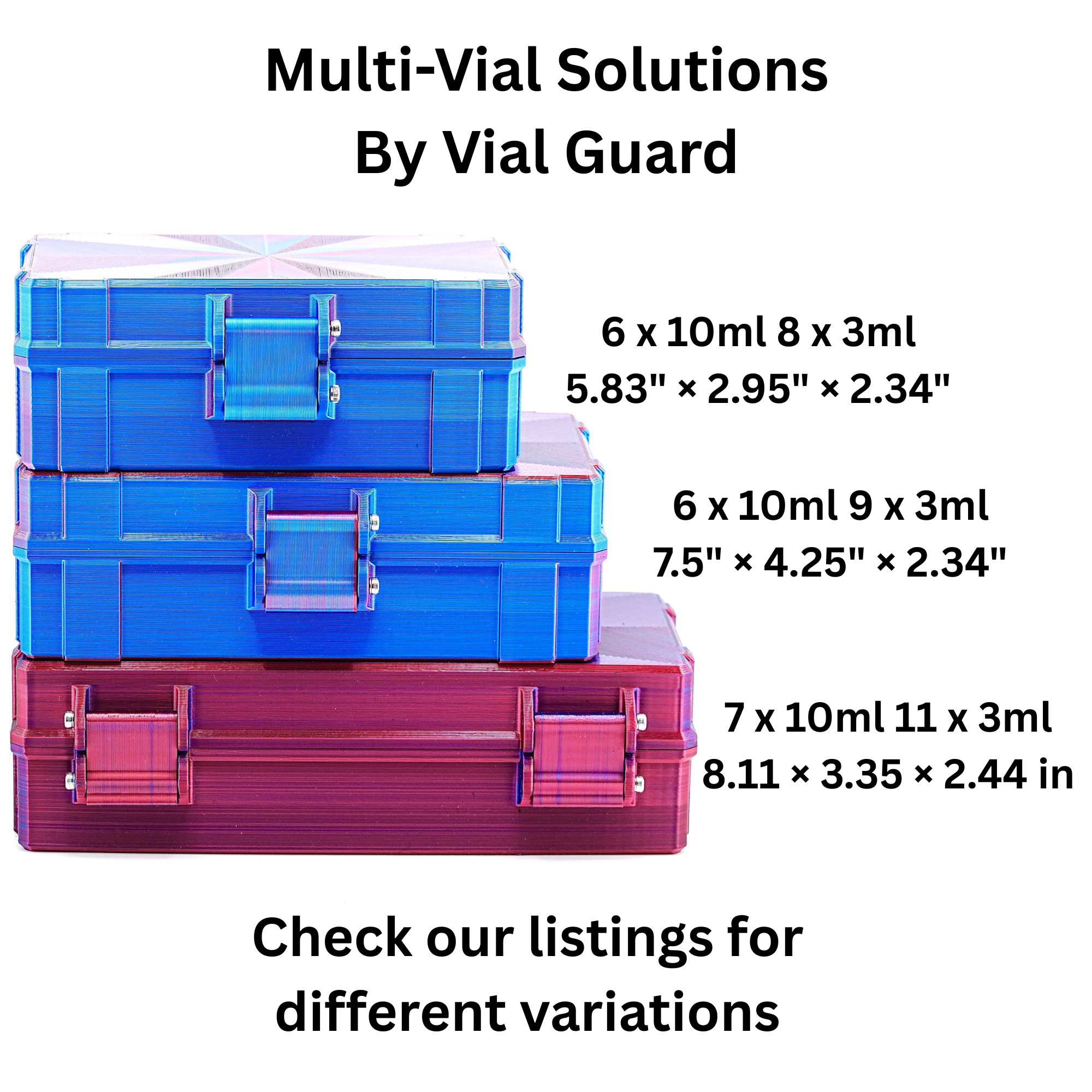
A dedicated peptide storage case solves the placement problem permanently: it sits in the back of the middle shelf, keeps all your vials together, and blocks light every time the fridge door opens.
The Best Solvent: BAC Water vs Sterile Water vs Acetic Acid
Your choice of reconstitution solvent is one of the highest-impact storage decisions you'll make:
- Bacteriostatic water (BAC water) — 0.9% benzyl alcohol inhibits bacterial growth from repeated needle punctures. Shelf life: 4–6 weeks refrigerated. Gold standard for weekly-dosed peptides (GLP-1s, TB-500) and multi-week protocols.
- Sterile water — no preservative. Each needle puncture is a contamination risk. Shelf life: 5–7 days. Only use if you'll consume the entire vial within a week.
- 0.6% acetic acid — required for certain peptides that don't dissolve in BAC water (GHK-Cu, some growth hormone peptides). Bacteriostatic. Shelf life similar to BAC water but slightly more acidic, which itself acts as a preservative.
If you're unsure which solvent your peptide needs, check the vendor's certificate of analysis or consult our complete reconstitution guide.
Pro Tip: Calculate exactly how much solvent to add before you start. The concentration (mg/ml) determines your dose per unit on an insulin syringe. Adding too much or too little solvent is a dosing error that compounds every injection. Do the math first, write it on the vial label.
Light Protection: Why It Matters More Than Most People Think
Light degradation is the most underestimated threat to peptide potency because it's invisible and cumulative. Here's what actually happens:
UV and near-UV visible light (280–400nm wavelengths) are absorbed by aromatic amino acids in peptide chains, particularly tryptophan and phenylalanine. This absorbed energy triggers photooxidation reactions that irreversibly alter the amino acid structure. The peptide's receptor binding is compromised — it may still look like a clear solution, but its activity is reduced.
The math is unforgiving. A peptide stored on an open fridge shelf experiences brief light exposure every time the fridge opens — say 20 times per day, 2 seconds each. That's 40 seconds of direct light daily, or roughly 17 minutes per month. Over a 6-week reconstituted shelf life, that adds up to 1.7 hours of cumulative light exposure. Studies on GLP-1 peptides show measurable potency reduction after as little as 30 minutes of direct light exposure.
The solution is simple: store every vial inside an opaque hard-shell case. Zero light reaches the vials, ever. This is the single most cost-effective improvement most peptide users can make to their storage setup. See our full case lineup — every model is fully opaque and purpose-built for fridge storage.
Temperature Excursion: What Happens If It Gets Too Warm
Life happens. Power outages, travel delays, forgotten cases in warm cars. Here's a practical guide to temperature excursions:
- Up to 2 hours at room temperature (25°C) — minimal impact on most peptides. Bring back to cold ASAP and use within the normal window.
- 2–8 hours at room temperature — meaningful degradation begins. Some potency loss, particularly for GLP-1 peptides. Still usable but effectiveness may be reduced.
- 8+ hours above 25°C, or any time above 40°C — significant denaturation. Consider the vial compromised. The cost of a replacement vial is less than the cost of running a failed protocol.
- Car exposure in summer — a car interior can reach 60–70°C on a hot day. Even a few minutes in a parked car with windows up can irreversibly denature a reconstituted peptide.
Bottom Line: The best way to store peptides is simple — freeze powder, refrigerate reconstituted, block light completely, use BAC water, and keep everything in a dedicated case. One properly-chosen storage case eliminates 90% of the variables that destroy peptides. Browse our cases →
Quick-Reference Storage Rules by Peptide Type
- GLP-1 peptides (Semaglutide, Tirzepatide, Retatrutide): Refrigerate at 2–8°C. Never freeze reconstituted. Use BAC water. 4–6 week shelf life.
- Growth hormone peptides (CJC-1295, Ipamorelin, Sermorelin, GHRP-6): Freeze powder at -20°C. Refrigerate reconstituted. BAC water recommended. 4 weeks shelf life.
- Healing peptides (BPC-157, TB-500): Freeze powder. Refrigerate reconstituted. BAC water. 4–6 weeks. Very light-sensitive.
- Anti-aging peptides (GHK-Cu, Epithalon): Copper peptides need acetic acid solvent. Refrigerate reconstituted. 3–4 weeks. Extremely light-sensitive.
- Tanning peptides (MT2, Melanotan 2): Ironically the most light-sensitive peptide on this list. Freeze powder, refrigerate reconstituted, opaque storage mandatory.
For a complete chart with temperatures for 20+ peptides, see our peptide storage temperature chart.