Why Organization Matters: It's a Safety Issue
This isn't about being neat for the sake of it. When you're running multiple peptides — each with different dosing schedules, reconstitution dates, and storage requirements — disorganization becomes a genuine safety risk.
Consider a common scenario: you have three identical-looking 3ml vials in the fridge. One is BPC-157 (5mg reconstituted in 2ml BAC water), one is TB-500 (5mg in 1ml), and one is CJC-1295 (2mg in 1ml). The concentrations are different, the dosing is different, and the injection timing is different. Grab the wrong vial and you're injecting the wrong compound at the wrong dose.
A proper organization system eliminates this risk entirely.
Labeling Systems That Actually Work
The best labeling system is the one you'll actually maintain. Here are three approaches ranked from simplest to most thorough:
Level 1: Colored Caps
The fastest method. Assign a color to each compound and snap on a colored vial cap. Blue for BPC-157, green for TB-500, red for CJC-1295. You can identify the right vial at a glance without reading anything.
Level 2: Written Labels
Add small adhesive labels to each vial with:
- Compound name (abbreviated is fine: BPC, TB5, CJC)
- Reconstitution date
- Concentration (e.g., 250mcg/0.1ml)
- Discard date (4-8 weeks post-reconstitution)
Level 3: Color + Label + Log
For complex protocols or bulk buyers importing from Mexico, combine colored caps with written labels and a tracking log (spreadsheet or notebook). Record every vial: compound, lot number, source pharmacy, purchase date, reconstitution date, volume remaining.
Pro Tip: Freezer-safe labels are essential if you store backups in the freezer. Standard adhesive peels off at -20°C. Use cryo-labels or medical-grade freezer tape. See our freezer storage guide for more details.
Case Zones: Separating 3ml from 10ml, Active from Backup
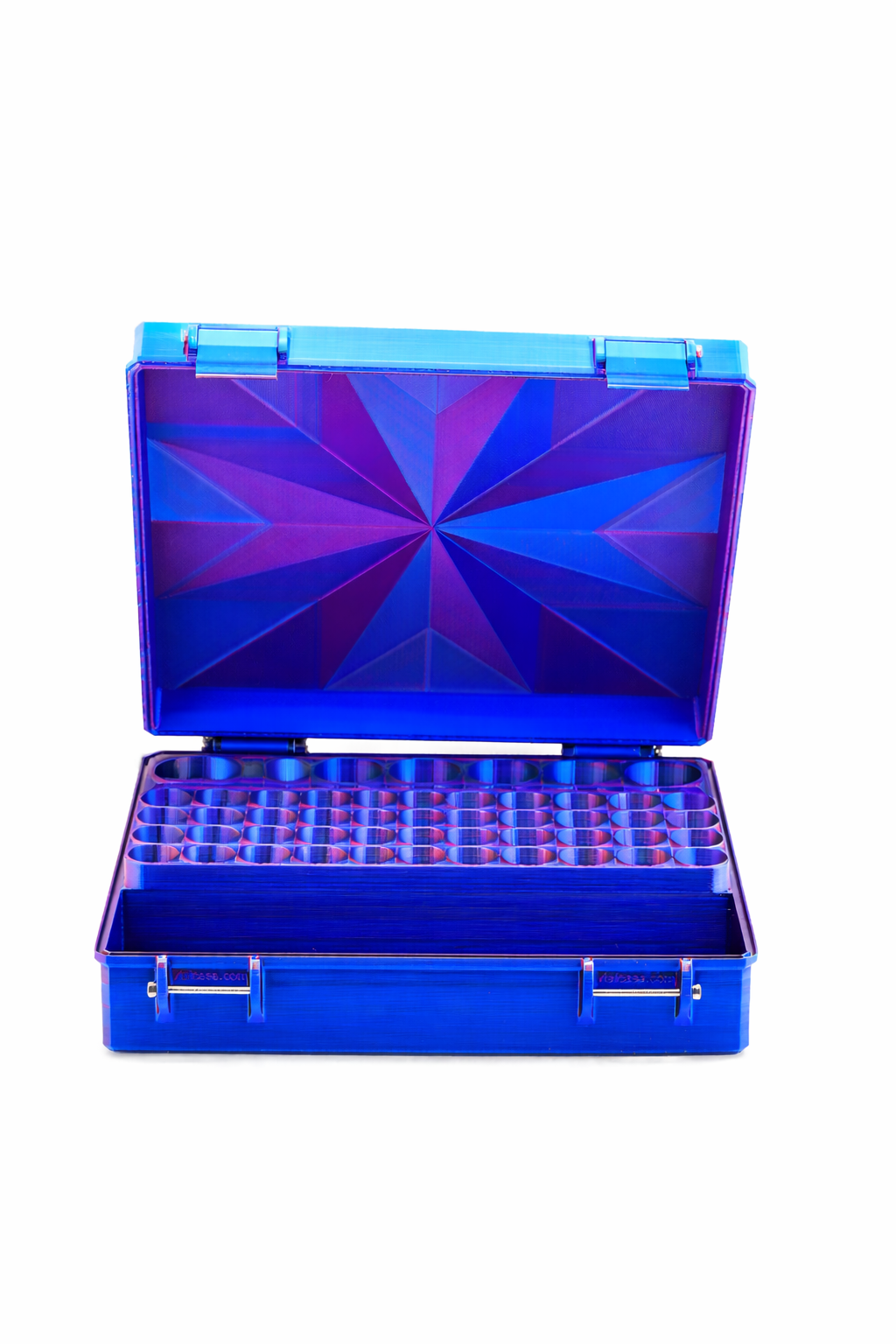
A well-organized peptide storage case uses zones — designated areas for different categories of vials. Here's a practical zoning system:
- Zone 1: Active 3ml vials — the peptides you're currently drawing from (BPC-157, TB-500, etc.)
- Zone 2: Active 10ml vials — BAC water, compounded GLP-1, multi-dose vials
- Zone 3: Backup/sealed vials — unreconstituted reserves, either in the same case or a separate freezer case
- Zone 4: Syringes and supplies — insulin syringes, alcohol wipes, mixing syringes
The key principle: active vials stay in the fridge case, backups stay in the freezer case. This prevents accidentally reconstituting a backup when you still have an active vial, and keeps your freezer inventory clear.
Multi-Peptide Protocol Examples
Here are real-world protocol setups and how to organize them:
The Healing Stack: BPC-157 + TB-500
This is the most common two-peptide stack. Organization is straightforward:
- 2 active vials (one BPC-157, one TB-500) in the fridge case — both are 3ml vials
- 1 vial BAC water (10ml) in the same case
- Color-code: blue cap for BPC, green for TB5
- Both dose 250-500mcg subcutaneously, often at the same time — but never mix in the same syringe
The GLP-1 + Peptide Combo
Increasingly common as people combine weight-loss GLP-1 agonists with healing or performance peptides:
- 1 vial compounded Tirzepatide (10ml) — weekly injection
- 1 vial BPC-157 (3ml) — daily injection
- 1 vial BAC water (10ml)
- Mixed vial sizes = need a case that handles both 3ml and 10ml
The Full Stack: 4-5 Peptides
For experienced users running growth hormone secretagogues, healing peptides, and GLP-1 simultaneously:
- CJC-1295 (3ml) + Ipamorelin (3ml) — evening dosing
- BPC-157 (3ml) — morning dosing
- Tirzepatide (10ml) — weekly
- BAC water (10ml) x2
- Total: 3 active 3ml vials + 3 active 10ml vials = 6 slots minimum, plus room for backups
Pro Tip: Keep a simple chart on your phone or stuck to the fridge: compound name, dose, frequency, injection site rotation. It takes 30 seconds to check before each dose and eliminates mix-up risk entirely.
Syringe Organization
Syringes deserve their own section in your system. Mixing up a reconstitution syringe (large gauge, 3ml) with an injection syringe (29-31 gauge insulin syringe) can damage vial stoppers or make injections painful.
- Separate by type — reconstitution syringes in one bag/section, injection syringes in another
- Pre-stage daily draws — some users pre-fill insulin syringes for the day and store them capped in the fridge. Label each with the compound name
- Sharps disposal — keep a sharps container in the same area as your case. Never re-cap and reuse needles
Tracking Reconstitution Dates
Every reconstituted vial has a countdown timer. With BAC water, you have roughly 4-8 weeks of stability. With sterile water, you have 1-2 weeks. Losing track of when you reconstituted means guessing whether your peptide is still active — and that's money and efficacy you can't afford to waste.
Best practices:
- Write the date on the vial — use a fine-tip permanent marker directly on the glass, or on the cap
- Write the discard date — reconstitution date + 6 weeks = discard date
- Use a spreadsheet — for large collections, track: compound, vial number, reconstitution date, BAC water used, estimated volume remaining, discard date
For more on how long each compound lasts, see our peptide shelf life guide.
Scaling Up: Bulk Buyers and Mexico Importers
If you're importing peptides from Mexico — buying 20, 50, or even 100+ vials at a time from farmacias or compounding pharmacies — you need a system that scales beyond a small fridge case.
Here's the approach that works for high-volume users:
- Sort on arrival — separate lyophilized (freezer) from reconstituted (fridge). Mexican compounding pharmacies often sell both forms
- Inventory log — spreadsheet with every vial: compound, pharmacy name, batch/lot, purchase date, expiration, quantity, location (freezer slot number)
- Large-capacity case — the Vial Vault Pro 56 handles 56 vials in organized rows. For 100+ vials, use multiple cases or a dedicated shelf system
- Rotate stock — first-in, first-out. Use the oldest vials first
- Travel case for border crossing — keep a separate hard-shell travel case for the drive or flight back. Crush resistance protects glass vials in luggage, and organized presentation looks more professional at customs
The Weekly Prep Routine
The most organized peptide users spend 10 minutes once a week on maintenance. Here's a sample routine:
- Check active vials — estimate remaining volume. If a vial is running low, pull a backup from the freezer to thaw overnight
- Inspect for degradation — cloudiness, particles, or discoloration means discard immediately
- Verify reconstitution dates — discard anything past the 6-week mark (BAC water) or 2-week mark (sterile water)
- Restock syringes and supplies — make sure you have enough insulin syringes and alcohol wipes for the coming week
- Update your log — note what was used, what was discarded, and what needs reordering
This takes less time than brewing coffee and saves you from the frustration of discovering an empty vial or expired compound mid-protocol.
For the full picture on storage conditions, read our Peptide Storage Guide.