Peptide degradation follows predictable rules. Heat, light, contamination, and physical damage each break compounds down in well-understood ways — which means each one can be systematically prevented. The tips below are ranked by their impact on potency preservation: the higher the tip, the more potency it protects when followed consistently. Together, all ten form a complete storage protocol that keeps every compound viable from first vial to last dose.
For a deeper dive into the chemistry behind each of these rules, see the definitive guide to storing research peptides in 2026.
Tip 1: Never Leave Reconstituted Peptides at Room Temperature for More Than 30 Minutes
Temperature excursion is the single largest cause of reconstituted peptide degradation, and it is also the most avoidable. Once a peptide has been dissolved in aqueous solution, it is operating under the same thermodynamic rules as any other labile biological molecule: warmth accelerates the chemical reactions that destroy it.
The specific mechanisms are twofold. First, hydrolysis — the cleavage of peptide bonds by water molecules — proceeds at a rate that roughly doubles for every 10°C increase in temperature. At 25°C (room temperature), hydrolysis is already proceeding at a measurably higher rate than at 4°C. Second, deamidation of asparagine and glutamine residues is highly temperature-dependent, converting these residues into aspartate and glutamate and altering the peptide's charge and receptor-binding profile. Both reactions are irreversible.
The 30-minute room-temperature limit is a practical threshold, not a cliff. Some compounds tolerate brief excursions longer than this; others, particularly GLP-1 receptor agonists, begin showing measurable potency loss within 1–2 hours at 25°C. The 30-minute guideline is conservative enough to apply safely across all common research peptides. The protocol is simple: draw your dose, return the vial to cold storage, dose. Do not leave vials sitting on a countertop while you prepare other materials. For compound-specific temperature limits, consult the peptide storage temperature chart.
This tip ranks first because temperature excursion is the most common cause of potency loss in real-world research settings — not because researchers do not know to refrigerate peptides, but because the small, casual excursions (leaving a vial out while you fill a syringe, then getting distracted) accumulate into significant degradation over a multi-week protocol.
Tip 2: Freeze Lyophilized Peptides at −20°C, Not in the Fridge
There is a persistent misconception that refrigerating lyophilized peptide powder is adequate for long-term storage. It is not. Refrigerator temperature (2–8°C) slows degradation of lyophilized powder significantly compared to room temperature, but it does not arrest it. At 4°C, moisture in the surrounding environment slowly penetrates even well-sealed vials over months, rehydrating trace amounts of the powder and initiating the hydrolysis and deamidation reactions that degrade the compound.
At −20°C (standard home freezer temperature), these reactions essentially stop. Molecular mobility drops to near zero, water vapor transport is halted, and the compound remains in stable long-term storage. The difference in shelf life is substantial: lyophilized peptides stored at 4°C typically retain full potency for 3–6 months. The same compounds stored at −20°C routinely maintain potency for 12–36 months, with some sequences remaining viable for longer.
The practical protocol: store all lyophilized stock in the freezer inside a sealed bag or dedicated case that prevents moisture ingress during the remove-and-replace cycle. Label each vial with compound name and arrival date. Before reconstituting, remove the vial from the freezer and let it equilibrate to room temperature for 15–20 minutes with the cap on. This prevents condensation from forming inside the vial when warm room air meets cold glass — and condensation in your powder is early-onset degradation. For a full protocol on freezer storage, see freezer storage for peptides.
Freezer vs. fridge — the summary rule: Lyophilized powder lives in the freezer (−20°C). Reconstituted solution lives in the fridge (2–8°C). These are opposite rules for opposite states. Confusing them costs potency in both directions: underfreezing powder and overfreezing solution.
Tip 3: Use Bacteriostatic Water, Not Sterile Water
The choice of reconstitution solvent determines how long your reconstituted peptide remains viable and how much contamination risk you accept with each injection. This decision is made once per vial and cannot be reversed. Get it right the first time.
Bacteriostatic water (BAC water) contains 0.9% benzyl alcohol, a preservative that inhibits bacterial growth. Every time you insert a needle through the rubber stopper of a reconstituted vial, you create a potential pathway for microbial contamination. The benzyl alcohol in BAC water kills bacteria that enter through these punctures before they can establish growth and begin producing proteases — the enzymes that degrade peptide bonds. The result: reconstituted peptides in BAC water typically remain viable for 4–6 weeks when refrigerated correctly.
Sterile water contains no preservative. It is sterile at the moment of first use, but each subsequent needle puncture introduces contamination risk with no chemical defense. Shelf life with sterile water: 5–7 days. For any protocol involving weekly or more frequent dosing, sterile water requires reconstituting fresh vials every week, dramatically increasing the cost and logistical complexity of a protocol. BAC water gives you 4–8 times longer shelf life per reconstituted vial. For complete reconstitution guidance, see reconstituting peptides with BAC water.
The one exception: some peptides require dilute acetic acid (typically 0.6%) for complete dissolution. GHK-Cu and certain growth hormone fragments fall into this category. For these compounds, use acetic acid as the primary reconstitution solvent, then dilute with sterile saline or BAC water to reduce acidity to tolerable levels. Always check your compound's solubility profile before selecting a solvent.
Tip 4: Label Every Vial the Moment You Reconstitute It
This tip is ranked fourth not because labeling directly preserves potency, but because unlabeled or poorly-labeled vials are the leading cause of dosing errors — and dosing errors are how expensive peptides get wasted, protocols get invalidated, and costly mistakes happen. Labeling is the administrative infrastructure that makes everything else in your storage system reliable.
The rule is absolute: label the vial before you put it down. Not after you finish drawing your first dose. Not when you get around to it later. The moment the reconstitution is complete, pick up the marker and write four things on the vial or its label tape:
- Compound name — spelled out clearly, not abbreviated to a single letter
- Date reconstituted — full date (month/day/year)
- Concentration — mg per ml (e.g., "5 mg / 1 ml" or "10 mg / 2 ml = 5 mg/ml")
- Expiry date — reconstitution date plus 28–42 days depending on compound and solvent
A vial that looks like every other vial in your fridge without a label is a liability. At 4 AM, or after a week away, or when you are running a multi-compound protocol, unlabeled vials cause real mistakes. The 90 seconds you spend labeling a vial properly is insurance against errors that cannot be undone. For label templates and a visual guide, see how to label peptide vials.
Tip 5: Store in an Opaque, Hard-Shell Case
Light degradation is the most underestimated potency threat in peptide storage because it is invisible, cumulative, and easily prevented with the right equipment. Photooxidation — the UV and near-UV-driven oxidation of aromatic and sulfur-containing amino acid residues — permanently alters the receptor-binding profile of affected peptides. The damage is irreversible, and it accumulates with every second of light exposure.
The standard solution most researchers attempt — using amber vials — provides partial protection. Amber glass filters wavelengths below approximately 450 nm, but transmits 20–40% of near-UV light at 400–450 nm. For a 6-week reconstituted protocol, partial filtration is not sufficient. The only complete solution is storing vials inside an opaque container that transmits zero light.
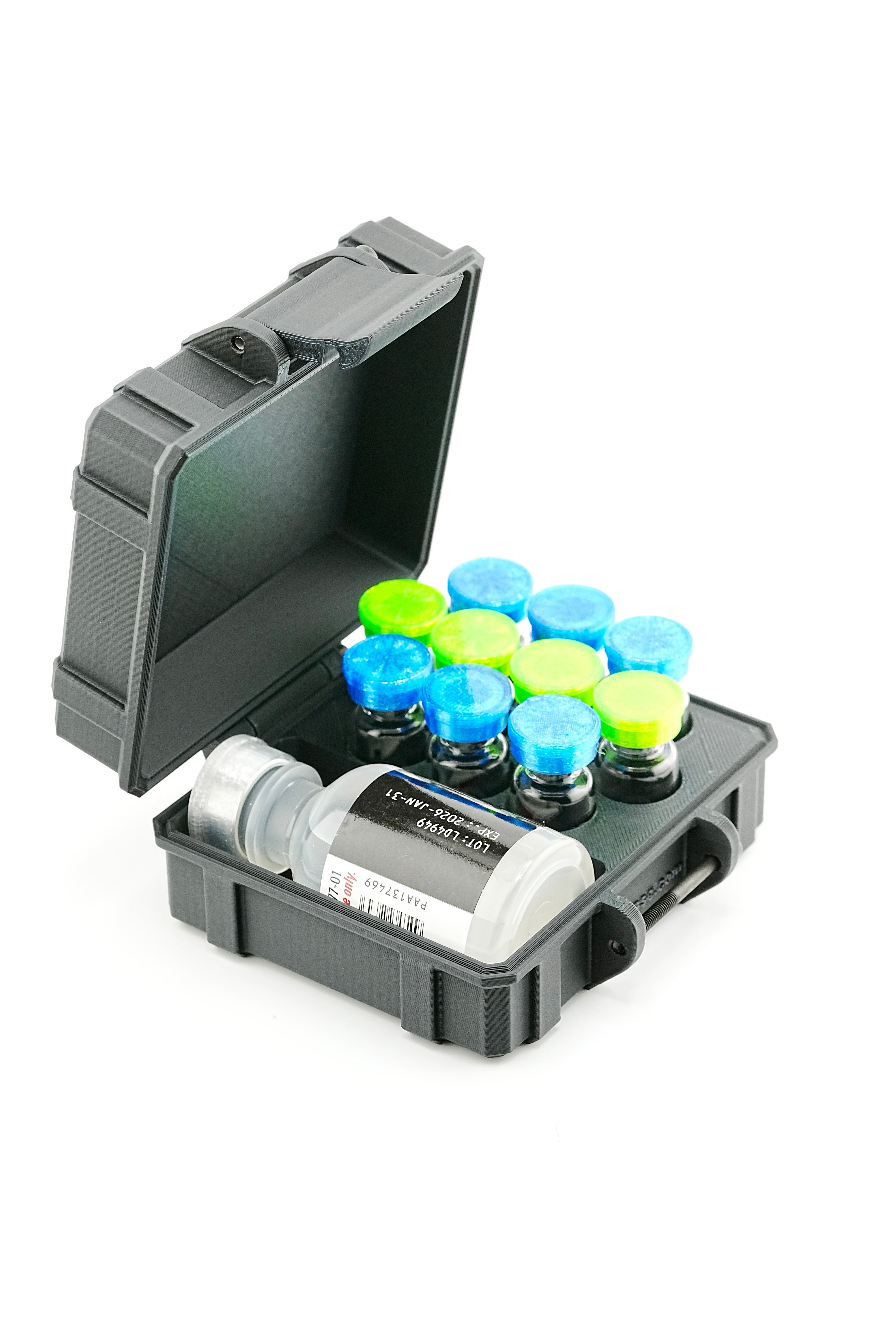
A purpose-built hard-shell opaque case provides total light blocking while also delivering two additional benefits: individual compartment slots that prevent vials from contacting each other (eliminating cross-contamination and label confusion), and rigid walls that protect glass vials from impact during refrigerator handling. For photosensitive compounds like BPC-157, GHK-Cu, and MT-2, opaque case storage is especially critical. For a full comparison of storage cases, see the top 10 peptide storage cases and the best peptide case for 2026. For more on the amber vs. clear debate, see amber vs. clear vials.
Tip 6: Never Freeze Reconstituted Peptides
This is the storage rule that causes the most expensive single-event losses in peptide research. Freezing a reconstituted peptide does not put it into suspended animation — it destroys it. When aqueous peptide solution freezes, water molecules form ice crystals that expand as they solidify. The mechanical force of crystallization physically shears peptide chains, breaking bonds and denaturing three-dimensional structure in ways that are not detectable by visual inspection. The solution thaws clear. The compound is largely inactive.
The mechanism is well-documented in biopharmaceutical manufacturing, where freeze-thaw stability is a key quality parameter for protein and peptide drug products. Repeated freeze-thaw cycles cause cumulative damage: the first cycle may reduce activity by 15–20%, the second by another 15%, and by the fifth cycle, biological activity can be reduced to 40–60% of baseline even in compounds that appeared to dissolve cleanly after thawing.
The confusion that causes this mistake: researchers know that lyophilized powder should be frozen and incorrectly generalize this rule to reconstituted solution. The underlying chemistry is completely different. Powder has no water to crystallize; solution does. Freeze powder, never solution. If you have accidentally frozen a reconstituted vial, treat it as potentially compromised — particularly for any research where dosing accuracy matters. This mistake is covered in detail in the guide to peptide storage mistakes.
What to do if you accidentally freeze a reconstituted vial: Let it thaw slowly at refrigerator temperature (not at room temperature). Inspect for visible precipitation, cloudiness, or color change. If any are present, discard the vial. If the solution thaws clear, some activity may remain, but potency will be reduced. Factor this into your protocol assessment and consider whether a fresh vial is needed for accurate research outcomes.
Tip 7: Keep the Fridge Door Closed — Store Peptides on the Back Shelf, Not the Door
Refrigerator temperature is not uniform. The location of your vials within the fridge has a significant impact on the thermal stability they experience over a 4–6 week reconstituted protocol, and the fridge door is the worst possible storage location for temperature-sensitive compounds.
Every time a refrigerator door is opened, warm room air mixes with cold interior air. The temperature on door shelves — which are directly exposed to this warm air exchange — spikes by 4–6°C on average and can take 15–20 minutes to return to baseline. In a household where the refrigerator is opened 15–20 times per day, door shelf peptides are experiencing brief but repeated thermal excursions throughout the day. Each excursion is a small dose of degradation. Compounded over 6 weeks, the potency impact is meaningful.
The back of the middle shelf is the coldest, most thermally stable location in a standard refrigerator. The compressor wall provides consistent cold, and the position at the back of the shelf means warm air from door openings dissipates significantly before reaching the vials. This location, combined with a closed opaque case, is as close to ideal cold-storage conditions as a domestic refrigerator can provide. For a complete guide to optimizing your fridge setup, see peptide fridge organization.
Tip 8: Use Separate Slots for Different Compounds
Cross-contamination and organizational confusion are underappreciated failure modes in multi-compound research protocols. When vials from different compounds share a storage space without clear physical separation, two categories of problems emerge.
The first is contamination risk. If a needle used for one compound is inadvertently reused on another vial, biological material from the first solution is introduced into the second. Even trace amounts of a proteolytic enzyme carried over this way can initiate degradation in the contaminated vial. The solution is to use each needle once and to never reuse needles between vials — but physical separation of compounds into dedicated slots provides a structural barrier that prevents the casual contamination that happens when vials are clustered together without clear organization.
The second is label confusion. Even clearly labeled vials can be misread under low light, at inconvenient angles, or when handling multiple vials quickly. Physical separation into dedicated slots means that a specific compound is always in a specific place — you develop spatial memory for your protocol. The chance of grabbing the wrong vial drops dramatically when each vial has a reserved location.
A purpose-built vial case with individual compartments solves both problems simultaneously: each slot holds one vial, and the slots are physically separated by rigid walls that prevent needle carryover and ensure consistent vial location. This also integrates naturally with the labeling protocol in Tip 4 and the organization system covered in organizing your peptide protocol.
Tip 9: Keep a Dose Log
A dose log is the administrative complement to the physical storage system. Where the case and fridge organization protect the compound itself, the dose log protects the accuracy and integrity of the research protocol. Without a dose log, three common failures occur with regularity.
The first is double-dosing. In a regular protocol, particularly one involving multiple compounds with different dosing frequencies, it is easy to lose track of whether a dose has been administered when there is no written record. A dose log makes the last dose date unambiguous.
The second is unexpected depletion. Without tracking remaining volume per vial, researchers frequently run out of a compound mid-protocol with insufficient time to order a replacement. A dose log lets you project depletion dates in advance and order replacements before the current vial is exhausted.
The third is research outcome assessment. If you cannot accurately reconstruct your dosing history — timing, amounts, any missed doses, any protocol changes — your ability to interpret your research results is severely compromised. A dose log is the data record that makes outcomes interpretable.
The log format can be minimal: compound name, date, dose amount, and a running estimate of vial volume remaining. A small physical notebook kept near your storage setup works well. For protocols involving multiple compounds, a simple spreadsheet provides better cross-referencing. See the peptide shelf life guide for reference data on how long each compound should last at your dosing frequency.
Tip 10: Have a Power Outage Plan
A power outage is a low-probability, high-impact event for reconstituted peptide storage. The average home refrigerator maintains safe temperatures for approximately 4 hours with the door closed after power loss. If the outage extends beyond 4 hours without intervention, reconstituted peptides begin experiencing meaningful temperature excursions. Having a plan in advance prevents the reactive scrambling that leads to poor decisions — and prevents the expensive mistake of unknowingly continuing a protocol with degraded compounds.
The plan has four components:
- Know your compounds' room-temperature limits. Most reconstituted peptides can tolerate 8–12 hours at 25°C before significant potency loss. GLP-1 peptides (semaglutide, tirzepatide) are more sensitive and should be considered at elevated risk after 4–6 hours above 25°C. For a full breakdown by compound, see the GLP-1 storage guide.
- Have a backup cold pack. A frozen gel pack kept in your freezer can be transferred to your storage case to extend cold storage for an additional 4–8 hours during an outage. Wrap the cold pack in a paper towel to prevent direct vial contact, which could cause localized freezing.
- Keep the refrigerator door closed. Every time you open the door during an outage, you release cold air and shorten the window of safe storage. Resist the urge to check. The fridge maintains temperature best when kept closed.
- Know when to discard. A vial that has been above 25°C for more than 8 hours, or above 30°C for any extended period, should be treated as compromised. Using a potentially degraded compound in a research protocol produces unreliable outcomes. The cost of a replacement vial is less than the cost of a failed protocol. For the complete decision framework, see the peptide power outage guide.
Quick Reference Card: All 10 Tips at a Glance
Print this list and keep it with your storage setup. It takes 30 seconds to scan and covers every major potency-protection decision in your protocol.
- 1. 30-minute rule: Never leave reconstituted peptides at room temperature for more than 30 minutes. Return to cold storage immediately after dosing.
- 2. Freeze lyophilized powder: Store powder at −20°C (freezer), not the fridge. Let vials reach room temp before opening to prevent condensation.
- 3. BAC water only: Always reconstitute with bacteriostatic water for 4–6 week shelf life. Sterile water gives only 5–7 days.
- 4. Label immediately: Label every reconstituted vial before you put it down. Compound name, date reconstituted, concentration, expiry date.
- 5. Opaque hard-shell case: Store all vials inside an opaque case. Amber glass alone is not sufficient. Zero light means zero photooxidation.
- 6. Never freeze reconstituted peptides: Ice crystals destroy peptide bonds permanently. Freeze powder; refrigerate solution. No exceptions.
- 7. Back shelf, not the door: Store vials at the back of the middle shelf. The fridge door swings 4–6°C warmer with every opening.
- 8. One compound per slot: Keep each compound in a dedicated, fixed slot. Prevents cross-contamination and label confusion in multi-compound protocols.
- 9. Keep a dose log: Record every dose. Prevents double-dosing, tracks depletion, and makes protocol outcomes interpretable.
- 10. Power outage plan: Keep a backup cold pack frozen. Know your compound's room-temp limit. Know when to discard and replace.
The bottom line: Following all 10 of these tips consistently adds zero cost to your protocol (most require only habits and one good storage case), and it protects the full potency of compounds that cost $50–$300 per vial. The ROI on correct storage is better than almost any other protocol variable you can optimize. Start with tips 1, 2, and 3 if you are new to peptide research — those three alone prevent the majority of common potency losses. For deeper reading, see the complete peptide storage guide, the definitive 2026 research peptide storage guide, and the peptide travel checklist for keeping compounds potent away from home.
Disclaimer: This article is intended for informational and educational purposes only. The compounds discussed are research chemicals. Nothing in this guide constitutes medical advice, clinical guidance, or a recommendation for human use. Always consult a qualified healthcare professional before using any peptide compound. Regulations governing research peptides vary by jurisdiction — ensure compliance with applicable local laws.