How Light Damages Peptides
Before comparing vial types, it's important to understand why light damages peptides in the first place. Peptides are chains of amino acids, and several common amino acids are photosensitive:
- Tryptophan — absorbs UV light at 280nm, leading to photooxidation
- Tyrosine — absorbs UV at 275nm, generates reactive oxygen species
- Methionine — oxidizes to methionine sulfoxide under light exposure
- Histidine — photosensitive in the presence of oxygen
- Cysteine/Disulfide bonds — UV light can break disulfide bridges that hold peptide structure together
The damage occurs in two wavelength ranges: UV light (200-400nm) causes the most rapid degradation, while visible light (400-700nm) causes slower but still significant damage over extended periods. This is why storing peptides for weeks or months — even under normal room lighting — is a real problem.
Amber Vials: What They Block (and What They Don't)
Amber glass gets its color from iron and sulfur compounds added during manufacturing. These additives selectively absorb certain light wavelengths:
- UV blocking: Amber glass blocks approximately 90-95% of UV light below 450nm. This is significant — it eliminates most of the UV-driven photodegradation.
- Visible light: Amber glass transmits 10-50% of visible light depending on thickness and wavelength. It's not opaque — hold an amber vial up to a light and you can see the liquid inside.
- Standard compliance: USP (United States Pharmacopeia) Type I amber glass meets pharmaceutical standards for light protection of sensitive compounds.
The Key Point: Amber glass is significantly better than clear glass, but it's not a complete solution. It blocks most UV but still transmits visible light. For peptides stored for weeks in a lit refrigerator, that visible light transmission matters.
Clear Vials: The Zero-Protection Problem
Clear (flint) glass provides essentially zero light protection. It transmits 80-90% of both UV and visible light. Clear vials are used in peptide packaging primarily because:
- They're cheaper to manufacture
- Users can see the contents — powder quality, reconstitution clarity, fill level
- Manufacturers assume end-user storage will provide light protection
The problem: most peptide users don't provide adequate light protection. The vials sit on fridge shelves, exposed to the fridge light every time the door opens. Over weeks of use, this cumulative light exposure measurably degrades the compound.
The Real Comparison
| Factor | Clear Vial | Amber Vial | Opaque Case |
|---|---|---|---|
| UV blocking | ~10% | ~90-95% | 100% |
| Visible light blocking | ~10% | ~50-90% | 100% |
| Direct sunlight protection | None | Partial | Complete |
| Fridge light protection | None | Partial | Complete |
| Impact protection | None | None | Full |
Which Peptides Need the Most Light Protection?
Not all peptides are equally photosensitive. Here's a rough ranking:
- Extremely sensitive: BPC-157, GHK-Cu, Melanotan 2 — these degrade rapidly under any light exposure. Amber vials alone are insufficient.
- Highly sensitive: Semaglutide, Tirzepatide, Retatrutide, CJC-1295 — significant degradation under prolonged light exposure. Amber helps but isn't complete protection.
- Moderately sensitive: TB-500, Ipamorelin, Epithalon — more tolerant of brief light exposure, but still degrade over weeks without protection.
The safest approach: treat every peptide as if it's extremely photosensitive. The cost of proper storage is trivial compared to the cost of degraded compounds.
The Fridge Light Problem
Here's a scenario most people don't consider: your fridge light turns on every time you open the door. If you open the fridge 15-20 times per day (which is normal for a household), your peptide vials sitting on the shelf are exposed to light for a cumulative 10-20 minutes daily. Over a 4-week reconstituted shelf life, that's 5-10 hours of light exposure.
Most household refrigerators use LED bulbs that emit broadly across the visible spectrum. While they produce minimal UV, the visible light exposure over weeks is sufficient to cause measurable degradation — especially in highly photosensitive peptides like BPC-157 and GHK-Cu.
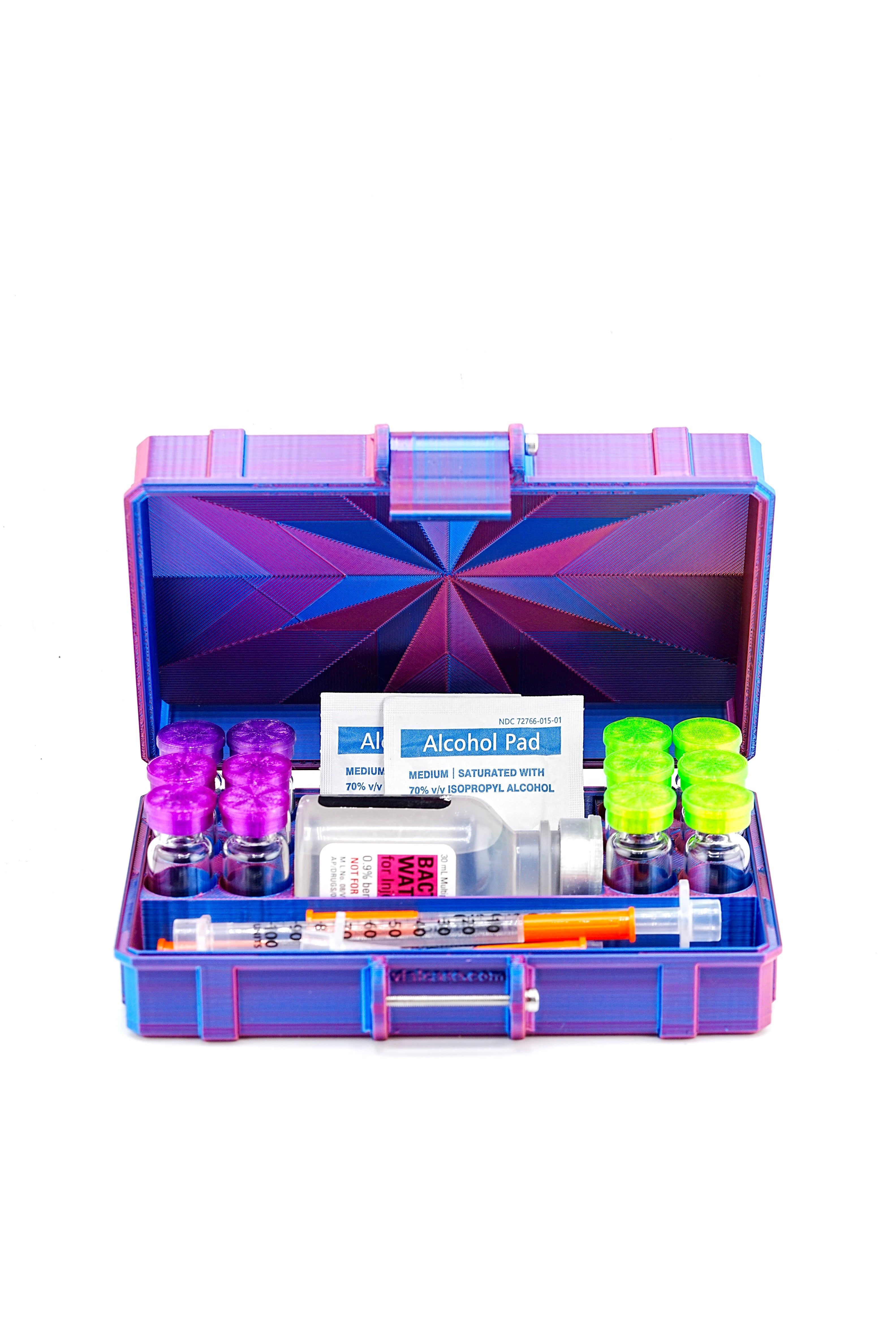
This is precisely the problem a fully opaque storage case solves. Your vials stay in complete darkness regardless of how many times the fridge door opens.
What About Wrapping Vials in Foil?
Some people wrap clear vials in aluminum foil as a DIY light-blocking solution. Does it work?
- Light blocking: Yes. Foil blocks 100% of light when fully wrapped.
- Practical problems: Foil tears easily, needs replacing after each use, makes it impossible to see the vial contents without unwrapping, doesn't provide impact protection, and looks unprofessional (especially at TSA checkpoints).
- Verdict: Better than nothing, but not a real solution. It's the duct tape of peptide storage — functional but far from ideal.
The Real Answer: The debate between amber and clear vials misses the point. Neither vial type provides complete light protection. The only 100% solution is storing your vials — amber or clear — inside an opaque, hard-shell peptide storage case. Then the vial color becomes irrelevant.
What If Your Peptides Only Come in Clear Vials?
Many vendors and compounding pharmacies only sell peptides in clear glass vials. This doesn't mean your compounds are doomed — it means light protection is entirely your responsibility. Steps to take:
- Transfer to a case immediately upon receiving your order. Don't let vials sit in the shipping box near a window.
- Store in the fridge inside the case — never on an open shelf.
- Minimize time outside the case. Pull a vial out, draw your dose, put it back. Keep exposure to under a minute per use.
- If traveling, use a hard-shell opaque case. Clear vials in a Ziploc bag in your suitcase get hours of ambient light exposure during transit.
Summary: Amber vs. Clear vs. Case
- Clear vials: Zero light protection. Your peptides need external protection immediately.
- Amber vials: Significant UV protection, partial visible light protection. Better, but not sufficient for weeks of storage.
- Opaque case (any vial): 100% light blocking, plus impact protection and organization. The only complete solution.
Bottom Line: Amber vials are better than clear, but neither provides complete protection for the weeks your peptides sit in the fridge. An opaque storage case eliminates the light variable entirely — whether your vials are amber, clear, or any color in between. Stop worrying about vial color and start controlling your storage environment.