What Makes a Good Peptide Case?
Before the rankings, it's worth knowing what you're actually evaluating. A purpose-built peptide case needs to do five things well:
- Block light completely — peptides like GHK-Cu, MT-2, and GLP-1 class compounds are photosensitive. Even ambient fridge light from repeated door openings degrades them over weeks. An opaque hard shell is non-negotiable.
- Protect against impact — glass vials are fragile. A case that crumples under light pressure will cost you $150-500 per vial when it fails. Hard-shell construction is the standard.
- Fit the fridge — most peptides live at 2–8°C between doses. Your case needs to fit on a shelf without monopolizing the back wall, and it must tolerate cold without cracking.
- Hold the right vial sizes — 3ml and 10ml are the dominant sizes. GLP-1 compounds (semaglutide, tirzepatide, retatrutide) come in both. Slots must match actual vial dimensions.
- Retain temperature on the go — for travel and day carry, insulated lining or cold-pack compatibility keeps your compounds in the safe zone between fridge and destination.
All ten picks below are from the VialCase lineup — the only brand purpose-engineered specifically for peptide and GLP-1 vials. They come in configurations for every need, and every option ships free with a 30-day risk-free trial.
Quick tip: If you're running a GLP-1 (semaglutide, tirzepatide, or retatrutide) your vials are almost certainly 3ml or 10ml compounded. Check your vial size before ordering — the right slot size eliminates rattle and prevents cap damage.
The Top 10 Ranked
#1 — Best Overall: VialCase 3ml 8-Slot
The most popular configuration for good reason. The 8-slot 3ml VialCase covers a 4–6 compound protocol with room for a BAC water vial, making it the right fit for the majority of peptide users. The opaque hard shell blocks 100% of ambient light, the precision foam seats keep every vial upright and separated, and the compact footprint fits cleanly on a fridge shelf. If you're running BPC-157, CJC-1295, Ipamorelin, and a GLP-1 simultaneously, this is your case. Shop →
#2 — Best for GLP-1 Users: VialCase 10ml 4-Slot
GLP-1 compounded vials often come in 10ml — a larger diameter than standard 3ml research peptides. The 10ml 4-slot VialCase is built around these wider vials with precision-matched slots that cradle the cap and prevent the side-to-side rattle that chips stoppers. Most GLP-1 users only run one or two compounds at a time, so 4 slots is exactly the right capacity without adding unnecessary bulk in the fridge door. The opaque shell is critical given how long a single GLP-1 vial sits open before it's used up. Shop →
#3 — Best for Retatrutide: VialCase 3ml Compact
Retatrutide is typically compounded in 3ml vials dosed weekly, meaning a single vial lives in your fridge for 4–6 weeks between reconstitution cycles. That extended light exposure is exactly why the fully opaque VialCase 3ml compact matters so much for retatrutide users specifically. Its slim profile — narrower than a standard 8-slot case — slips into the back of a middle shelf without taking over real estate. It's the clean, purpose-right solution for someone running retatrutide as a standalone compound. Shop →
#4 — Best for Travel: VialCase with Insulated Lining
The hard-shell VialCase travel configuration combines impact-rated construction with an insulated lining that maintains temperature for hours away from refrigeration. GLP-1 and retatrutide are among the most heat-sensitive peptides — even a few hours above 8°C degrades reconstituted compounds. For flights, road trips, or the commute to the office, this is the case that bridges the gap between your home fridge and your destination. Cold-pack compatible. TSA-friendly form factor. Shop →
#5 — Best for Beginners: VialCase Starter 2–4 Slot
Starting a first peptide protocol — maybe a single GLP-1 compound or BPC-157 plus BAC water — doesn't require a 20-slot case. The starter configuration is compact, affordable, and covers a single-compound setup without forcing you to overbuy before you know what your protocol will look like. It carries the same opaque hard-shell construction as every other VialCase, just in a smaller footprint. A smart entry point before you scale up. Shop →
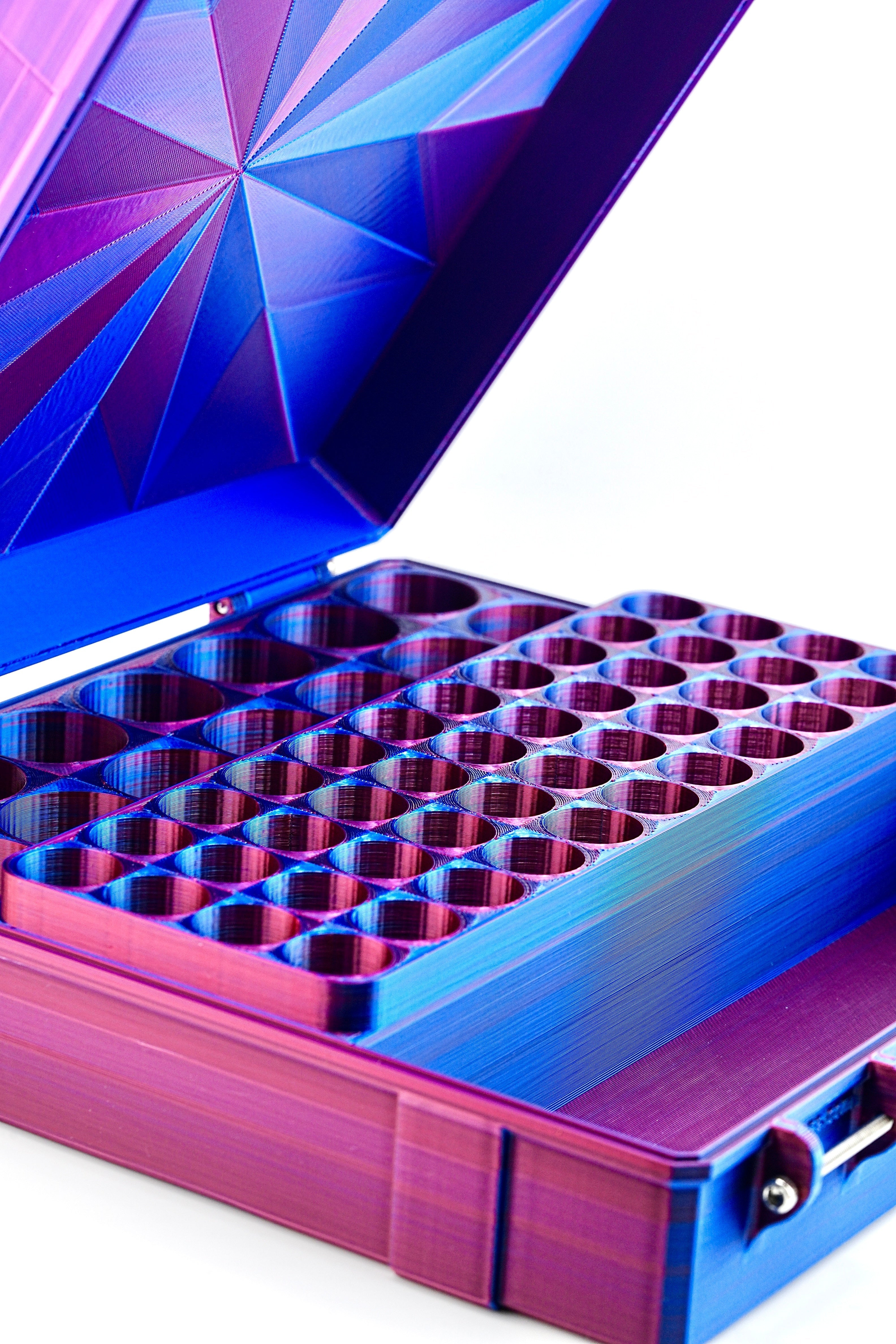
#6 — Best for Heavy Stacks: VialCase Large (6–8+ Compounds)
Serious biohackers and longevity-focused users running 6, 8, or more compounds simultaneously need real capacity. The VialCase large configuration accommodates mixed 3ml and 10ml vials in organized slots, so a BPC-157 + TB-500 + GHK-Cu + CJC-1295 + Ipamorelin + retatrutide stack all lives in one organized, labeled system. No more guessing which vial is which in the back of the fridge. Shop →
#7 — Best for Syringes: VialCase Syringe Case
Insulin syringes, reconstitution syringes, alcohol wipes, and needle caps — the consumables side of a peptide protocol creates its own organizational challenge. The VialCase syringe case gives sharps their own dedicated hard-shell home, separate from your vials, with organized slots for different needle sizes. It's an essential companion to any vial case if you're self-administering. Pairs especially well with the 8-slot or large vial case for a complete system. Shop →
#8 — Best for Freezer Storage: VialCase Freezer-Safe
Lyophilized (dry powder) peptides can be stored at −20°C for 12–24 months, which means your long-term stock lives in the freezer. The freezer-safe VialCase uses a silicone gasket seal and cold-tolerant materials that won't crack or warp at −20°C, unlike cheaper cases that become brittle in freezer conditions. If you buy peptides in bulk or want to stockpile a 6-month supply, this configuration keeps your investment intact for the long haul. Shop →
Freezer vs. fridge: Only store lyophilized (dry powder) peptides in the freezer. Once reconstituted with BAC water, peptides must stay refrigerated at 2–8°C — freezing a reconstituted vial damages the protein structure. See our storage temperature chart for the full breakdown.
#9 — Best for Light-Sensitive Peptides (GHK-Cu, MT-2): VialCase Opaque Shell
GHK-Cu and Melanotan-2 are among the most photosensitive peptides in common use — both degrade noticeably with extended light exposure, which explains why they're sold in amber vials. But amber glass only filters a portion of the spectrum; a fully opaque enclosure is the real protection. The VialCase opaque shell provides complete blackout with zero light leak, making it the right call for any protocol where light degradation is a primary concern. Essential for MT-2 users in particular, where potency consistency matters for dosing. Shop →
#10 — Best Value: VialCase Bundle
The bundle configuration combines a vial case with a cold pack and labeling kit — the three things most new peptide users realize they need after their first week. Instead of ordering pieces separately, the bundle gets you organized from day one at a lower combined cost. The included cold pack is gel-based (not ice), sized to maintain 2–8°C for 4–8 hours during transit without condensation risk. The label kit covers dose tracking and reconstitution date markings that are easy to skip but genuinely prevent dosing errors. Shop →
What to Look for in a Peptide Case: Buying Guide
With the rankings in place, here's how to apply them to your specific situation:
Match your vial size first
3ml and 10ml vials are not interchangeable in a case. A 3ml vial in a 10ml slot rattles and risks cap damage. A 10ml vial doesn't fit a 3ml slot at all. Know your vial size before ordering. GLP-1 compounded vials are commonly 3ml or 10ml depending on the compounding pharmacy; retatrutide is almost always 3ml. Check the label.
Count your current vials, then add 30%
Most users underestimate how quickly their collection grows. A beginner running one GLP-1 compound often adds a healing peptide within two months. Buy for where you'll be in six months, not where you are today.
Decide if you travel
GLP-1 users in particular tend to travel more than average — lifestyle optimization, medical tourism, conference travel. If your peptides come with you, the insulated travel case isn't optional; it's the difference between arriving with intact compounds or degraded ones. Read our full TSA travel guide for flying specifics.
Don't skip the syringe case
A disorganized sharps situation creates risk — both from accidental needle sticks and from needles contaminating vial stoppers. A dedicated syringe case solves both problems for under $30.
Frequently Asked Questions
Can I use any hard case for peptide storage?
Technically yes, but purpose-built cases matter for a few reasons. Generic hard cases don't have slots matched to 3ml or 10ml vial dimensions, so vials rattle and tip. They also typically aren't fully opaque — light can enter through seams, clear panels, or semi-translucent materials. And most generic cases aren't rated for freezer temperatures. A purpose-built case eliminates all three failure modes.
Do I need a separate case for GLP-1 vs. other peptides?
Not necessarily. If your GLP-1 vials are the same size as your other peptides (all 3ml, for example), one case handles everything. Where users run into trouble is mixing 3ml and 10ml in the same case — you'll want a dual-size configuration or two dedicated cases. The VialCase large and bundle options are designed for exactly this mixed-size scenario.
How long does a peptide case last?
A quality hard-shell case like VialCase is effectively permanent — there are no consumable components. The foam inserts may compress slightly over years of use but maintain their protective function. Most users buy one case and use it indefinitely, occasionally adding a second case as their protocol expands.