
What We Tested
Not every storage case is built for vials. Most cases on the market were designed for something else (photography gear, medical devices, cosmetics, tools) and get adapted by people who keep peptide and GLP-1 vials because, until recently, there were almost no purpose-built options. That adaptation often looks fine on the surface and falls short on the details that matter for small glass vials.
Our review criteria came down to six questions that reflect how people actually store and carry vials at home, at work and on the road.
Design a peptide case around your own vials
Add your vials and supplies, let Auto-arrange size the case, and check it in 3D before you order. Printed to order in the US.
1. Light Blocking
Many vial labels say to protect the contents from light, and amber glass only goes part of the way. If your label says it, a closed, solid case is the simplest way to follow it every day. We checked light penetration by placing a lux meter inside each closed case in a brightly lit room. Any case that let light in at the seams, at the closure or through the shell itself was marked down.
2. Vial Fit
The two most common vial sizes are 3 mL and 10 mL. Slots that are too large let vials rattle, which means glass-to-glass contact and scuffed stoppers. Slots that are too small need force to insert, which risks cracking the vial neck or pressing the stopper against the rim. We tested each case with real 3 mL and 10 mL vials and judged both fit and how easy each vial was to put in and take out. Correct fit means the vial seats without force, stands upright without support and doesn't rattle when the case is moved.
3. Impact Resistance
Glass vials break. A case that doesn't meaningfully cut that risk in transit, or in the everyday drops that happen in a bathroom or kitchen, isn't earning its place. We ran drop tests from counter height (about 90 cm) onto hardwood flooring, with vials in place and without. We also pressed on each case from the sides to mimic an overpacked bag or luggage stacked in an overhead bin. Cases were judged on whether the shell held up after drops and whether the vials stayed put inside.
4. Travel Readiness
People travel with their vials, for work trips, vacations and long weekends. Travel readiness covers form factor (does it fit a carry-on or personal item?), whether it drops neatly into an insulated cooler bag with ice packs for the trip, and whether it causes trouble at a TSA checkpoint. See our detailed guide on traveling with peptides through TSA for what airport security looks for and how to prepare.
5. TSA Compliance
A hard-shell case holding several vials, ice packs and syringes will go through X-ray screening. Cases that invite secondary inspection, because of unusual materials, packing that hides the vials on the X-ray image, or a size that bumps against carry-on rules, cost time and add friction. We checked each case against TSA carry-on and liquids rules and flagged any that would predictably trigger a closer look.
6. Size for Multi-Vial Kits
Someone keeping a single GLP-1 vial needs very different capacity from someone keeping six or more vials at once. Cases that only take two to four vials fail people with bigger kits. Cases with twelve or more slots are wasted space for someone with one vial. We judged each case against the three most common kit sizes: small (one or two vials), medium (three to five) and large (six or more).
The Testing Process
We gathered cases across five categories: purpose-built vial cases, medical equipment cases adapted for vials, generic hard-shell cases with foam inserts, soft insulated cases marketed for medication, and DIY setups built from off-the-shelf parts. Every case went through the same steps so they could be compared fairly.
Drop Tests
Each case was loaded with water-filled dummy vials of the right size (3 mL or 10 mL, depending on the slot) and dropped from about 90 cm onto hardwood three times: once flat on the bottom, once on a corner, once on the side. After each drop we inspected the shell for deformation, the closure for failure, and the vials for movement. Cases where vials hit each other or the walls during the drop were flagged for poor internal retention, a common failure in cases with pick-and-pluck foam that wasn't cut to the vial's diameter.
Light Penetration Tests
Each closed case was placed under a 500-lux light source (about as bright as a well-lit kitchen) with a miniature lux meter sealed inside. Cases with any interior reading failed. Several cases with shells that looked opaque still let light in at the hinge, at the latch seam, or through the shell itself where the wall was thin. You would never notice it in normal use, which is exactly why it's worth checking.
Fridge Fit
Every case went into a standard home refrigerator on the middle shelf. We recorded its footprint, whether it blocked airflow, and whether it got in the way of normal fridge use. Cases that needed a shelf removed or took over a large share of the shelf were noted. Cases that sat cleanly next to everyday food without any reshuffling scored well on fridge fit.
TSA Walk-Through
Each case went through TSA screening at a domestic airport with the same contents: four vials, two syringes, one gel cold pack and printed prescription documentation. We tracked whether any case triggered secondary screening and, if so, what prompted it. Hard-shell cases with complex interiors and solid shells were the most likely to get a manual check, but none of the cases led to anything being taken when the documentation was present.
Multi-Vial Organization
We loaded each case with a representative six-vial kit, four 3 mL vials and two 10 mL vials, and judged how well it handled both sizes at once. Cases with only one slot size were judged with six vials of that size. We also put round labels on each vial and checked how well the case supported a simple labeling system. See our guide on how to label peptide vials for the system we used.
Category Winners
After the full review, we picked a winner for five common situations. Our pick in every category is now the same kind of case: one you design yourself around what you actually carry. A stock layout makes you fit your kit to the case; a custom case is sized to the kit.
Best for GLP-1 Users
GLP-1 vials often come in 10 mL vials, though 3 mL is common too. Our pick is a custom case with 10 mL pockets for the vial in use plus a backup, and a bay for the supplies you keep with it. In the PeptideCase™ builder you add "10 mL vials", set how many, and the case is laid out around them, with a fitted pocket for each vial. If your vials are an unusual size, add "other size vials" instead. For more on GLP-1 vial cases, see what to look for in a GLP-1 storage case.
Best for Travel
For travel, the winning setup is two pieces: a hard case that holds every vial in its own pocket, carried inside an insulated cooler bag with gel cold packs. No hard case we looked at replaces a real cooler, and a custom case isn't one either. It is a protective organizer that sits inside the cooler. Size it in the builder so it fits the cooler bag you already own; the builder shows the exact length, width and height before you order. A hard shell also handles overhead-bin squeeze and road-trip bumps in a way soft pouches can't. For the complete playbook, see our TSA travel guide for peptides.
Best for Big Kits of 5+ Vials
Keeping six or more vials at once is common for people with several peptides on hand, plus a BAC water bottle. Ready-made 8-slot cases fit some of those kits and leave others with a vial or two that has no home. Our pick is a custom case: add each vial type and count, add a BAC water bottle bay, and Auto-arrange packs everything into the most compact layout. The tallest item sets the case height and shorter vials stand on a raised floor, so every vial top lines up at the rim. Big cases get a 5-knuckle hinge and two latches. See our guide to organizing a multi-vial kit for a labeling system that works inside a case like this.
Best for Beginners
First-time users with one or two vials don't need eight slots. Buying too much capacity at the start means a case that's bigger than necessary in your fridge and your bag. Our pick for beginners is a small custom case built for exactly what you have today, for example two 3 mL vials and a few syringes. If your kit grows later, design a second case for the new layout and keep the first one for travel or overflow.
Best Value
Value isn't the case with the most slots; it's the one where nothing is wasted. A custom case has no empty slots and no wasted shelf space, because every pocket is something you added. Pair it with a reusable gel cold pack for trips and a simple labeling system, and you've covered the three gaps most new users hit in their first month: vials loose in the fridge, nothing cold for the trip (that's the cooler's job), and no quick way to tell similar vials apart. For that last one, color-coded custom vial caps from the caps builder are an option.
Pro Tip: If you can't decide whether to build for the vials you have now or the vials you expect to have later, think about where the case lives. A case a little bigger than today's kit is fine on a fridge shelf. For a carry-on, build it around what you actually travel with.
What Every Good Case Must Have
After reviewing every type of case we could find, five requirements stood out. A case that misses any one of them will eventually cost you a vial.
1. Opaque Shell with Zero Light Penetration
Not semi-opaque. Not dark-tinted. If your vial label says to protect from light, the case shouldn't let light in through the body, the seams or the closure. A case on a fridge shelf sees the fridge light every time the door opens, potentially dozens of times a day. Every case that failed our light test was marked down whatever its other strengths. You can check any case yourself with the dark-room test further down this page.
2. Vial-Specific Slots Cut to Exact 3ml and 10ml Dimensions
Generic foam, pick-and-pluck foam and DIY inserts cut to rough sizes all share the same failure: vials rattle. Rattle means glass-on-glass contact. Glass-on-glass contact chips stoppers, stresses vial necks and, in the worst case, breaks the vial. The slot must match the vial, not approximately but closely. The vial should seat without pressure and stand upright without leaning. That level of fit takes a case designed around the vial; generic foam can't deliver it. It is also exactly what the builder does: every item you add becomes fitted pockets sized for that many vials.
3. Crush Resistance Against Realistic Load
A case in a refrigerator gets things stacked on top of it. A case in a carry-on gets squeezed when the bag shifts. A case in checked luggage gets the kind of handling that would alarm anyone who has watched bags being loaded. Crush resistance isn't about surviving a deliberate attempt to destroy the case; it's about surviving the ordinary chaos of being stored and carried. Any case that deforms under a 5 kg load held for 30 seconds isn't fit for the job.
4. Portability Without Compromising Vial Security
A case that protects vials perfectly in the fridge but can't travel is half a solution. Most people need to bring their vials somewhere at some point, even if it's just from home to a hotel once a year. A case must be portable in the sense that you can pick it up, move it and carry it without the vials shifting inside. The latch has to hold when a loaded case is carried at an angle. That's a lower bar than full travel readiness, but it's the minimum for any case that will ever leave the fridge.
5. Right Size for 3ml and 10ml Vials
This sounds obvious, but the market gets it wrong often. Cases sold for "vials" are frequently built for a different standard (lab tubes, chromatography vials, cosmetic samples) that doesn't match 3 mL and 10 mL vials. Before buying any case that wasn't designed for your vials, measure your vial's body and cap and compare them with the slot. A slot that's smaller won't take the vial; a slot that's much larger lets it rattle.
The One Case That Passes Every Fit Test
One kind of case passes the fit tests without qualification: a case built around your own vials. That's worth explaining in practical terms rather than marketing ones, because the reasons are specific.
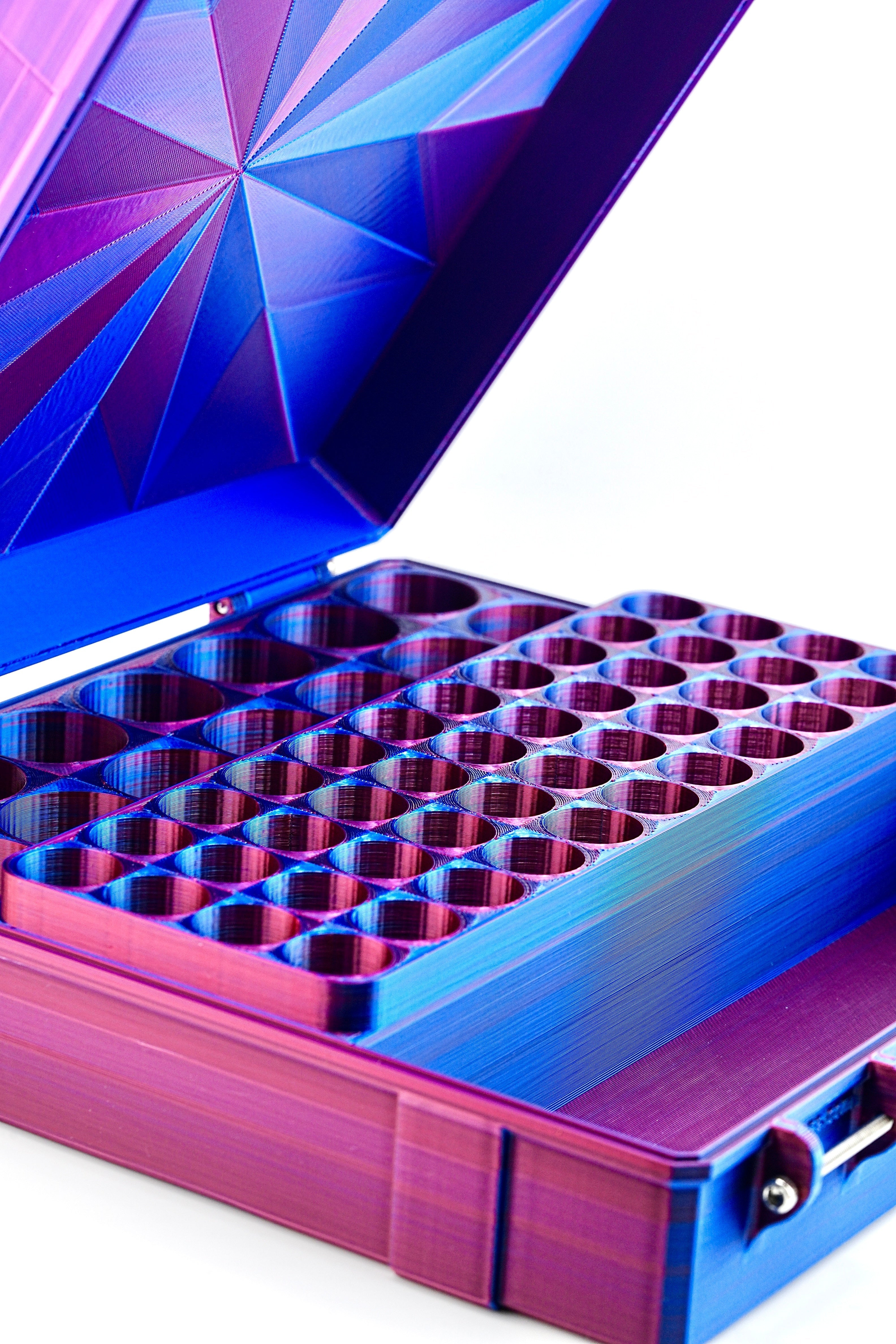
The PeptideCase™ builder starts with the vials, not with a stock case shape. You begin with an empty case, tap "Add item" and pick what you carry: 3 mL vials, 10 mL vials, peptide vials, TRT vials, glutathione vials, other size vials, syringes, alcohol pads, a BAC water bottle, pens, pen cartridges, a custom space with your own width, depth and height, or a temperature sensor. Every item becomes fitted pockets or an open bay sized for that many.
The tallest item sets the case height. Shorter vials stand on a raised floor, so every vial top lines up at the rim where it's easy to grab, and every storage space has a finger scoop.
Auto-arrange then packs everything into the most compact layout and shows the case size (length x width), the height and what it holds, with a top view, a lid view and a 3D view you can open, unlatch, close and drag to turn. The size shown is exactly what gets built, so you can check it against your fridge shelf, drawer or carry-on before you order.
The case closes with a print-in-place snap hinge and a locking latch; big cases get a 5-knuckle hinge and two latches. You choose Black or RGB Metallic, a Wide shape (hinge on the long side) or Deep (hinge on the short side), and one or two latches. Cases too big to print in one go are printed as two parts, lid and base. Every case is printed to order on the maker's own print farm in the US.
One honest limit: it is a protective hard case and organizer, not a cooler. It keeps nothing cold on its own, so pair it with a cooler bag and ice packs for trips, and follow the storage instructions on your product label or from your pharmacist or provider.
What Cheap Cases Get Wrong
The market for vial storage has grown fast alongside GLP-1 and peptide use, and with it came a wave of cases that look credible at first glance and fall short up close. Three failures show up again and again in cheaper cases.
Slots Too Large, Causing Glass-to-Glass Contact
The most common failure in cases that weren't built for vials is oversized slots. Cases listed as "3 mL vial compatible" often have slots cut wider than the vial body so the vial drops in easily. What that really creates is a few millimeters of side-to-side play per vial. In a six-slot case where every slot is too wide, the rattle adds up fast in transit and vials swing into each other. In our drop tests, several "3 mL compatible" cases showed scuffed stoppers on neighboring vials after a single 90 cm drop. That's precisely the damage a fitted pocket prevents. Our guide to common peptide storage mistakes covers this and other easy-to-miss problems.
Semi-Transparent Lids or Bodies
Plenty of mid-range cases use frosted acrylic, lightly tinted polycarbonate or a clear lid on a dark base. They look protective. Our light tests showed otherwise: frosted acrylic passed measurable light, tinted polycarbonate passed roughly a tenth to a third of the room's light depending on the tint, and a clear lid offered effectively none. The point of a see-through lid is convenience, so you can spot your vials without opening the case. If your label says to protect from light, that convenience works against you: a case that lets you see your vials also lets light reach them.
No Cold-Pack Slot
Cases with no plan for travel cooling force people to improvise: a loose ice pack wrapped in a towel around the outside of the case, or packs stuffed into a separate bag. Both are clumsy and inconsistent. The better approach is to treat cooling and protection as two separate jobs. An insulated cooler bag with gel ice packs handles temperature; a hard case inside it handles protection and organization. A custom case can be sized to drop into the cooler bag you already own, with room for the ice packs around it. Whatever you pack, follow the storage instructions on your product label or from your pharmacist or provider.
Pro Tip: Do a light test on any case before you commit to it. Close the case, take it into a dark room, hold a flashlight against the outside and look for light bleeding through at the seams or the closure. Then open it in a bright kitchen and look for any part of the lid or body that light shines through. If you see light, and your label says to protect from light, keep looking.
Final Buying Guide
The right case depends on how many vials you keep, how often you travel and whether you store 3 mL vials, 10 mL vials or both. Here is a practical way to choose.
1–2 Vials: Small Kits and Single GLP-1 Vials
If you keep a single GLP-1 vial, or one or two peptide vials with a BAC water bottle, a small case is the right scale. At this size, getting the pocket size right matters most: confirm whether your vials are 3 mL or 10 mL with your pharmacy before you order. In the builder, add exactly those vials, plus syringes or alcohol pads if you keep them together, and the case comes out no bigger than it needs to be.
3–5 Vials: Medium Kits
Three to five vials covers the most common setup: a GLP-1 vial plus two or three peptide vials. A case with a pocket for each, plus a BAC water bottle bay and room for one or two incoming vials, handles this comfortably. At this size, organization and labeling start to matter. With five vials of similar size, a clear labeling system is what stops you grabbing the wrong one. See our guide to organizing several vials for a labeling system that works alongside your case.
Color-code your vials
Custom snap-on caps for 3 mL or 10 mL vials, with a cap color plus an icon or letters. Sets from 25 caps.
6+ Vials: Large Multi-Vial Kits
People keeping six or more vials need a large case and, often, a second one so backup vials stay separate from the ones in use. Build one case for the vials you reach for and another for backups, and you never open the wrong one. Large designs get a 5-knuckle hinge and two latches, and a case too big to print in one go is printed as two parts. For really big collections, see our high-capacity storage guide.
Make your own custom peptide storage case
Every pick on this page points the same way: the best case is the one built around what you carry. Here's how to make it in the PeptideCase™ builder. Start with an empty case and tap "Add item". Pick your vials (3 mL, 10 mL, peptide, TRT, glutathione or other size) and how many of each, then add whatever travels with them: syringes, alcohol pads (flat or standing), a BAC water bottle, pens or pen cartridges, a custom space with your own width, depth and height, or a temperature sensor window for a small digital thermometer. Auto-arrange packs it all into the most compact layout and shows the case size, height and a 3D view you can drag to turn. Choose Black or RGB Metallic, Wide or Deep, one latch or two, and add a lid design if you like: a line or two of text, an icon, or your own SVG logo printed in a second color. Add to cart sends the design to the vialcase.com cart. Custom cases are made to order and final sale, and printing defects are still replaced. Start designing your case