
What Makes GLP-1 Storage Different
Many peptide vials turn over quickly: used often, finished soon, replaced. A GLP-1 vial is different. It's commonly used once a week, so a single vial can stay in your fridge for weeks before it's finished.
That changes what you need from a case. The vial gets taken out and put back many times. It sits through every fridge-door opening for as long as it's in use. It gets moved when someone cleans the shelf, reaches past it or stacks something on top. Small risks that don't matter for a vial you finish in a few days add up for one that stays around this long. The case you choose has to handle all of that.
Design a GLP-1 case around your vials
Add your GLP-1 vials, backups and supplies, check the exact size against your fridge shelf, and see it in 3D before you order.
The 5 Features a GLP-1 Case Must Have
1. Complete Light Blocking
Many GLP-1 labels say to protect the vial from light. Amber glass is a partial answer: it filters some light but lets plenty through, and a vial standing on an open fridge shelf gets the fridge light every time the door opens.
If your label asks for light protection, keep the vial in its carton or a closed, solid container between uses instead of standing it on an open shelf. Clear and tinted cases look tidy but let the light straight in, so check any case with a flashlight in a dark room before you rely on it.
2. Correct Vial Slot Size
Compounded GLP-1 vials come in two common sizes, 3 mL and 10 mL, depending on the pharmacy. A case with the wrong slot size isn't just inconvenient; it causes damage. A 3 mL vial rattling in a 10 mL slot scuffs its stopper over time, and a 10 mL vial won't fit a 3 mL slot at all.
Know your vial size before you order. Semaglutide and tirzepatide vials come in both sizes. When in doubt, measure the vial across its widest point and compare it with the slot. The right case has pockets matched to the vials you actually have.
Check your pharmacy: Some compounding pharmacies use less common sizes such as 2 mL, 5 mL or 8 mL. If your vials don't look like a standard 3 mL or 10 mL, the builder's "other size vials" item lays out pockets for them instead of forcing them into the wrong slot.
3. Fridge-Ready Dimensions
If your label calls for refrigeration, a GLP-1 case lives in your fridge for good. It needs to sit at the back of a middle shelf without taking over the space. Cases that are too tall tip forward when the shelf slides out; cases that are too wide crowd everything else.
The ideal GLP-1 case has a low, flat profile: wide enough to hold your vials securely, short enough to fit under the shelf above. It should slide in and out with one hand, stand without support and leave room for everything else. That sounds basic, but plenty of generic cases fail it. Measure your shelf gap first; the builder shows the exact height and footprint of your design, and the Wide or Deep shape lets you match a shallow or narrow shelf.
4. A Travel Plan: Insulation Around the Case
GLP-1 users travel for work, family and vacations, and every trip opens a gap between your fridge and your destination. A hard case doesn't close that gap by itself: it protects and organizes, but it isn't insulated and doesn't keep anything cold.
If your label calls for cold, pack the hard case inside an insulated cooler bag with a gel pack. The cooler handles temperature; the case keeps the vial in its own pocket so nothing rattles or breaks in the bag. If your label says not to freeze, keep a layer between a frozen pack and the vial. See our TSA travel guide for flying with vials.
5. Space for Syringes and BAC Water
A GLP-1 routine doesn't just involve the vial. There are insulin syringes, alcohol pads and often a BAC water bottle that should live with it. A case that only holds vials forces you to organize everything else separately, which means things go missing, syringes end up loose in a drawer, and every use turns into a scavenger hunt.
The best GLP-1 cases include a space for syringes and a bay for the BAC water bottle, so the whole kit comes out of the fridge as one unit and goes back the same way.
Why Cheap Alternatives Fail
Ziploc Bags
No light protection (clear plastic lets light straight through), no impact protection and no organization. A bag of glass vials and syringes is also the hardest kind of packing to explain at airport security. Zip bags don't stay sealed well in a damp fridge either: condensation collects inside, smudges labels and makes vials hard to identify after a few weeks.
Generic Medicine Organizers
Pill organizers and generic medicine boxes are built for tablets and capsules, not glass vials. The compartments are the wrong shape, there's no impact protection, and many are see-through. They're not designed for fridge life either; cheap plastic can turn brittle in the cold and latches give out. A generic organizer tends to last a couple of weeks before something cracks or falls out.
Leaving Vials in Original Packaging
Compounding pharmacies usually ship vials in cardboard boxes with basic foam inserts: fine for shipping, not built for weeks of daily fridge life. Cardboard soaks up moisture, the foam isn't matched to the vial, and there's no system for telling vials apart. If your label says to keep the vial in its carton, a case can still hold the carton; just don't rely on cardboard as your only protection.
The TSA point: A hard case with labeled, organized vials reads as medical supplies at a glance. A zip bag of loose vials and syringes reads as the opposite. TSA officers have discretion, and presentation matters more than most travelers expect.
What NOT to Look For
A few over-engineered options come up in forums that add cost and complexity without adding real protection:
- Dedicated mini fridges or smart coolers. Unless you're storing large quantities, a good case inside the fridge you already own is simpler, more portable and far cheaper than a specialty appliance.
- Nitrogen or argon purge systems. Built for laboratory storage, not for a vial you're using every week. Complete overkill.
- Vacuum-seal systems. They create pressure differences that can affect rubber stoppers, and they don't suit vials that are in regular use.
The best GLP-1 storage solution is the simplest one that covers all five features above: a solid hard shell, correct pockets, fridge-friendly dimensions, a travel plan built around a cooler bag, and space for supplies.
The Custom Case Solution
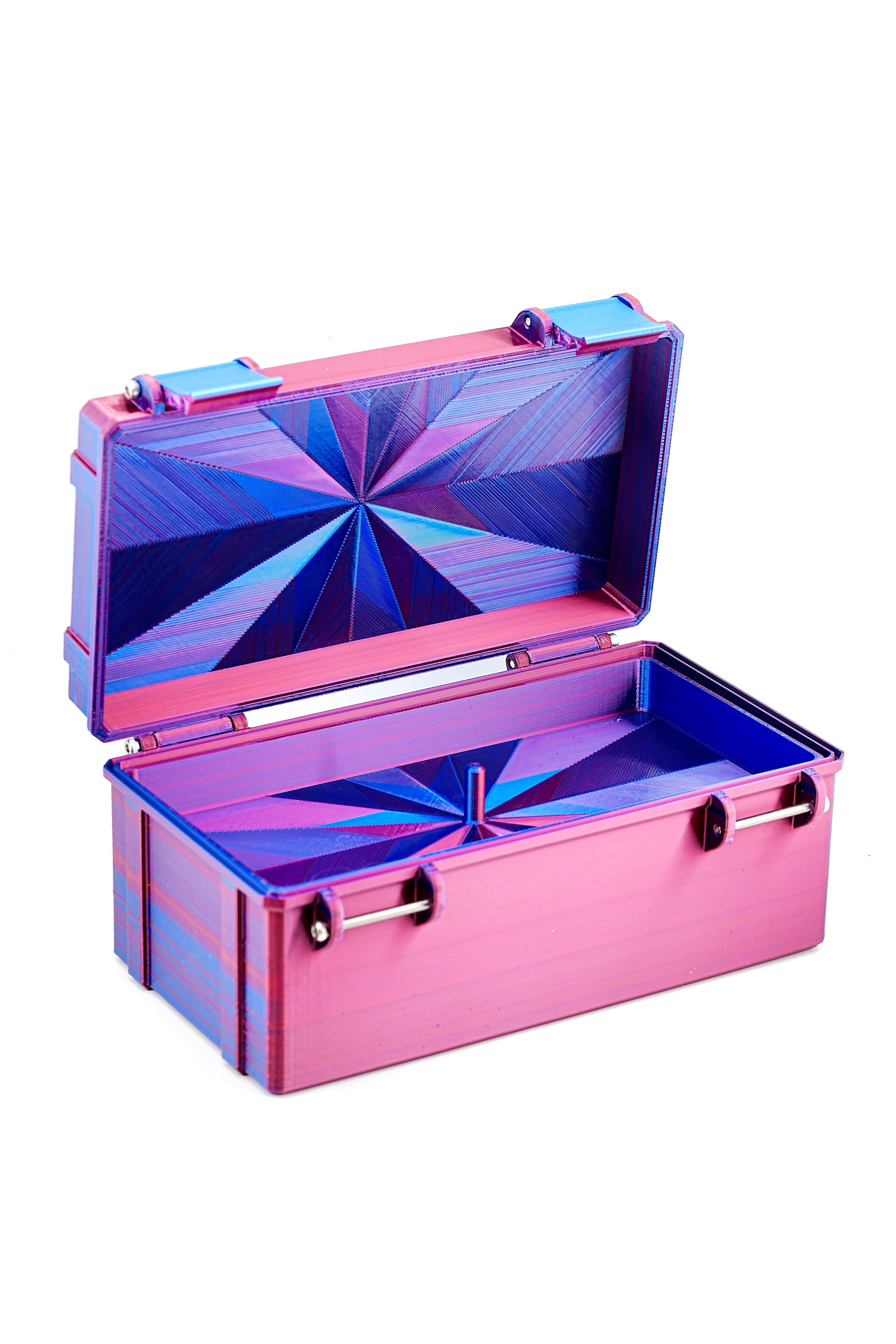
The fastest way to get the right pockets, the right size and a home for your supplies is a case built around your vials instead of a stock layout. The PeptideCase™ builder starts with an empty case. You add your GLP-1 vials (10 mL, 3 mL or other size) and set how many, then add the supplies that live with them. Every item becomes fitted pockets or an open bay sized for that many, and every storage space has a finger scoop. The tallest item sets the case height, and shorter vials stand on a raised floor so every vial top lines up at the rim.
Auto-arrange packs everything into the most compact layout, and the builder shows the case size (length x width), height and contents with a top view, a lid view and a 3D view. The case closes with a print-in-place snap hinge and a locking latch, and it's printed to order on the maker's own print farm in the US. It is a protective hard case and organizer, not a cooler, so it can live in your fridge and ride inside a cooler bag.
Make your own custom GLP-1 storage case
A GLP-1 case should fit your vial, your shelf and your routine, and only a custom case fits all three. In the PeptideCase™ builder, start with an empty case and tap "Add item". Add your GLP-1 vials with enough pockets for the one in use, the next one and your backups. Then add syringes, alcohol pads (flat or standing) and a BAC water bottle if you keep one, or pens and pen cartridges if that's your format. Want to watch the temperature? Add a temperature sensor window for a small digital thermometer. Auto-arrange plots the most compact layout and shows the exact size, so you can check it against your fridge shelf before you order. Choose Black or RGB Metallic, Wide or Deep, and add your name or an icon to the lid in a second color. Design your GLP-1 case