
Testosterone cypionate, enanthate, and propionate usually come in 10 mL multi-use vials. Unlike a single-use peptide vial, a TRT vial gets opened and handled over and over, so keeping the stopper clean, the label readable and the glass in one piece matters more than most people expect. Add the syringes, needles, alcohol pads, and a spot for a sharps container, and a TRT kit is more complex to organize than most.
Here are all 10 storage approaches ranked from least to most effective for a complete TRT setup. The #1 pick is the one we build: a custom case you design yourself around the exact vials and supplies you keep.
Design a TRT case around your vials
Add your TRT vials, syringes and alcohol pads, and the builder lays out a hard case with a fitted pocket for each one.
#10 — Worst: Random Drawer or Cabinet (No System)
The most common TRT "storage solution" for new users: a miscellaneous drawer. Vials rolling around near other items, capped syringes loose in a tray, alcohol pad packets scattered everywhere. The problems pile up over time: misplaced supplies on the day you need them, vials sitting in a bathroom cabinet (the worst possible spot, thanks to steam and heat swings from the shower), and zero visibility into what you're running low on. Anyone past their first few weeks on TRT should have graduated past this.
#9 — Zip-Up Toiletry Bag
A step up in organization, but soft-sided fabric bags offer no protection for glass vials and no separate spaces for needles vs. pads vs. vials. Most toiletry bags are light-colored or see-through, so they do little to keep vials out of the light. The bigger issue: fabric bags pick up moisture in bathrooms, which ruins labels and packaging and can leave the rubber stopper sitting in damp fabric.
#8 — Plastic Shoebox or Storage Bin
A dedicated bin for TRT supplies is at least a system. Everything is in one place and easy to find. The failure modes: no individual compartments means things shift and rattle, no lid security means it can be knocked over and spill, and clear plastic bins leave every vial in view and in the light. Fine as a starter system; outgrown quickly by anyone who wants a routine that runs on autopilot.
#7 — First Aid Kit Repurposed for TRT
Red or white hard-shell first aid kits have latching lids, multiple internal trays, and a compact footprint. The compartments are sized for bandages and gauze, not 10 mL testosterone vials, so you end up with awkward packing arrangements. The main advantage is the latching lid, which prevents accidental opening. If you already own one, it's a functional interim solution — just not designed for the job.
#6 — Lockable Steel Medication Box
For households with children or roommates, a lockable steel box solves the security problem that no soft case addresses. The tradeoffs: steel boxes are heavy, often lack internal organization beyond a single tray, and are sized for pill bottles rather than vials and syringes. If household security is your primary concern, this ranks higher than its #6 position. If you live alone and security isn't the priority, the lack of organization brings it down.
Pro Tip: Mark each testosterone vial with a small label showing the date you opened it. If you keep TRT and other vials in the same case, give each type its own cap color or label color so you can tell them apart at a glance, even in a dim fridge.
Color-code your vials
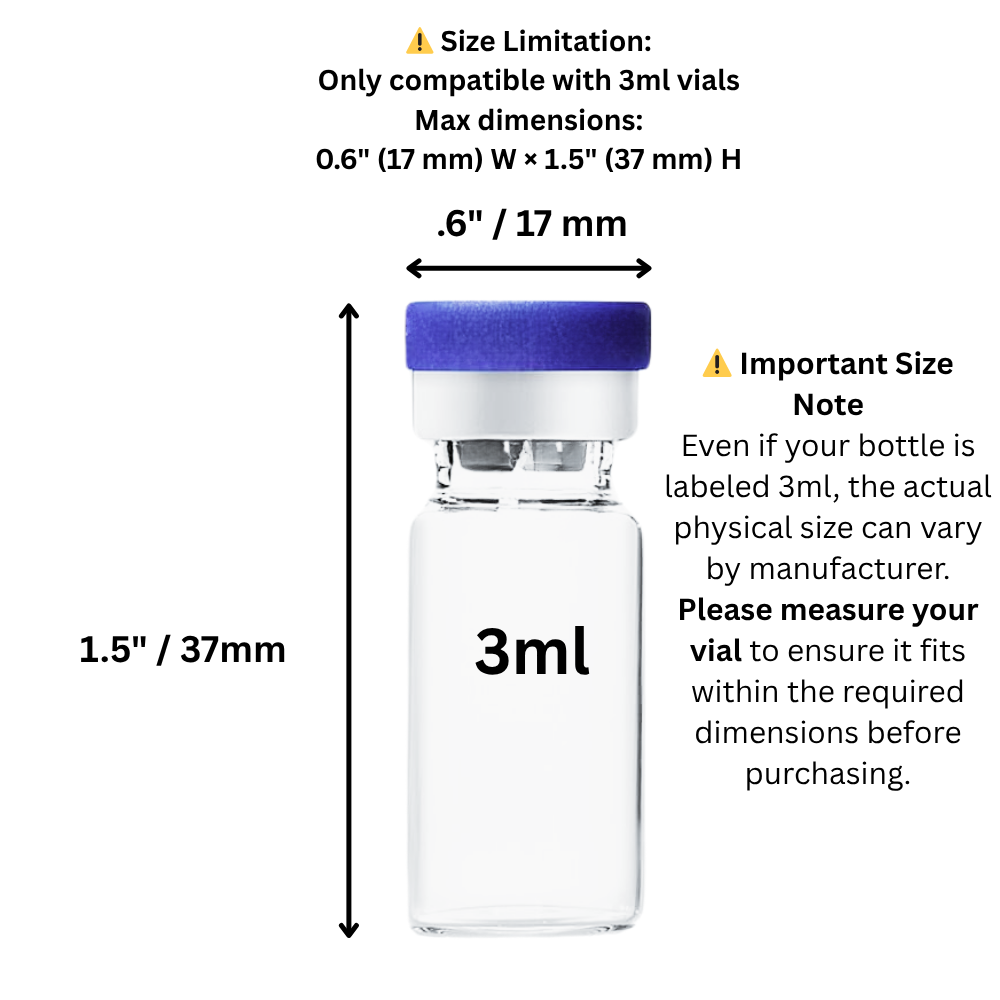
Custom snap-on caps for 3 mL or 10 mL vials, with a cap color plus an icon or letters. Sets from 25 caps.
#5 — Soft Insulin / Diabetic Supply Case
Designed for insulin vials, syringes, and lancets, these cases are closer to the TRT use case than most on this list. They have dedicated syringe pockets, vial slots, and a compact footprint. The main limitation is sizing: insulin vials are 10 mL but narrower than many testosterone vials. Plenty of diabetic supply cases won't comfortably fit a testosterone vial without force, and the syringe pockets are sized for insulin syringes, which are shorter than the syringes many TRT users carry.
#4 — Clear Hard-Shell Travel Case with Compartments
Hard-sided, compartmentalized, and travel-ready. The clear construction is the main drawback for long-term home storage: your vials are always on display and always in the light, and most labels advise keeping vials away from light. Clear cases are acceptable for travel where you're pulling the kit out briefly; not ideal for a permanent setup in the fridge or on a shelf.
#3 — Medical-Grade Injection Kit Case (Opaque)
Hard-shell, opaque, and specifically marketed for medication kits. Better organized than a generic hard case, with individual syringe slots and a dedicated vial pocket. The TRT-specific limitation is usually capacity: these cases are designed for one vial type, not someone keeping TRT alongside peptide vials or a GLP-1. If TRT is the only thing you store, this is a solid option.
#2 — Custom Foam-Fitted Pelican-Style Case
Cut your own foam to fit your exact vials, syringes, and accessories, and you have a near-perfect storage solution. The case handles drops, the foam stops vial movement, and an opaque shell keeps light out. The gaps: foam cutting is tedious to get right, and you lose flexibility when you switch vial sizes or add a second vial type. A properly executed DIY foam case is excellent; the execution is what most people get wrong.
#1 — Best: A Custom Case You Design Yourself (PeptideCase™ Builder)
Instead of cutting foam or forcing your vials into a case built for something else, you design the case around your kit. In the PeptideCase™ builder you add TRT vials (or 10 mL vials), syringes, alcohol pads and anything else you carry, and each item becomes fitted pockets or an open bay sized for exactly that many. The tallest item sets the case height, and shorter vials stand on a raised floor so every vial top lines up at the rim, easy to grab. Every storage space has a finger scoop.
It is a hard case with a print-in-place snap hinge and a locking latch, so it works on a shelf, in the fridge, or in a carry-on. TRT is long-term for most people, so a case built once around exactly what you keep saves the daily hunt for supplies. Design your TRT case in the builder.
Does Testosterone Need to Be Refrigerated?
It depends on the product, so follow the storage instructions on your product label or from your pharmacist or provider. Pharmacy and manufacturer labels differ, and they are the only reliable answer for your specific vial.
Whatever the label says, the case is a protective organizer, not a cooler. It does not keep anything cold. If your label says room temperature, the case keeps vials together on a shelf away from the bathroom. If it says refrigerate, the closed case sits on a fridge shelf and keeps the vials upright, separated, and out of the way of food and sliding jars.
Make your own custom TRT case
A TRT kit is the perfect job for a case you design yourself, because the supplies are predictable: one or two vials in use, a few spares, syringes and pads. In the builder you start with an empty case, tap "Add item" and choose TRT vials, 10 mL vials, syringes and alcohol pads (flat or standing), plus how many of each. If you also keep peptide vials or 3 mL vials, add them to the same case. Need room for something else? Add a custom space and type in its width, depth and height.
Auto-arrange packs everything into the most compact layout, and the builder shows the case length, width and height, what it holds, and a top view, a lid view and a 3D view you can open, unlatch and drag to turn. Choose Black or RGB Metallic, a Wide or Deep shape, and a single or dual latch. Add one or two lines of text, an icon or your own logo to the lid if you want it to stand out in a shared fridge. Your case is printed to order in the US, and the size shown is exactly what gets built.