
What to Look for in a Peptide Case
Before diving into specific cases, here are the five features that separate a real peptide case from a repurposed jewelry box:
- Light protection — many peptide and GLP-1 labels say to protect from light. An opaque, fully enclosed shell keeps vials in the dark every time the lid is shut.
- Crush resistance — glass vials are fragile. A hard-shell case withstands luggage compression, drops, and the general abuse of travel.
- Precise vial fit — slots sized for specific vial sizes keep vials upright, secure, and separated. Loose vials rattle, chip, and can break stoppers.
- Capacity — how many vials do you carry? A case that's too small forces you to leave vials loose; too big and you're hauling unnecessary bulk.
- Fridge fit — most vials live in the fridge between uses. Check the case's outside size against your fridge shelf before you buy, not after.
Skip the closest fit. Design the exact fit.
Add the vials, pens and syringes you carry, let Auto-arrange lay them out, and see the exact case size before you order.
The Lineup: Every Case Category Reviewed
Here's every common case category, starting with the one we now recommend first.
Top Pick: A Custom Case You Design Yourself (PeptideCase™ Builder)
Instead of picking the closest fixed layout and living with the empty slots, you design the case around what you carry. Start with an empty case, tap "Add item" and choose 3 mL vials, 10 mL vials, syringes, a BAC water bottle, a peptide or injector pen — and how many of each. Auto-arrange packs everything into the most compact layout, and the size shown is exactly what gets built.
Best for: any kit that doesn't match a standard layout — several vial sizes, pens plus vials, syringes alongside
Capacity: whatever you add — every item becomes fitted pockets or an open bay sized for that many
Pros: shorter vials stand on a raised floor so every vial top lines up at the rim; a finger scoop on every space; Black or RGB Metallic; Wide or Deep shape; single or dual latches; optional text, icon or logo printed into the lid
Cons: made to order and final sale (printing defects are still replaced), so count what you carry before you order
Starter Cases: 2-4 Slots
Perfect for one product or daily carry. If you keep a single vial — say one peptide vial plus a BAC water bottle — a compact 2-4 slot case is all you need.
Best for: GLP-1 pen users, beginners with one vial, gym bag carry
Capacity: 2-4 vials (3 mL or 10 mL depending on the model)
Pros: Ultra-portable, fits in a pocket or purse, an easy entry point
Cons: No room for growth. If you add a second vial type, you'll outgrow it immediately
Mid-Range Cases: 10-20 Slots
The sweet spot for most users. These cases handle several different vials with room for a BAC water bottle, backup vials, and often include syringe storage.
Best for: kits with several different vials (for example peptide vials plus a GLP-1), users who keep both active and backup vials
Capacity: 10-20 vials in two sizes
Pros: Enough capacity for most kits, organized zones for different vial sizes, often includes a syringe compartment
Cons: May not be enough for people who keep a larger home supply
Pro Tip: If you're unsure between a 10-slot and 20-slot case, go with the 20. Your collection will grow. Nobody regrets having extra capacity, but plenty of people outgrow their first case within months. Read our vial organization guide to plan your setup.
Pro Level: The Vial Vault Pro 56
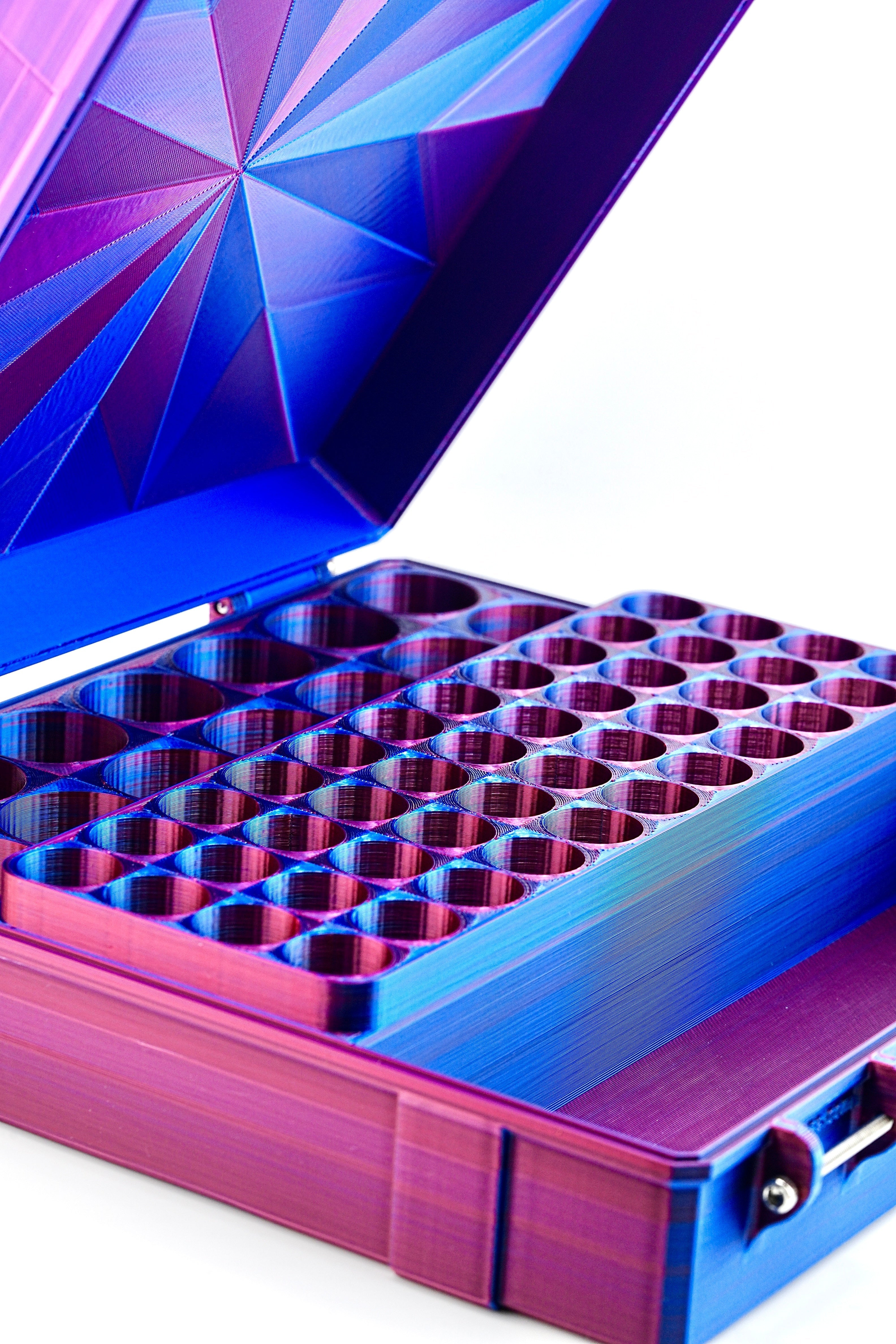
The flagship fixed layout. 56 slots for 3 mL and 10 mL vials, organized in labeled rows with a dedicated syringe section. Hard-shell construction, fully opaque.
Best for: people keeping several different vials, anyone organizing 20-50+ vials at home
Capacity: 56 vials in a 3 mL plus 10 mL configuration
Pros: Massive capacity without being unwieldy, solid build quality, labeled zones for organizing by vial
Cons: Too large for daily carry to the gym; a fixed layout, so if your kit doesn't match it, a custom case fits better
Bulk Storage: 50, 100, and 200+ Slots
For large home supplies, clinics, or households sharing one fridge. Individual cases won't cut it at this volume. Bulk storage uses modular inserts or several cases on a dedicated shelf.
Best for: large home supplies, med spas and clinics, multi-person households
Capacity: 50-200+ vials
Pros: Maximum capacity, modular design (add trays as needed)
Cons: Not portable; these are home storage solutions. Pair with a smaller travel case for trips
Travel Cases: Hard-Shell for Flights and Road Trips
This is a critical category. If you fly with peptides, drive long distances, or even just commute to the office, you need a case that's built for transit.
What makes a travel case different:
- Impact-rated shell — survives being dropped, squeezed in an overhead bin, or knocked around in a bag (always carry on, but still)
- Secure latching — won't pop open in your bag
- TSA-friendly — organized, labeled vials make screening simpler. A bag of loose vials and syringes raises questions; a purpose-built case answers them
- Cold pack compatible — small enough to sit in a cooler or insulated bag with a cold pack on longer trips
- Paperwork alongside — keep pharmacy labels on your vials and your prescription or provider letter with the case
Pro Tip: For international trips, keep medication in its original labeled packaging where you can, carry your prescription or provider letter, keep everything in your carry-on, and check the airline's and destination's current rules yourself before you go.
Accessories Worth Adding
Beyond the case itself, a few accessories round out a complete storage system:
- Colored vial caps — caps in different colors give you instant identification at a glance. Essential when you keep several different vials
- Syringe storage — syringes belong in their own trough next to your vials, organized and separated, not loose in the bag
- BAC water bottle bay — bottles are larger than peptide vials and need a wider space. Some cases include a dedicated bay
- Cold packs — gel packs for travel inside a cooler or insulated bag. Not loose ice (melt water and soggy labels)
- Labels — write what's in each vial and the date you opened it, so nothing depends on memory
Color-code your vials
Custom snap-on caps for 3 mL or 10 mL vials, with a cap color plus an icon or letters. Sets from 25 caps.
Which Case Is Right for You? The Decision Tree
Answer these three questions and you'll know exactly what you need:
1. How many vials do you have?
- 1-4 vials: Starter case (2-4 slot)
- 5-15 vials: Mid-range case (10-20 slot)
- 16-50 vials: Vial Vault Pro 56
- 50+ vials: Bulk storage system (modular inserts or multiple cases)
- Any number, unusual combination: a custom case built around exactly what you carry
2. What sizes are your vials?
- All 3 mL: Dedicated 3 mL case for the tightest fit
- All 10 mL: 10 mL-specific case
- Both sizes (most common): Case with dual-size zones — or a custom case where each size gets fitted pockets and shorter vials stand on a raised floor so every top lines up
3. Do you travel with your vials?
- No travel (fridge only): Any case works; prioritize capacity, organization and fit on your shelf
- Domestic flights: Hard-shell travel case, TSA-friendly design
- International trips: Hard-shell travel case that fits inside a cooler with ice packs, professional appearance, room for prescriptions and documentation
- Daily carry (gym, office): Compact starter or mid-range case that fits in a bag
Value Comparison: What to Expect
Case prices move around too much to list, but the pattern between tiers holds:
- Starter (2-4 slot): lowest upfront cost, highest cost per slot
- Mid-range (10-20 slot): moderate upfront cost, better cost per slot
- Pro (Vial Vault Pro 56): higher upfront cost, far lower cost per slot
- Bulk storage (50-200 slot): lowest cost per vial stored, home use only
- Accessories (caps, cold packs, labels): small add-ons
Consider cost per slot when comparing. Larger cases are almost always a better value per vial stored. A custom case adds another angle: no empty slots, because every space is sized for something you added.
Make Your Own Custom Peptide Case
Every category above is a compromise: a fixed number of fixed-size slots, chosen by someone who has never seen your kit. The PeptideCase™ builder flips that. Start with an empty case, tap "Add item" and pick what you carry — 3 mL vials, 10 mL vials, peptide vials, TRT vials, other size vials, syringes, alcohol pads, a BAC water bottle, a peptide pen, injector pen or pen cartridges — and how many. Need room for something odd? Add a custom space and type its width, depth and height.
Auto-arrange packs it all into the most compact layout, and you can check the top view, the lid view and a 3D view you can drag to turn, open or closed. Choose Black or RGB Metallic, a Wide or Deep shape, one latch or two, and optionally print one or two lines of text, an icon or your own logo into the lid in a second color. Each case is printed to order on the maker's own print farm in the US, exactly the size the builder shows.
The Bottom Line
The "best" peptide case is the one that fits your current collection, accommodates growth, and handles your lifestyle — whether that's a quiet fridge at home or a monthly flight.
If you're just starting out, a mid-range 10-20 slot case gives you room to grow. If your kit is already varied — several vial sizes, pens, syringes — a case you design yourself means nothing rattles in a slot made for something else.
For the full rundown on choosing and using a case, read our complete guide to peptide cases and our fridge organization guide.
Supplies referenced in this article: gel ice packs