
One of the biggest complaints from people who keep GLP-1, TRT and peptide vials together is that the storage situation gets bulky fast. A GLP-1 vial, a testosterone vial, a few peptide vials, syringes, a BAC water bottle and alcohol pads, and before you know it you are hauling what feels like a small pharmacy.
It doesn't have to be that way. A case built around the actual dimensions of your vials collapses all of that into something that fits cleanly inside a gym bag, a briefcase or a carry-on. Here is how to get there.
Design a compact case for your daily carry
Add only what you carry, let Auto-arrange shrink the layout, and check the exact size against your bag before you order.
The Bulk Problem With Multi-Vial Carry
Ask anyone carrying GLP-1, TRT and peptide vials what their biggest day-to-day frustration is, and "carrying all this stuff" comes up constantly. The problem isn't just inconvenience. Most people solve the size problem in ways that create new storage problems.
The common workarounds: a zip bag stuffed into a gym bag (no light protection, no impact protection, everything rattles), a makeup or toiletry bag (soft-sided, crushable and still too big), or leaving everything in the fridge at home. None of these are real solutions.
The bulk usually comes from the wrong container, not from having too much gear. A kit that needs a medium-sized bag when packed loosely can fit into a case the size of a hardcover book when every item has a fitted spot. The difference is pockets sized to each vial, a tight layout and no dead space.
The core insight: Bulk isn't caused by having too many vials. It's caused by cases and bags that aren't designed around the real dimensions of vials and syringes. A case built for your exact kit removes the dead space and shrinks the footprint.
What You Actually Need to Carry Every Day
Before solving the size problem, be precise about what you actually carry on a given day. For most people with a combined kit, the list looks something like this:
- GLP-1 vial or pen: often a 3 mL or 10 mL vial, or a pen. It may not travel every day, but it needs a spot.
- Testosterone vial: usually a 10 mL multi-use vial, and usually the tallest single item in the kit.
- Peptide vials: small vials, most often 3 mL, and often two to four of them.
- BAC water bottle: wider and taller than a small vial, so it needs its own spot.
- Syringes: sometimes in two sizes, which should stay apart.
- Alcohol pads: a handful of individually wrapped pads.
- Sharps disposal: a small travel sharps container if you will be away from home; it stays a separate item, not loose in the case.
That's the real list. When you map those items against their actual size (small vials are a few centimeters tall, syringes are longer than any vial), the total footprint is much smaller than most improvised setups suggest.
Slim vs. Standard Cases: What You Give Up and What You Keep
There is a real trade-off between compact and standard-sized cases. Here is what actually changes when you go slim.
What you keep in a compact case:
- Hard-shell protection. A well-made small case is still rigid and crush-resistant.
- Light protection. A closed, solid shell keeps vials in the dark at any size.
- Fitted vial pockets. A good compact case still holds 3 mL and 10 mL vials side by side.
- Syringe storage. A trough for syringes fits even in a small layout.
- An easy security check. A tidy small case of labeled vials is simple to show if you are asked.
What you give up in a compact case:
- Raw capacity. A slim case usually holds 4 to 8 vials versus 10 to 20 in a full-size case.
- Room for extras. Gel packs, spare supplies and backup syringes take space.
- Room to grow. If your kit expands, you may outgrow the case.
For most people with a GLP-1 + TRT + peptide kit, 4 to 8 vials is exactly right. You are carrying a handful of vials plus supplies, not a whole fridge shelf, and a compact case handles that with room to spare.
Size reality check: Measure your actual vials before choosing a case. A 10 mL testosterone vial is much taller than a 3 mL vial, so make sure the case is deep enough for it. Some "compact" cases are sized only for 3 mL vials and leave you without a spot for your TRT vial.
The Anatomy of a Compact Carry Case
Not all compact cases are built the same. Knowing what separates a case built for vials from a repurposed cosmetic case or a generic hard box helps you choose right the first time.
Shell construction: look for a rigid shell that does not flex when you squeeze it. Soft-sided "hard cases" defeat the purpose; if the shell bends, so does the pressure on the glass inside.
Pocket design: fitted pockets are the single biggest difference. A proper pocket holds a vial snugly without rattling, and each vial type (3 mL, 10 mL, the BAC water bottle) should have a spot sized for it. Generic inserts you have to cut or stuff lead to vials shifting in transit.
Layout: the best compact cases put vials standing upright with syringes and pads in their own spaces beside them, so nothing is stacked on top of the glass and the footprint stays small.
Closure system: a latch that locks keeps the case shut when it gets squeezed in a bag. If the case will ride in a gym bag or backpack with other gear on top of it, two latches are better than one.
Condensation: if you pack the case into a cooler with a cold pack, wrap the pack in a cloth. Condensation makes paper labels peel and marker ink run, so waterproof labels are worth it.
Fitting Your Kit Into a Small Footprint
The goal is to carry less without leaving behind anything you need. Here is a practical layout for a GLP-1 + TRT + two-peptide kit in a compact case:
- Pocket 1: GLP-1 vial, in the center for easy access.
- Pocket 2: testosterone vial (10 mL), the tallest item, which sets the case height.
- Pocket 3: peptide vial number one, front left.
- Pocket 4: peptide vial number two, front right.
- Bay 5: BAC water bottle in its own spot.
- Supply spaces: a syringe trough and a bay for alcohol pads.
That's a complete kit in a case roughly the size of a paperback, smaller than the front pocket of most laptop bags. The key is starting from a layout rather than trying to cram things in after the fact.
If your kit has more than five vials, consider which ones actually need to travel with you and which stay home. Most people only need to carry the vials they will use while they are out. A four-vial travel case next to a larger home case is a completely valid approach.
The Gym Bag Test: Will It Fit?
The gym bag is the toughest compact carry test. Shoes, a water bottle, a change of clothes, a shaker cup, headphones: anything you add has to survive being squeezed, tossed and occasionally dropped.
Here is what a compact case needs to pass the gym bag test:
- A small exterior: most gym bags have a side compartment roughly the size of a paperback. A case bigger than that competes with your shoes in the main compartment.
- Latches that hold: when a water bottle lands on the case, a weak latch pops. Locking latches, or two of them, hold.
- Pockets that lock vials in place: vials clinking inside a case are a noise problem and a broken-glass problem. Fitted pockets fix both.
- Easy to grab: a case you can pull out and open in one motion saves time and reduces drops.
The practical gym scenario: the case comes out of your bag, the latch clicks open, the vial you need is in its usual pocket, it goes back, the case closes. A disorganized bag-within-a-bag setup easily triples that time, and friction is exactly what makes people leave things behind.
Gym bag tip: Keep the case in the same compartment every single time. A fixed spot means you reach for it without searching, which helps most when you are tired after a workout.
Office and Commute Carry: The Professional Case Setup
Carrying vials to work adds a discretion requirement that the gym doesn't have. A compact case solves this, but only if it looks like an ordinary accessory rather than a medical kit.
The cases that work best for office carry look like a pen case, a tech accessory case or a toiletry kit. A matte black shell is ideal. Skip anything with medical crosses or pill graphics if you would rather not invite questions; a plain lid, or one with your own initials, reads as personal gear.
For desk-drawer storage during the day, the case needs to fit a standard desk drawer, and a thinner case slides in without catching. Measure before you commit if that matters to you.
Commute carry, whether a briefcase, laptop bag or backpack, has similar size needs but different forces. Structured bags move less, but they get stacked, set down hard and sent through bag scanners at office security. A plain hard case goes through without a second look.
If a label says to keep a vial refrigerated, the case itself will not do that: it is a protective organizer, not a cooler. Use the office fridge, or put the case in a small insulated lunch bag with a cold pack for the commute, and follow the storage instructions on your product label or from your pharmacist or provider.
Travel Carry: When Compact Matters Most
Travel is where a compact case earns its keep. Every extra inch becomes a real problem when you are moving through airports, hotel rooms and rental cars.
The order of preference for packing: personal item, then carry-on, never checked luggage. Your vials should ride in the bag that goes under the seat in front of you. It stays with you the whole flight, it never sits in a cargo hold, and it doesn't get lost. A compact case that fits the front pocket of a personal item is the ideal form factor.
Security screening makes a lot of people nervous. Officers see insulin kits and medical supplies all the time, and an organized case of labeled vials is easy to show and easy to explain; a zip bag of loose vials is not. Check TSA's current rules for medical items before you fly, keep medication in its original labeled packaging where you can, and see our guide to flying with vials.
For international trips, the same logic applies: a tidy case is easier to present than a loose collection of vials and syringes. Keep your prescriptions or a letter from your prescriber in an easy-to-reach pocket of your bag, and check your destination's current rules yourself before you go.
Hotel storage is simple with a compact case. If a label says refrigerate, the case goes straight into the in-room fridge; its small footprint doesn't take over the shelf, and the hard shell keeps vials from being knocked around if housekeeping opens the door. A name label on the outside is a sensible precaution.
Travel cold chain tip: If any vial should stay cold, pack the case inside a small cooler with a slim gel pack, and freeze the pack the night before so it starts as cold as possible. The case keeps everything still and together; the cooler does the cooling.
Design your own custom compact carry case
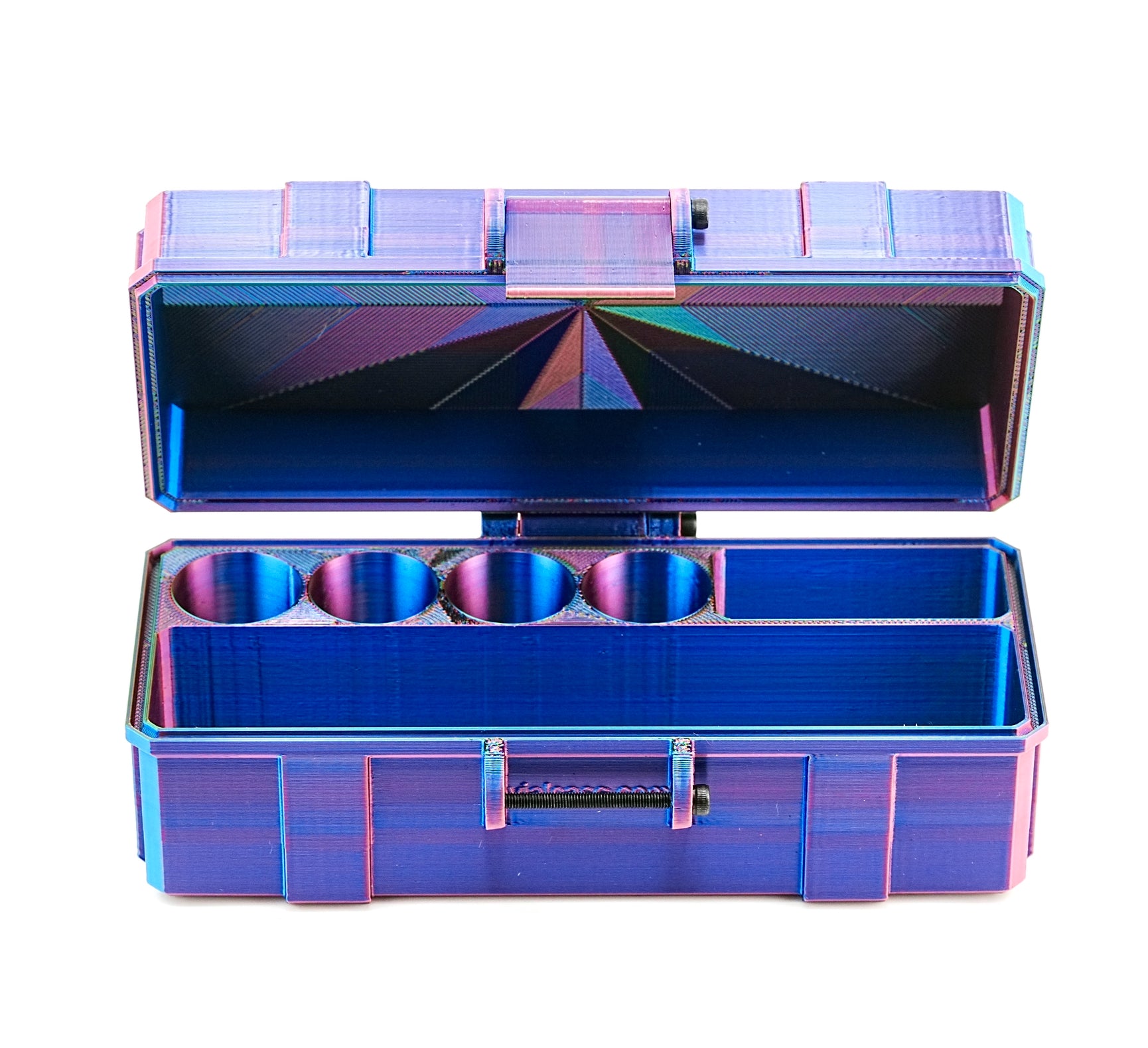
Most compact cases are a guess: a fixed grid that fits someone else's kit. The PeptideCase™ builder flips that. Start with an empty case, tap "Add item" and choose exactly what you carry: one 10 mL TRT vial, one GLP-1 vial or pen, two 3 mL peptide vials, a BAC water bottle, syringes and alcohol pads. Each item becomes fitted pockets or an open bay sized for that count, with a finger scoop in every space.
Auto-arrange packs it into the most compact layout, and the builder shows the case length, width and height before you order, so you can check it against your gym bag or desk drawer. The tallest item sets the height and shorter vials stand on a raised floor, so every vial top lines up at the rim.
Pick Black for a low-key office look or RGB Metallic, choose a Wide or Deep shape, and go with dual latches if the case will ride under other gear. Printed to order in the US, at exactly the size shown. Build your compact case