
Why "Best" Depends on What You Carry
Ask a forum which peptide case is best and you'll get ten different answers, because everyone carries something different. Someone with a single GLP-1 vial needs maybe four spots and a compact profile that fits in a purse. Someone keeping five or six different vials needs twenty or more spots, clear organization, and room for syringes and alcohol pads.
Choosing on size alone is the wrong frame. The right frame is: what do I actually keep today, and what will I keep in six months? Kits tend to grow, so leave a little room rather than buying a case you'll outgrow next month.
That said, a huge case for one vial is just bulk. The goal is a case matched to your reality: organized, compact for the load it carries, and tough enough for daily use or travel. That's what this guide helps you find.
Skip the slot-count compromise
Add the exact vials and supplies you carry. The builder makes a hard case with a fitted pocket for each one, in the most compact layout.
What Every Great Peptide Case Must Have
Before getting into specific options, here are six features every serious peptide case needs. A case that fails on any one of them is the wrong case.
1. Hard Shell Construction
Soft pouches and zipper bags offer zero crush protection. Glass vials don't survive being squeezed by a laptop, sat on in a bag or tossed in an overhead bin. A rigid hard shell is the baseline for any case you carry or travel with. It isn't a premium feature; it's the floor.
2. Fully Opaque Walls
Many product labels say to protect vials from light. Clear cases look nice on a shelf but work against that. When the case is closed, the inside should see no light at all: opaque all the way around, not just on top.
3. Vial-Specific Slots
A foam insert with round cutouts isn't a slot. A real peptide case holds each vial upright and separated in a pocket sized for it. Vials that rattle together chip glass, knock off caps and get swapped when your labels aren't perfect. Snug, separate slots prevent all of that.
4. Correct Fit for 3 mL and 10 mL Vials
The two most common vial sizes are 3 mL and 10 mL, and they are not interchangeable. A 10 mL vial won't fit a 3 mL slot, and a 3 mL vial in a 10 mL slot rattles and tips. Know your vials and buy a case matched to them, or one with slots for both if you use both.
5. Secure, Positive-Click Latch
A case that pops open in your bag has failed at its most basic job. The latch should close with a positive click, resist accidental opening, and stay shut under the pressure a bag takes on a commute or a flight. Magnetic closures and friction-fit lids aren't good enough for glass vials.
6. Compact Enough to Actually Use
A case you leave at home because it's too bulky is useless. The best case fits your routine: gym bag, travel bag, fridge shelf. Capacity is valuable right up to the point where the case stops going with you.
The Best Peptide Cases in 2026, Ranked by Use Case
Best Overall: A Custom Case You Design Yourself (PeptideCase™ Builder)
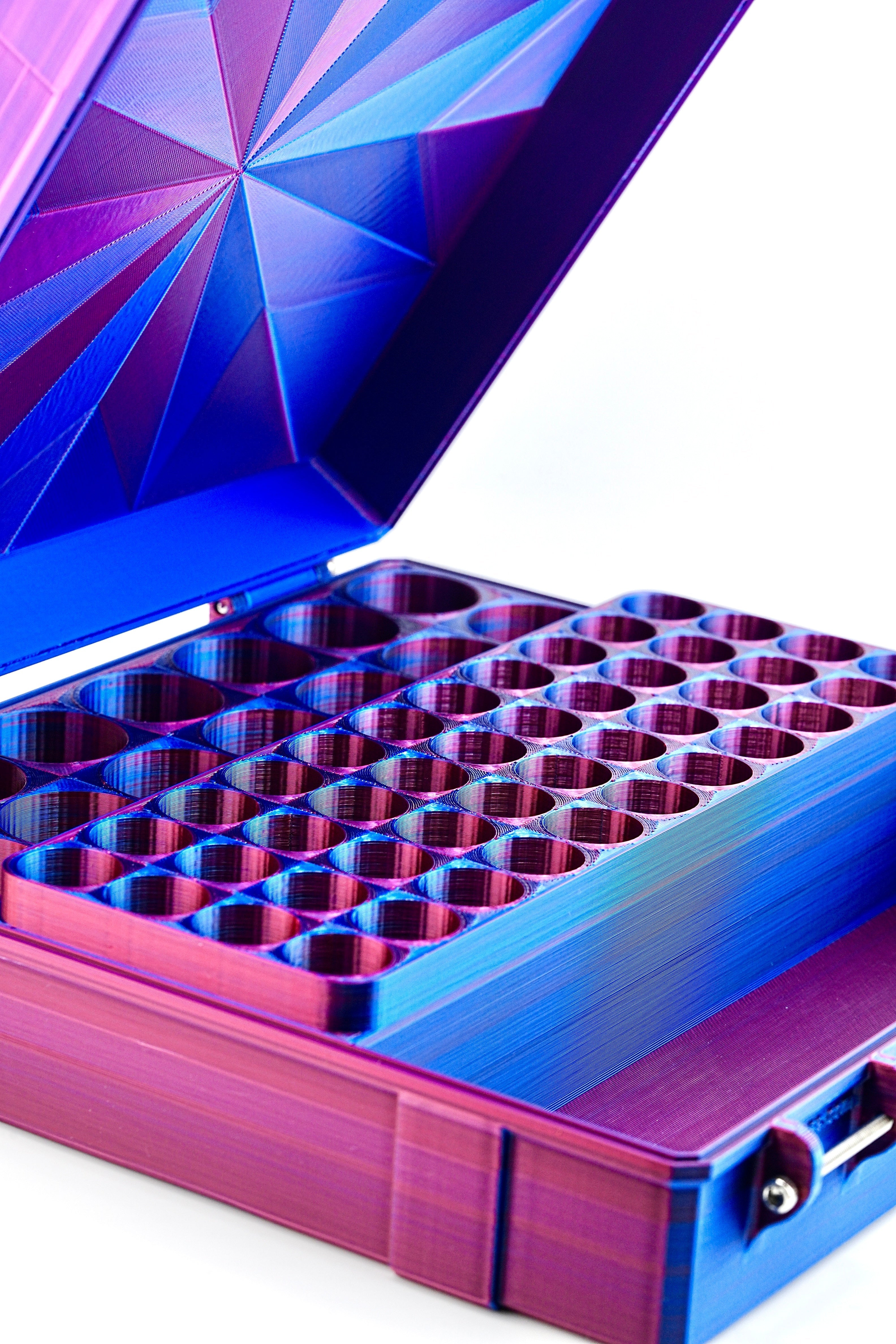
Every ready-made case below is a compromise: a fixed number of slots in one vial size, with or without a supply compartment. A custom case skips the compromise. In the PeptideCase™ builder you start with an empty case, tap "Add item," and pick exactly what you carry and how many: 3 mL vials, 10 mL vials, other size vials, syringes, alcohol pads, a BAC water bottle, pens or pen cartridges. Each item becomes fitted pockets or an open bay sized for that many, and Auto-arrange packs it all into the most compact layout.
It ticks all six boxes above: a hard shell, fitted pockets for 3 mL and 10 mL vials side by side in one case, a locking latch on a print-in-place snap hinge, and a size you see before you order. Shorter vials stand on a raised floor so every top lines up at the rim.
Best for: anyone whose kit doesn't match a standard slot count, anyone who keeps both 3 mL and 10 mL vials, and anyone who wants the smallest case that holds everything.
What it doesn't do: It isn't a cooler, and it's made to order rather than pulled off a shelf.
Best for Beginners / 1-2 Vials: A 10-Slot Compact 3 mL Case
If you're just getting started with one or two vials, a compact 10-slot case for 3 mL vials is a sensible entry point. Ten slots sounds like more than a beginner needs, but kits grow, and this size handles that without a replacement.
The compact footprint keeps it portable; it slips into a gym bag or purse without adding real bulk. Look for a hard shell, an opaque interior and slots molded for 3 mL vials.
Best for: first-time users, GLP-1 pen users who keep one or two backup vials, anyone easing into proper storage.
What it doesn't do: 10 mL vials won't fit, and there's usually no syringe compartment. If you already keep three or more different vials, start a step up.
Best for a GLP-1 Kit: A 10-Slot Case with Extra Storage
GLP-1 kits have specific needs: typically one or two vials, a few backups, and enough organized space to keep supplies labeled and together. A 10-slot case with an extra storage compartment covers that: room for current and backup vials, plus a compartment sized for alcohol pad packets and small accessories, so the kit stays self-contained.
Best for: anyone keeping a single GLP-1 vial plus backups who wants organized storage without extra bulk.
What it doesn't do: Not ideal if you keep several other vials alongside the GLP-1. At that point you want an all-in-one.
Best All-in-One: A 12-Slot Case with Syringe and Pad Compartments
This is the format most people with several vials end up on: twelve 3 mL vial slots plus dedicated compartments for syringes and alcohol pads. Everything lives in one organized hard-shell case.
The design is deliberately self-contained. You're not pulling vials from one case, syringes from a pouch and alcohol pads from a bathroom drawer. Open one case, take what you need, close it, put it back. It's also a strong travel option, since everything TSA needs to see is organized in a single container.
Best for: people keeping 3-8 different vials, anyone traveling with their kit, people who want all their supplies in one place.
What it doesn't do: The slots are sized for 3 mL vials. If you also keep 10 mL vials, they need separate storage.
Best for 10 mL Vials (GLP-1 / TRT): A 13-Slot 10 mL Case
If your kit centers on 10 mL vials, such as GLP-1 or TRT vials, standard 3 mL cases won't work. A 13-slot case built for the larger format holds your main vials, several backups and still leaves spare slots, and an extra compartment handles syringes and accessories. Larger vials are heavier, which makes a solid hard shell even more important.
Best for: GLP-1 and TRT users whose vials are 10 mL, and anyone whose main vial format is 10 mL.
What it doesn't do: 3 mL vials sit loose in 10 mL slots. It's a dedicated 10 mL case, not a universal one.
Best for Large Kits: A 20-Slot Case with Syringe Storage
Twenty vial slots is serious capacity. This format suits people keeping eight or more different vials, people who store active and backup vials together, or anyone who likes to reorder less often. A syringe compartment runs alongside the vial section, so supplies stay with the vials.
Best for: large kits, people who keep reserves in the same case, frequent travelers with a lot to carry.
What it doesn't do: It's bigger than the compact options, so it's less suited to minimalist daily carry if you only keep one or two vials.
Pro tip: The best peptide case is the one you use every day. A generic case that leaves vials rattling loose defeats the purpose. A case built for your vials costs far less than replacing a broken one, and it protects every vial after that.
Color-code your vials
Custom snap-on caps for 3 mL or 10 mL vials, with a cap color plus an icon or letters. Sets from 25 caps.
What We Looked for in Each Case
Every case here is judged on the same four criteria:
Drop Protection
A hard-shell case should survive a drop from counter height without cracking or letting vials shift enough to break. We look at wall thickness, latch security and how snugly each slot holds its vial. A vial held firmly in a fitted slot takes far less of the impact than a vial loose in a foam-lined box.
Light Blocking
Close the case and look for light leaks, especially around the latch and hinge. A case with visible light coming through fails. This rules out many "vial cases" sold online, which use translucent or semi-opaque shells.
Slot Security
Vials should take a deliberate pull to remove but come out cleanly. Turn a loaded case upside down: vials should stay put. Slots that drop vials when tilted are disqualifying; slots so tight they risk chipping the glass rim are not ideal either. The sweet spot is firm hold without force.
Value
Cost per slot is the most honest way to compare cases of different sizes: a bigger case with many slots can be better value than a small one with few. We also weigh build quality and extras such as syringe storage and supply compartments.
Cases to Avoid
The vial storage market has plenty of products that don't do the job. Steer clear of these:
Generic Cases with Wrong Slot Sizes
The most common failure. A case labeled "vial storage" with foam inserts or generic round cutouts won't hold 3 mL or 10 mL vials correctly. The slots are either too wide (vials tip and rattle) or too narrow (vials stick, risking a chipped rim on removal).
Soft Zipper Pouches
Zero crush protection. Anything else in the bag presses against the pouch and the vials inside. Glass breaks. Many pouches also have translucent panels. A soft pouch is only acceptable as an outer layer around a hard case, never as the main container.
Medication Travel Bags
These are designed for pens and pre-filled syringes, not loose vials. The inside is usually laid out for pen-shaped items, so 3 mL vials end up lying loose. The insulation can also give a false sense of security: without a cold pack, insulation only slows warming. Use a cooler bag with ice packs for temperature, and a hard case inside it for protection.
3 mL vs. 10 mL: Matching Your Case to Your Vials
Understanding vial size conventions is essential to buying the right case. The short version:
3 mL vials are the most common small vial format, and the size most ready-made peptide cases are built around.
10 mL vials are common for GLP-1 vials and TRT vials. They are noticeably taller and wider than 3 mL vials and need correspondingly larger slots.
If you only use 10 mL vials, buy a 10 mL case. If you only use 3 mL vials, buy any 3 mL case that matches your volume. If you use both, you need either two cases or a case with slots for both sizes, which is exactly what a custom case makes easy.
Our complete guide to peptide cases goes deeper if you want the full breakdown.
How Long Should a Peptide Case Last?
A well-made case should last years of daily use, not months. The parts that wear first are predictable: the latch (from opening and closing), the slot grip (from taking vials in and out) and the hinge (from daily flexing). Cases with mechanical latches that click positively outlast friction and magnetic closures.
Look for a solid hinge and latch above everything else. Custom cases from the PeptideCase™ builder use a print-in-place snap hinge and locking latch, and big cases get a 5-knuckle hinge and two latches. They are made to order and final sale, but printing defects are still replaced.
Design your own custom peptide case
If none of the slot counts above match your kit, build the case around it instead. Open the PeptideCase™ builder, start with an empty case and tap "Add item": choose 3 mL or 10 mL vials, peptide vials, TRT vials, glutathione vials, other size vials, syringes, alcohol pads (flat or standing), a BAC water bottle, a peptide pen, pen cartridges, or a custom space you size yourself. Each item becomes fitted pockets or an open bay sized for that many, with a finger scoop in every space.
Auto-arrange finds the most compact layout. The builder shows the case size, height and what it holds, with top, lid and 3D views. Choose Black or RGB Metallic, a wide or deep shape, and single or dual latches, and add a lid design with text, an icon or your own logo in a second color. It's printed to order in the US, and the size shown is exactly what gets built.
The Bottom Line
Here's the decision tree in plain terms: if your kit doesn't fit a standard slot count, or you use more than one vial size, design a custom case. One or two 3 mL vials: a 10-slot compact case. A GLP-1 kit: a 10-slot case with extra storage, or a 13-slot 10 mL case if your vials are 10 mL. Several different vials: a 12-slot all-in-one. Eight or more: a 20-slot case with syringe storage.
The most common regret is waiting too long to get a proper case, not getting one too soon. Pick the one that fits what you carry today, with a little room to grow.