
You're on the Right Site
If you searched for "peptide cases" or "peptidecase" and landed here — you're in the right place. PeptideCase.com is the home of the PeptideCase™ custom case builder: you design a hard-shell case around the vials, pens and supplies you actually carry, and it's 3D printed to order in the US.
The vial storage market has grown fast alongside GLP-1s, peptides and TRT. With that growth has come confusion — dozens of generic vial cases flooding Amazon, a handful of look-alike websites with similar spellings, and plenty of advice that has nothing to do with the vials you own. This guide cuts through it.
By the end, you'll know exactly what a proper peptide case needs to do, what separates a purpose-built case from a generic pill organizer, and how to get a case that fits your kit instead of the other way around.
Get a case that fits your kit
Start empty, add the vials, pens and syringes you carry, and the builder lays out a hard case sized exactly for them.
Why Peptides Need a Dedicated Storage Case
Peptide and GLP-1 vials are small, glass and easy to lose track of. A case doesn't change what's in them — it changes what happens to them. The three things a case has to handle are:
- Temperature: Many vials and pens carry a refrigerate instruction. Follow the storage instructions on your product label or from your pharmacist or provider. A hard case is a protective organizer, not a cooler — it sits in the fridge at home and inside a cooler with ice packs when you travel.
- Light: Plenty of labels also say to protect from light. Amber vials help, but an opaque case that closes fully keeps every vial in the dark, including every time the fridge door opens.
- Physical damage: Most vials are glass. A single drop can shatter one, and glass-to-glass contact in a bag cracks vials and damages stoppers.
A purpose-built peptide case solves the last two outright and makes the first easy: it keeps the lid shut on the light, cradles each vial in its own slot so nothing moves, and fits neatly on a fridge shelf or inside a cooler.
Key Insight: Most vial breakage doesn't happen in the fridge — it happens in transit. Between the pharmacy, the gym bag and the carry-on, your vials take real knocks every day. A dedicated case is the single biggest quality-of-life upgrade for anyone who carries vials regularly.
The 5 Things Every Peptide Case Must Have
Before we get to recommendations, here's the non-negotiable checklist. Any peptide case worth buying should hit all five:
1. Hard Shell Construction
Soft pouches, silicone sleeves, and padded bags do not protect glass vials from impact. If you drop a soft case, you drop your vials. A hard shell absorbs and spreads impact force, protecting the vials inside even from significant drops. This is non-negotiable if you're carrying vials anywhere.
2. Fitted Vial Slots
Each vial needs its own dedicated slot. A fitted pocket holds the vial upright, stops it sliding sideways, and prevents glass-to-glass contact. Slots made for 3 mL or 10 mL vials specifically (as opposed to one-size-fits-all compartments) also stop vials rattling — which matters more than most people realize when you're running through an airport or driving rough roads.
3. Complete Light Blocking
When the case is closed, no light should reach your vials. That means opaque walls and a secure latch that keeps the lid fully shut. Cases with mesh windows, clear panels, or loose lids fail this requirement.
4. Proper Sizing for Peptide Vials
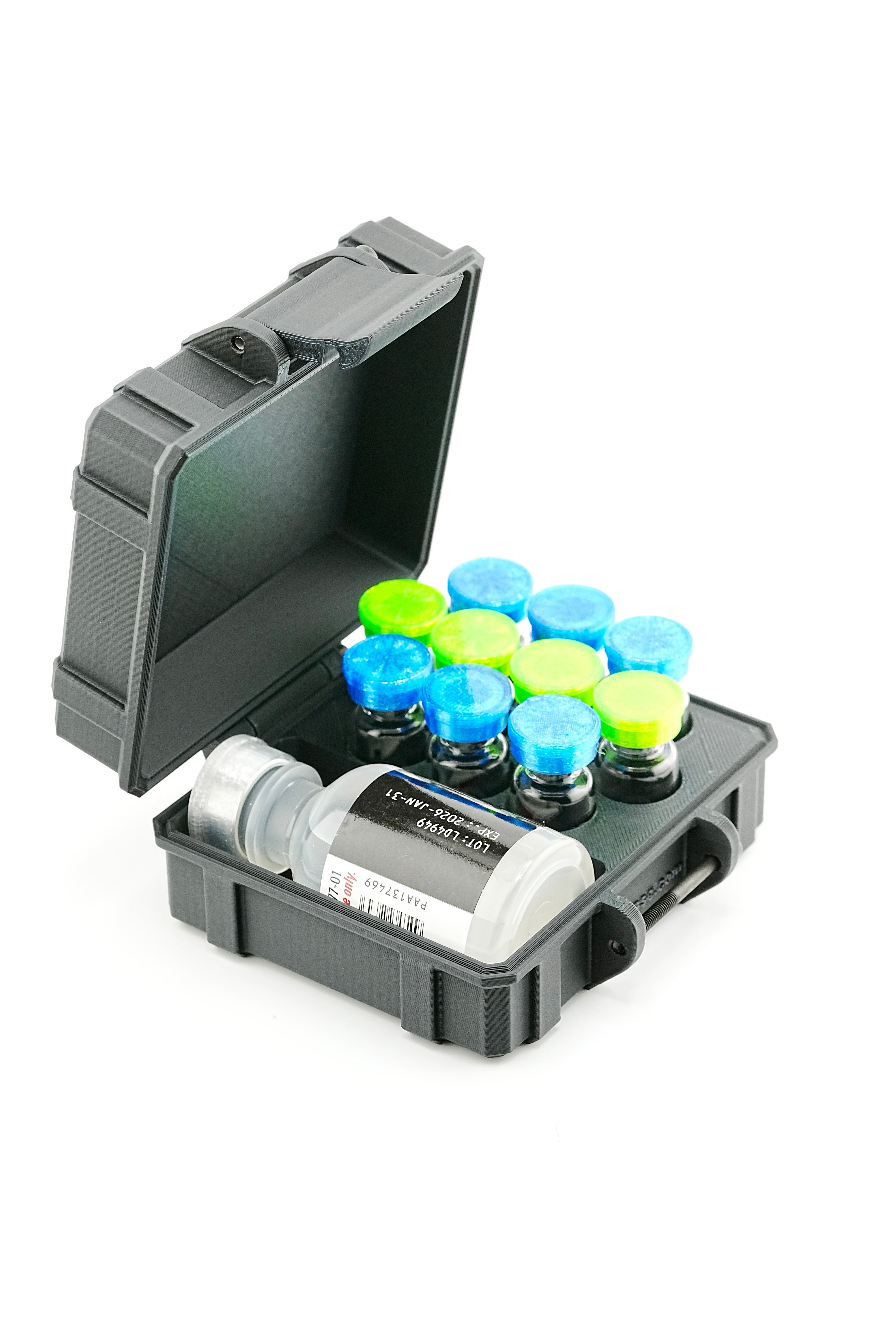
Common peptide vials are 3 mL (roughly 45 mm tall and 13 mm across). Larger bottles, like a BAC water bottle, are often 10 mL (roughly 56 mm tall and 23 mm across). These are not the same dimensions as insulin vials, supplement bottles, or most lab equipment. A case designed generically for "vials" may be too loose (vials rattle) or too tight (slots that squeeze the stopper). The best peptide cases are sized for the exact vials you carry.
5. TSA-Friendly Profile
If you travel with vials — and most people do, at some point — your case will go through airport screening. An organized, professional-looking hard case with labeled vials sends a very different signal than a zip bag of loose glass. Clear organization makes screening simpler, at home and abroad.
What to Avoid: Common Peptide Case Mistakes
The market is full of options that look like they'll work but fall short in practice. Here's what to avoid:
Generic Fishing Tackle or Art Supply Cases
You'll find plenty of forum advice suggesting "just use a fishing lure case" or a cheap craft organizer. These have clear lids (no light protection), no padding (just empty plastic compartments), and flimsy hinges that don't survive travel. They also look nothing like a medical storage case, which matters at airport security.
Silicone Vial Sleeves
Silicone sleeves protect individual vials from casual contact but provide zero structural protection from drops, no light blocking once the vial is out of a case, and no way to carry several vials safely together. They're an add-on to a real case, not a replacement.
Repurposed Pill Cases
Standard pill organizers are designed for tablets, not glass vials. The compartments are the wrong size, there's nothing to absorb impact, and most are not light-tight. Syringes don't belong in them either — they need a trough of their own.
Expecting a Case to Keep Things Cold
A hard-shell case on its own will warm up to the temperature of your bag. If your label calls for refrigeration and you'll be away from a fridge for hours, put the case inside a cooler or insulated bag with a gel pack, and check your product label for how long it may be kept out of the fridge.
Pro Tip: For trips, the standard setup used by experienced travelers is a hard-shell case, a small cooler with a gel cold pack, and printed documentation (prescription or pharmacy label). See our TSA travel guide for specifics.
Peptide Cases by Use Case: Which Type Do You Need?
Not everyone has the same needs. Here's how to match a case to your situation:
Home Storage Only
If you never travel with your vials and only need a case to keep them organized and protected in your fridge, a standard hard-shell case is ideal. The priorities are light blocking when the fridge door opens, slots that keep vials from tipping, and a latch that stays shut. Look for a case that fits on a standard refrigerator shelf without taking up excessive space — see our fridge organization guide.
Daily Carry / Gym Use
If you carry vials to the gym or the office, you need maximum impact protection in a compact size. A case that holds 4-6 vials with a secure latch is ideal, and it should be slim enough for a gym bag side pocket.
Travel (Domestic Flight)
For domestic flights, the priorities are screening and protection. A hard-shell case with a professional appearance, organized slots, and room for your syringes alongside your vials covers all bases. Keep medication in your carry-on, and pair the case with a cooler and gel cold pack for longer travel days.
Travel (International)
International trips call for the most robust setup: a secure latch, room for documentation next to the case, and maximum physical protection. A larger case that holds your whole kit — vials, syringes, a BAC water bottle, alcohol pads — keeps everything in one place instead of scattered across your luggage. Check the airline's and the destination's current rules yourself before you go.
Several Different Vials
If you keep three or more different products at once — for example a GLP-1 alongside peptide vials — you need enough capacity to hold everything organized. Cases with 8, 10, or 12+ slots are ideal. Colored caps or labeled slots prevent mix-ups when you're grabbing vials quickly.
The PeptideCase.com Recommendation
After years of comparing fixed-layout cases, our recommendation has changed: design the case around your kit. Every fixed case is a guess about what you carry. The PeptideCase™ builder removes the guess:
- Built around your items: Start with an empty case, tap "Add item", and pick 3 mL vials, 10 mL vials, peptide vials, TRT vials, syringes, alcohol pads, a BAC water bottle, pens or pen cartridges — and how many. Each becomes fitted pockets or an open bay sized for that many.
- Vial tops at the rim: The tallest item sets the case height; shorter vials stand on a raised floor so every top lines up at the rim, easy to grab. Every space has a finger scoop.
- Hard shell, real latch: A print-in-place snap hinge and locking latch; big cases get a 5-knuckle hinge and two latches.
- Clean, professional look: Black or RGB Metallic, Wide or Deep shape, with optional text, an icon or your logo printed into the lid.
- What you see is what gets built: The builder shows the size, height, a top view, a lid view and a 3D view before you order. Each case is printed on the maker's own print farm in the US.
Good to know: custom cases are made to order and final sale (printing defects are still replaced). Add to cart sends your design to the vialcase.com cart, where checkout happens.
How to Organize Your Peptides Inside a Case
A good case is only as useful as the system you use inside it. Here are the organization habits experienced users swear by:
Label Every Vial
This sounds obvious, but mix-ups from unlabeled vials are far more common than people admit. Write on the vial or use small round label stickers with the contents and the date you opened it. If you keep several similar-looking vials, a different colored label or cap per product is worth the small effort. Our vial labeling guide has more ideas.
Keep the BAC Water Bottle in a Dedicated Slot
A BAC water bottle should have its own labeled spot, separate from your vials, so it's never confused with one. Many people use the slot nearest the latch so it's always in the same position.
Store Syringes Separately
Syringes need their own trough alongside the vial slots. If your case doesn't have one, keep them in a separate small case. Loose syringes in a vial case damage the interior and get in the way of the vials.
Rotate Your Vials
If you keep more than one vial of the same product, put the newest at the back and use from the front (oldest first). That way an older vial never gets pushed to the back and forgotten until it's past the date on its label.
Make Your Own Custom Peptide Case
Everything on the checklist above — hard shell, fitted slots, a closed lid that keeps out light, the right size for your vials, a tidy look at security — is easier to get when the case is designed for one kit: yours. In the PeptideCase™ builder you add what you carry and how many, and Auto-arrange packs it into the most compact layout. Need a space for something that isn't on the list? Add a custom space and enter its width, depth and height. Want to check temperature without unpacking? Add the temperature sensor item: a clip-in window in the lid or a socket inside the case for a small digital thermometer.
Before you order you'll see the case size (length x width), its height and what it holds, with a 3D view you can open, unlatch, close and drag to turn. Cases too big to print in one go are printed as two parts, lid and base. The size on screen is exactly what gets built.
Start building your peptide case
The Bottom Line on Peptide Cases
A peptide case is not optional equipment for anyone who keeps glass vials. Fragile glass, light-sensitive labels and life in a fridge or a travel bag all point the same way: give every vial a fitted, protected, labeled place.
The criteria are straightforward: hard shell, fitted slots sized for your vials, complete light blocking, and a professional appearance that works at airport security. Cases that hit all five are worth it. Cases that miss any one of them leave a gap.
For travel-specific advice, see our TSA travel guide. For a breakdown of case types side by side, see our best peptide cases of 2026 roundup.
Supplies referenced in this article: gel ice packs