Peptide-assisted fat loss is no longer fringe medicine. GLP-1 receptor agonists are now household names, Phase 2 and Phase 3 trial data is publicly available, and millions of people are running injectable peptide protocols for weight management. The challenge now isn't finding options — it's ranking them accurately by mechanism, clinical evidence, and real-world effectiveness.
This list covers the full spectrum: FDA-approved clinical compounds, compounded GLP-1 analogs, research-grade secretagogues, and recovery peptides that protect lean mass during aggressive cuts. Every entry includes the mechanism, typical dose range, clinical data where available, and — critically — the exact storage requirements that keep your investment intact.
Storage isn't a footnote. A vial of retatrutide or tirzepatide can represent $200–600 worth of compound. Improper storage — wrong temperature, light exposure, poor reconstitution practice — destroys potency. Each ranking below includes a specific storage note so you know exactly what you're working with.
#1 — Retatrutide: The Triple Agonist That Changes the Ceiling
Retatrutide (LY3437943) is a GIP/GLP-1/glucagon triple agonist developed by Eli Lilly. In Phase 2 trials published in 2023, it produced mean weight loss of 17.5% at 24 weeks and up to 24.2% in the highest dose cohort — figures that eclipsed every single agonist that came before it. The glucagon agonism is what sets it apart: while GLP-1 and GIP components suppress appetite and improve insulin sensitivity, glucagon receptor activation directly drives hepatic fat oxidation and increases energy expenditure at rest. You lose fat faster because your metabolism is running hotter, not just because you're eating less.
Typical dose range: 1mg to 12mg subcutaneous weekly, with most clinical protocols in the 4–8mg range after titration. Compounded retatrutide is widely available in 3ml vials at concentrations that support weekly administration.
Storage note: Refrigerate at 2–8°C after reconstitution. Use within 4–6 weeks. Do not freeze reconstituted vials — freeze-thaw cycles destroy peptide structure. Lyophilized powder can be stored at −20°C for up to 18 months. Light-sensitive — always store in an opaque case. See our full retatrutide storage guide for reconstitution ratios and handling protocols.
#2 — Tirzepatide: The Dual Agonist That Proved the Concept
Tirzepatide (Mounjaro, Zepbound) is a GIP/GLP-1 dual agonist. The SURMOUNT-1 trial showed mean weight reduction of 20.9% at 72 weeks in the 15mg cohort — the first compound to convincingly break the ~15% ceiling that defined the original semaglutide data. The dual mechanism works by hitting both the GLP-1 receptor (appetite suppression, slowed gastric emptying, improved glycemic control) and the GIP receptor (enhanced insulin secretion, improved lipid metabolism, direct adipocyte effects). The combination produces additive effects that single-target agonists cannot replicate.
Typical dose range: 2.5mg weekly titrated up to 15mg weekly over 20 weeks. Compounded tirzepatide is available in both 3ml and 10ml vials depending on pharmacy and concentration.
Storage note: Refrigerate at 2–8°C. Compounded tirzepatide reconstituted with BAC water is stable for 4–8 weeks refrigerated. Protect from light — photodegradation of the GIP/GLP-1 peptide backbone accelerates with ambient fridge light exposure. Store in an opaque hard-shell case. See our tirzepatide storage guide for detailed protocols.
#3 — Semaglutide: The Benchmark GLP-1
Semaglutide (Ozempic for diabetes, Wegovy for weight management) remains the reference standard for GLP-1-mediated fat loss. The STEP trials demonstrated approximately 14.9% mean weight reduction at 68 weeks with the 2.4mg weekly dose. Its mechanism is well-characterized: selective GLP-1 receptor agonism prolongs satiety, reduces caloric intake by 20–30%, slows gastric emptying, and improves insulin sensitivity. It lacks the glucagon component that makes retatrutide more aggressive on fat oxidation, but its safety and tolerability profile over years of clinical use makes it the lower-risk option for many users.
Typical dose range: 0.25mg weekly titrating to 2.4mg weekly over 16–20 weeks. Compounded versions are available in concentrations from 0.5mg/mL to 10mg/mL in 3ml or 10ml vials.
Storage note: Refrigerate at 2–8°C after reconstitution. Stable for 4–6 weeks refrigerated. Pre-mixed pens should not be frozen. Light-sensitive — store in an opaque case. Compounded vials are particularly vulnerable to temperature excursions; a single excursion above 25°C for several hours can meaningfully reduce potency. See our semaglutide storage guide for more detail.
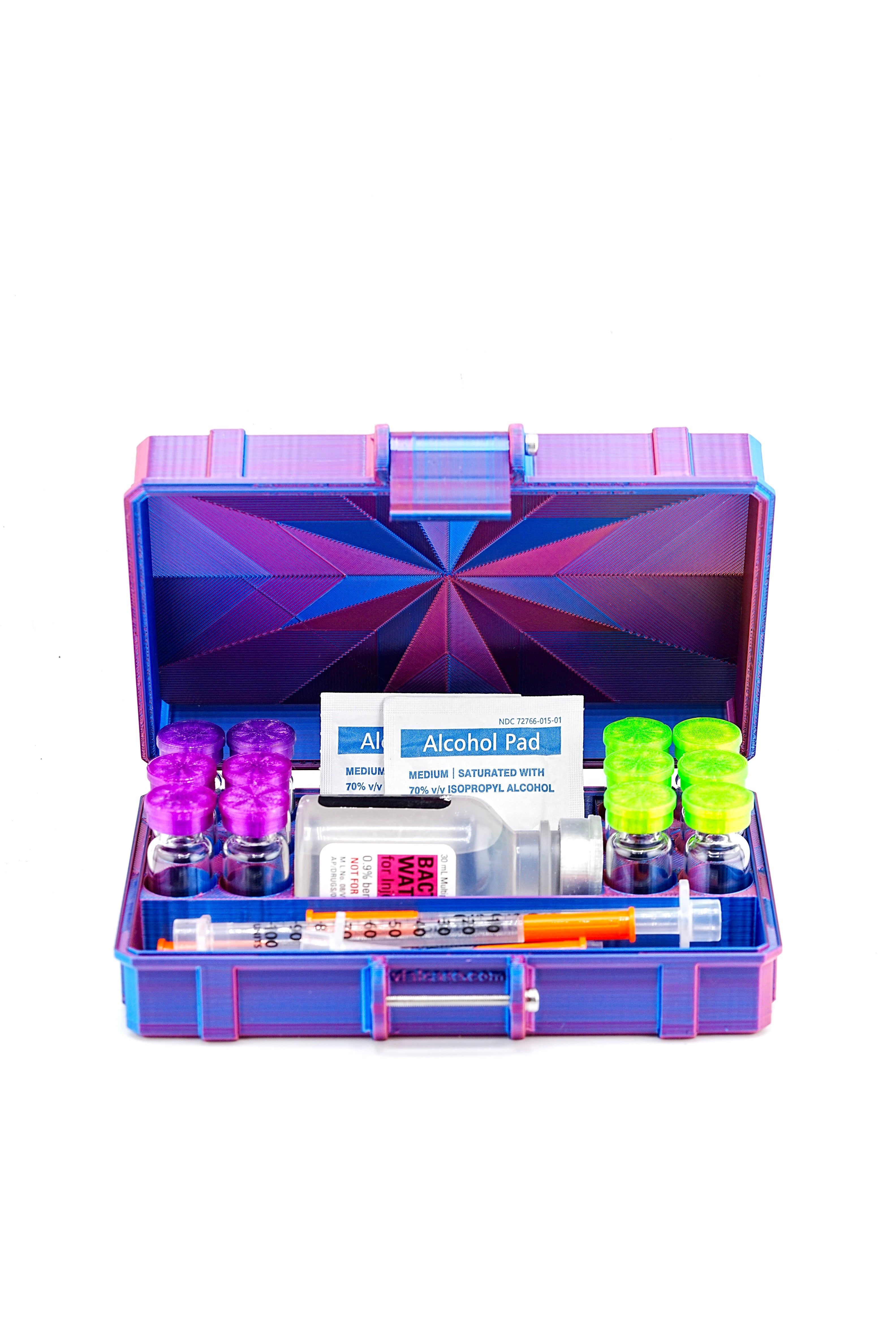
Pro Tip: GLP-1 vials — semaglutide, tirzepatide, retatrutide — are often held in the fridge for 4–8 weeks at a time between doses. That extended light exposure adds up. An opaque hard-shell case isn't optional for these compounds; it's the difference between stable potency and gradual degradation you'll never measure but will feel.
#4 — AOD-9604: Targeted Fat Oxidation Without the Glucose Effects
AOD-9604 is a synthetic fragment of human growth hormone (hGH), specifically the C-terminal fragment 176–191 of the hGH amino acid sequence. This fragment retains the lipolytic (fat-burning) activity of full hGH but — critically — does not stimulate IGF-1 production or affect blood glucose. That separation matters: users get the fat oxidation benefits of GH-mediated lipolysis without the insulin resistance or hyperglycemia risks associated with exogenous hGH. It preferentially activates fat cell receptors in adipose tissue, stimulating intracellular lipase activity and accelerating triglyceride breakdown. Clinical trials in obese subjects showed modest but consistent fat reduction at doses of 1mg daily.
Typical dose range: 300–500mcg subcutaneous once or twice daily. Most protocols run 8–12 weeks. Best results reported when dosed on an empty stomach or fasted, as insulin suppresses GH receptor activity.
Storage note: Refrigerate at 2–8°C after reconstitution with BAC water. Use within 3–4 weeks. Lyophilized powder is stable at room temperature for short periods but should be refrigerated for anything beyond a few days. Moderately light-sensitive — store in an opaque case. See our full AOD-9604 storage guide for reconstitution and handling details.
#5 — CJC-1295 + Ipamorelin: The GH Secretagogue Stack for Lipolysis
CJC-1295 is a GHRH (growth hormone releasing hormone) analogue that extends the half-life of endogenous GHRH from minutes to days by binding to albumin. Ipamorelin is a selective GHRP (growth hormone releasing peptide) that triggers GH pulses without significantly elevating cortisol or prolactin. Together, they produce sustained elevation of growth hormone levels — both raising baseline GH and amplifying natural GH pulses. The fat loss mechanism is GH-mediated lipolysis: elevated GH stimulates adipose tissue to release stored fatty acids via activation of hormone-sensitive lipase. Running CJC-1295 + Ipamorelin while in a caloric deficit produces a leaner, more preserved physique compared to dieting without GH support.
Typical dose range: CJC-1295 at 100–300mcg combined with Ipamorelin at 100–300mcg per injection, 1–3 times daily. Most fat loss protocols use once-daily dosing before sleep to align with natural GH pulses.
Storage note: Both peptides must be refrigerated at 2–8°C after reconstitution. Use within 4–6 weeks. Keep separate vials unless using a pre-mixed compounded formulation. Both are moderately light-sensitive. Store in an opaque case with designated slots for each vial. See our CJC-1295/Ipamorelin storage guide for pairing and reconstitution protocols.
#6 — GHRP-6: Strong GH Pulse With a Double-Edged Effect
GHRP-6 is one of the original synthetic growth hormone releasing peptides. It binds to the ghrelin receptor (GHSR-1a) to trigger strong, rapid GH pulses. The GH release drives lipolysis — particularly effective at mobilizing visceral fat — and makes GHRP-6 a legitimate tool for body recomposition and fat loss. The caveat is the mechanism: because GHRP-6 is a ghrelin mimetic, it significantly increases appetite, often within 30–60 minutes of injection. This ghrelin-mediated hunger spike is pronounced enough that GHRP-6 is generally not the optimal choice for a pure weight loss protocol where appetite control is the priority. It is, however, highly effective for body recomposition where you're trying to add muscle while losing fat simultaneously, using the hunger spike strategically around training.
Typical dose range: 100–300mcg subcutaneous 1–3 times daily. GH pulses are blunted if injected within 2 hours of a carbohydrate-containing meal. For fat loss, fasted morning dosing is standard.
Storage note: Refrigerate at 2–8°C after reconstitution. Use within 4 weeks. Lyophilized GHRP-6 powder is stable at room temperature for up to 30 days but degrades faster than most peptides due to its small molecular weight. Store reconstituted vials in an opaque refrigerated case — GHRP-6 is sensitive to both light and temperature fluctuation. See our GHRP-6 storage guide for full handling protocols.
Pro Tip: If you're stacking multiple compounds from this list — say, a GLP-1 for appetite control plus a GH secretagogue for fat mobilization — you're managing multiple vials with different reconstitution dates, dose volumes, and shelf lives simultaneously. A labeled, organized case isn't a nice-to-have; it's how you avoid dosing errors and wasted compound. See our guide to organizing a multi-compound peptide protocol.
#7 — BPC-157: Gut Health, Metabolism, and Indirect Fat Mobilization
BPC-157 (Body Protection Compound 157) is a pentadecapeptide derived from a gastric juice protein in humans. Its primary evidence base is in tissue repair — accelerating healing of tendons, ligaments, muscle, and gut lining. Its role in a fat loss protocol is indirect but meaningful. BPC-157 improves gastrointestinal integrity, which directly affects nutrient absorption efficiency and gut microbiome composition — both linked to fat storage regulation in recent research. It also reduces systemic inflammation, which is mechanistically connected to leptin resistance and impaired fat mobilization in overweight individuals. Users in caloric deficit report improved recovery and reduced injury frequency, which enables more consistent training output.
Typical dose range: 200–500mcg subcutaneous or intramuscular once or twice daily. Oral administration at higher doses (1–2mg) targets gut-specific effects. Most fat loss protocols run BPC-157 as a supporting compound alongside a primary GLP-1 or GH secretagogue.
Storage note: Refrigerate at 2–8°C after reconstitution. BPC-157 is relatively stable for a peptide — use within 6–8 weeks refrigerated. Lyophilized powder can be stored at room temperature for 30 days or at −20°C for up to 24 months. Moderately light-sensitive. Store in an opaque case. See our BPC-157 storage guide for full protocols.
#8 — TB-500: Muscle Preservation During Caloric Deficit
TB-500 (Thymosin Beta-4 fragment) is a synthetic version of a ubiquitous regulatory peptide found in virtually all human and animal cells. Its primary mechanism is actin regulation — it sequesters G-actin monomers and promotes cell migration, angiogenesis, and tissue repair. In the context of a fat loss protocol, its value is muscle and connective tissue preservation. Aggressive caloric deficits inevitably create some degree of muscle catabolism, and the increased training volume many users pursue while cutting raises injury risk. TB-500 reduces both risks: it accelerates recovery from training stress, decreases DOMS, and protects joints and tendons under the mechanical load of high-volume cutting phases. The result is a more intact, functional lean mass at the end of a cut.
Typical dose range: 2–2.5mg subcutaneous twice weekly for the first 4–6 weeks (loading phase), then 2–2.5mg weekly for maintenance. Most users run 8–12 week cycles.
Storage note: Refrigerate at 2–8°C after reconstitution. Use within 4–6 weeks. TB-500 is among the more heat-labile peptides — do not leave reconstituted vials at room temperature for extended periods. Lyophilized powder: stable at −20°C for up to 24 months. Store in an opaque case — light-sensitive. See our TB-500 storage guide for handling details.
#9 — Sermorelin: Gentler GH Stimulation for Long-Term Body Recomposition
Sermorelin is a synthetic analogue of the first 29 amino acids of endogenous GHRH (growth hormone releasing hormone). It stimulates the pituitary to produce and secrete GH via the same physiological pathway as natural GHRH — meaning GH release is regulated by somatostatin feedback loops, making it self-limiting and significantly safer than exogenous GH administration. The fat loss mechanism is the same as CJC-1295 but with a gentler, more pulsatile GH release pattern. Sermorelin is best suited to long-term body recomposition protocols — gradual improvements in body composition over 6–12 months rather than the rapid fat loss rates seen with GLP-1 class compounds. It's particularly popular for users over 40 where declining GH contributes to increased visceral fat accumulation.
Typical dose range: 100–500mcg subcutaneous before sleep, 5–6 days per week. Dosing before sleep aligns with the largest natural GH pulse of the day and avoids competition with daytime cortisol and somatostatin activity.
Storage note: Refrigerate at 2–8°C after reconstitution. Use within 20 days — Sermorelin has a shorter post-reconstitution shelf life than most GH secretagogues. Lyophilized powder: refrigerate for up to 6 months, or freeze at −20°C for up to 24 months. Highly light-sensitive — store in a fully opaque case. See our storage guide for GH secretagogues for related handling protocols.
#10 — Melanotan 2 (MT-2): Appetite Suppression and Fat Mobilization via Melanocortin
Melanotan 2 is a cyclic lactam analogue of alpha-melanocyte stimulating hormone (α-MSH), a melanocortin peptide. Its weight loss mechanism operates through the central melanocortin system — specifically MC3R and MC4R receptors in the hypothalamus that regulate energy homeostasis. MC4R activation in the arcuate nucleus of the hypothalamus reduces food intake by suppressing appetite independent of GLP-1 pathways. This makes MT-2 particularly useful as an adjunct to GLP-1 compounds (hitting appetite suppression via a second, complementary pathway) or as a standalone option for users who cannot tolerate GLP-1 class nausea. Additionally, MT-2 activates MC1R in adipocytes, directly stimulating lipolysis and fatty acid oxidation. The tanning effect (MC1R in melanocytes) is the most visible side effect and a reliable marker that the compound is active and properly stored.
Typical dose range: 250–500mcg subcutaneous daily for the first 1–2 weeks, then 500mcg–1mg maintenance 2–3 times weekly. Start low — MT-2 produces nausea, flushing, and spontaneous erections at higher doses during initial use.
Storage note: Refrigerate at 2–8°C after reconstitution. Use within 4 weeks. MT-2 is one of the most photosensitive peptides in common use — UV and visible light cause rapid degradation of the melanocortin backbone. Lyophilized powder must be stored in the dark; room temperature storage accelerates degradation even in amber vials. An opaque case is essential. See our Melanotan 2 storage guide for full handling protocols.
Storage Bottom Line: All Injectable Peptides Require Refrigeration and a Proper Case
Every compound on this list shares the same fundamental storage requirements: cold temperatures, darkness, and protection from physical damage. What varies is the degree of sensitivity and the post-reconstitution shelf life. Here's the summary:
- Retatrutide, Tirzepatide, Semaglutide: 2–8°C refrigerated, 4–8 weeks post-reconstitution, highly light-sensitive. These are your most expensive and most vulnerable vials.
- AOD-9604, CJC-1295, Ipamorelin, GHRP-6, Sermorelin: 2–8°C refrigerated, 3–6 weeks post-reconstitution, moderately to highly light-sensitive.
- BPC-157, TB-500: 2–8°C refrigerated, 4–8 weeks post-reconstitution, moderately light-sensitive. More thermostable than GLP-1 class but still require proper cold chain.
- MT-2: 2–8°C refrigerated, 4 weeks post-reconstitution, extremely light-sensitive. Never store in a clear case or near a window.
Running even 2–3 compounds from this list simultaneously means managing multiple vials with different reconstitution dates, dose volumes, and expiry windows. A disorganized fridge shelf with unsecured vials — no light protection, no impact resistance, no labeling system — is how expensive peptides get degraded or confused. A purpose-built, opaque, hard-shell peptide case eliminates every one of those failure modes at once.
If you want the full breakdown of what makes a case purpose-built for GLP-1 and research peptides, read our top 10 peptide storage cases for 2026.
For broader storage principles that apply across all injectable peptides, see our guides on the most common peptide storage mistakes and understanding peptide shelf life. If you're new to reconstitution, start with our complete guide to reconstituting peptides with BAC water.
This content is for informational and educational purposes only and does not constitute medical advice. Always consult a licensed healthcare provider before beginning any peptide or hormone protocol.