Why Millions Are Switching from Mounjaro to Compounded Tirzepatide
Tirzepatide is the active molecule in Eli Lilly's blockbuster GLP-1/GIP dual agonist medications Mounjaro (diabetes) and Zepbound (obesity). Branded Mounjaro pens retail for $900–$1,200 per month without insurance. Compounded tirzepatide, produced by licensed 503B pharmacies, delivers the same active molecule for $150–$250 per month — a savings of $700–$1,000 every single month.
That cost difference has driven massive adoption of compounded tirzepatide, with hundreds of thousands of patients now sourcing through telehealth platforms and compounding pharmacies. But switching from a branded pen to a compounded vial isn't just a billing change — it's a fundamentally different product with different storage requirements, different handling protocols, and different fragility profiles. Getting storage wrong means degrading the very compound you're saving money on.
Branded Mounjaro Pen Storage: What Lilly Says
The FDA-approved labeling for Mounjaro pens provides clear, well-tested storage instructions built around real-world patient use:
- Unopened pens: Refrigerate at 2–8°C (36–46°F). Do not freeze. Use before the expiration date. Store in original packaging to protect from light.
- In-use pens: After first use, the pen may be stored at room temperature up to 30°C (86°F) or continued in the refrigerator. Discard after 21 days from first use, regardless of remaining medication.
- Never freeze: A frozen Mounjaro pen must be discarded. Freezing damages the auto-injector mechanism and can cause aggregation in the solution.
The 21-day room-temperature window is a significant patient convenience engineered into the Lilly formulation. It exists because pharmaceutical manufacturers run extensive stability studies to support extended room-temperature labeling. Compounding pharmacies do not have equivalent resources to validate this window for their preparations — which is why their instructions are stricter.
Pro Tip: Even with branded pens, avoid storing them loose in the refrigerator door. Door shelves experience the most temperature cycling in any fridge. A dedicated peptide storage case placed on a middle shelf maintains much more stable temperatures and prevents pens from rolling and breaking.
Compounded Tirzepatide Vial Storage: Stricter, Always
Compounded tirzepatide is typically dispensed as a pre-mixed solution in multi-dose glass vials — 1ml, 2ml, or 5ml depending on concentration and dose schedule. Unlike the branded pen with its engineered room-temperature stability, compounded vials require strict refrigeration at all times:
- Always refrigerated: 2–8°C (36–46°F) from the moment you receive the vial until the final dose. There is no room-temperature window — not for 21 days, not for 21 minutes.
- Use by the beyond-use date (BUD): Most compounding pharmacies assign a 28–30 day BUD from dispensing. This is not a conservative estimate — it reflects the actual stability window the pharmacy has validated. Do not use past this date.
- Light protection required: Tirzepatide is sensitive to UV and visible light. Keep vials in their dispensing bag or, better, in an opaque peptide case inside the refrigerator.
- Never freeze: Freezing compounded tirzepatide causes protein aggregation that makes the solution unusable and can shatter the glass vial.
The practical implication for daily dosers: every time you reach into the fridge for the vial, draw your dose, and return it, you're creating brief room-temperature exposure. Keep that window under 5 minutes. Have your syringe prepped before you pull the vial out.
Dosing from a Compounded Tirzepatide Vial: The Units Math
One of the biggest adjustments when switching from a branded pen to a compounded vial is the dosing math. Mounjaro pens are pre-dosed — you just dial and inject. Compounded vials require you to calculate your dose in milliliters based on the concentration your pharmacy dispensed.
Common compounded tirzepatide concentrations are 5mg/ml and 10mg/ml. If your prescription calls for 5mg weekly and your vial is at 5mg/ml concentration, you draw exactly 1ml per dose. If your vial is at 10mg/ml concentration, you draw 0.5ml for the same 5mg dose. Always verify the concentration on your pharmacy label before drawing.
A useful tip: insulin syringes marked in units (U-100) can be confusing for peptide dosing. Use a 1ml syringe marked in tenths of a milliliter for clearer, less error-prone dosing. Keeping a conversion chart with your vials — easy to tuck inside a dedicated storage case — prevents dosing errors during protocol changes.
Pro Tip: If your compounded tirzepatide solution appears cloudy, has visible particles, or has changed color from clear/colorless, do not inject it. These are signs of aggregation, contamination, or temperature damage. Contact your pharmacy immediately. A vial that looks wrong almost certainly is wrong — degraded GLP-1 medication won't just be less effective, it can cause injection site reactions.
Light Sensitivity: An Often-Overlooked Risk
Both branded and compounded tirzepatide are sensitive to light — particularly UV. The branded Mounjaro pen comes in opaque packaging for this reason. When you transfer to a compounded glass vial stored in your home refrigerator, that packaging protection disappears.
A glass vial sitting on the refrigerator shelf is exposed to the interior light every time the door opens. Modern LED refrigerator lights are cooler than older incandescent bulbs but still emit light in wavelengths that drive photooxidation in sensitive peptide solutions. Over a 28-day use period with a fridge that opens 10–15 times per day, the cumulative light exposure is significant.
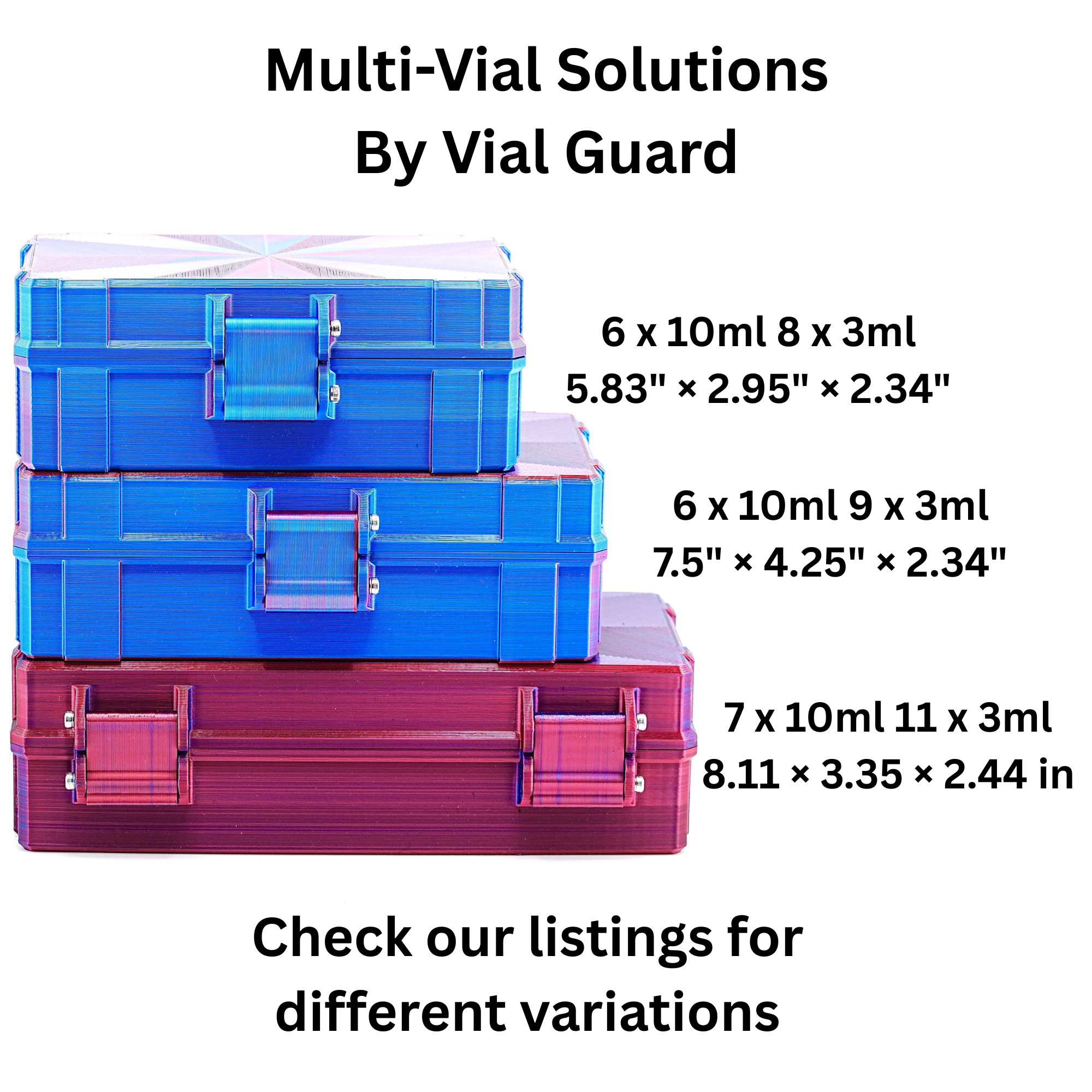
The fix is simple: store your compounded tirzepatide vials inside an opaque case inside the refrigerator. A purpose-built vial case blocks all ambient light, keeps vials from rolling and cracking against each other, and maintains more stable temperatures than a bare shelf position.
Traveling with Compounded Tirzepatide vs. a Mounjaro Pen
Here's where the two formats diverge most practically. Mounjaro pen users traveling for less than 21 days can simply keep the in-use pen at room temperature — no cold chain required for most domestic trips. Compounded tirzepatide vial users have no such flexibility. Every trip, regardless of length, is a cold-chain event.
For travel with compounded tirzepatide vials:
- Pre-chill a gel ice pack to 2–4°C — cold but not frozen, which would freeze the vial
- Pack vials in an insulated, opaque hard-shell case with the pack
- Always carry on — never check. Cargo holds are not temperature-controlled and can swing from -20°C to +50°C
- At hotels, confirm the mini-fridge is actually cold before putting vials in — some run warm
- For international travel, review our international peptide travel guide for customs documentation
An insulated, hard-shell peptide case designed for 10ml vials is ideal for tirzepatide travel. It maintains cold for 8–12 hours with a single gel pack, protects glass from impact, and presents professionally at TSA checkpoints.
Why a Storage Case Pays for Itself in One Prevented Vial Loss
At $200 per month for compounded tirzepatide, a single wasted vial from improper storage represents one month of medication. A quality peptide storage case costs a fraction of that — and it prevents losses from light exposure, temperature excursions, physical breakage, and the disorganization that leads to missed or doubled doses.
The math is straightforward: if a case prevents even one vial degradation event over a year of monthly dosing, it's paid for itself many times over. And beyond the financial argument, degraded tirzepatide simply doesn't work as well. If you're not getting the appetite suppression and weight loss results you expect, storage quality is a variable worth examining before assuming the medication isn't working.
Bottom Line: Compounded tirzepatide is not a budget version of Mounjaro with the same packaging tolerances — it's a more fragile preparation that demands consistent refrigeration, light protection, and organized handling. The savings are real, but only if the compound is still potent when you inject it.