What Is AOD-9604?
AOD-9604 — also written as AOD9604 — is a modified fragment of human growth hormone (hGH), specifically corresponding to the C-terminal region of the hGH molecule (amino acids 176–191 with an added tyrosine residue at the N-terminus). It was originally developed by Metabolic Pharmaceuticals in Australia as a potential treatment for obesity, with the core idea of isolating the fat-metabolizing activity of hGH without triggering IGF-1 production or the growth-promoting effects associated with full-length hGH.
Mechanistically, AOD-9604 is believed to stimulate lipolysis (the breakdown of stored fat) and inhibit lipogenesis (the formation of new fat), particularly targeting adipose tissue. Research subjects in clinical trials demonstrated statistically significant reductions in body fat without the glucose dysregulation, IGF-1 elevation, or tissue proliferation concerns associated with full hGH administration. Although AOD-9604 did not advance to FDA approval as a pharmaceutical, it remains a widely researched compound in the peptide community, typically dosed at 250–500mcg per day.
The peptide arrives as a white lyophilized powder in small vials — most commonly 1mg or 2mg fill weights — which is an unusually small payload compared to peptides like BPC-157 (which often comes in 5mg vials) or TB-500 (which comes in 2–5mg vials). This small fill weight is the single most important factor shaping AOD-9604 storage decisions. There is no margin for degradation.
Temperature Requirements for Every Stage
AOD-9604 is a 16-amino-acid peptide. Like all peptides, it is vulnerable to heat-induced hydrolysis, oxidation, and aggregation. The temperature rules are non-negotiable, and the small vial size means even partial degradation produces a measurable impact on your effective dose per injection.
Here is how temperature requirements break down across the two states you'll encounter:
- Lyophilized AOD-9604 (dry powder, unopened): Store at -20°C (-4°F) for long-term preservation. Under these conditions, manufacturer data and research consensus suggest stable potency for 12–24 months. For shorter-term holding periods of 1–3 months, refrigeration at 2–8°C (36–46°F) is acceptable. Room temperature storage beyond 24–48 hours is not recommended and will accelerate degradation, particularly in humid environments. Light exposure accelerates oxidation, so always store in opaque or amber vials away from direct light.
- Reconstituted AOD-9604 in BAC water: Refrigerate immediately after reconstitution at 2–8°C (36–46°F). The usable shelf life of reconstituted AOD-9604 is approximately 4–6 weeks when stored correctly. Never freeze a reconstituted solution — the ice crystal formation that occurs during freezing physically disrupts peptide bonds and destroys potency. A frozen-then-thawed reconstituted vial should be discarded.
- Room temperature handling window: Keep it brief. Pull the vial from the fridge, draw your dose, and return it. Five minutes or less per dose event is the target. Repeated room-temperature exposure compounds over a multi-week protocol and incrementally accelerates degradation.
Pro Tip: If you're running a long protocol and want to protect your lyophilized reserve, store unopened vials at -20°C (-4°F) and transfer only the vial you plan to reconstitute within the next 1–2 weeks to the refrigerator. Never thaw and refreeze lyophilized vials repeatedly — each thermal cycle stresses the powder even before reconstitution.
Reconstituting AOD-9604: Volume Math That Matters
Reconstitution for AOD-9604 requires more precision than for most peptides precisely because the vial contents are so small. A dosing error on a 2mg vial at 250mcg per day gives you 8 doses total. Miscalculate your concentration and you might be injecting 150mcg when you think you're injecting 250mcg — a 40% dosing error with no obvious way to detect it.
The standard approach is to use bacteriostatic water (BAC water) as the reconstitution solvent. BAC water contains 0.9% benzyl alcohol, which acts as a bacteriostatic preservative and extends the usable shelf life of your reconstituted peptide significantly versus sterile water. Our complete BAC water reconstitution guide covers the full technique in detail, but here is the dose math for AOD-9604 specifically:
- 1mg vial, target dose 250mcg: Add 1ml BAC water → concentration = 1mg/ml = 1000mcg/ml. Draw 0.25ml (25 units on a U-100 insulin syringe) per dose. 4 doses total per vial.
- 2mg vial, target dose 250mcg: Add 2ml BAC water → concentration = 1mg/ml = 1000mcg/ml. Draw 0.25ml (25 units) per dose. 8 doses total per vial.
- 2mg vial, target dose 500mcg: Add 2ml BAC water → same concentration. Draw 0.5ml (50 units) per dose. 4 doses total per vial.
- 2mg vial, alternate reconstitution with 1ml BAC water: Concentration = 2mg/ml = 2000mcg/ml. Draw 0.125ml (12.5 units) per 250mcg dose. Higher concentration, smaller draw volume — acceptable with a precise insulin syringe but leaves less room for measurement error.
The 1ml or 2ml reconstitution volumes are recommended because they keep your draw volumes large enough to measure accurately on a standard U-100 insulin syringe. Avoid reconstituting with 0.5ml or less — the resulting concentration is extremely high and the draw volume (6 units or less for a 250mcg dose) is at the lower limit of reliable insulin syringe accuracy.
Inject BAC water into the lyophilized vial slowly along the inside glass wall rather than directly onto the powder. Swirl gently — never shake or vortex. Shaking introduces air bubbles and mechanical stress that damages the peptide structure. The solution should become completely clear within 30–60 seconds of gentle swirling.
Shelf Life and the Stakes of Small Vials
Reconstituted AOD-9604 in BAC water remains usable for approximately 4–6 weeks when refrigerated consistently at 2–8°C. Beyond that window, peptide degradation accelerates regardless of how well the solution was prepared. The benzyl alcohol in BAC water prevents microbial growth but cannot stop the chemical degradation that occurs over time from oxidation, hydrolysis, and free radical activity.
Here is where the small vial size creates a compounding storage problem unique to AOD-9604. Most other peptides come in fill weights large enough that some degradation over a multi-week protocol still leaves you with a functional effective dose. With a 1mg or 2mg vial, you have no such buffer. If your reconstituted solution has degraded 25% by week five because it wasn't refrigerated consistently, you're not just dosing sub-optimally — you've lost a significant percentage of a very small absolute quantity of peptide.
The practical implication: track your reconstitution dates rigorously. Write the date directly on the vial with a fine-point permanent marker, or use a small label. Never leave it to memory. Check our guide on peptide shelf life for context on how degradation rates vary across peptide families. Also review the peptide storage temperature chart for a quick reference comparison across compounds you may be stacking with AOD-9604.
Why Labeling Is Non-Negotiable for AOD-9604
The labeling problem with AOD-9604 is more acute than with most peptides for one straightforward reason: the vials are small. A 1mg or 2mg vial is significantly smaller than a standard 10ml pharmaceutical vial. In a research context where you may have multiple peptides in storage — a CJC-1295 vial, an Ipamorelin vial, a BPC-157 vial, and your AOD-9604 alongside syringes, BAC water, and alcohol wipes — an unlabeled small vial is genuinely difficult to identify by sight alone.
Confusing an unlabeled AOD-9604 vial with another compound is not just a theoretical risk. The consequences range from injecting the wrong peptide entirely to drawing from a vial you already reconstituted weeks ago, believing it to be a fresh lyophilized vial. Every vial in your storage system should carry at minimum:
- Compound name (e.g., "AOD-9604")
- Fill weight or concentration (e.g., "2mg" or "2mg/2ml = 1000mcg/ml")
- Reconstitution date (leave blank until reconstituted; fill in immediately after)
- Status indicator: "Lyophilized" or "Reconstituted"
Small preprinted or handwritten labels designed for vials are available from laboratory supply vendors. Alternatively, a fine-point permanent marker on the vial cap or frosted label area on the glass works well for compact labeling. Our dedicated guide on how to label peptide vials covers all practical approaches including pre-printed label systems and color-coding for multi-compound stacks.
Pro Tip: Use color-coded dot stickers on vial caps as a secondary identification system when running a multi-peptide stack. Assign one color to AOD-9604 and a different color to each other compound. Even at a glance, and even when vials are close together in a case, you'll never reach for the wrong one. This is especially valuable at night or early morning when cognitive clarity isn't at its peak.
Stacking AOD-9604 with Ipamorelin and CJC-1295
AOD-9604 is frequently run alongside GH-axis peptides as part of a fat-loss stack. The most common combination pairs AOD-9604 with Ipamorelin and CJC-1295. The rationale is complementary: AOD-9604 directly targets adipose tissue lipolysis, while the CJC-1295/Ipamorelin combination drives pulsatile GH release that further supports fat metabolism, muscle preservation, and recovery. Some researchers also include Sermorelin as a GHRH component in more conservative protocols; see our Sermorelin storage guide for that compound's specific requirements.
The good news from a storage logistics standpoint is that AOD-9604, Ipamorelin, and CJC-1295 share nearly identical storage requirements. All three are lyophilized peptides reconstituted with BAC water, all refrigerate at 2–8°C after reconstitution, all have 4–6 week reconstituted shelf lives, and all are degraded by heat, light, and freeze-thaw cycling once reconstituted. This means a single well-organized storage case handles the entire stack without any temperature or handling conflicts.
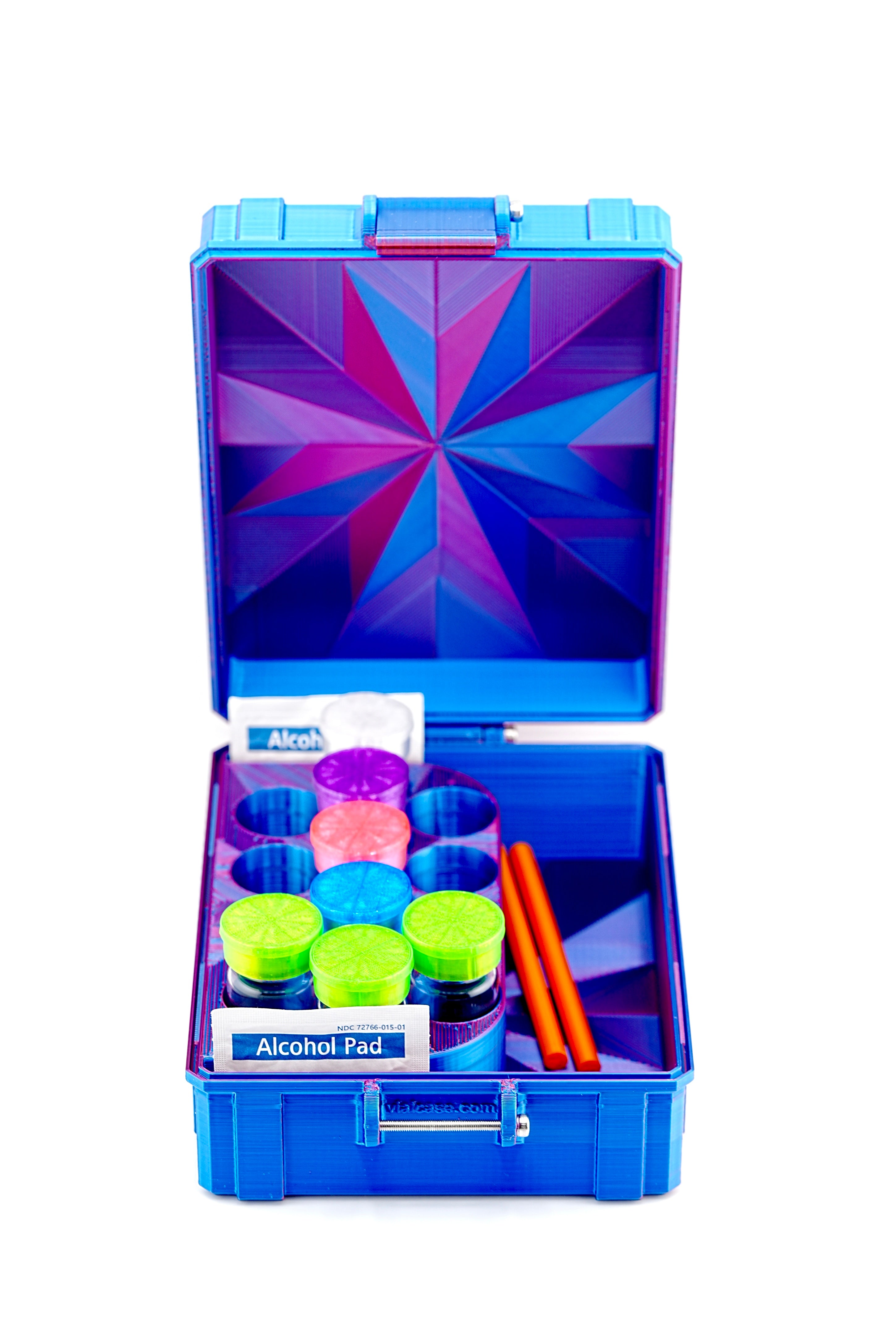
The organizational challenge in a three-compound stack is keeping vials clearly differentiated and tracking reconstitution dates across multiple compounds simultaneously. This is where a purpose-built multi-vial peptide storage case with dedicated labeled slots pays for itself immediately. Reaching into an unmarked collection of small vials at 6am before a fasted dose is a recipe for a dosing error. Structured, labeled storage eliminates that risk entirely.
Common AOD-9604 Storage Mistakes and How to Avoid Them
AOD-9604's small vial size and moderate price point (relative to, say, full hGH or more exotic research peptides) can create a false sense that mistakes are recoverable. They often aren't. Here are the storage errors that most frequently compromise AOD-9604 protocols:
- Leaving reconstituted vials at room temperature for extended periods. The most common mistake. Reconstituted AOD-9604 left on a counter between morning and evening doses can accumulate meaningful degradation over a multi-week protocol. Return vials to the refrigerator within 5 minutes of each draw.
- Freezing reconstituted solution. Some users who are familiar with freezing lyophilized peptides mistakenly freeze reconstituted vials "for safety." Freezing reconstituted AOD-9604 destroys it. If you're unsure whether a vial has been accidentally frozen, discard it and reconstitute fresh.
- Reconstituting with regular sterile water instead of BAC water. Sterile water has no preservative. Reconstituted AOD-9604 in sterile water should be used within 24–72 hours and does not have a multi-week shelf life. Always use bacteriostatic water for any peptide you intend to use over days or weeks.
- Shaking the vial during or after reconstitution. Mechanical agitation causes peptide aggregation and foaming. Gently swirl and tilt; never vortex or shake vigorously.
- Storing in a frost-free freezer without protection. Frost-free freezers run automatic defrost cycles that create temperature fluctuations of up to 10°C inside the freezer compartment. For lyophilized vials, store in a secondary insulated container (a small hard-shell case inside the freezer) to buffer against these cycles.
- Failing to label vials before or immediately after reconstitution. The failure point is usually the 30-second window right after reconstitution, when users plan to label "in a minute" and then don't. Write on the vial before you add the BAC water — label the date of reconstitution on the same label line as the compound name.
For a comprehensive review of the errors that affect all peptides in a storage context, our peptide storage mistakes guide covers the full list with explanations of the chemistry behind each failure mode.
Traveling with AOD-9604: Cold-Chain Logistics for a Daily Dose Peptide
AOD-9604's typical dosing schedule — once daily at 250–500mcg, often in the morning fasted — is more travel-friendly than a three-times-daily protocol. You're working with one vial puncture per day, one brief out-of-fridge exposure, and a predictable daily routine that is easier to maintain while traveling.
The core travel requirements are straightforward. Your reconstituted vial must stay between 2–8°C (36–46°F) throughout transit. The practical approach:
- Use an insulated, hard-shell case with a properly pre-chilled gel ice pack. Standard 400g gel packs maintain temperatures below 8°C for 8–12 hours in a well-insulated case.
- Always carry your peptides in your carry-on luggage. Checked baggage holds are unmonitored for temperature and can reach extreme highs and lows. This is non-negotiable.
- Airport security: TSA allows medically necessary liquids in carry-on bags. Reconstituted peptides in sealed vials, with syringes, typically pass without issue when presented separately at the checkpoint. A printed label on your vials and a note from a prescribing provider (if applicable) can prevent delays. Our full TSA peptide travel guide covers the details.
- At your destination, locate refrigeration immediately. Hotel mini-fridges run at approximately 4–6°C and are adequate for peptide storage.
- For trips exceeding 5 days, consider bringing additional lyophilized vials (kept in the insulated case, which functions as a cool-storage container) rather than a single large reconstituted vial. Reconstitute fresh at your destination if possible.
For lyophilized vials you're transporting without active refrigeration, an insulated case alone provides adequate protection for transit periods under 4–6 hours. Beyond that, a gel pack is strongly recommended. The dry powder is more thermally stable than reconstituted solution, but repeated heat exposure will accelerate degradation even before you reconstitute.
Why a Dedicated Case Is Essential for a Small-Vial Peptide
The argument for a dedicated storage case is stronger for AOD-9604 than for almost any other peptide in common research use, and it comes down entirely to vial size and the irreversibility of degradation. When your entire protocol payload fits in a 1–2mg vial — roughly the size of a lipstick cap — the difference between a controlled, organized storage environment and a haphazard drawer full of loose vials is the difference between a successful protocol and a wasted one.
Consider what happens in an unorganized storage setup. The AOD-9604 vial gets jostled against other vials, rolling around with reconstituted and lyophilized compounds mixed together. The vial isn't labeled clearly, so you squint at it under poor lighting to verify the contents. It's been sitting near the back of the fridge where temperature fluctuations from door openings are more pronounced. None of these events individually destroys the peptide, but the compound effect over a 6–8 week protocol is meaningful degradation and a higher risk of dosing errors.
A purpose-built peptide storage case designed for 3ml research vials holds your AOD-9604 and stack companions in individual slots, protected from jostling, light, and temperature swings. Combined with the labeling and protocol practices described above, it is the single organizational investment that removes the most risk from an AOD-9604 protocol. For more on how to structure multi-compound refrigerator storage, see our guide on peptide fridge organization.
This content is for informational and educational purposes only and does not constitute medical advice. Always consult a licensed healthcare provider before beginning any peptide or hormone protocol.