Peptides for muscle growth operate across several distinct biological axes: direct anabolic signaling via IGF-1, GH pulse amplification via secretagogues, and tissue repair acceleration via healing peptides that let you train harder and recover faster. The compounds on this list are not interchangeable — they work through different pathways, require different administration timing, and have very different risk-reward profiles. Understanding the mechanism of each is the prerequisite to using any of them intelligently.
This ranking is built on three criteria: strength of anabolic or recovery mechanism, quality and volume of available evidence (human data weighted over animal), and consistency of real-world results as reported across experienced users. Experimental compounds at the bottom of the list are included because their theoretical mechanisms are sound even where human trials are limited — but they are labeled clearly.
Storage requirements are non-negotiable for every compound here. Many of these peptides are expensive, delicate, and directly sensitive to temperature excursions and light exposure. A poorly stored vial of IGF-1 LR3 or a degraded CJC-1295 batch won't give you suboptimal results — it will give you no results. Each entry includes exact storage parameters.
#1 — IGF-1 LR3: The Most Directly Anabolic Peptide Available
IGF-1 LR3 (Insulin-like Growth Factor-1 Long R3) is a modified analogue of human IGF-1 with an arginine substitution at position 3 and a 13-amino-acid extension at the N-terminus. These modifications prevent binding to IGF-1 binding proteins (IGFBPs), which normally sequester the majority of circulating IGF-1 and limit its bioavailability. The result is a compound with approximately 3x the potency of regular IGF-1 and a half-life extended from ~12 minutes to 20–30 hours. IGF-1 LR3 directly stimulates muscle cell hyperplasia (increase in cell number) and hypertrophy (increase in cell size) by binding IGF-1 receptors in skeletal muscle and activating the PI3K/Akt/mTOR anabolic cascade. It also activates satellite cells — the resident stem cells of skeletal muscle — driving them to proliferate and fuse with existing muscle fibers. No other peptide in common use has a more direct or more powerful effect on muscle tissue growth.
Typical dose range: 20–100mcg intramuscular or subcutaneous post-workout daily. Most protocols run 4–6 weeks on, 4–6 weeks off due to IGF-1 receptor downregulation with chronic exposure. Bilateral administration (injecting into the worked muscle) is theorized to amplify local effect.
Storage note: Refrigerate at 2–8°C after reconstitution with acetic acid solution (0.6% acetic acid is standard, not BAC water — IGF-1 LR3 is unstable in neutral pH). Use within 3 weeks of reconstitution. Highly sensitive to temperature — even brief excursions above 25°C accelerate degradation significantly. Lyophilized powder: stable at −80°C indefinitely, −20°C for up to 12 months, or 2–8°C for up to 90 days. Store in a fully opaque case. See our IGF-1 LR3 storage guide for reconstitution and handling protocols.
#2 — CJC-1295 + Ipamorelin: The Gold Standard GH Stack for Muscle Growth
CJC-1295 is a GHRH analogue modified with a Drug Affinity Complex (DAC) technology that binds to albumin in the bloodstream, extending its half-life from minutes to 6–8 days. This produces a sustained elevation of baseline GH levels between natural pulsatile releases. Ipamorelin is a selective GH secretagogue that triggers additional GH pulses with minimal effect on cortisol or prolactin — a meaningful advantage over non-selective GHRPs that raise stress hormones alongside GH. Together, they create both elevated baseline GH and amplified pulse height, resulting in chronically elevated IGF-1 levels. IGF-1 is the primary downstream mediator of GH's anabolic effects in muscle: it drives protein synthesis, nitrogen retention, and satellite cell activation. Clinical data on CJC-1295 shows statistically significant increases in GH and IGF-1 with twice-weekly dosing; real-world users report consistent lean mass gains and accelerated recovery over 12–24 week protocols.
Typical dose range: CJC-1295 100–300mcg + Ipamorelin 100–300mcg per injection, once or twice daily. Most muscle growth protocols dose before sleep (to align with endogenous GH release) and optionally pre-workout. Run for 12–24 weeks continuously.
Storage note: Refrigerate both peptides at 2–8°C after reconstitution. Use within 4–6 weeks. Store in separate vials unless using a pre-blended compounded formulation. Both are moderately to highly light-sensitive — store in an opaque case with dedicated slots for each vial. Lyophilized: stable at −20°C for 24+ months. See our full CJC-1295/Ipamorelin storage guide.
#3 — GHRP-6: Strong GH Pulse and Strategic Hunger Increase for Bulking
GHRP-6 is one of the first synthetic GHRP compounds developed and remains one of the most studied. It binds the ghrelin receptor (GHSR-1a) in the pituitary and hypothalamus, triggering strong, rapid GH pulses. In muscle growth contexts, GHRP-6 has an important advantage over other secretagogues: the ghrelin receptor agonism that makes it increase appetite is a feature, not a bug, during a caloric surplus. Ghrelin-mediated appetite stimulation makes eating above maintenance significantly easier — a practical limiting factor for natural hard gainers. The GH pulse itself drives IGF-1 elevation, protein synthesis, and satellite cell activity downstream. For bulking protocols where caloric surplus is the goal, GHRP-6 addresses both the anabolic signaling (GH/IGF-1 axis) and the practical challenge of eating enough to grow.
Typical dose range: 100–300mcg subcutaneous 2–3 times daily. Best results when dosed fasted — glucose and fatty acids in the bloodstream blunt the GH pulse. Timing injections 30–60 minutes before meals leverages the appetite-stimulating effect strategically.
Storage note: Refrigerate at 2–8°C after reconstitution. Use within 4 weeks. GHRP-6 is a relatively small peptide and more vulnerable to thermal degradation than larger compounds. Lyophilized powder: stable at room temperature for up to 30 days, −20°C for 24 months. Store in an opaque case — sensitive to both light and temperature fluctuation. See our GHRP-6 and Hexarelin storage guide.
#4 — Hexarelin: The Most Potent GHRP for Maximum GH Pulse Height
Hexarelin is a synthetic hexapeptide and the most potent GHRP analogue in common use. It produces a larger GH pulse than GHRP-6 at equivalent doses and has a longer duration of action. Like GHRP-6, it acts on the GHSR-1a receptor, but the structural modifications that distinguish hexarelin produce greater receptor affinity and stronger downstream GH secretion. In comparative studies, hexarelin produces GH peaks 2–3x higher than GHRP-2 and GHRP-6. The tradeoff is more pronounced cortisol and prolactin elevation compared to selective GHRPs like Ipamorelin, and faster desensitization with continuous use. Hexarelin is best used in 4–8 week cycles, particularly during dedicated muscle-building phases where maximizing GH pulse amplitude is the priority. It pairs well with CJC-1295 for a combined baseline elevation plus high-amplitude pulsatile release pattern.
Typical dose range: 100–200mcg subcutaneous 2–3 times daily. Desensitization occurs within 4–8 weeks of consistent use; cycling off for 4+ weeks restores receptor sensitivity. Do not use continuously — diminishing returns accelerate rapidly past the 8-week mark.
Storage note: Refrigerate at 2–8°C after reconstitution. Use within 3–4 weeks. Hexarelin is among the more heat-sensitive GHRPs; avoid leaving reconstituted vials at room temperature for extended periods. Lyophilized: stable at −20°C for 18–24 months. Store in an opaque case — light-sensitive. See our Hexarelin storage guide for full handling protocols.
Pro Tip: GH secretagogues — GHRP-6, Hexarelin, Ipamorelin — all require injection timing relative to meals to maximize GH pulse height. Keeping a dedicated, labeled case makes it easier to identify the right vial quickly without fumbling in the fridge when you're timing a pre-workout dose. A disorganized fridge setup is how dosing errors happen.
#5 — BPC-157: Accelerated Tendon, Ligament, and Muscle Repair for Higher Training Volume
BPC-157 (Body Protection Compound 157) is a pentadecapeptide derived from a gastric juice protein. Its anabolic relevance for muscle growth is indirect but significant: it dramatically accelerates the repair of tendons, ligaments, muscle fibers, and joint surfaces. The primary mechanism involves upregulation of growth hormone receptors in tendon fibroblasts, promotion of angiogenesis (new blood vessel formation) in damaged tissue, and modulation of NO (nitric oxide) pathways that drive local tissue healing. The real-world implication is straightforward: heavy compound training at the volumes and intensities required for maximal muscle growth consistently produces connective tissue micro-damage that accumulates into chronic injury. BPC-157 reduces the recovery time between hard training sessions, decreases the severity and duration of overuse injuries, and keeps athletes training productively rather than deloading through injury. More consistent, higher-volume training produces more muscle. BPC-157 is the compound that enables the training volume, not the compound that directly builds the muscle.
Typical dose range: 200–500mcg subcutaneous or intramuscular once or twice daily, ideally near the site of injury or training stress. Most cycles run 4–8 weeks. Some users run BPC-157 continuously at lower doses as injury prevention rather than treatment.
Storage note: Refrigerate at 2–8°C after reconstitution. Stable for 6–8 weeks refrigerated — more thermostable than most peptides. Lyophilized: stable at room temperature for 30 days or at −20°C for up to 24 months. Store in an opaque case. See our BPC-157 storage guide and our guide to the Wolverine Stack (BPC-157 + TB-500).
#6 — TB-500: Systemic Tissue Repair and Reduced Recovery Time
TB-500 (Thymosin Beta-4 synthetic fragment) works through actin regulation — specifically sequestering G-actin to enable cell migration, angiogenesis, and systemic tissue repair throughout the body. Where BPC-157 tends to have more localized effects (especially strong at the site of injection), TB-500 acts systemically, making it the better choice for distributed recovery needs: multiple joint stress simultaneously, full-body fatigue from high-frequency training, or soft tissue damage that doesn't have a single anatomical focus. The combination of BPC-157 (local) and TB-500 (systemic) has become one of the most popular recovery stacks in the peptide space precisely because they address repair at different scales. For muscle growth, the case is the same as BPC-157: better recovery means more productive training, and more productive training means more muscle over time.
Typical dose range: 2–2.5mg subcutaneous twice weekly for a 4–6 week loading phase, then 2–2.5mg weekly for maintenance. Most users run 8–12 week cycles with 4–6 weeks off.
Storage note: Refrigerate at 2–8°C after reconstitution. Use within 4–6 weeks. Among the more heat-labile peptides in common use — reconstituted TB-500 degrades noticeably faster than BPC-157 above 8°C. Lyophilized: stable at −20°C for 24 months. Store in an opaque case — light-sensitive. See our TB-500 storage guide for full handling and reconstitution protocols.
#7 — Sermorelin: The Entry Point for GH Peptide Protocols
Sermorelin is a synthetic analogue of the first 29 amino acids of endogenous GHRH. It stimulates the pituitary gland to produce and secrete GH through the same physiological pathway as natural GHRH, subject to normal somatostatin feedback inhibition. This self-regulating mechanism makes it the safest entry point into GH peptide use: it cannot drive GH levels above what the pituitary can physiologically produce, and the response profile is more gradual and sustained than synthetic GHRP compounds. For muscle growth, Sermorelin produces meaningful increases in GH and IGF-1 over 12–24 week protocols, with users reporting improved recovery, better sleep quality (GH is primarily secreted during slow-wave sleep), and gradual lean mass improvements. It is not as potent as CJC-1295/Ipamorelin for rapid GH elevation, but its tolerability profile makes it appropriate for longer, lower-intensity protocols, particularly for users over 35 where declining GH is a real factor in training recovery.
Typical dose range: 100–500mcg subcutaneous before sleep, 5–6 nights per week. Dosing before sleep aligns with the largest natural GH pulse and avoids daytime cortisol competition. Long-term protocols of 6–12 months are common.
Storage note: Refrigerate at 2–8°C after reconstitution. Sermorelin has a shorter post-reconstitution shelf life than most — use within 20 days. Lyophilized: refrigerate up to 6 months, or freeze at −20°C for up to 24 months. Highly light-sensitive — store in a fully opaque case. See our GH secretagogue storage guide for related protocols.
#8 — GHK-Cu: Connective Tissue Integrity and Anti-Catabolic Effects
GHK-Cu (Copper peptide GHK-Cu) is a naturally occurring tripeptide — glycine-histidine-lysine complexed with copper(II) — found in human plasma, saliva, and urine. Its role in muscle growth is primarily protective and supportive: it stimulates collagen and elastin synthesis in connective tissue, reduces the activity of matrix metalloproteinases (enzymes that break down extracellular matrix), and modulates inflammatory signaling to suppress excess catabolism of muscle and connective tissue. Research data shows GHK-Cu activates over 4,000 human genes, a significant portion of which are involved in tissue repair and anti-inflammatory regulation. In heavy training contexts, this translates to better maintenance of connective tissue integrity at the joints (tendons, ligaments, fascia) that take the most mechanical stress, and a reduction in the catabolic signaling that limits net protein accretion during high-volume phases. It also reduces IL-6 and TNF-alpha, pro-inflammatory cytokines that directly inhibit muscle protein synthesis when chronically elevated.
Typical dose range: 1–3mg subcutaneous or intramuscular daily. Some protocols use topical application at higher concentrations for localized connective tissue support, though systemic effects require injectable administration. Cycles of 4–8 weeks are standard.
Storage note: Refrigerate at 2–8°C after reconstitution. Use within 4 weeks. GHK-Cu is extremely photosensitive — the copper complex degrades rapidly under UV and visible light, producing free copper ions that can damage the peptide backbone. Amber glass vials are standard but insufficient alone; an opaque case is essential. Lyophilized: stable at −20°C for 18–24 months. See our GHK-Cu storage guide for full handling protocols.
Pro Tip: Running a muscle growth stack with 4+ compounds means managing multiple vials with different reconstitution dates, dose volumes, reconstitution solvents (some use BAC water, some use acetic acid), and shelf lives. Label every vial with compound name, reconstitution date, concentration, and expiry date. A labeled, organized case is what separates a professional protocol from a chaotic one. See our guide to labeling peptide vials properly.
#9 — Follistatin 344: Myostatin Inhibition (Highly Experimental)
Follistatin 344 is a natural glycoprotein that binds and inhibits myostatin — the primary negative regulator of skeletal muscle mass in mammals. Myostatin functions as a molecular ceiling on muscle growth: it suppresses satellite cell activation, inhibits muscle protein synthesis, and prevents muscle fiber hypertrophy beyond a genetically determined set point. Animals with naturally occurring myostatin deficiencies (Belgian Blue cattle, certain dog breeds, and documented human cases) develop dramatically increased muscle mass with minimal fat. Follistatin 344 theoretically raises this ceiling by binding circulating myostatin and its related ligand activin A, preventing them from activating the SMAD2/3 signaling pathway that limits muscle growth. If the mechanism holds in humans at practical doses, it would be the most transformative muscle growth intervention available. The critical caveat: human trial data is essentially nonexistent. Animal studies are compelling; the jump from animal models to human physiology for myostatin inhibition has not been validated. Use with significant caution and awareness of unknown risks.
Typical dose range in experimental use: 50–100mcg intramuscular in the target muscle group, once weekly. Protocols are highly variable given the absence of established human dosing data. This is genuinely experimental territory.
Storage note: Refrigerate at 2–8°C after reconstitution. Use within 2–3 weeks. Follistatin is a glycoprotein with a complex tertiary structure — it is among the most sensitive peptides to temperature excursion and freeze-thaw cycling. Lyophilized: stable at −20°C. Never freeze reconstituted follistatin. Highly light-sensitive. Store in an opaque case at all times. Handle with extreme care during reconstitution — do not vortex or shake; roll gently.
#10 — MGF (Mechano Growth Factor): Local Satellite Cell Activation Post-Workout
Mechano Growth Factor is an alternatively spliced variant of the IGF-1 gene, produced locally in skeletal muscle in response to mechanical loading and micro-damage from resistance training. Where systemic IGF-1 LR3 activates IGF-1 receptors throughout the body, MGF acts locally in the exercised muscle tissue to activate satellite cells in the immediate post-workout window. Its unique N-terminal extension (the E-domain) is distinct from IGF-1 and directly stimulates satellite cell proliferation independent of the classical IGF-1 receptor — a separate anabolic signaling axis. The rationale for exogenous MGF administration is to amplify and extend the local satellite cell activation signal that occurs naturally post-training but decays within minutes in plasma. By injecting MGF directly post-workout into the worked muscle group, users attempt to extend and intensify this satellite cell response. PEGylated MGF (with polyethylene glycol modification for extended half-life) is the more common form in research peptide markets, extending the active window from minutes to hours.
Typical dose range: 100–200mcg intramuscular into the worked muscle group immediately post-workout. PEGylated MGF at the same dose can be used less frequently due to extended half-life. Often stacked with IGF-1 LR3 in the post-workout window for combined satellite cell activation (MGF) and systemic IGF-1 receptor-mediated anabolism (IGF-1 LR3).
Storage note: Refrigerate at 2–8°C after reconstitution. Use within 3 weeks. MGF is highly thermolabile — among the most storage-sensitive peptides in common use. Temperature excursions above 25°C for even a few hours cause measurable degradation. Lyophilized: stable at −20°C for 12–18 months. Never freeze reconstituted MGF. Highly light-sensitive. Store in a fully opaque case. Handle reconstituted vials with care; avoid agitation.
The Stack Most Used for Muscle Growth
In practice, the most effective and most commonly run muscle growth peptide stack combines compounds from three different functional categories: direct anabolism, GH axis amplification, and recovery acceleration. The stack looks like this:
- Direct anabolism: IGF-1 LR3 (20–60mcg post-workout, 4–6 week cycles) and/or MGF (100mcg post-workout into worked muscle)
- GH axis amplification: CJC-1295 (200mcg) + Ipamorelin (200mcg) before sleep, daily throughout the cycle
- Recovery acceleration: BPC-157 (250–500mcg daily) + TB-500 (2mg twice weekly loading, then weekly) to enable high training volume without accumulating injury
This combination addresses every major limiting factor in natural muscle growth: the anabolic signaling ceiling (IGF-1 LR3/MGF), the GH/IGF-1 baseline (CJC-1295/Ipamorelin), and the training volume ceiling imposed by recovery capacity (BPC-157/TB-500). Running all five to six compounds simultaneously is the approach used by the most experienced peptide users chasing maximal muscle development.
The practical challenge this creates is storage complexity. You're managing 4–6 active vials simultaneously, each with a different reconstitution date, a different shelf life, different dose volumes, and in some cases different reconstitution solvents (IGF-1 LR3 requires acetic acid, not BAC water; others use BAC water). Some need to be injected daily, others twice weekly. In the absence of a clear organizational system, dosing errors accumulate and expensive peptides get wasted past expiry or degraded from improper storage.
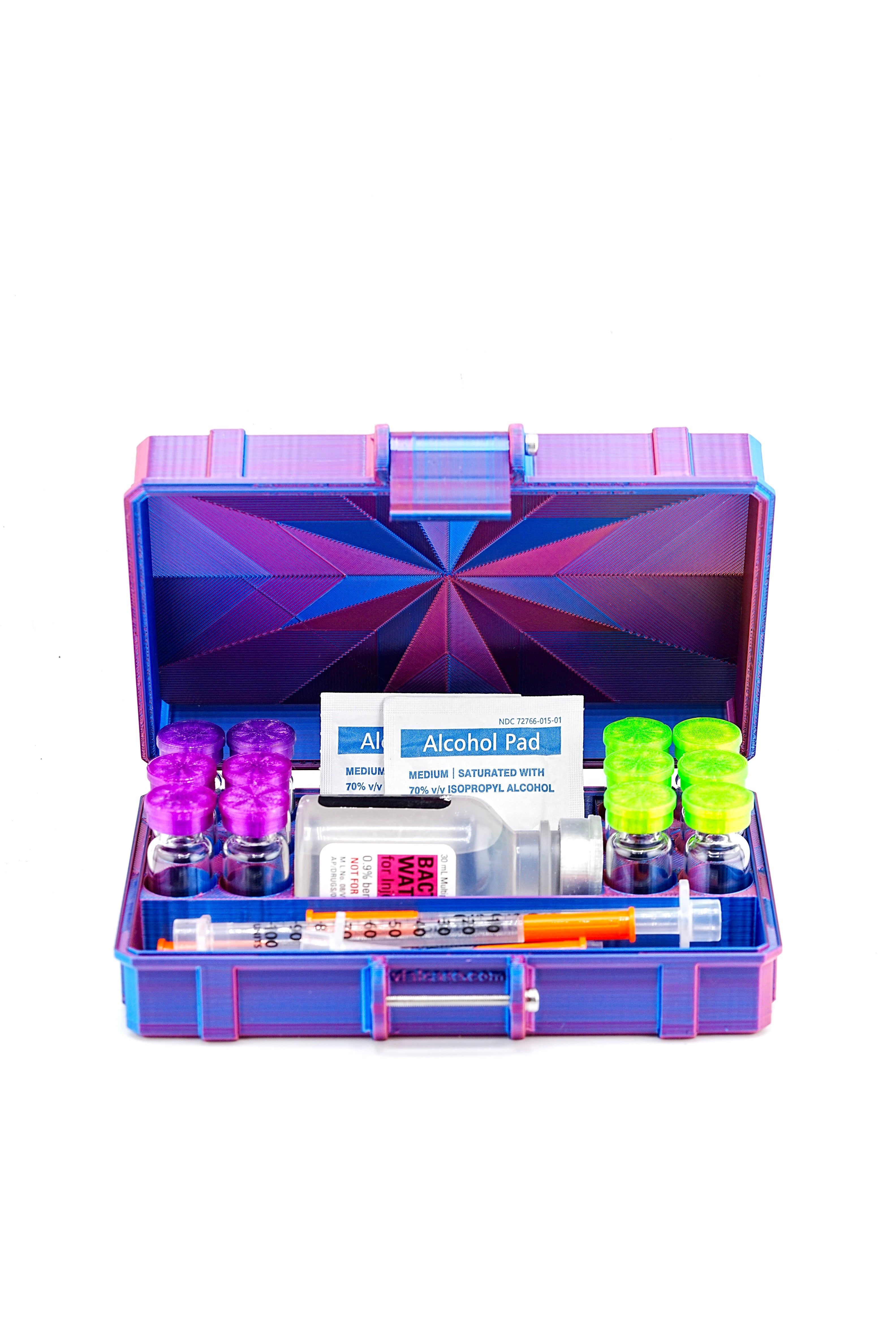
A purpose-built, labeled, opaque, hard-shell peptide case is not optional when you're running a stack this complex — it's the organizational infrastructure that makes the protocol manageable. You need dedicated slots for each vial, protection from ambient fridge light for all of them, and impact resistance that keeps glass vials intact when the case gets moved.
For a complete guide to setting up storage for a multi-compound muscle stack, see our beginner peptide stack storage guide and our detailed breakdown of the Wolverine Stack (BPC-157 + TB-500). For the best case configurations for running 4–8 vials simultaneously, see our ranked list of the top 10 peptide storage cases for 2026.
For broader storage principles, see our guides on common peptide storage mistakes, peptide shelf life, and reconstituting peptides with BAC water.
This content is for informational and educational purposes only and does not constitute medical advice. Always consult a licensed healthcare provider before beginning any peptide or hormone protocol.