What Is the Wolverine Stack?
The "Wolverine Stack" refers to the combination of BPC-157 and TB-500 (Thymosin Beta-4), two peptides that are commonly used together for their complementary regenerative properties. The nickname comes from the combination's reputation for supporting rapid recovery — like the comic book character's healing factor.
- BPC-157 (Body Protection Compound-157): A 15-amino-acid synthetic peptide derived from gastric juice. Primarily researched for tendon, ligament, and gut healing. Works locally at the site of injury.
- TB-500 (Thymosin Beta-4): A 43-amino-acid peptide naturally produced by the thymus gland. Researched for systemic tissue repair, inflammation reduction, and cell migration. Works systemically throughout the body.
The theory behind stacking them is that BPC-157 provides targeted, local healing while TB-500 provides systemic repair support — addressing injury from both angles simultaneously. Whether you're recovering from a torn rotator cuff, a nagging knee, or post-surgical healing, the Wolverine Stack has become the go-to protocol.
Storage Requirements: BPC-157 vs. TB-500
The good news: both peptides in the Wolverine Stack have similar storage requirements. The bad news: BPC-157 is significantly more light-sensitive than TB-500, so your storage setup needs to accommodate the more fragile compound.
| Factor | BPC-157 | TB-500 |
|---|---|---|
| Lyophilized storage | -20°C (12-24 months) | -20°C (12-24 months) |
| Refrigerated storage | 2-8°C (3-6 months) | 2-8°C (3-6 months) |
| Reconstituted shelf life (BAC) | 4-8 weeks | 4-8 weeks |
| Light sensitivity | Extremely high | Moderate |
| Vial size (typical) | 3ml vial (5mg) | 3ml vial (5mg) |
Key Takeaway: Since BPC-157 is the more fragile compound, your storage setup should be designed around its requirements. If BPC-157 is properly stored, TB-500 will be too — it's more forgiving.
Organizing Your Wolverine Stack
Running two peptides simultaneously creates an organization challenge that single-peptide users don't face. Here's how to keep your Wolverine Stack organized:
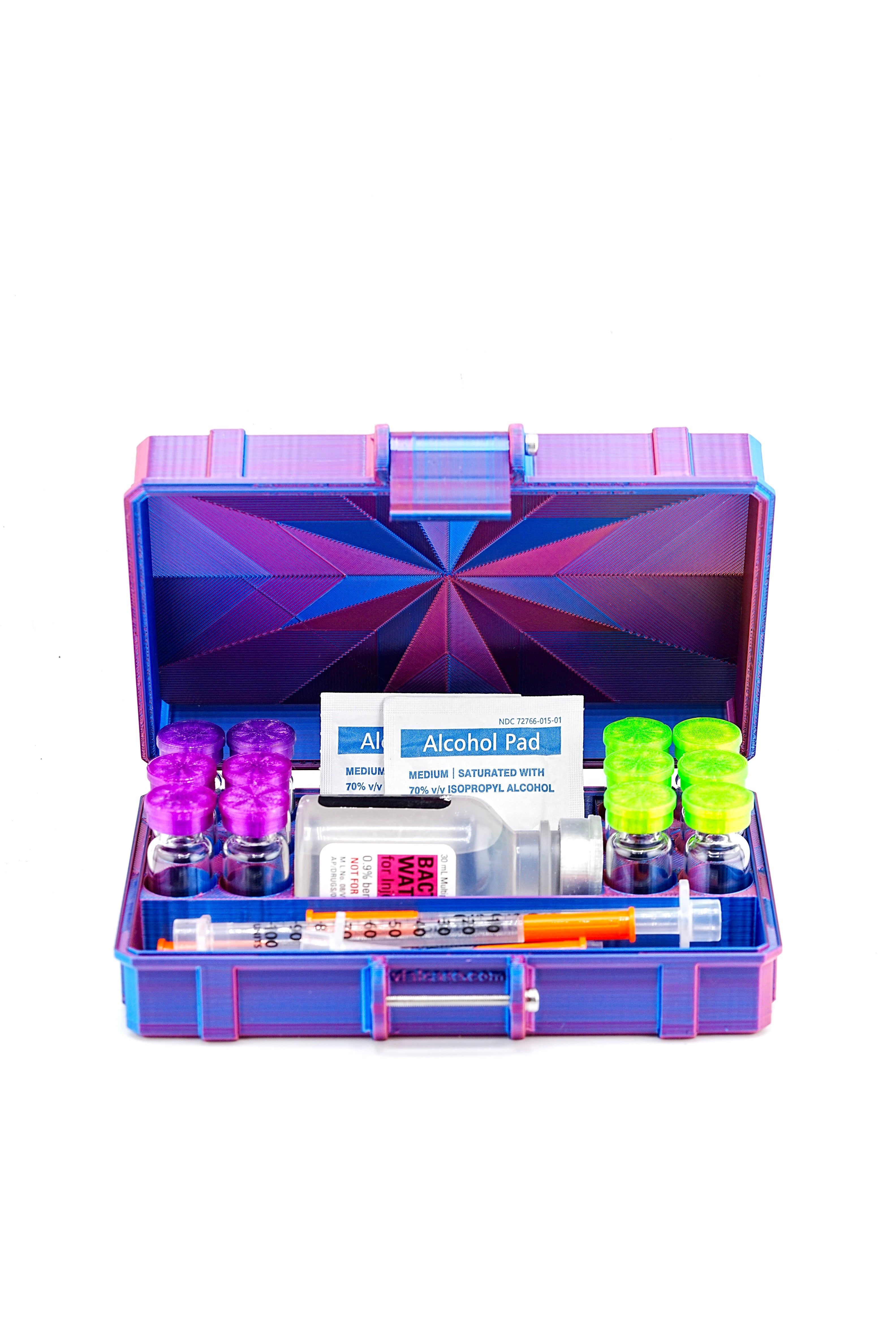
- Color-coded caps: If your vials have removable colored caps, assign one color to BPC-157 and another to TB-500. This prevents mix-ups during dosing — especially important when you're drawing from both vials back-to-back.
- Label everything: Write the compound name and reconstitution date on each vial. "BPC - 3/15" tells you exactly what's in the vial and how old it is.
- Separate slots: Store each peptide in its own designated slot in your case. A multi-slot case prevents vials from touching, rolling, or mixing up.
- BAC water slot: Your reconstitution water needs a home too. Cases with mixed-size slots accommodate both 3ml peptide vials and 30ml BAC water bottles.
Reconstitution Timeline: Syncing Your Stack
One of the trickiest parts of running the Wolverine Stack is keeping both compounds on the same reconstitution schedule. Here's a practical approach:
- Reconstitute both on the same day. This synchronizes your shelf life timers and makes tracking simpler.
- Use the same BAC water source. One bottle of BAC water is sufficient for both vials. This reduces contamination vectors and keeps your supply streamlined.
- Match your dilutions for easier dosing. Many users reconstitute both BPC-157 (5mg) and TB-500 (5mg) with the same volume of BAC water (2ml each), creating identical concentrations. This means the same syringe marking gives the same dose from either vial.
- Set a calendar reminder for your reconstitution dates. At week 4, it's time to evaluate whether your vials need replacing.
Pro Tip: Some users buy BPC-157 and TB-500 in pre-mixed "Wolverine blend" vials from certain vendors. While convenient, pre-mixed vials remove the ability to adjust individual doses. Storing separate vials gives you more protocol flexibility — and a proper case makes managing two vials just as easy as one.
How Many Vials Do You Need?
A typical Wolverine Stack protocol runs 4-8 weeks. Here's a rough vial estimate:
- 4-week protocol: 2 vials BPC-157 (5mg each) + 2 vials TB-500 (5mg each) = 4 vials total
- 8-week protocol: 4 vials BPC-157 + 4 vials TB-500 = 8 vials total
- Plus BAC water: 1 bottle (30ml) is sufficient for the entire protocol
At any given time, you'll have 2 reconstituted vials in active use and potentially several lyophilized vials in reserve. A case with 6-10 slots handles the full protocol comfortably. Check out our product lineup to find the right capacity for your stack.
Traveling with the Wolverine Stack
Athletes and active individuals — the primary Wolverine Stack demographic — are also the people most likely to be traveling for competitions, training camps, or work. Travel storage tips for dual-peptide protocols:
- Carry on only. Two shattered vials is twice the financial loss. Hard-shell cases in carry-on luggage.
- Keep both vials together. A single organized case with both compounds looks far more legitimate at TSA than multiple loose vials.
- Cold pack for flights over 3 hours. Especially on connecting flights where your bag may sit in overhead bins or on the jetway.
- Bring syringes in original packaging. Insulin syringes are common and rarely questioned, but original packaging eliminates any doubt.
- Documentation helps. If you have a prescription or purchase receipt, keep it accessible. For a complete guide, see our TSA travel guide.
Adding More Peptides to Your Stack
Many Wolverine Stack users eventually add additional compounds to their protocol. Common additions include:
- GHK-Cu — copper peptide for skin and tissue repair, adding a third recovery vector
- CJC-1295 + Ipamorelin — growth hormone secretagogues for enhanced recovery and sleep
- Semaglutide or Tirzepatide — GLP-1 compounds for body composition alongside healing
As your stack grows, organization becomes exponentially more important. Three or four reconstituted vials that look identical are a recipe for dosing errors. A dedicated case with designated slots for each compound — clearly separated and labeled — is the difference between a clean protocol and a chaotic one.
Bottom Line: The Wolverine Stack doubles your healing potential — but also doubles your storage responsibility. Same temperature, same light protection, same BAC water rules. The only difference? You need a case that holds more than one vial. Keep both compounds organized, labeled, and protected, and your stack will stay potent through the entire protocol.