Why Multi-Peptide Storage Is a Different Problem
Storing one peptide is straightforward: refrigerate the reconstituted vial, freeze the lyophilized backup, label the date. Most people manage that. But the moment you add a second compound — and especially when you hit three, four, or five compounds in a protocol — the system breaks down fast.
Here's what typically happens: you have five unlabeled or barely-labeled vials in the fridge door. Two are 3ml vials, two are 10ml, one is BAC water. You reconstituted them at different times. One is BPC-157 and one is TB-500 and they look identical — clear liquid, same vial size, similar-looking stoppers. You're dosing before work, it's early, you grab the wrong one. Or you forget which vials were reconstituted two weeks ago versus last week. Or one compound accidentally ends up in the freezer after a roommate reorganizes things, and you come back to a ruined vial you paid $60 for.
These aren't hypothetical failures. They're the predictable result of running a multi-compound protocol without a storage system designed for it. This guide fixes that, stack by stack.
The Core Rules for Any Multi-Peptide Protocol
Before getting into specific stacks, these principles apply universally regardless of which compounds you're running:
Rule 1: Lyophilized vs. Reconstituted Storage Are Not the Same
Lyophilized (freeze-dried) peptides are stable at -20°C (-4°F) in the freezer for 12-24 months with minimal degradation. Once reconstituted into solution with bacteriostatic (BAC) water, everything changes. Reconstituted peptides must be refrigerated at 2-8°C (36-46°F) — never frozen. Freezing a reconstituted vial forms ice crystals that physically break peptide bonds and degrade the compound, often to the point of complete loss. This mistake is surprisingly common among beginners who assume "colder is always better."
The rule: freeze lyophilized powder, refrigerate reconstituted solution, never reverse these.
Rule 2: Label Every Vial Immediately
Label at the moment of reconstitution, not afterward. The label needs three pieces of information: the compound name, the concentration (e.g., "5mg/mL"), and the date reconstituted. A vial with just "BPC" written on it in Sharpie is not an adequate label when you're three weeks into a protocol and trying to remember when you mixed it. Our complete vial labeling guide covers materials, placement, and systems for multi-compound protocols in detail.
Rule 3: Separate Active Vials from Backup Stock
Reconstituted vials (in-use, refrigerator) and lyophilized backups (freezer) should never share the same physical space. If your backup stock is in the fridge alongside your active vials, it will eventually get confused with a reconstituted vial and accidentally frozen — or worse, reconstituted without realizing it was already mixed. Keep the freezer for lyophilized powder only.
Rule 4: Know Your Shelf Life Per Compound
Reconstituted peptides have different effective shelf lives depending on the compound and reconstitution solution. Most peptides reconstituted in BAC water are stable for 4-8 weeks refrigerated. Some are less stable. Only reconstitute what you'll realistically use within that window. See the full breakdown in our peptide shelf life guide.
Pro Tip: Use a dry-erase marker on your refrigerator shelf or a small whiteboard to write the reconstitution date of each active vial next to it. It takes 10 seconds and eliminates the guessing game entirely when you're three weeks into a protocol.
Stack 1: The Wolverine Stack (BPC-157 + TB-500)
This is the most popular injury recovery and tissue repair stack in the research community. BPC-157 (Body Protection Compound-157) at 250-500mcg per day combined with TB-500 (Thymosin Beta-4) at 2-2.5mg twice weekly creates a synergistic healing environment that's far more effective than either compound alone. Storage for this stack is relatively simple because both compounds follow the same rules.
Storage Breakdown
- BPC-157 lyophilized: Freeze at -20°C (-4°F). Stable for 12-24 months.
- TB-500 lyophilized: Freeze at -20°C (-4°F). Stable for 12-24 months.
- BPC-157 reconstituted: Refrigerate at 2-8°C (36-46°F). Use within 4-6 weeks of mixing.
- TB-500 reconstituted: Refrigerate at 2-8°C (36-46°F). Use within 4-6 weeks of mixing. TB-500 is typically dosed twice weekly, so a 10mg vial reconstituted at 2mg/mL lasts about 5 doses — roughly 2.5 weeks at standard protocol.
Labeling the Wolverine Stack
The risk here is visual confusion. BPC-157 typically comes in 5mg vials; TB-500 comes in 5mg or 10mg vials. Both are clear liquid after reconstitution. Without labels, they are indistinguishable. If you confuse them and inject TB-500 at a BPC-157 dose (or vice versa), you're either underdosing one and overdosing the other — a waste of expensive compound. Label both vials immediately with compound name, concentration, and date mixed. Use a different colored label or marker for each compound as a visual fail-safe.
For a full deep-dive on the individual storage requirements for each compound, see our BPC-157 storage guide and TB-500 storage guide.
Case Setup for the Wolverine Stack
With 2 active reconstituted vials and 2 lyophilized backups, you need at minimum a 4-slot case. A 6-slot case gives you room for a BAC water vial and a spare. A single PeptideCase fits this stack perfectly and keeps both active vials organized and light-protected in the refrigerator.
Stack 2: The GH Stack (CJC-1295 + Ipamorelin)
The CJC-1295/Ipamorelin stack is the most widely used growth hormone secretagogue combination, popular for fat loss, muscle recovery, improved sleep quality, and anti-aging effects. CJC-1295 (with or without DAC) is a GHRH analogue; Ipamorelin is a GHRP. Together they produce a synergistic GH pulse that neither compound achieves as effectively alone. Typical protocol is 100mcg Ipamorelin + 100-200mcg CJC-1295 without DAC, 2-3 times daily, or CJC-1295 with DAC once or twice weekly.
Storage Breakdown
- CJC-1295 (no DAC) lyophilized: Freeze at -20°C (-4°F). Stable for 24 months properly frozen.
- CJC-1295 with DAC lyophilized: Freeze at -20°C (-4°F). Due to the DAC (Drug Affinity Complex) modification, this compound is slightly more stable but still benefits from frozen storage for anything beyond 1-2 months.
- Ipamorelin lyophilized: Freeze at -20°C (-4°F). Stable for 12-24 months.
- CJC-1295 reconstituted: Refrigerate at 2-8°C (36-46°F). Stable 3-4 weeks in BAC water.
- Ipamorelin reconstituted: Refrigerate at 2-8°C (36-46°F). Stable 3-4 weeks in BAC water.
Dosing Schedule and Storage Coordination
The GH stack is typically dosed pre-sleep (and often pre-workout and pre-sleep), which means you're drawing from both vials at the same time. This actually simplifies storage: both vials travel together, both are stored together, and both get labeled and replaced at the same time. Keep them in adjacent slots in your case with a colored dot system — blue for CJC, green for Ipamorelin, for example.
Because this stack is dosed 2-3 times daily, vials turn over in 3-4 weeks at typical concentrations (200mcg per injection). Reconstitute one vial at a time to avoid letting mixed peptide sit unused past the 4-week mark. For full individual storage guidance, see our dedicated CJC-1295/Ipamorelin storage guide and Ipamorelin storage guide.
Stack 3: The Anti-Aging Stack (GHK-Cu + Epithalon + NAD)
This is where storage gets more complex, because each compound has slightly different stability characteristics and some — particularly NAD — have unique handling requirements that catch people off guard.
GHK-Cu Storage
GHK-Cu (Copper Peptide) is used for skin rejuvenation, collagen synthesis, anti-inflammatory effects, and hair follicle stimulation. Lyophilized GHK-Cu stores at -20°C (-4°F) for up to 24 months. After reconstitution, refrigerate at 2-8°C (36-46°F) and use within 4-6 weeks. GHK-Cu is notably sensitive to heavy metal contamination — always use sterile BAC water for reconstitution, and never use tap or distilled water. The copper complex can degrade in the presence of certain metal ions. Keep away from direct light, which accelerates copper-catalyzed oxidation.
Epithalon Storage
Epithalon (Epithalamin) is a tetrapeptide derived from the pineal gland with anti-aging and circadian rhythm-regulating properties. Lyophilized at -20°C (-4°F) for 24+ months. Reconstituted in BAC water at 2-8°C (36-46°F) for 4-6 weeks. Epithalon is one of the more stable peptides in reconstituted form and tends to hold up well under proper refrigeration conditions. Full storage details are in our Epithalon storage guide.
NAD Storage — The Outlier
NAD (Nicotinamide Adenine Dinucleotide) precursors or NAD peptides are the most thermolabile component of this stack. NAD is highly sensitive to both heat and pH changes. Lyophilized NAD powder should be stored at -20°C (-4°F) and is typically stable for 12-18 months if kept completely dry. Once reconstituted, NAD solution degrades faster than most peptides — use within 2-3 weeks refrigerated, and never expose to temperatures above 25°C (77°F) even briefly. NAD is also light-sensitive: amber vials are strongly preferred, and an opaque case is essential. See our full breakdown in the NAD peptide storage guide.
Case Setup for the Anti-Aging Stack
With three active reconstituted vials plus lyophilized backups, you're looking at 6-9 vials total at any given time. This stack needs either a large multi-slot case (8+ slots) or two separate cases: one dedicated to active vials in the fridge, one for lyophilized backup in the freezer. A two-case system is the cleaner solution — it eliminates the risk of accidentally placing a lyophilized vial in the refrigerator case or vice versa.
Pro Tip: For the anti-aging stack, reconstitute compounds on a staggered schedule rather than all at once. Reconstitute GHK-Cu and Epithalon on week 1, NAD on week 2. This ensures you always have fresh NAD (the least stable compound) while avoiding the situation where all three need replacement simultaneously.
Stack 4: The Looksmaxing Stack (CJC-1295 + Ipamorelin + BPC-157 + GHK-Cu)
The looksmaxing stack combines GH secretagogues for body composition and recovery with tissue repair and skin compounds for aesthetic optimization. Running four compounds simultaneously is where organization becomes critical — not just for potency, but for dose accuracy. A mix-up at this level isn't just wasteful; it can mean administering the wrong dose of the wrong compound entirely.
Storage Matrix for the Full Looksmaxing Stack
- CJC-1295 (no DAC): Lyophilized at -20°C / Reconstituted at 2-8°C, 3-4 weeks
- Ipamorelin: Lyophilized at -20°C / Reconstituted at 2-8°C, 3-4 weeks
- BPC-157: Lyophilized at -20°C / Reconstituted at 2-8°C, 4-6 weeks
- GHK-Cu: Lyophilized at -20°C / Reconstituted at 2-8°C, 4-6 weeks
All four compounds follow compatible storage rules — lyophilized freeze, reconstituted refrigerate — which makes this stack logistically simpler than it might appear. The challenge is purely organizational: four vials in use, plus backups, plus a BAC water vial. That's 9-10 vials at once. For more on building and running this specific stack, see our looksmaxing peptide stack guide.
Labeling System for 4+ Compounds
With four active vials that all contain clear liquid in similar-sized containers, a color-coded label system is non-negotiable. The simplest approach:
- Assign a color to each compound (e.g., red = CJC, blue = Ipamorelin, green = BPC-157, yellow = GHK-Cu)
- Use colored dot stickers or colored permanent markers on the cap of each vial
- Write the full label (compound name, concentration, date mixed) on a small adhesive label on the side of the vial
- Keep a reference card in your case listing each color, compound name, concentration, and reconstitution date
This two-layer system — color for quick visual identification, written label for full information — eliminates confusion even when you're dosing quickly in low light. Our vial labeling guide goes deeper on materials and placement for every vial size.
Fridge Organization: Active Vials vs. Backup Stock
The most common organizational failure is treating the refrigerator as a single zone for everything. A proper peptide fridge setup has two distinct areas:
Zone 1: Active Vials (Dedicated Case in the Fridge)
Keep all reconstituted, in-use vials in a single dedicated case inside the fridge. The case should be opaque (blocking light every time the fridge door opens), have individual slots that prevent vials from clinking together and breaking, and have enough slots to accommodate your entire active protocol plus your BAC water vial. Never store food near your peptides — temperature consistency is better toward the back of the fridge, away from the door, where ambient temperature stays stable even when the fridge is opened.
Zone 2: Lyophilized Backup (Freezer, Separate Case)
All lyophilized powder — unopened, unreconstituted vials — belongs in the freezer at -20°C (-4°F). These are your long-term reserves. Use a separate case or clearly labeled container in the freezer so they cannot be confused with the active fridge case. When you reconstitute a new vial, move it from the freezer case to the fridge case and label it immediately.
For a complete guide on setting up a fridge system for a multi-peptide protocol, see our peptide fridge organization guide and protocol organization guide.
Pro Tip: Never store reconstituted peptide vials in the fridge door. The door is the warmest, most temperature-variable zone in the refrigerator — every time it opens, door-stored vials experience a brief temperature spike. The interior shelf, toward the back, maintains the most consistent 2-8°C (36-46°F) range. A dedicated case on the interior shelf is the correct setup.
Choosing the Right Case for Your Stack Size
Case selection depends directly on how many active vials you're running simultaneously:
- 2-compound stack (Wolverine Stack): A single 6-slot case handles 2 active vials + 1 BAC water vial + 3 lyophilized backups. Compact and sufficient.
- 2-compound GH stack (CJC-1295 + Ipamorelin): Same as above. A 6-slot case works well with room for spares.
- 3-compound stack (Anti-aging stack): 8-slot case minimum for active use. Consider a second dedicated case for lyophilized backups in the freezer.
- 4-compound stack (Looksmaxing stack): A 10-12 slot case for the full protocol. Alternatively, a dedicated 6-slot fridge case for active vials and a separate 6-slot freezer case for backups.
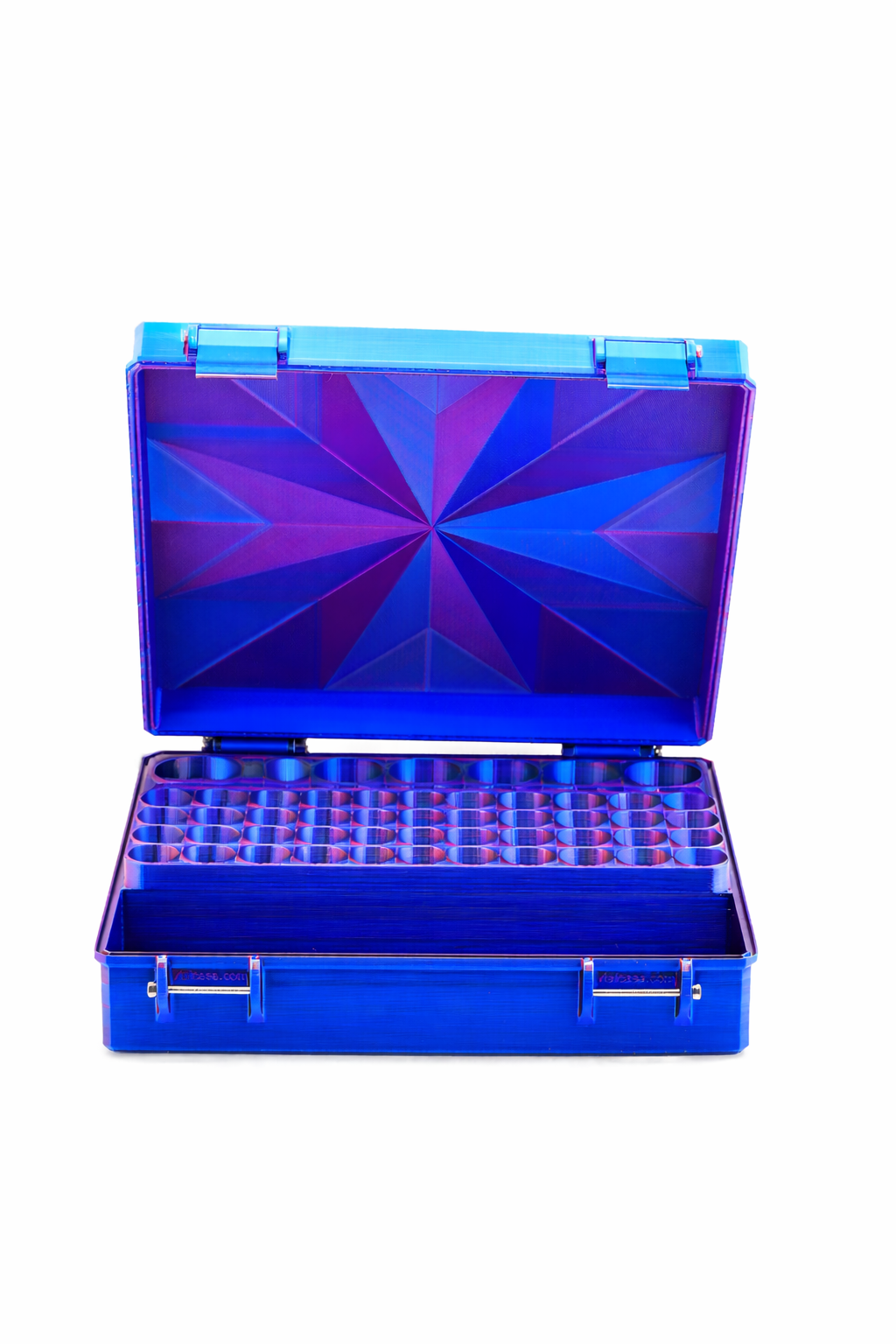
The key feature to look for in any multi-slot case: individual fitted slots that prevent vials from rattling and maintain their upright position, a light-blocking opaque shell, and a secure latch that won't pop open in the fridge or during travel. Generic pill organizers and Ziploc bags do not meet these criteria and are not adequate for peptide storage.
What Happens When You Confuse Compounds
It's worth being direct about this, because it's the main reason to take labeling and organization seriously. Here are the real consequences of mix-ups in common stacks:
- Injecting BPC-157 at a TB-500 dose: You're not getting the receptor activity TB-500 provides, and you're depleting your BPC-157 supply at 5-10x the intended rate. Practical effect: wasted compound, protocol disruption, cost of replacing the vial.
- Confusing CJC-1295 with Ipamorelin: Injecting double the dose of one GH secretagogue while getting none of the other undermines the entire synergistic mechanism of the stack. The GH pulse these compounds create together requires both components.
- Accidentally freezing a reconstituted vial: The compound is degraded, potentially to zero activity. You've lost whatever remained in the vial. For a 5mg BPC-157 vial at typical market prices, that's $40-80 gone.
- Using an expired reconstituted vial: Injecting degraded peptide is at best ineffective and at worst introduces degradation byproducts or contamination risk from a vial that was insufficiently preserved.
None of these outcomes are acceptable when you're spending hundreds of dollars on a protocol. The labeling and organizational system described in this guide takes about 10 minutes to set up and prevents all of them.
This content is for informational and educational purposes only and does not constitute medical advice. Always consult a licensed healthcare provider before beginning any peptide or hormone protocol.