
Preparation Math Belongs With Your Label
How a vial is prepared and used depends on the specific product, its concentration and your own instructions, and the right place for that math is your product label and your pharmacist or provider, who know exactly what you have. A generic web calculator can't, and a wrong number from one isn't worth the risk.
What a calculator can work out well is the physical side: vials, bottles, supplies and the case that holds them. The calculator on this page answers the question that comes up every time a kit grows: what size case do I actually need?
Calculate the case your kit needs
Add each vial, bottle and supply with its count, and the builder works out the layout and the exact case size.
The Case Size Calculator: How It Works
The PeptideCase™ builder works like a case size calculator. You tell it what you carry and how many of each, and it works out the rest:
- The layout. Auto-arrange places every item in the most compact arrangement it can find.
- The footprint. The builder shows the case length and width.
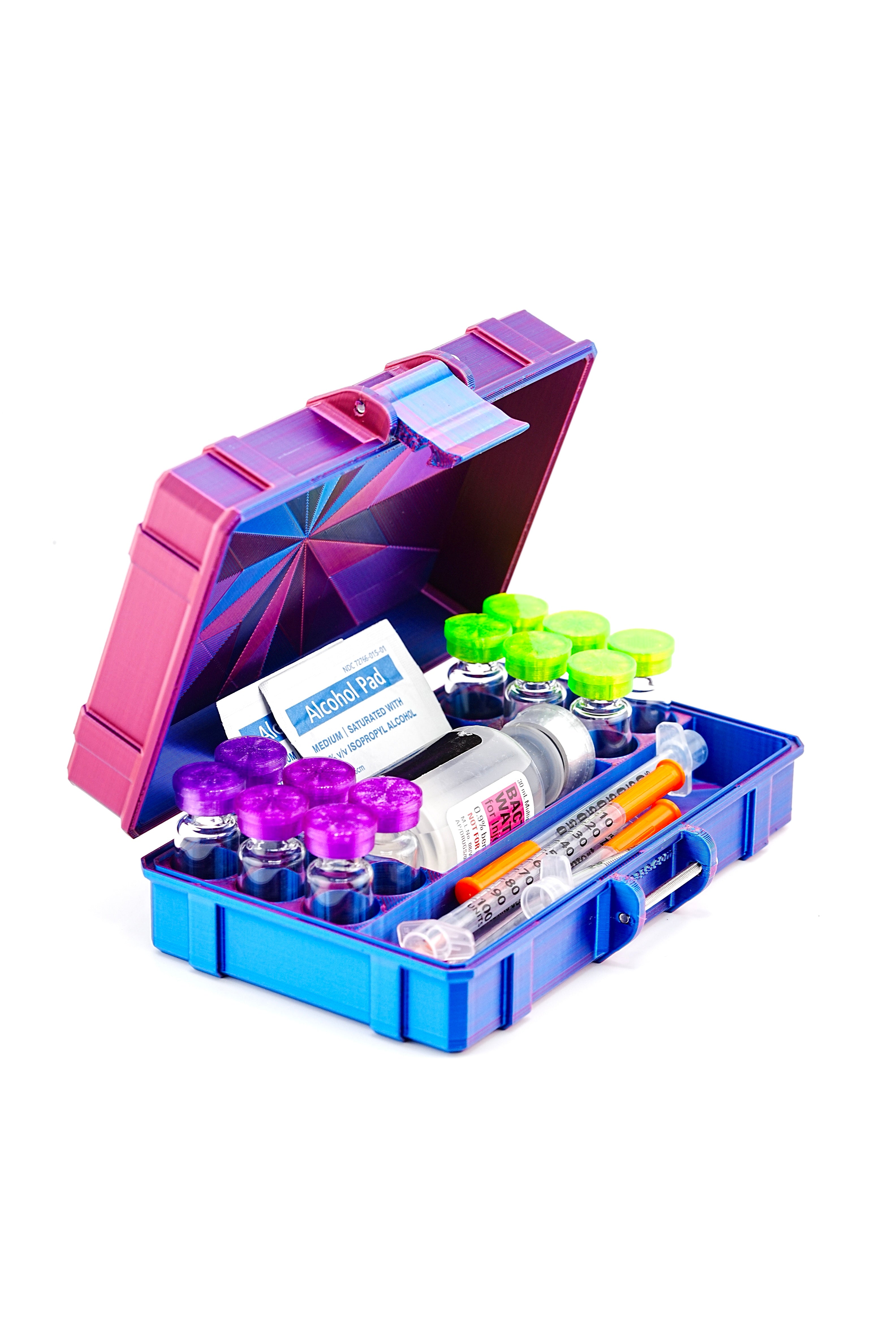
- The height. The tallest item sets the case height; shorter vials stand on a raised floor so every vial top lines up at the rim.
- What it holds. A summary of everything inside, plus a top view, a lid view and a 3D view you can open, unlatch and drag to turn.
The size shown is exactly what gets built, so you can check it against a fridge shelf, a drawer, a bag or a travel cooler before you order.
What to Enter: Your Inputs
The only inputs are the items you carry and how many of each. Start with an empty case, tap "Add item" and choose from:
- Vials: 3 mL vials, 10 mL vials, peptide vials, TRT vials, glutathione vials or other size vials
- Supplies: syringes, alcohol pads (flat or standing) and a BAC water bottle
- Pens: a peptide pen, an injector pen or pen cartridges
- A custom space: you enter its width, depth and height
- A temperature sensor: a clip-in window in the lid, or a socket inside the case, for a small digital thermometer
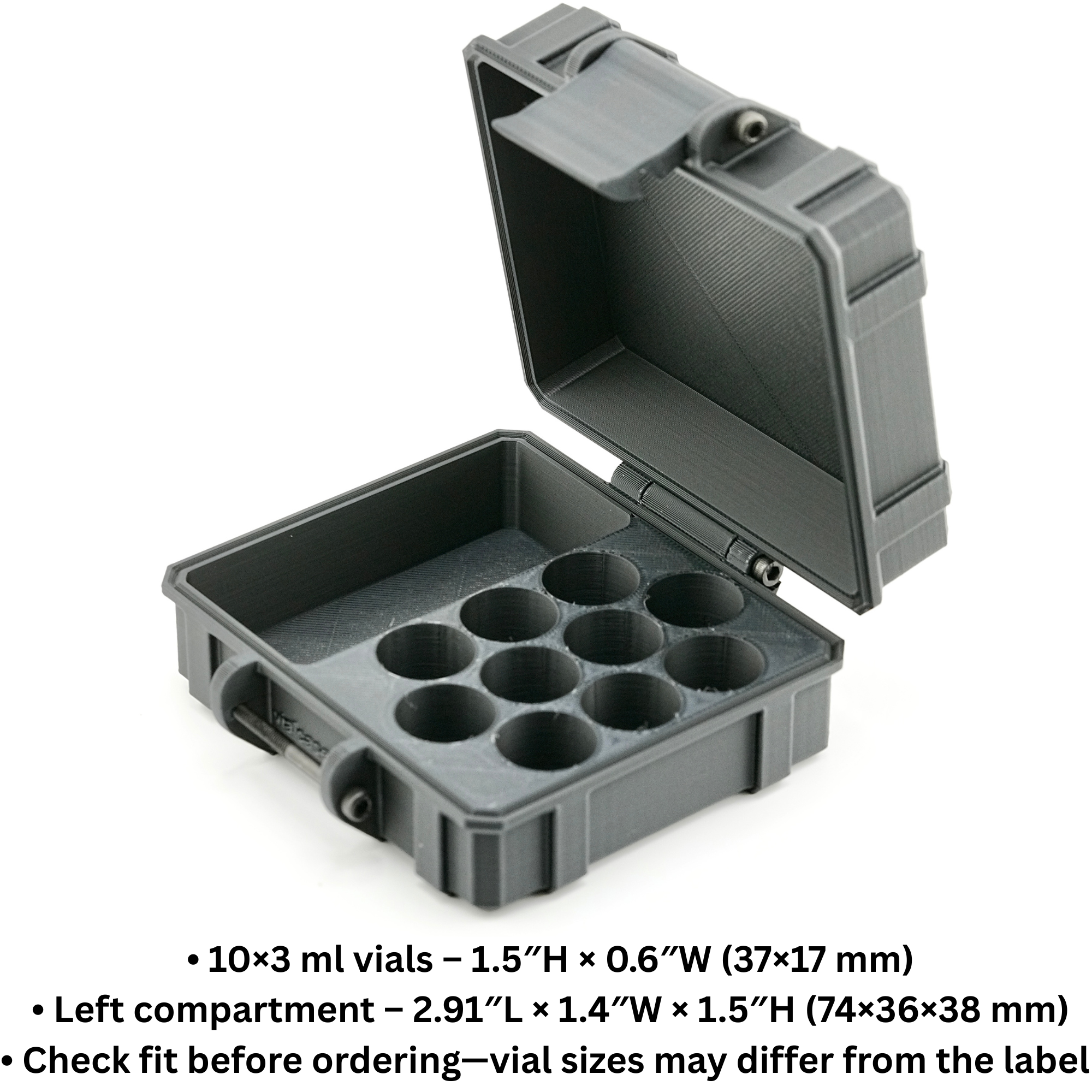
Every item becomes fitted pockets or an open bay sized for that many, and every storage space gets a finger scoop, so each item is easy to lift out.
Storage Matters as Much as the Math
Whatever your instructions say about preparing a vial, the vial still has to live somewhere afterward. Loose vials on a fridge shelf break, roll and get confused with each other. A few habits keep a kit tidy:
- One case, one spot. Everything lives in the same case on the same shelf.
- Label every vial with the product name and the date you opened it, and follow your label or pharmacist for how long an opened vial can be used.
- Color-code the caps so each product has its own color.
- Follow your label for temperature. A case is a protective organizer, not a cooler; it can sit in a fridge or go inside a cooler.
Color-code your vials
Custom snap-on caps for 3 mL or 10 mL vials, with a cap color plus an icon or letters. Sets from 25 caps.
A Kit Workflow That Works
- Get your instructions from the source. Your product label and your pharmacist or provider cover preparation, use and storage conditions.
- List your kit. Every vial by size, the bottle, the supplies.
- Size the case. Enter that list in the builder and let Auto-arrange work out the layout and dimensions.
- Label and color-code. Names and open dates on every vial, a cap color per product.
- Keep a simple log of open dates and refills, in a notebook or a phone note.
Build your own custom case from your kit list
Here's the calculator in practice. Say you keep four 3 mL vials, two 10 mL vials, a BAC water bottle, a few syringes and some standing alcohol pads. Add each one in the builder with its count, and every item becomes fitted pockets or an open bay sized for that many. The BAC water bottle is the tallest, so it sets the height, and the 3 mL vials stand on a raised floor to meet it at the rim.
Auto-arrange packs it into the most compact layout and shows the length, width and height. Then choose Black or RGB Metallic, a Wide or Deep shape and one latch or two, and add text, an icon or your own SVG logo to the lid if you like. It's printed to order in the US at exactly the size shown.
Calculate your case size in the builder