
Quick Answer: Check the Label on Your Bottle
Whether a bottle of BAC (bacteriostatic) water needs the fridge is printed on its label, and that's the instruction to follow. Storage instructions vary by product and maker, and they can differ for unopened and opened bottles, so read both parts of the label. If anything is unclear, ask your pharmacist.
What the label doesn't tell you is where the bottle should live in your kit. That's the part people get wrong: the bottle ends up lying on its side in a drawer, rolling around a fridge shelf or rattling against vials in a bag. This guide covers that side of BAC water storage.
Give your BAC water bottle its own bay
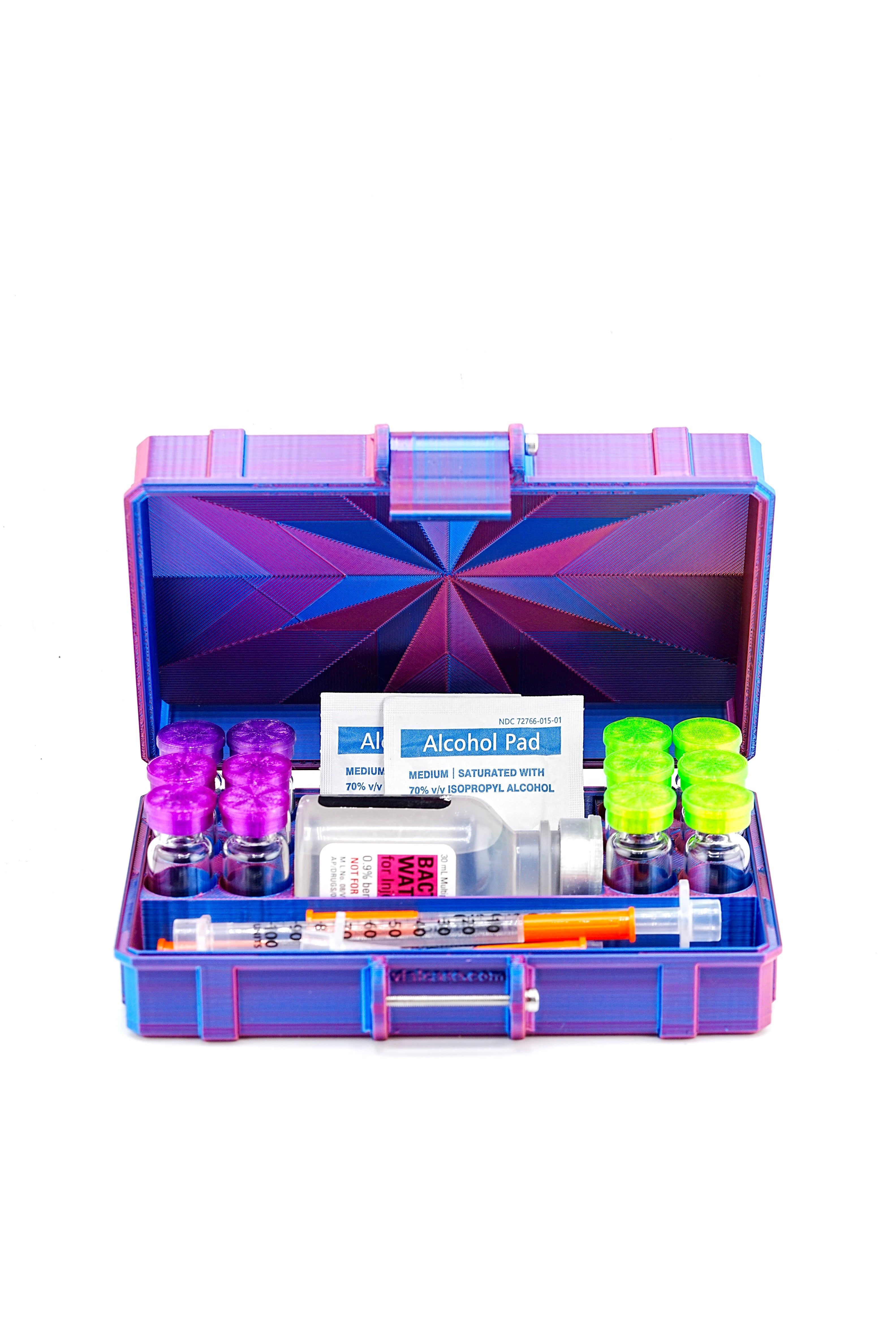
Add a BAC water bottle and your vials, and the builder lays out a case where the bottle has a bay and every vial top lines up.
What a BAC Water Bottle Is, Storage-Wise
Physically, a BAC water bottle is a glass vial with a rubber stopper and a crimped aluminum cap, usually 10 mL or 30 mL. That makes it noticeably taller and wider than the 3 mL vials most peptides come in, which is exactly why it never fits a standard vial slot. In a case full of 3 mL pockets, the BAC water bottle is the thing left loose.
It's also glass, so it chips and cracks like any vial. A bottle that rolls off a shelf or knocks against other vials in a bag can crack at the neck or the base.
Unopened vs Opened Bottles: Keep Track of Dates
Once you have more than one bottle, it's easy to lose track of which one is open and since when. Two simple habits fix that:
- Write the open date on the bottle. A small label or a strip of medical tape works. Follow the label or your pharmacist for how long an opened bottle can be used, and never use one past its printed expiration date.
- Keep unopened bottles separate. Store spares in their box or a separate row of the case, so the open bottle is always the one in the same spot.
If Your Label Says Fridge, or Room Temperature
If the label calls for the fridge, keep the bottle upright on an interior shelf, away from the door, in the same case as your vials. The door gets jostled every time it opens, and a tall bottle in the door rack is the first thing to fall out.
If the label allows room temperature, keep the bottle in a cool, dark cupboard, not on a sunny windowsill or in a steamy bathroom, and still keep it upright in a case so it can't roll.
Either way, remember that a case is a protective organizer, not a cooler. It doesn't change the temperature; it keeps the bottle safe wherever the label says it belongs.
Storing BAC Water Alongside Peptide Vials
Most people keep the bottle with the vials it's used alongside, which makes sense: one case, one spot, everything together. The catch is the size difference. To store them together well, you need:
- A bay sized for the bottle, not a 3 mL slot it can't fit or an open corner it slides around in.
- Pockets for each vial, so the small vials stay upright and apart.
- Tops at a usable height. When a short vial sits next to a tall bottle in a flat case, the short one is hard to grab.
- Room for supplies such as alcohol pads, if they live with the bottle.
Label every vial and the bottle, and keep each one in the same place every time, so a gap tells you instantly that something hasn't been put back.
Check the Bottle Before You Use It
Look at the bottle itself: cracks or chips in the glass, a crimp cap that's loose or lifted, or a stopper that looks pushed in or torn. Check the expiration date, too. If the container is damaged, the bottle is expired, or anything about it looks off, don't guess; set it aside and ask your pharmacist.
Packing BAC Water for Travel
Pack the bottle in your carry-on, in its original labeled packaging where possible, upright in a hard case. A 10 mL or 30 mL bottle is well under the 3.4-ounce TSA liquids limit, and medically necessary liquids are allowed in larger amounts if you tell the officer at the start of screening. Check TSA's and your airline's current rules before you fly. If your label calls for cold, the closed case goes inside an insulated cooler. Our peptide travel checklist covers the rest.
Design your own custom case with a BAC water bay
The PeptideCase™ builder treats the BAC water bottle as an item of its own, so it gets a bay sized for it instead of being squeezed into a vial slot. Start with an empty case, tap "Add item" and choose a BAC water bottle, then add the vials that go with it (3 mL vials, peptide vials, 10 mL vials or other size vials) plus syringes and alcohol pads, flat or standing, if you keep them together. Every item becomes fitted pockets or an open bay sized for that many, with a finger scoop in every space.
Because the bottle is usually the tallest item, it sets the case height, and the shorter vials stand on a raised floor so every top lines up at the rim, easy to grab. Auto-arrange packs everything into the most compact layout, and the builder shows the exact size and a 3D view before you order.