
Why Hard Shell Matters for Peptide Storage
The case for a peptide hard case starts with what's actually in your bag: small glass vials with thin necks, rubber stoppers and aluminum crimp caps. A cracked vial or a broken stopper is not a slow problem. The moment the glass gives, whatever was inside is gone, and so is the money you paid for it.
Borosilicate glass, the standard material for peptide vials, handles chemicals and temperature changes well, but it is brittle. A 3 mL vial dropped onto a tile floor will break. Two vials that knock together in transit chip each other's lips. A stopper that takes a side impact can lift or crack its crimp seal, and a damaged seal is something you may not notice until you look closely.
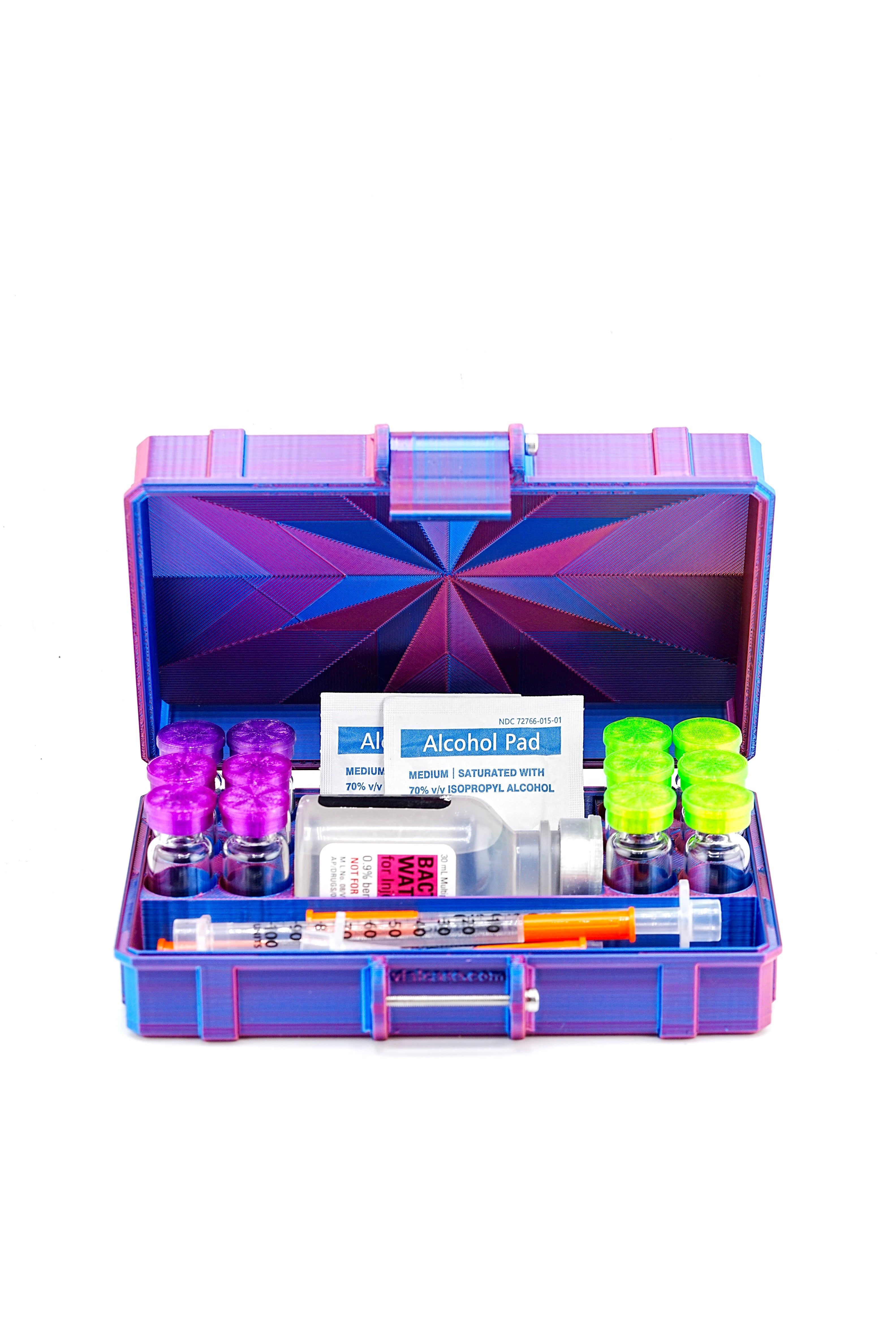
Hard shell cases address all of these failure modes at once. A rigid outer shell takes the impact before it reaches the glass. Fitted interior pockets hold each vial upright and apart, so no vial-to-vial contact is possible. A closed, solid shell keeps the vials out of light and out of sight. A secure mechanical latch stops the case from popping open in a bag and spilling everything.
Design a hard case around your vials
Add your vials, pens and supplies, and the builder lays out a hard case with a locking latch and a fitted pocket for each one.
This is not a luxury feature. Carrying glass vials without a proper peptide hard case is the equivalent of transporting fine wine in paper bags. What's inside is too expensive and too fragile to leave unprotected.
What Hard Shell Actually Means
The term "hard case" gets applied loosely in the market. Here's what each material category actually delivers.
ABS Hard Shell (True Hard Shell)
Acrylonitrile butadiene styrene (ABS) and similar rigid thermoplastics are the genuine article. ABS is used in professional instrument cases, device housings and industrial equipment containers for one reason: it keeps its shape under impact, temperature swings and compressive load. When you squeeze a rigid plastic case, it does not flex. When you drop it, the shell absorbs the energy instead of passing it straight to the contents, and it doesn't soften or warp in a warm car the way a foam case can.
A true hard shell peptide case pairs that rigid exterior with interior pockets shaped for vials, not loose foam blocks or fabric loops, so each vial sits in an exact position with no play. Rigid walls plus fitted pockets is the combination that earns the label "peptide hard case" without qualification.
Soft Neoprene Cases (Not Hard Shell)
Neoprene is a synthetic rubber used in wetsuits and laptop sleeves. It is cushioning, not protection. A neoprene peptide case will soak up minor vibration but has almost no compressive resistance. A heavy textbook placed on a closed neoprene case will squash it until the vials inside are carrying the load. In an overhead bin, a bag of clothes on top of a neoprene case can produce enough force to crack a vial. Thin neoprene also lets light through. These cases are marketed as travel-friendly because they are light and packable, but they are not appropriate for glass vials under any conditions.
EVA Foam Shell Cases (Marginal)
Ethylene-vinyl acetate (EVA) foam cases sit in the middle. EVA is denser than neoprene and holds its shape better at room temperature. It provides real cushioning and some compressive resistance when nothing is pressing on it. The problem is "some." EVA gives under sustained load, not as dramatically as neoprene, but enough to pass force to the vials. Cold makes EVA stiffer, and repeated trips in and out of the fridge can crack it along seams and fold lines. EVA cases are fine for light home use on a fridge shelf. They are not suitable as travel cases, and not reliable anywhere outside forces are likely. EVA is better than nothing; it is not a substitute for a true hard shell.
The 4 Things a Peptide Hard Case Must Do
Regardless of brand, price point or marketing claims, every peptide hard case must pass four functional tests. Cases that fail any of them are not fit for purpose.
1. Crush Resistance Under Load
Place the closed case on a flat surface and set a heavy book or a few cans on top for a minute. When you open the case, every vial should be exactly where you placed it, with no sign of the shell or the pockets bending. If the shell visibly compressed, the vials were under load. If a pocket shifted, the vial was moving. A true peptide hard case shows no deformation and no pocket movement under this test.
2. Complete Light Blocking
Many vial labels say to protect the contents from light, and the simplest way to do that is to keep vials in a closed case with solid walls. Check yours: close the case in a dark room, shine a bright flashlight against the shell and the seams, and look for any glow on the inside. Clear lids, mesh panels and thin fabric all fail this check. Whatever your label says about light, a solid, fully closed shell makes it easy to follow.
3. Positive-Click Mechanical Latch
The closure must engage with a definite mechanical click and stay shut when you squeeze the case. Grip it firmly: no accidental release. Then press sideways on the seam where the two halves meet: no gap should open. A zipper alone, a magnet alone, or a snap that opens with a fingernail is not enough for travel. The closure has to survive the case being dropped, squeezed and knocked against hard surfaces.
4. Correct Internal Dimensions for 3ml or 10ml Vials
A typical 3 mL vial is roughly 16 mm across and about 35 mm tall without the stopper; a typical 10 mL vial is roughly 23 mm across and about 50 mm tall. Pockets a few millimeters wider than the vial allow enough sideways movement for vial lips to chip on each other. Pockets that are too narrow stress the glass every time you push a vial in or pull it out. Measure your own vials, ask the maker for the pocket dimensions before buying, or choose a case that is built around your vial sizes. "Fits vials" is not a specification. For the full size comparison, see 3 mL vs 10 mL vials.
How We Ranked These Cases
Five criteria, weighted by how much they matter in daily use:
- Shell rigidity (hardness test): does the shell flex under hand pressure, and how much? The less it gives, the less force reaches the glass.
- Light blocking: does any light get through the closed case? Checked with a bright flashlight against the shell and seams.
- Vial fit precision: do your vials sit upright and still in their pockets, or is there sideways play? Checked with standard 3 mL and 10 mL glass vials.
- Travel form factor: does it fit in a TSA checkpoint bin without fuss? Is it compact enough for a backpack pocket or a small carry-on?
- Value for what you carry: does it hold exactly what you need, or are you paying for empty slots and carrying a bigger case than necessary? Are your supplies included in the layout, or do they need a second container?
Best Peptide Hard Cases Ranked (Worst to Best)
Rank 5: Generic Amazon Hard Shell Cases
Shell material: varies (often thin ABS or an ABS/EVA hybrid) | Verdict: Do not use
The generic hard shell category on Amazon covers dozens of listings that share one flaw: they are not designed for vials. Their foam is pre-cut into rectangular blocks or generic round cutouts that don't match standard 3 mL vials. A typical cutout is far wider than the vial, so the vial rocks in every direction. That guarantees movement, stopper contact and glass-on-glass chipping in transit.
The shell on budget cases is often a thin plastic skin over an EVA interior, which means it looks rigid but compresses. Hinges and latches are generally weak and loosen with regular use. Light blocking is inconsistent, and many let light in at the seams. These cases look cost-effective. They are not, because they fail at exactly the moment that matters.
Rank 4: Pelican-Style Generic Hard Cases
Shell material: heavy-duty ABS or polypropylene | Verdict: Overkill with poor vial fit
Pelican-style cases, and their generic equivalents, are genuinely excellent at what they're designed for: protecting cameras, electronics and instruments in harsh environments. The shell is true hard shell. The latches are mechanical and robust. Gasket seals keep moisture out. If you need to drop a case from head height onto concrete, a Pelican-style case handles it.
The problem for vials is interior fit. These cases use pick-and-pluck foam: layers of pre-scored foam you tear out to make a cavity. What you get is a ragged foam pocket that doesn't hold a vial cleanly upright, with torn edges that press unevenly on the glass. They are also bulky, built as transport cases rather than everyday carry. You pay more than a purpose-built vial case costs and get worse vial protection. The shell quality is excellent; the vial-specific fit is poor.
Rank 3: Ready-Made 10-Slot Compact Hard Case
Shell material: rigid plastic hard shell | Capacity: 10 x 3 mL vials | Verdict: Solid entry-level hard case
A compact ready-made case with ten molded 3 mL slots ranks third not because a good one lacks shell quality, but because of capacity and layout. Ten slots suit someone who keeps one kind of vial plus a few spares. Add a BAC water bottle, syringes or a second kind of vial and it fills quickly, or you end up carrying the extras in a separate pouch.
When the shell is genuinely rigid, the slots are molded for 3 mL vials and the latch is a real mechanical snap, this is proper hard-case protection in a small package. The limits are slot count and the fixed layout: every slot is the same 3 mL size, so 10 mL vials, pens and supplies have nowhere to go.
Rank 2: Ready-Made 10-Slot Case with an Accessory Compartment
Shell material: rigid plastic hard shell | Capacity: 10 x 3 mL vials + an open compartment | Verdict: Better for people who carry supplies
Adding an open compartment answers the most common complaint about single-zone vial cases: where do the syringes, alcohol pads and BAC water go? With the supplies in their own compartment, all ten vial slots stay free for vials. If you keep two kinds of vials, you can carry the in-use vials, a spare of each and your supplies in one organized hard-shell package.
The extra compartment adds some thickness but barely changes the footprint, so it still fits a backpack main compartment or a gym bag pocket. The trade-off is that the compartment is one open space: supplies slide around inside it, and the layout is still built for someone else's kit, not yours.
Rank 1: A Custom Case You Design Yourself (PeptideCase™ Builder)
Shell: 3D printed hard case with a print-in-place snap hinge and locking latch | Capacity: whatever you add | Verdict: Best peptide hard case overall
The top spot goes to the only option on this list that is built around your kit instead of an average one. In the PeptideCase™ builder you start with an empty case, tap "Add item" and pick what you carry and how many: 3 mL vials, 10 mL vials, peptide vials, TRT vials, glutathione vials, other size vials, syringes, alcohol pads (flat or standing), a BAC water bottle, peptide pens, other pens or pen cartridges. Every item becomes fitted pockets or an open bay sized for that many, so you're not paying for empty slots or squeezing a bottle into a pocket that was never meant for it.
The tallest item sets the case height, and shorter vials stand on a raised floor so every vial top lines up at the rim, easy to grab. Every storage space has a finger scoop. Auto-arrange works out the most compact layout, and the builder shows the case length, width and height and what it holds, with a top view, a lid view and a 3D view you can open, unlatch and drag to turn.
You choose Black or RGB Metallic, a Wide shape (hinge on the long side) or a Deep shape (hinge on the short side), and a single latch or dual latches. Big cases get a 5-knuckle hinge and two latches automatically. The case is printed to order on the maker's own print farm in the US, and the size shown is exactly what gets built.
Pro Tip: If your case flexes when you squeeze it, it's not hard shell; it's marketing. A true hard case feels like a solid block in your hand, not a CD jewel case. If you can see foam compressing through any panel, the vials inside are not protected from crushing.
Hard Shell for Travel vs. Home Storage
Your choice of peptide hard case should reflect where it actually spends its time. The requirements differ in ways that matter.
Travel Hard Shell Cases
Travel brings forces home storage never sees. A carry-on in an overhead bin may have several heavy bags on top of it. A backpack tossed onto an airport seat takes a sharp jolt. Hours of road vibration add up to thousands of small knocks. At the checkpoint, your case rides a conveyor and may be handled by someone who doesn't care which way up it goes.
A travel hard case needs to be compact enough for security bins and overhead bins, with the strongest latch you can get, because travel is when an accidental opening does the most damage. It also helps at screening: a clean case that opens to organized vials in fitted pockets is quick to inspect, while a loose bag of vials and supplies invites a longer look. Keep items in their original labeled packaging where you can, carry your paperwork, and check current TSA and airline rules. The case is part of your travel strategy.
Home Storage Hard Shell Cases
Home storage relaxes some requirements and tightens others. Portability matters less; capacity and organization matter more. A home case can be larger than carry-on size and can put slot count ahead of a slim profile. What it faces is constant handling: in and out of the fridge or cupboard, past jars and food containers, opened by more than one person in a shared kitchen. The latch can be a little less critical, since the case isn't being carried, but it still needs to close securely.
If you keep a lot of vials at home, consider two cases: a compact one for what you're using now and a second for spares. That keeps the everyday case small and quick to open, while the spares stay together and untouched. For temperature, follow the storage instructions on your product label or from your pharmacist or provider; a hard case is a protective organizer, not a cooler, and it can sit on a fridge shelf if that's what your label calls for.
What Breaks First in Soft Cases
Understanding how non-hard-shell cases fail makes the case for a genuine peptide hard case concrete rather than theoretical.
Zipper Pull Failure
The zipper on a soft case is the highest-stress point in the design. It's pulled open and closed many times a week, often while cold and stiff from the fridge. Soft-case zippers commonly start to fail at the pull or the slider with regular use. A partly failed zipper doesn't close fully, leaving a gap. A fully failed one can tear out of the fabric. When a soft case zipper fails inside a bag, the vials are loose and unprotected.
Neoprene and Fabric Tears
Neoprene tears where stress concentrates: corners, strap attachments, and anywhere a sharp edge such as a syringe cap or a vial lip keeps rubbing the inside. The tear usually grows for a while before you notice it, and the area around it has been giving less cushioning the whole time. Fabric cases split at the seams when overpacked. Once a tear starts, neither material gives any structural protection.
No Light Blocking
Soft cases, almost universally, do not block light. The fabric that makes them flexible is thin enough to glow when you hold it up to a lamp. A fabric pouch on a fridge shelf near a window, or on a sunny counter, lets light reach the vials all day. If your label says to protect the contents from light, a fabric pouch doesn't do that job, and no amount of careful handling changes it. This is a material problem, not a quality problem.
Foam Compression Over Time
EVA and polyurethane foam take a permanent set with repeated use. At first, the foam springs back every time. After many openings, the foam around the most-used vials has flattened, and a pocket that once held a vial snugly now lets it wobble. Eventually every pocket in a foam-lined soft case has the same problem, and the vials that used to be held still are rattling on every trip to the gym.
Make your own custom peptide hard case
Ready-made hard cases make you fit your kit to their layout. A custom case flips that. Open the builder, start with an empty case and tap "Add item" for each thing you carry: maybe six 3 mL vials, two 10 mL vials, a BAC water bottle, syringes and standing alcohol pads. Need room for something unusual, like a small spray bottle or a pen? Add a custom space and type in its width, depth and height.
Auto-arrange packs it all into the most compact layout, every vial top lines up at the rim, and every storage space gets a finger scoop. Check the top, lid and 3D views, then pick Black or RGB Metallic, Wide or Deep, and one latch or two. You can also print one or two lines of text, an icon or your own SVG logo into the lid in a second color, and the builder checks it is thick enough to print sharply. Cases too big to print in one go are printed as two parts, lid and base. Add to cart sends your design to the vialcase.com cart for checkout.
Build your hard case around your vials
The Bottom Line
If you've been using a neoprene case, a fabric pouch, a zip bag or a generic foam case for your vials, you're accepting a breakage risk that's entirely within your control to remove. A proper peptide hard case is not an upgrade; it's the baseline for any kit worth protecting.
The ranking is clear. A case you design yourself is the best peptide hard case for most people: a hard shell with a locking latch, a fitted pocket or bay for every item you actually carry, and a size that's exactly as big as it needs to be. If you only ever carry ten 3 mL vials, a good ready-made 10-slot hard case covers the basics.
What you should not buy is anything ranked below those: not the generic Amazon cases that fail the fit test, not the Pelican-style cases that fail the vial-specific design test, and not any soft or EVA case that fails the most basic requirement of a peptide hard case, which is being hard.
For the complete decision framework, including 10 mL vial options, see our peptide cases buyer's guide. For travel-specific picks, see the best peptide travel case guide for 2026. For more on what hard shell options exist this year, see our hard shell case review.