
The Two Formats: What They Actually Are
When people compare vials with pre-filled syringes and pens, they're comparing two very different physical objects that can hold similar things. The format decides how fragile the product is, what supplies travel with it, and what kind of storage it needs. That's the starting point for everything in this comparison.
Glass Vials (The Vial Format)
A vial is a small glass bottle sealed with a rubber stopper and an aluminum crimp cap, usually with a plastic flip-off top. Vials come in common sizes, most often 3 mL and 10 mL, and some arrive as a liquid while others arrive as a powder. Either way, the contents are drawn out with a syringe, so a vial almost never travels alone: syringes and alcohol pads come with it.
Vials are the standard format for compounded GLP-1 prescriptions, TRT and many other products. They're simple, but they are glass, and glass needs protecting.
One case for your vials and pens
Add 3 mL or 10 mL vials, pens, cartridges and supplies. The builder fits them all into one compact hard case with a fitted space for each.
Pre-Filled Syringes and Pens (The Pen Format)
A pre-filled syringe or pen arrives with the contents already inside a plastic device, ready to use, usually with a dial and a cap. Many brand-name GLP-1 products come in this format. A pen has a sturdy body, it usually ships in a carton, and it uses small pen needles instead of separate syringes.
In general, the pen format is typical of brand-name products, while the vial format is typical of compounded and pharmacy-dispensed products. Plenty of people end up with both at different times, or both at once.
Storage Requirements: Where the Formats Diverge Most
Storage is where the two formats feel most different day to day, and it's where people make mistakes by assuming one follows the other's rules.
Vial Storage
Every vial product comes with its own storage instructions, and they can be quite different from a pen's. Follow the storage instructions on your product label or from your pharmacist or provider: that covers temperature, light, freezing and how long it can be used after opening. Confusing one product's rules with another's is one of the most common storage mistakes.
What vials have in common is handling. You take the vial out, use it and put it back, every time. A vial with a fixed spot in a case goes back in the same place without thinking. A loose vial ends up in the door, behind the leftovers or on the counter.
Pen Storage
Pens come with a package insert that spells out how to store them before and after first use, and those rules can change once a pen is in use. Read the insert for your exact product rather than relying on what a friend's pen allows.
Pens are tougher than vials, but they still roll around the fridge, get crushed in bags and get left in hot cars. A spare pen or two plus pen needles is still a small kit worth keeping together.
Pro tip: Whatever your label allows, heat is the universal enemy. A parked car, a bag in the sun or a hot bathroom can get far warmer than most labels allow. If you're traveling in summer, plan for a cooler bag with ice packs whether you carry pens or vials.
Head-to-Head Comparison: Vials vs. Pens Across Key Dimensions
| Dimension | Glass vials | Pre-filled pens |
|---|---|---|
| Breakage risk | Higher: glass can chip or crack | Lower: plastic body and cap |
| Light protection | Often none unless you add a case | Usually a carton |
| Supplies that travel with it | Syringes, alcohol pads, sharps container | Pen needles |
| Storage rules | On the product or pharmacy label | On the package insert |
| Space in a bag | Several small items to keep together | One larger item |
| Needs a case? | Yes, at home and on the road | Helpful, especially for travel |
Breakage Risk
- Vials: Glass on glass in a fridge drawer, a drop from the counter, or a heavy bag can chip or crack a vial. A cracked vial is no longer sealed the way it was made.
- Pens: The plastic body takes knocks well, although a pen can still be crushed or cracked under real weight.
Light Protection
- Vials: Many labels say to protect the contents from light. A bare vial on a fridge shelf is lit every time the door opens, so a closed case does real work here.
- Pens: Most pens come in a carton, and keeping them in it or in a case covers the same need.
Supplies and Organization
- Vials: A vial kit is several items: the vials themselves, syringes and alcohol pads. If you keep more than one vial, labeling matters too. This is where loose storage falls apart fastest.
- Pens: Fewer pieces: the pen, its cap and pen needles. Easier to keep together, though spares and needles still go missing.
Travel Convenience
- Pens: Compact and sturdy. Check your package insert for what it says about storage away from the fridge.
- Vials: Need a hard case to survive a bag, and if your label calls for refrigeration, a cooler bag with ice packs around that case. Several vials and their supplies take more planning than one pen. See our TSA travel guide for the checkpoint.
Pro tip: If you travel with vials and want pen-like convenience, the answer isn't to change formats; it's to pack smarter. A hard case with a fitted pocket for every vial and supply, inside an insulated cooler bag with ice packs, makes vials just as easy to carry. The case protects; the cooler bag and ice packs handle temperature.
Why Most Kits End Up Full of Vials
Outside brand-name pens, most products people keep at home come in vials. Vials are cheap to make, easy to fill in different amounts, and standard across pharmacies, so it's common to end up with several of them, often in two sizes.
That creates an organization problem pens rarely do. Two 3 mL vials and a 10 mL vial look alike from above in a dim fridge. Without fixed positions, labels or a color system, it's easy to grab the wrong one. Without separate pockets, they knock together every time the drawer opens.
Bottom line: if you keep more than one or two vials, you need a storage system designed for vials, not a pen pouch. Our guide to labeling vials covers the labeling side; colored caps are another quick way to tell vials apart.
Color-code your vials
Custom snap-on caps for 3 mL or 10 mL vials, with a cap color plus an icon or letters. Sets from 25 caps.
The Hidden Cost of Improper Vial Storage
Vials are practical, but only if they're stored well. The losses are rarely dramatic: a vial chips against another in the drawer, a vial sits in the fridge door for a week, a vial rolls behind the groceries and gets forgotten, a vial gets swapped for its look-alike. Each one means a replacement, a call to the pharmacy and a gap you didn't plan for.
A good vial case costs less than replacing a single vial and protects every vial you keep after that. It handles breakage, light exposure when the fridge opens, and the disorganization that leads to grabbing the wrong vial. It doesn't handle temperature: that's the fridge's job at home and a cooler bag's job on the road.
This is the core reason vials need a dedicated case and pens often don't: vials are more fragile, they come with more pieces, and you usually have several of them. For more on fridge setup, see our fridge organization guide.
When a Pen Needs Less Storage
Pens aren't always the harder thing to store. There are situations where a pen kit is clearly simpler:
- A single pen in use. One pen in its carton on a fridge shelf needs little more than a consistent spot.
- Short trips. A sturdy pen and a few pen needles pack small, provided you follow the insert's storage rules for time away from the fridge.
- No spare supplies. With no syringes or alcohol pads to manage, there's less to lose.
The picture changes once you carry spare pens, pen cartridges, needles, or a pen alongside vials. Then you're back to a kit with several pieces, and a case that holds each one in place earns its spot.
The Practical Conclusion: Vials Need a Case, Pens Are Better With One
Pens are engineered to be handled: a sturdy body, a cap and a carton do a lot of the protecting for you. That's a real advantage when it comes to storage.
Vials are unprotected glass with a rubber stopper, often several at once, plus syringes and alcohol pads. They need a case that blocks light, keeps glass from touching glass, and keeps the whole kit organized so you always grab the right vial. On the road, that case goes inside a cooler bag with ice packs if your label calls for cold.
If you keep vials, a case isn't optional equipment. If you keep pens, it's the easiest way to carry spares and needles together. If you keep both, you want one case built for both.
Make your own custom case for vials and pens
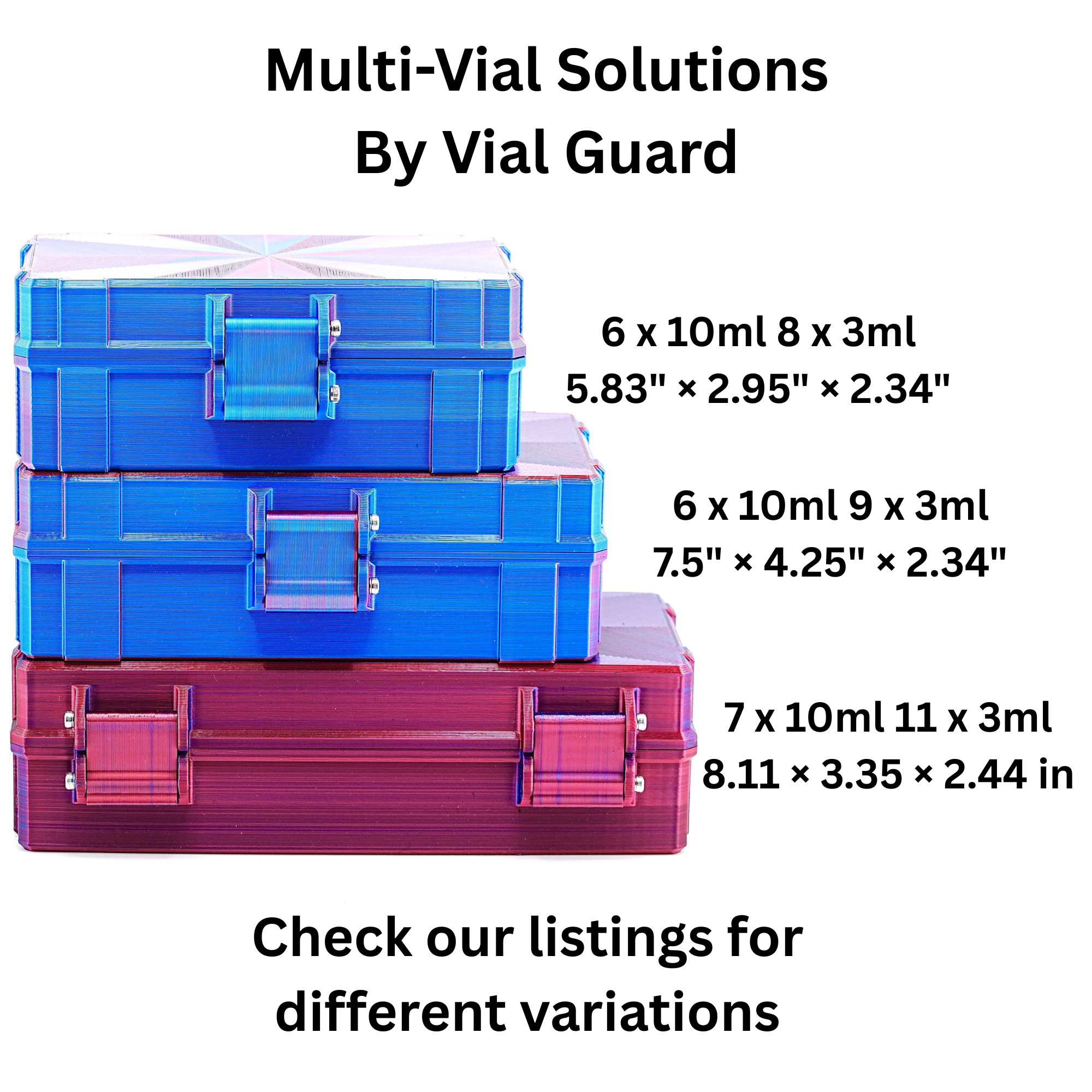
Most ready-made cases pick a side: vial slots or a pen pouch. The PeptideCase™ builder lets you have both in one hard case. Start with an empty case, tap "Add item," and pick what you keep and how many: 3 mL vials, 10 mL vials, other size vials, a peptide pen, an injector pen, pen cartridges, syringes and alcohol pads. Every item becomes fitted pockets or an open bay sized for that many, with a finger scoop in each space.
The tallest item sets the case height, and shorter vials stand on a raised floor so every top lines up at the rim. Auto-arrange finds the most compact layout and shows the case size, height and contents with top, lid and 3D views. Choose Black or RGB Metallic, a wide or deep shape, and single or dual latches on a print-in-place snap hinge. It's printed to order in the US.