
Why People Search for a "Peptide Bag"
The search term "peptide bag" or "peptides bag" comes from a reasonable mental model. Most people who keep peptide vials have some experience with medical or wellness products that come in bags: insulin kits, travel medicine pouches, supplement carry cases. The picture is of something portable, organized and made for carrying a kit. That instinct is entirely correct.
The vocabulary, though, gets in the way of finding the right product. When most people type "peptide bag" into a search engine, they want something that will safely carry and store their vials, syringes, BAC water and alcohol pads in one organized unit. What they find under "bag" (neoprene pouches, fabric rolls, cosmetic bags) are products that carry but don't protect. That's a real difference, and it shows up the first time a vial cracks in transit.
The better word is "peptide case." It changes which products appear, which features you compare and, ultimately, whether your vials survive the trip.
Design the case that goes in your bag
Add your vials and supplies and see the exact case size before you order, so it fits the backpack, gym bag or carry-on you already use.
What a "Bag" Actually Does vs. What Peptides Need
Bags transport. Cases protect. That sounds like a play on words, but it's a practical engineering difference.
A bag is a flexible container designed to hold things and make them portable. Rigidity isn't part of the design. It's allowed to flex, squash and take the shape of whatever presses on it, because its usual contents (clothes, groceries, books) aren't harmed by that. A bag's closure exists to keep things from falling out, not to resist a load pressing on it. Its walls aren't designed to keep light out or to keep items from touching each other.
Glass vials need exactly what bags don't provide: a rigid shell, individual separation, a closure that holds under pressure, light protection where the label asks for it, and materials that cope with living in a fridge. A small glass vial needs its container to hold it still while you move, and to survive being in a bag that someone inevitably drops a water bottle on. A fabric bag can't do any of that. A hard case can.
The 5 Types of Bags People Try for Peptides (And Why Each Fails)
Most people go through a predictable series of bag-type containers before they find a proper case. Here's the honest breakdown.
1. Cooler Bags and Lunch Bags
The reasoning is sound: if your label calls for cold, a cooler bag stays cold. The trouble is at the vial level. Cooler bags are designed for cans, bottles and food boxes, not for small glass vials with rubber stoppers. There are no individual vial slots, so vials roll around inside and knock into each other with every step. The insulated walls aren't always opaque, and many let light through when held up to a window. Most importantly, cooler bags offer no crush resistance: set a bag on top of a soft cooler and the weight goes straight onto loose glass. Cooler bags solve the temperature problem in isolation while leaving three others: vial movement, light and crushing.
2. Makeup Bags and Cosmetic Pouches
These are probably the most common improvised vial container. They're the right size, available everywhere, and some have inner pockets that look like they could work. The failure is structural. Cosmetic pouches are soft by design, and the same soft sides that make them easy to pack make them useless against pressure. A makeup bag with six vials at the bottom of a gym bag carries the full weight of everything above it straight to the glass. There are no individual slots, so glass touches glass, and light passes through most pouch fabrics. They fall short on every point that matters for vials.
3. Gym Bags and Backpack Pockets
Loose vials in a gym bag pocket aren't storage; they're controlled chaos. No vial separation, no crush resistance, no light protection. Vials bounce against keys, chargers and bottles with every step of a commute. Each knock is small; hundreds of them stress the glass, loosen stoppers and eventually crack a vial. Backpack pockets also go wherever you go, including hot cars and sunny benches, so they're a poor place for anything with storage instructions. Using a bag pocket as your vial storage is the fastest route to broken glass.
4. Insulin Travel Bags
Insulin bags are made for a different format: insulin pens, pen needles and lancets. They're well built for that job and fall short for vials for the same reason a hammer makes a poor screwdriver: wrong dimensions. A 3 mL vial is a different shape from a pen, and insulin bags are laid out for pens, so their pockets don't hold vials upright in individual slots. Many include cooling inserts designed around pens; whether that suits your vials depends on your label. If you use GLP-1 pens, an insulin bag may work for a while. For a vial-based kit, the layout is wrong.
5. Fabric Medical Pouches
Fabric medical pouches, like the ones used for small first-aid kits or medication rolls, look the part but miss on the details. They're usually too small for more than two or three vials plus a syringe, have no individual vial slots, use fabric walls that let light through, and close with zippers or Velcro that wear out with constant trips in and out of the fridge. The fabric also soaks up moisture in the fridge and stays damp against vials and labels. Some people like the size for carrying a single vial; for anything more, they fall short immediately.
What Peptides Actually Need From a Container
Strip away the marketing language and the requirements for a vial container are practical and specific. All five matter.
A hard shell for crush resistance. Glass vials can't survive pressure without a rigid wall between them and whatever is pressing. The walls shouldn't flex when you squeeze them. If you can press the sides and feel them move toward the vials, the case isn't protecting them from a packed bag or an overhead bin.
Solid walls where your label asks for light protection. If your vial label says to protect from light, the closed container shouldn't let any in: no translucent panels, no mesh, no gaps at the hinge. Test it by pressing a flashlight against the outside of the closed case in a dark room. If you see a glow inside, light is getting in.
Individual slots for vial security. Each vial needs its own slot sized to it, so it can't move sideways. Vials that move inside the case knock against each other in transit and rattle in storage. Pockets sized for your 3 mL or 10 mL vials stop that entirely.
A closure that holds under pressure. The closure has to keep the case shut when something presses on it, not just when it's sitting still. Zippers and Velcro don't meet that bar. A mechanical latch that clicks into place keeps the case shut upright, sideways or upside down under load.
Fridge-friendly materials and size. A container that lives in the fridge shouldn't soak up moisture, rely on glued seams or squash flat on the shelf. It should also fit the shelf it's meant for, so it doesn't end up in the door.
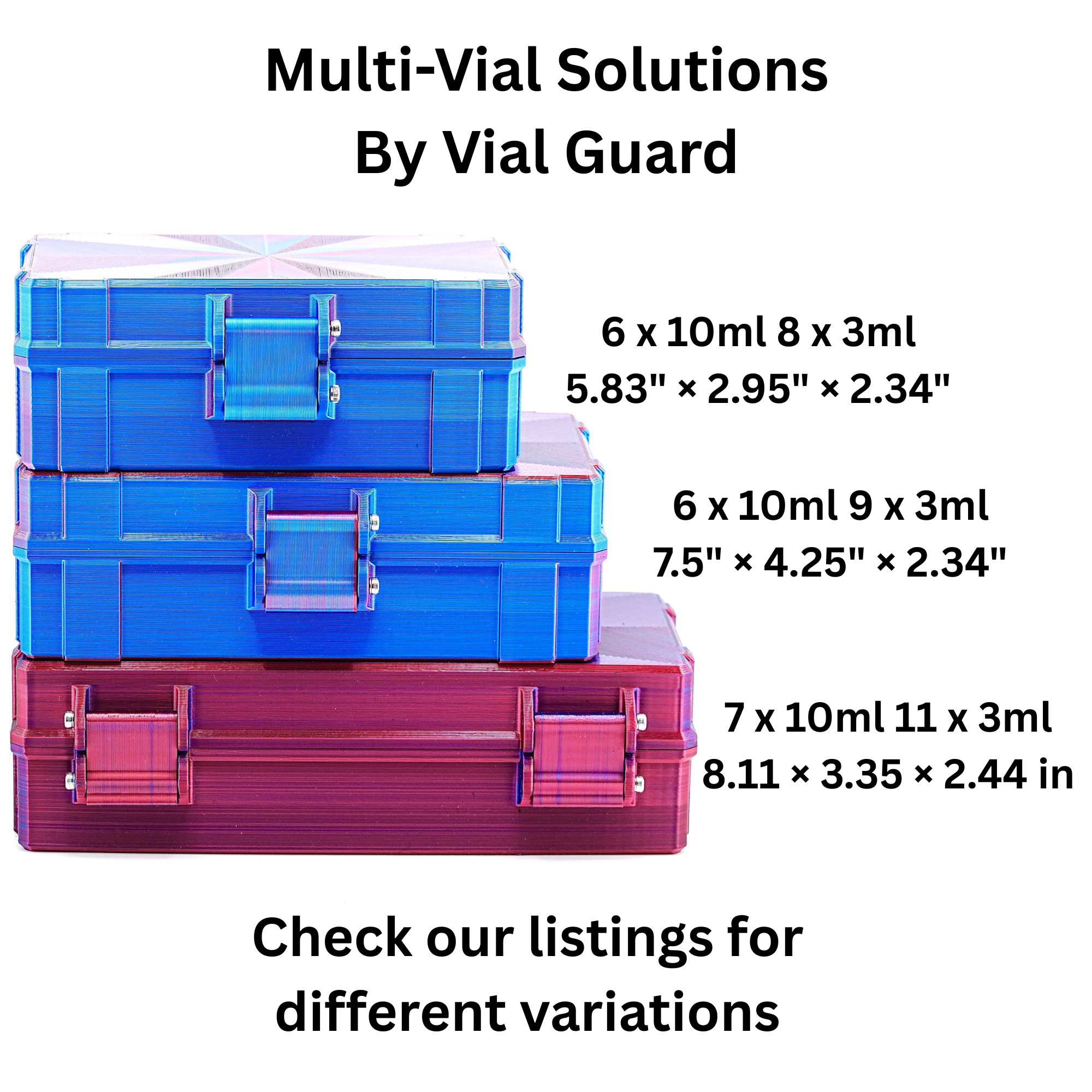
The Bag vs. Case Comparison
Here's the honest side-by-side of bag-type containers and hard cases with fitted pockets, on the points that matter for vials.
| Criteria | Bag-Type Container | Hard Case With Fitted Pockets |
|---|---|---|
| Crush Resistance | None: soft walls pass pressure straight to the vials | Rigid shell takes the pressure instead of the glass |
| Light | Partial at best; most fabric lets light through | Solid shell with a closed lid; check any case for leaks if your label says protect from light |
| Vial Security | Vials roll freely and knock together | Each vial held in its own pocket |
| Temperature | Cooler bags only; ordinary bags do nothing | Not a cooler either: it rides inside a cooler bag with ice packs |
| Fridge Fit | Slumps on the shelf, gets squashed, fabric stays damp | Holds its shape; you can check its exact size against the shelf |
| TSA Presentation | Loose vials in a bag invite a closer look | An organized case with labeled vials is easy to explain |
| Wear | Zippers fail, fabric frays, foam compresses | No zippers or Velcro: a hinge and a locking latch |
When a Bag Is OK (and When It's Not)
This isn't a blanket rejection of bags. There is one situation where a bag is the right choice, and several where it clearly isn't.
When a Bag Is Acceptable
A soft cooler bag used to carry vials when temperature is the main concern, say a two-hour drive with vials whose label calls for cold, is a sensible use of a bag, especially when the vials sit in a rigid inner case inside it. The bag handles temperature; the case handles protection. Used together, that's a legitimate setup.
When a Bag Is Not Acceptable
Any setup where a bag is your main storage is the wrong one. Vials rolling loose in any bag, cooler, fabric, cosmetic or otherwise, are one trip away from broken glass. Any arrangement that puts light on vials whose label says to protect from light works against that label. And any soft container used as the last layer of protection in a bag that gets squeezed is a cracked vial waiting to happen.
Bags also make airport security harder. A bag of loose vials and exposed syringes in a carry-on is a secondary screening scenario that slows you down and can end with items being taken. An organized case with labeled vials and syringes in their own spaces is what TSA officers see every day, and it's much easier to explain. The organization is part of your travel plan, not just your storage plan.
The Hybrid Solution: Use a Case Inside Your Bag
The right answer for most people who want portability isn't a bag instead of a case. It's a case inside a bag. You keep the convenience of your gym bag, backpack or carry-on, and the vials inside get the full protection of a hard shell.
A hard case is self-contained protection. It holds the vials still, resists pressure from everything around it in the bag, and stays shut whatever gets piled on top. The bag carries the case. The case protects the vials. Each does the job it was built for.
This is how experienced people actually carry vials. The case is the constant: it goes wherever the vials go, inside whatever bag suits the day, whether that's a backpack, a gym bag, a carry-on or a messenger bag. It's never the bag alone.
Pro Tip: If you're looking for a "peptide bag", what you actually want is a compact hard case that fits inside a bag. The case protects the vials; the bag carries the case. Looking for one bag that does both is the wrong framing; no soft product gives you both the protection and the portability that a case-plus-bag setup does.
The Real Cost of Using the Wrong Container
The cost of improvised storage isn't just the vial that breaks. It's the cleanup of broken glass, the wait for a replacement, the gap in your routine while you wait, and the vial next to it that may have been splashed or chipped. A stopper damaged by vial-on-vial contact can make a vial unusable even when the glass is intact.
Light and heat problems are worse, because you often can't see them. A vial that spent an afternoon in a backpack pocket in the sun looks exactly like one that didn't.
Against that, a proper case is a one-time purchase that protects every vial that goes in it afterward. The question isn't whether you can afford a proper case; it's whether you can afford to keep replacing what a bag lets break.
Recommended Setup by Activity
Different routines call for different cases. Here's what to build for the most common ones.
Daily Gym Carry
If you carry vials in a daily backpack or gym bag, build a compact case that fits the pocket you already use: for example a few 3 mL vials and a row of standing alcohol pads. The builder shows the exact length, width and height, so you can measure the pocket first. Choose the Deep shape (hinge on the short side) if the pocket is narrow. Your bag carries the case; the case protects the vials. Put that case in the gym bag you already own and the "peptide bag" problem is solved.
Travel and Flights
For travel, build a case that holds every vial you'll need plus syringes, alcohol pads and a BAC water bottle, sized for your carry-on or personal item. An organized layout is easy to explain at TSA, and a hard shell copes with overhead-bin squeeze. If your label calls for cold, the case rides inside a cooler bag with gel ice packs. See our best peptide travel case guide for the full breakdown.
Full Home Storage
For home, where you might keep four to six kinds of vials plus backups, build a larger case with a pocket for each vial in use, extra pockets for backups and a space for syringes. It lives on your fridge shelf, comes out when you need it and goes straight back. For setting up a whole kit, see our guide to organizing several vials.
Make your own custom case for the bag you already carry
The point of a case-inside-a-bag setup is that the case fits the bag. Stock cases come in a handful of sizes; a custom case comes in yours. In the PeptideCase™ builder you start with an empty case, tap "Add item" and choose what you carry: 3 mL vials, 10 mL vials, peptide vials, syringes, alcohol pads (flat or standing), a BAC water bottle, pens, or a custom space with your own width, depth and height. Every item becomes fitted pockets or an open bay sized for that many, and each space has a finger scoop. Auto-arrange packs it into the most compact layout and shows the exact length, width and height, with a 3D view you can open and turn, so you can check it against your backpack pocket before you order. Pick Black or RGB Metallic and add your initials to the lid so it's easy to spot in a crowded bag. Design a case that fits your bag
Where to Buy the Right Peptide Case
The right case is the one built for your vials, not a cosmetic case with new branding or a foam box in a generic size. Design it in the case builder, then Add to cart sends the design to the vialcase.com cart, where you check out. Each custom case is printed to order on the maker's own print farm in the US. Because it's made to order it's final sale, though printing defects are still replaced. If you're still weighing options, our peptide case buyer's guide covers vial size, capacity and travel versus home storage.
The search for a "peptide bag" ends with a peptide case. Everything you wanted from a bag (portability, organization, a dedicated home for your vials) a hard case gives you, plus the crush resistance and vial separation that bags can't. Stop searching for the right bag. Put the right case in the bag you have.