
Vials are expensive and made of glass. Yet most people store them with essentially zero protection: loose in a cardboard box, rattling around a zip bag, or standing uncovered on a fridge shelf where the light hits them every time the door swings open and anything you grab can knock them over.
This guide covers what "unprotected" really means, the three everyday risks it exposes your vials to, what a proper vial case actually does, and how to set one up in under a minute.
Design a case that fits every vial you own
Tell the builder which vials and supplies you keep. It sizes a fitted pocket for each one and shows the case in 3D before you order.
What "Unprotected" Storage Actually Means
When we say "unprotected," we don't just mean sitting out in the open. Unprotected storage covers a wide range of setups that share the same core problem: the vial is exposed to knocks, to light, or to the most changeable spots in your fridge.
The paper box your vials shipped in was designed for transit, not for weeks in a fridge. Once the flaps are open, it does nothing about light, and it goes soft in fridge humidity. A zip bag has no structure at all: glass vials knock together and can crack, and the plastic lets light straight through. A loose vial on a fridge shelf sits in a spot that changes every time the door opens, gets lit up on every visit, and has nothing stopping it from tipping when you move something nearby.
None of these setups were designed with fragile glass and labeled instructions in mind. Many vial labels ask you to keep the contents refrigerated, away from light, or both, and a vial that rolls into the door shelf or sits under the fridge light is not following its label.
The good news: protecting your vials is not complicated. It takes one piece of equipment, a proper storage case, and about 30 seconds of setup. First, here is exactly what you are protecting against.
The Three Risks You're Taking Every Day
Unprotected storage exposes your vials to three distinct risks, and each one is at work whether you notice it or not.
Heat Exposure: Fridge Door Temperature Spikes
Most people know which of their vials the label says to refrigerate. Fewer people know that not every part of a fridge holds the same temperature. The door, where many people instinctively put small items, sees the biggest swings in the whole fridge. Every time you open it, room-temperature air washes over whatever sits there, and a busy household opens the fridge many times a day.
A middle shelf toward the back is the steadiest spot in most fridges. That is where a vial case belongs: one box, always in the same place, away from the door. The fridge does the cooling; the case simply keeps every vial parked in the right spot instead of drifting toward the front.
If your label says refrigerate, follow it exactly, and if a vial was left out or ended up somewhere it shouldn't, ask your pharmacist or provider what to do rather than guessing.
Light Exposure: The Fridge Light Problem Nobody Talks About
Here is something people rarely think about: every time you open the fridge, the interior light switches on and shines on your vials. Open the door 10 to 15 times a day and a vial on an open shelf is lit up 10 to 15 times a day.
That matters because many vial labels say "protect from light." Amber glass helps with UV but still lets visible light through, and clear glass lets nearly everything through. Our guide on amber vs. clear vials goes into the details.
The reliable fix is to store vials inside a closed, solid container, one that shuts completely so the fridge light never reaches them, no matter how often someone reaches for leftovers.
Physical Damage: Glass Vials Are More Fragile Than You Think
Glass vials are not designed to survive drops, collisions or a jar of pickles sliding into them. They are designed to be handled carefully, one at a time. In a household fridge, they are often stored loose, next to heavy items, where anyone grabbing something quickly can knock them.
A tipped vial can crack or shatter. Two vials knocking together can chip the glass or damage the rubber stopper. A cracked stopper or chipped rim is a vial you should not use, and it is usually discovered at the worst moment.
Fitted pockets in a proper case hold each vial on its own, so nothing touches, nothing rolls and nothing can tip or fall, even if the whole case gets bumped.
How Fast Does Unprotected Storage Go Wrong?
Breakage is instant: a vial tips, rolls off a shelf or meets a falling jar, and it is gone. Everything else happens quietly. A label lifts in condensation and the ink runs. A vial migrates to the door shelf. A cardboard box goes soft and stops holding anything upright.
The trouble is that most of this is invisible. A vial that sat under the fridge light every day, or rode in the door for a week, looks exactly the same as one that was stored the way its label asks. You cannot judge a vial by looking at it, which is why the time to protect it is from day one, not after something goes wrong.
If you are ever unsure whether a vial was stored the way its label says, ask your pharmacist or provider before you use it.
Key fact: Storage mistakes are silent. A vial looks the same whether it was stored perfectly or badly. The only way to be confident is to control the storage conditions from the start.
What a Proper Vial Case Actually Does
A purpose-built vial case handles all three risks at once, with no ongoing effort from you. Once the vials are inside, the case works passively, around the clock.
Here is what each feature actually does:
- Solid hard shell: a closed lid keeps vials in the dark, including when the fridge light comes on, and a rigid shell takes knocks the glass would otherwise take.
- Fitted pockets: each vial sits in its own spot, so vials cannot tip, roll, touch each other or rattle against the walls.
- One steady spot: a single box is easy to keep on the same middle shelf at the back of the fridge, instead of a scatter of vials drifting toward the door.
- Secure latching: the case stays closed. No lids popping open, no vials rolling out when the fridge gets rearranged.
- Organization: a dedicated spot for every vial means you always reach for the right one. With several vials in rotation, this matters enormously.
A good case doesn't just protect vials, it protects you from errors. When every vial has a home and you can see at a glance what is in each spot, you are less likely to grab the wrong one, less likely to lose track of which vial you are on, and less likely to discover a cracked vial halfway through.
One thing a case is not: a cooler. It does not make anything colder. It is a protective organizer that sits in your fridge, or in a cooler when you travel.
Setting Up Your Case in 30 Seconds
A common objection to a storage case is that it sounds like a hassle. It isn't. Here is the whole setup:
- Open the case.
- Put each vial in its pocket. Match vial size to pocket size; a snug fit is a protected fit.
- Label if needed. If you keep several different vials, label the vials (or color-code their caps) so you can identify each one at a glance.
- Close the case and put it where the label says. If that is the fridge: middle shelf, toward the back, away from the door. Done.
That's it. From now on, every vial comes out of a protected, consistent spot. The setup takes less time than reading this section.
30-second setup: vials in pockets, labels if you keep more than one kind, close the case, back of a middle fridge shelf (if the label says refrigerate).
Common "Solutions" That Don't Work
Before settling on a real case, most people try one or more improvised alternatives. Here is why each one falls short:
The paper box. It came with your vials and looks like it should work. But the flaps don't seal out light, there is no rigidity (vials tip and knock together inside), and it is not water-resistant: one spill in the fridge and it is mush. Good for the trip from the mailbox to the fridge. Not a storage solution.
Zip bags. Flexible plastic gives zero structural protection. Two vials touching in a bag and sliding around a shelf can be worse than no container, because it feels organized while setting up glass-on-glass knocks. Most bags are see-through, too. Not a storage solution.
Pill organizers. Designed for tablets, not glass vials. The compartments are the wrong size and shape, the lids don't close securely, and any bump tips the vials inside. Not a storage solution.
The pattern is the same across all three: they solve at most one problem (looseness) and ignore the rest (light, knocks, tipping). A purpose-built case handles all of them with a single piece of equipment.
Choosing the Right Case for Your Kit Size
The right case depends on how many vials you keep at any given time.
One or two vials: a compact case with a few pockets is ideal. You likely have one vial in use, maybe a spare, and a BAC water bottle. A small case takes up almost no fridge space and slips into a carry-on.
Three to six vials: this covers most people. A mid-size case gives you room for the vials you use, the water bottle and one or two spares without overflowing into a second container.
Seven or more vials: if you keep several kinds of vials, or GLP-1 vials alongside peptide vials, you need a larger case with clear zones, for example GLP-1 vials in one row and peptide vials in another. Our high-capacity storage guide covers bigger setups.
Frequent travelers: prioritize locking latches, a size that fits your carry-on, and pockets snug enough that nothing moves when the bag gets bumped in the overhead bin. A case that works at home but rattles on a flight misses the point. If a label says to keep a vial cold, pack the case inside a small cooler with a gel cold pack wrapped in a cloth. See our guide to flying with vials.
Rule of thumb: plan for a little more than you keep today. It is easier to have a pocket or two to spare than to hunt for a second case when you add a vial.
Make your own custom vial protection case
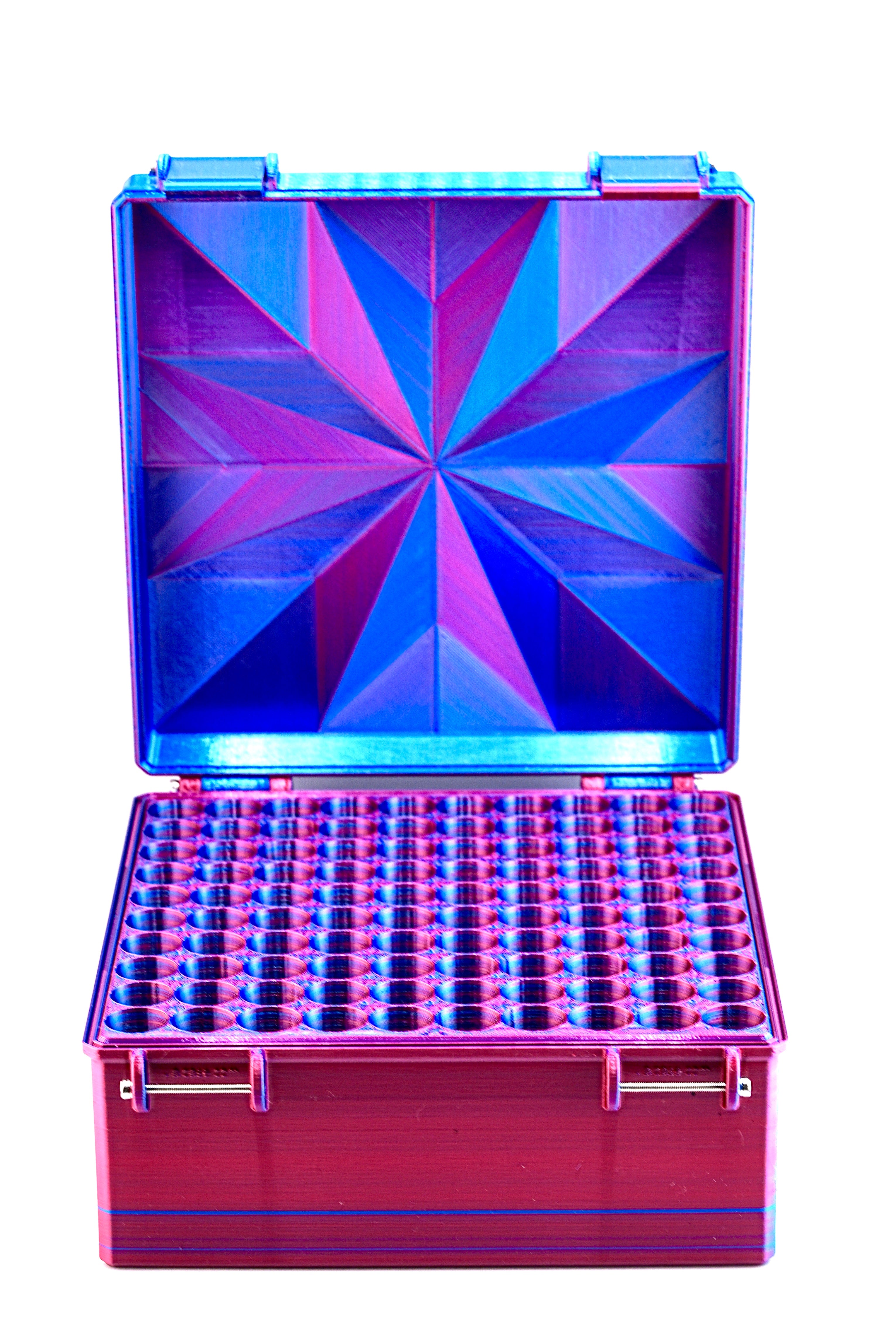
Off-the-shelf cases make you fit your vials to their layout. The PeptideCase™ builder does it the other way around. Start with an empty case, tap "Add item" and pick what you keep: 3 mL vials, 10 mL vials, peptide vials, TRT vials, a BAC water bottle, syringes or pens, in the quantities you actually have. Every item becomes fitted pockets or an open bay sized for that count, and every space has a finger scoop so vials lift out easily.
The tallest item sets the case height. Shorter vials stand on a raised floor, so every vial top lines up at the rim. Auto-arrange packs the layout as tight as it goes, and you see the case size, a top view, a lid view and a 3D view before you order.
Choose Black or RGB Metallic, a Wide or Deep shape, and one or two locking latches on a print-in-place snap hinge. Your case is printed to order in the US at exactly the size shown, ready to sit on a fridge shelf or ride in a cooler. Design a case that protects your vials