
What Is a Peptide Case?
A peptide case is a purpose-built storage case for peptide vials: the small glass vials, usually 3 mL or 10 mL, that people keep in the fridge, a drawer or a travel bag. Unlike a generic medication case or a foam-lined hobby box, a proper peptide case is shaped around the dimensions and fragility of those vials.
The distinction matters because glass vials are not forgiving. They crack when they knock together, roll off shelves, and get confused with look-alikes. Experienced users usually learn this the hard way, with a broken vial on the kitchen floor.
A good peptide case solves four problems at once. It keeps each vial upright in its own pocket so glass never touches glass. It shields vials from bumps, drops and crushing in a bag. It keeps vials covered, which matters for any product labeled "protect from light." And it organizes several vials so you always grab the right one. One thing it doesn't do is keep vials cold: a case is a protective organizer, not a cooler, and it sits inside a fridge or a cooler wherever your label says the vials belong.
If you keep any vials at all, from a single GLP-1 vial to a kit of five or six different products, a dedicated case is the foundation of an organized setup.
Skip the slot-count guesswork
Add the exact vials and supplies you keep, and the builder sizes a hard case to fit them, with every vial top lined up at the rim.
The 5 Non-Negotiables for Any Peptide Case
Not every product marketed as a "peptide case" meets the minimum standard. These five features are non-negotiable; if a case fails on any one of them, move on.
1. Hard Shell Construction
Glass vials do not survive soft-case compression. A neoprene pouch or fabric roll-up bag offers zero crush resistance. One heavy book on top of a soft case, one squeeze in an overhead bin, one dropped gym bag, and you're cleaning up broken glass. A rigid hard-shell case takes the impact and spreads force away from the vials. There is no substitute.
2. Opaque Design
Many products in vials carry a "protect from light" instruction. A clear or translucent case, however well it fits your vials, is a display case, not a storage case. Look for an opaque shell with no windows or mesh panels, so vials stay covered every time the fridge door opens.
3. Precisely Sized Pockets
Vials that rattle are vials at risk. A 3 mL vial and a 10 mL vial differ in both diameter and height, and pockets sized for the exact vial keep each one upright, separated and still. Generic foam with oversized cut-outs lets vials shift enough to chip stoppers, stress glass necks and loosen crimp caps over miles of vibration.
4. Suited to Cold Storage
Your case will probably live in the fridge, and it may ride in a cooler. Its materials should handle cold and condensation without warping or cracking, and it should fit on a fridge shelf without crowding everything else. Soft cases with glued layers can come apart in damp, cold conditions. Keep your everyday case for the fridge shelf, your bag and travel; for vials your label says can be frozen, use labeled freezer bags or a freezer box instead.
5. Secure, Positive-Click Closure
A case that opens under pressure is a liability. Whether it's in a carry-on, a backpack or a gym bag, the closure must hold under direct force. Look for a mechanical latch that clicks shut. Zippers fail at stress points, and Velcro wears out with cold and humidity. A purpose-built peptide case uses a mechanical latch, period.
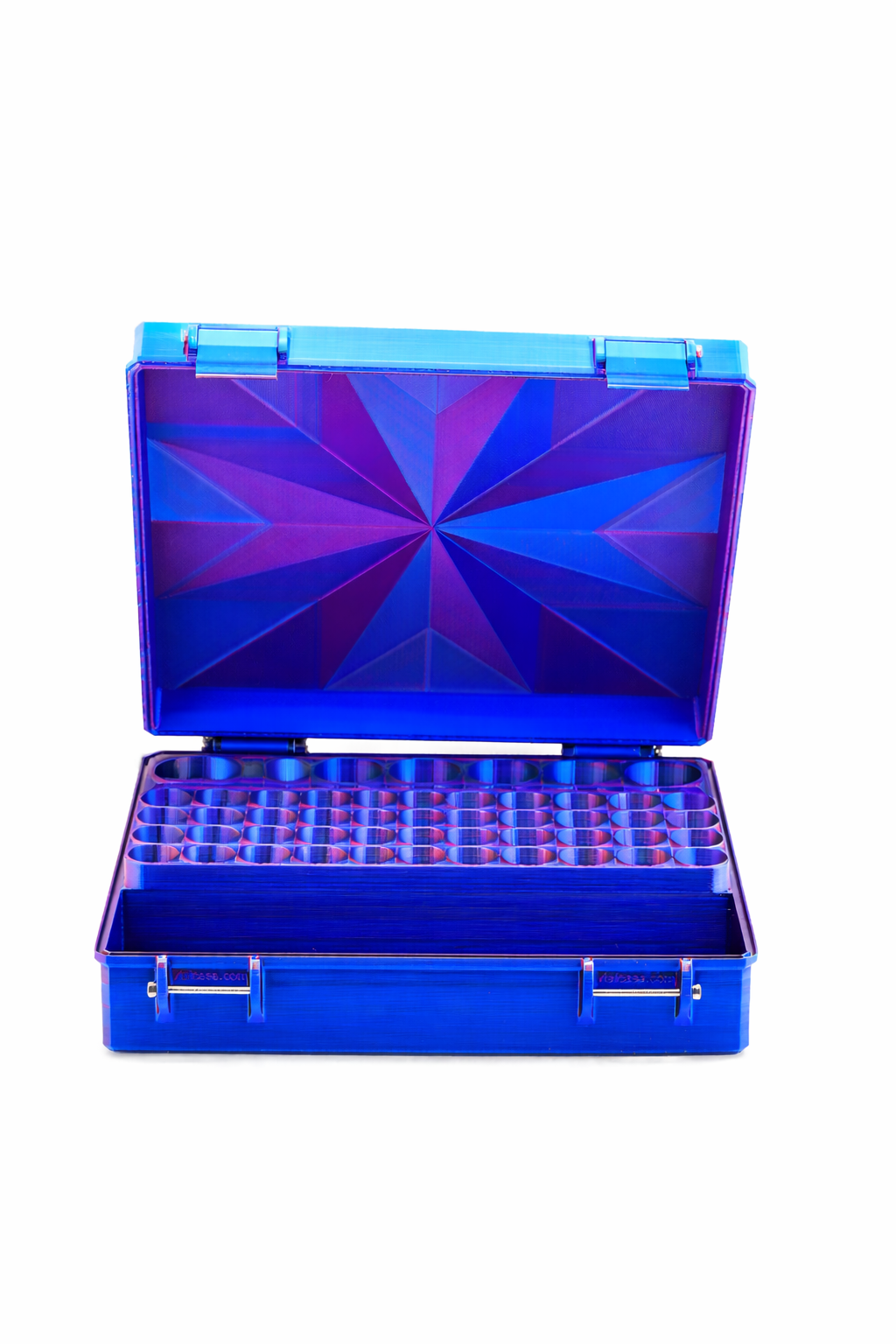
3ml vs. 10ml Cases: Which Do You Need?
This is the first branching decision every buyer faces, and getting it wrong means buying twice.
Most peptide vials are 3 mL. If everything you keep comes in 3 mL vials, you need a case with 3 mL pockets. Our 3 mL vs 10 mL vial guide shows how to tell the sizes apart.
The 10 mL vial is common for GLP-1 vials and other multi-use vials, and some pharmacy-prepared products come in sizes in between. Check your actual vial size before you buy any case.
If you keep both sizes, say a 10 mL GLP-1 vial alongside a few 3 mL vials, you have two options with ready-made cases: buy a case for each format, or hunt for a multi-format case with zones for both. A custom case solves it directly: in the PeptideCase™ builder you add 3 mL vials and 10 mL vials to the same case, and shorter vials stand on a raised floor so every vial top lines up at the rim. The key is never forcing a 3 mL vial into a 10 mL slot or the other way around.
How Many Slots Do You Actually Need?
Slot count is where most buyers underestimate. The instinct is to buy for what you keep today, but most collections grow, and buying again in six months costs more than buying right the first time.
Single Product: 4-10 Slots
If you keep one product (one vial in use, one or two backups, plus a sterile water bottle), a case with four to ten pockets covers you cleanly. A compact hard-shell case fits a gym bag, a desk drawer or a mini fridge shelf without taking up meaningful space.
Two or Three Products: 10-20 Slots
Keeping two products, or adding a GLP-1 vial to your kit? You need room for several vials in use, a sterile water bottle, and backups for each. A 10-slot case fills up fast. Look for a case with a separate compartment for syringes and the water bottle, so the vial pockets stay free for vials.
Larger Kits (4+ Products): 20+ Slots
A kit of four to six different products needs at least 20 pockets. Count one vial in use per product, one backup per product, one or two sterile water bottles, and a little buffer for incoming vials. Integrated syringe storage saves you from carrying a second case.
With the builder, you skip the guesswork: you enter exactly how many of each item you keep, and the case is sized for that count.
Pro Tip: The case that fits your kit perfectly is the one you'll actually use. Buy too few slots and vials end up loose in the fridge. Buy far too many and you'll never travel with it. Match the case to what you really keep, not your theoretical maximum collection.
Material Matters: Why Hard Shell Wins
Shop broadly and you'll find three material categories. They are not equal.
Rigid Hard Shell
Rigid plastic shells, whether molded ABS or a solid printed case, are the standard for peptide cases. They resist impact, keep their shape in the fridge, and can be made with pockets sized to exact vial dimensions. Rigid shells don't flex meaningfully under moderate pressure, so your vials stay protected even if weight is stacked on the closed case. For vial storage, a rigid hard shell is the correct choice.
EVA Foam Shell
Ethylene-vinyl acetate (EVA) foam cases sit in the middle. They're stiffer than fabric and offer some crush resistance, but they are not truly hard-shell. EVA compresses under sustained load, enough to pass force to glass vials in a packed case. EVA cases can work for gentle home storage, but they aren't ideal for travel or anywhere the case may take a hit.
Cardboard and Fabric Alternatives
Many people starting out use cardboard pharmacy boxes, repurposed jewelry pouches or zip bags. That isn't storage; it's gambling. Cardboard absorbs moisture, offers zero crush resistance and collapses under weight. Zip bags offer no protection from light or impact. A single dropped bag can wipe out a month of vials in an instant. A proper case is cheap insurance against that.
Travel vs. Home Storage Cases
The requirements change depending on where your case spends most of its time.
Home Storage Cases
Home storage prioritizes capacity, organization and a good fit on your fridge shelf. Portability matters less. You want enough pockets, a layout that lets you identify every vial at a glance, and materials that handle moving between the fridge and the counter. Larger multi-zone cases that wouldn't fit a carry-on are perfectly fine here.
Travel Cases for Flights and Commuting
Travel changes the calculus. When you're traveling with vials, your case faces forces home storage never sees: overhead bin compression, security screening, baggage handling if you're forced to check, road vibration, and being packed and unpacked again and again. A travel case needs to be compact enough for a carry-on, rigid enough to survive compression, and organized enough to make screening easy. An organized, labeled case looks like a medical kit. A bag of loose vials with exposed syringes looks like a problem.
For travel, the footprint matters as much as the slot count. A case that holds your whole kit securely in a package about the size of a hardcover book is the target. The builder shows the exact length, width and height of your case before you order, so you know it fits your bag. See our full best peptide travel case guide for more.
What to Look For in a Peptide Case: Full Checklist
Run every case you're considering against this list. A case that fails two or more of these items isn't worth buying.
- Hard-shell construction: a rigid shell with no meaningful flex under hand pressure.
- Opaque shell: no translucent panels or mesh windows.
- Precisely sized pockets: made for 3 mL or 10 mL vials specifically, not generic foam cut-outs.
- Vials held upright: pockets keep vials vertical, not lying down or at an angle.
- Vial-to-vial separation: each vial isolated, with no shared space that lets neighbors touch.
- Suited to cold storage: fits your fridge shelf and handles cold and condensation.
- Mechanical latch closure: a positive-click latch that won't open under pressure; not Velcro, not a zipper alone.
- Right slot count: what you keep now plus backups plus a little room to grow.
- Accessory storage: at minimum, a space for syringes and alcohol pads if you carry them.
- Portable footprint: if you travel, it must fit a standard carry-on or backpack without repacking everything.
Top Peptide Cases to Buy in 2026
Based on build, vial fit, capacity and how well each matches real kits, here are the peptide case options worth considering in 2026.
#1 Pick: A Custom Case You Design Yourself (PeptideCase™ Builder)
Every ready-made case is a compromise between the slot count it comes with and the kit you actually keep. A custom case from the builder removes the compromise: you add exactly the items you carry (3 mL vials, 10 mL vials, other size vials, syringes, alcohol pads, a BAC water bottle, pens or pen cartridges) in the counts you need, and Auto-arrange lays them out in the most compact case possible. Snap hinge, locking latch, printed to order in the US. Best for: anyone whose kit doesn't match a standard slot count, kits with both 3 mL and 10 mL vials, travel.
Budget Pick: 10-Slot Compact
A ten-pocket compact hard case is the simplest entry point into real storage. Ten 3 mL pockets in a hard shell with a secure latch. It won't hold a large kit, but for one product with backups and a sterile water bottle, it covers the basics. Best for: beginners, single-product kits, gym bag carry.
Step-Up: 10-Slot with Extra Storage
A ten-pocket case with a secondary compartment changes what you can carry: ten 3 mL pockets plus dedicated space for syringes, a sterile water bottle and alcohol pads. It's the first format that eliminates a second pouch for loose accessories. Best for: two-product kits, anyone who wants everything in one case.
Best All-Around Ready-Made: 12-Slot All-in-One
A twelve-pocket all-in-one with integrated syringe and alcohol pad storage in a travel-ready size is the common default for ready-made cases. Twelve pockets cover most kits with room for backups, and nothing is stored separately. Best for: several products, travel, anyone who wants a single tidy case.
GLP-1 Specialist: 13-Slot 10ml
A thirteen-pocket 10 mL case is built for people who keep GLP-1 vials in the 10 mL format, with supplementary storage alongside. Best for: anyone who uses 10 mL vials exclusively.
Pro Tip: The best peptide case isn't the biggest one; it's the one that matches your real vial count, fits where you store it, and travels with you without friction. Consistent use is what protects your vials.
Design your own custom peptide case
If none of the slot counts above match what you keep, design the case around your kit instead. The PeptideCase™ builder starts with an empty case. Tap "Add item," pick what you carry (3 mL vials, 10 mL vials, peptide vials, TRT vials, glutathione vials, other size vials, syringes, alcohol pads, a BAC water bottle, a peptide pen, injector pen or pen cartridges, even a custom space you size yourself), and enter how many of each. Every item becomes fitted pockets or an open bay sized for that count, and Auto-arrange finds the most compact layout.
The tallest item sets the case height; shorter vials stand on a raised floor so every vial top lines up at the rim, and every space has a finger scoop. Choose Black or RGB Metallic, a Wide or Deep shape, and single or dual latches, and add text, an icon or your own SVG logo to the lid in a second color. The top view, lid view and 3D view show exactly what gets printed. Start designing your peptide case
Common Mistakes When Buying Peptide Cases
Avoid these errors that experienced users report again and again:
- Buying for today's vial count only: kits grow. Leave some room beyond what you keep now.
- Choosing a soft case to save money: the first time a vial breaks, the savings disappear. Hard shell is not optional.
- Ignoring where the case will live: measure your fridge shelf and the bag it travels in, and keep frozen stock in labeled freezer bags or a freezer box rather than in your case.
- Buying a case without syringe storage: then carrying syringes in a separate pouch that gets lost or crushed.
- Accepting vague pocket sizes: "fits vials" is not a specification. Make sure it fits your vial's diameter and height.
- Overlooking the closure: a magnet-only closure on a travel case is not enough; look for a mechanical latch.
For a broader look at storage failures and how to prevent them, see our guide to the most common peptide storage mistakes.
The Bottom Line
Peptide cases range from barely adequate to purpose-built. The difference shows up as broken vials, lost vials and grabbing the wrong one, all of which are preventable with the right case.
For most people, the right answer is a case that fits the kit they actually keep. If a ready-made slot count matches yours, a compact hard case or a 12-slot all-in-one will do the job. If it doesn't, or you keep both 3 mL and 10 mL vials, a custom case from the PeptideCase™ builder is sized to exactly what you carry.
What you shouldn't do is improvise. A proper case is the cheapest insurance your vials have.