
Why Travel Is the Highest-Risk Moment for Your Vials
Vials are fragile in predictable ways. Heat, light and physical shock are the enemies the label warns you about, and a loose glass vial cracks when it hits another one. Disorganization adds a fourth problem: a multi-vial kit turns into a guessing game when you're unpacking in a hotel bathroom without your usual setup.
All four risks peak during travel. Your vials move from a fridge into a bag, into a car, into an airport, into a cabin where the overhead bin routinely gets crushed by other bags. You hand your carry-on to strangers who move it without care. You arrive at hotel rooms with unfamiliar mini-fridges at unknown settings. And if anything goes wrong, like a cracked vial, you're far from home and your usual supplies.
A proper travel case doesn't remove every risk, but it removes most of them. This guide covers what to look for, what to avoid, and which kinds of cases are worth buying for different trips.
Design a travel case sized to your exact kit
Add what you travel with and the builder packs it into the smallest hard case that fits, so nothing rattles in your carry-on.
TSA Rules for Traveling with Peptides
The most common misconception about flying with vials is that the 3-1-1 rule applies. It does not. The TSA's 3.4-ounce liquid limit applies to non-essential liquids like toiletries and beverages. Medications, including liquid medications, are exempt from the 3-1-1 rule, so you can carry full-size medication vials in your carry-on.
You are also permitted to carry syringes in your carry-on when they're with your medication. TSA may ask you to declare them at the checkpoint. The standard guidance is: tell the officer you have medication, keep it easy to reach for inspection, and be ready to explain what it is. A prescription isn't required, but documentation of your medical need, and medication in its original labeled packaging, can smooth things over.
In practice, the best approach at the checkpoint is a case that's organized and easy to open. A hard-shell case with labeled vials in dedicated pockets reads as a medical kit immediately. A zip bag of unmarked vials with loose syringes reads as the opposite. Presentation matters as much as the rules themselves. Rules can change, so check TSA's current guidance before you fly.
For what to say, how to present your kit and how to handle secondary screening, see our detailed TSA guide for travelers with vials.
The 4 Things That Make a Travel Case Different From a Home Case
A home storage case and a travel case solve different problems. Here's what separates them:
Compact Form Factor
A home case can be as big as your fridge shelf allows. A travel case has to fit a carry-on, a bag or a large coat pocket without taking so much space that you resent packing it. Travel cases are all about capacity-to-size ratio: the most vials in the smallest footprint, with nothing wasted.
Working With a Cold Pack
A home case sits in a fridge. A travel case spends hours outside one. A hard-shell case isn't insulated and doesn't keep anything cold on its own, so if your label calls for refrigeration, it needs to pair with gel cold packs and an insulated pouch or small cooler. The case should close securely and fit inside the pouch with the pack. That pairing matters on any long travel day.
Latch Security
In a bag, a case gets squeezed, tilted and occasionally dropped. The latch on a travel case has to resist all of that without opening. Friction-fit lids and magnetic closures that feel fine on a table fail under bag pressure. A positive-click mechanical latch is the only acceptable closure for a case that lives in a carry-on or backpack.
TSA-Friendly Presentation
A travel case should look like medical equipment at a glance: organized, labeled, tidy. A jumble of vials and syringes wrapped in a T-shirt raises questions; a purpose-built case with a place for everything answers them before they're asked. The impression you make at a checkpoint or customs desk is a real consideration.
How to Keep Vials Cold on a Flight
If your label calls for refrigeration, the goal during air travel is to keep vials within the range on that label for the whole journey. Here's the practical breakdown:
Gel packs, not ice. Loose ice melts and creates condensation that soaks labels and puddles in your bag. Gel cold packs made for medication travel stay cold for hours, depending on the weather and pack size. Wrap the pack so it doesn't touch the vials directly, and put your hard-shell case and the pack together in an insulated pouch. For long international days, bring a second pack.
Pre-chill the setup. Before packing, put the insulated pouch (and the case, if your vials already live in the fridge) in the fridge for an hour. A setup that starts cold stays cold longer than one packed at room temperature.
Skip the overhead bin. Cabin temperature is generally controlled, but overhead bins can run warmer than the seats, and they're where bags get crushed. Keep your vial case in your personal item under the seat in front of you.
Know your label's limits. Some products allow time out of the fridge and some don't. Read the label, or ask your pharmacist or provider, before a long travel day, and plan your cold packs around the answer instead of assuming it'll be fine.
The Best Peptide Travel Cases in 2026, Ranked
Rank 6: Soft Neoprene Insulin Travel Pouches
Why it fails: These pouches are designed for pens and prefilled syringes, not loose glass vials. Nothing holds a 3 mL or 10 mL vial upright, so vials end up lying down and rattling against each other. Neoprene offers no crush protection; a squeezed bag or a drop can easily mean broken glass. And the insulation gives a false sense of security: without a cold pack, the pouch just traps whatever temperature it starts at. Avoid it for vials.
Rank 5: Generic Hard-Shell Makeup Cases
Why it falls short: These beat neoprene because at least the shell is rigid. But the inside is built for cosmetics: flat trays and dividers for odd shapes, nothing sized for round vials. A vial lying in a makeup tray has no side support and chips against its neighbors in transit. Many have mirrored or clear lids, too. They're better than nothing for carrying one or two vials by hand on a short trip, but they aren't a real vial case.
Rank 4: 10-Slot Compact Case
A ten-pocket compact case earns its spot for travelers carrying one or two vials on a short trip. The footprint is genuinely small; it fits the outer pocket of a carry-on, a large coat pocket or a purse. Ten 3 mL pockets give you room for current vials plus a couple of extras, with a hard shell and a positive-click latch.
Why it ranks lower for travel: no syringe storage, no space for alcohol pads, and no room to spare. For a same-day or overnight trip with one or two vials and your other supplies in a separate pouch, it's a clean, lightweight option. For anything longer or more complex, move up the list.
Rank 3: 12-Slot All-in-One
A twelve-pocket all-in-one is a strong choice for travelers carrying a few different vials. Twelve pockets cover most kits with room to spare, and built-in syringe and alcohol pad storage keep the whole kit in one container: no secondary pouches, no loose accessories, no digging through a bag.
For checkpoint presentation, it's ideal: everything is organized and visible in seconds. The hard shell protects against overhead bin crushing and drops, and the latch stays closed under bag pressure.
Rank 2: 20-Slot with Syringe Storage
For travelers with larger kits, a twenty-pocket case with an integrated syringe compartment holds many vials, backups and a sterile water bottle in one organized container. The larger capacity means you're not splitting your kit across several cases during a trip, which is the most common organizational failure for travelers. One case, everything in it, one thing to track and one thing to pull for inspection.
Rank 1: A Custom Case You Design Yourself (PeptideCase™ Builder)
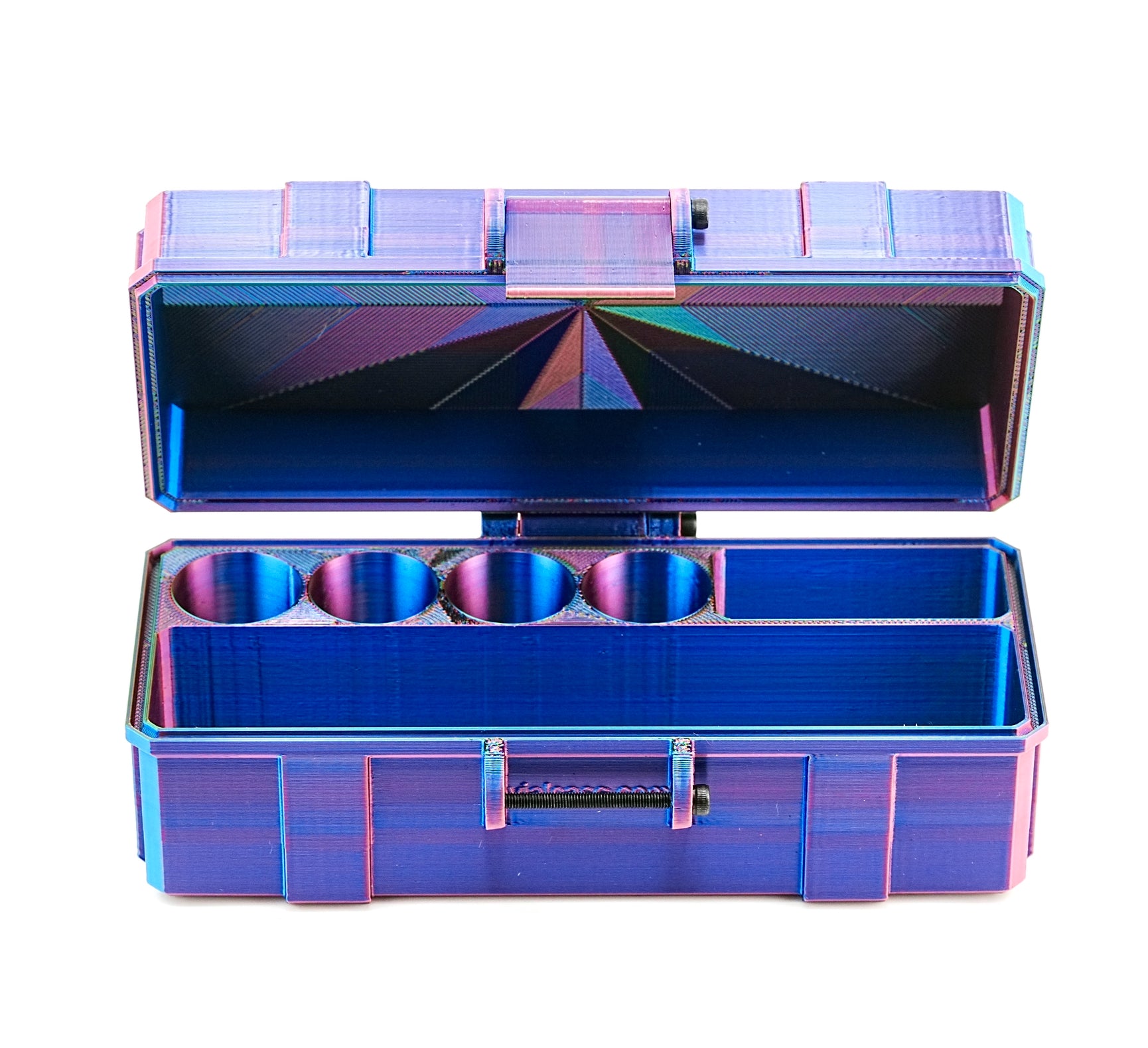
Every ready-made case above asks you to fit your kit to its slot count. A custom case flips that: you add exactly what you travel with, such as four 3 mL vials, one 10 mL vial, a pen, syringes and alcohol pads, and the builder's Auto-arrange packs it into the most compact case possible. For travel, that means the smallest footprint for your exact kit, nothing rattling in empty slots, and every vial top lined up at the rim so you can find what you need fast at a checkpoint or in a dim hotel room. You can even add a custom space you size yourself, for example to fit a slim gel pack. Design your travel case
Pro Tip: Always carry vials in your carry-on, never in checked bags. Cargo holds and ramps can see extreme cold at altitude and serious heat on a sunny tarmac during delays, and checked bags get thrown. Checked baggage is not an option for anything you care about.
Hotel Storage: What to Do When You Arrive
Getting your vials to the destination is half the battle. The other half is storing them correctly in a hotel room.
The mini-fridge is your first choice, but check it before trusting it. Hotel mini-fridges vary widely: some run close to freezing, and some barely run cold at all. Put a small fridge thermometer inside, give it half an hour, and compare the reading with the range on your label. If it's off, adjust the dial or keep using your cold packs and pouch.
If there's no mini-fridge, your gel packs and insulated pouch become your cold source. Ask the front desk for a fridge (many hotels provide one for medical needs), or use the ice machine and the hotel freezer to refresh your packs.
Never leave vials near a window. If your label says "protect from light," a sunny windowsill or desk is one of the worst spots in the room. Keep your case closed and in the fridge or the coolest shaded spot.
Don't rely on the bathroom counter. Bathrooms get hot and steamy during showers and hair-drying. Take out only what you need, then put the vials back where your label says they belong right away.
International Travel: Customs Rules for Peptides
Crossing borders with medication adds variables that domestic travel doesn't have. Rules for medications differ by country: some require a prescription, some limit quantities, and some restrict certain products entirely. Enforcement also varies.
The principles that hold in most places: carry personal-use quantities only, keep everything in original labeled packaging, bring documentation of medical use (a prescription, a doctor's letter, clinic records), and declare when in doubt. Declared items create far fewer problems than undeclared ones that get found.
For more detail, see our international travel guide. The short version: check your destination's current rules yourself before you pack, bring documentation, declare when in doubt, and carry personal-use quantities only.
Road Trip vs. Air Travel: Different Risks, Different Setups
Road trips and flights create different storage challenges. Knowing which risks apply to your trip helps you pack the right way.
Air Travel Risks
On a flight, the main risks are long hours away from a fridge (especially with connections), crushing in the overhead bin, and checkpoint questions. The answers: carry-on only, cold pack and insulated pouch if your label calls for it, a positive-click latch, and organized presentation. A case sized to your exact kit handles all of this.
Road Trip Risks
On a road trip, heat is the dominant concern. A car parked in the sun gets dangerously hot within minutes, so never leave vials in a glove box or on a back seat at a rest stop. Road vibration is a secondary but real concern: vials rattling for hours in a loose container can chip and crack.
For road trips, keep your case in the air-conditioned cabin (never the trunk), put it in a cooler or insulated bag on long drives if your label calls for refrigeration, and secure it so it isn't sliding around a seat. Pre-chill the cooler with a frozen gel pack before loading. Our road trip guide covers the full setup.
For short drives in mild weather, follow your label; for anything longer or hotter, treat the trip like the cold chain it is.
Build your own custom travel case
The best travel case is the smallest one that holds exactly what you carry. In the PeptideCase™ builder you start with an empty case, tap "Add item," and pick what goes on the trip: 3 mL vials, 10 mL vials, peptide vials, other size vials, syringes, alcohol pads (flat or standing), a BAC water bottle, a peptide pen or pen cartridges, and how many of each. Each item becomes fitted pockets or an open bay sized for that count, and Auto-arrange works out the most compact layout.
The tallest item sets the case height; shorter vials stand on a raised floor so every top lines up at the rim. Every space has a finger scoop. The builder shows the exact length, width and height, so you know it fits your personal item, plus a 3D view you can spin open or closed. Pick Black or RGB Metallic, a Wide or Deep shape, and single or dual latches; big cases get two latches automatically. It's printed to order in the US. Start building your travel case
The Bottom Line: What Case to Buy for Your Trip Type
Here's the fast decision guide:
- Any trip where your kit doesn't match a standard slot count: a custom case from the PeptideCase™ builder, sized to exactly what you carry.
- Weekend trip, one or two vials: a 10-slot compact case; lightweight and pocket-sized.
- Several different vials, three to eight: a 12-slot all-in-one with syringes, alcohol pads and vials in one hard shell.
- Large kits, eight or more vials: a 20-slot case with syringe storage, so everything travels in one case.
- 10 mL vials: a case with pockets sized for 10 mL vials specifically; the right fit prevents rattling and breakage.
- Soft neoprene pouches and makeup cases: don't use them for vials. They fail on fit and physical protection at the same time.
Still deciding? The complete peptide case guide breaks the choice down by kit size and vial format. For a full pre-trip list, from packing to checkpoint to hotel, see the peptide travel checklist.