
What "Peptide Carrying Case" Actually Means
When people search for a "peptide carrying case" or "peptide bag," they usually mean the same thing: something to take their vials with them when they leave the house. But there are two fundamentally different use cases inside that one phrase, and confusing them leads to buying the wrong product.
Home storage cases live in your fridge or on a dedicated shelf. They prioritize capacity and organization — how many vials can I store, how easily can I find each one. They don't need to be portable. They can be larger and heavier, built for staying put rather than daily carry.
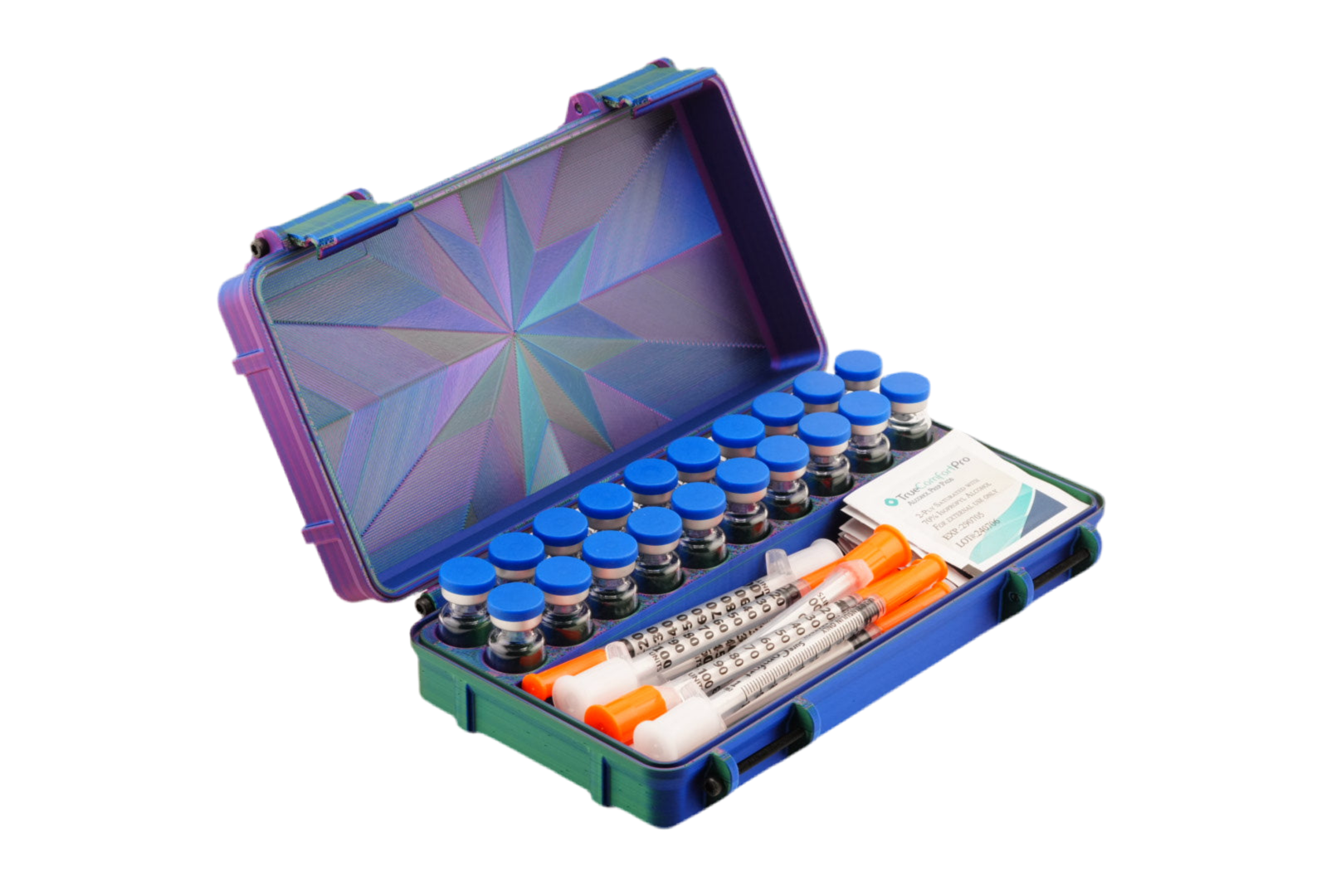
Carry and transport cases travel with you. They need to fit inside a bag, withstand movement, protect vials in transit, and work outside your home. The priorities are completely different: a compact footprint, a closure that won't pop open on the move, and real structural protection against knocks.
Design a carry case that fits your bag
Add only what you carry, see the exact case size before you order, and get a hard case with a fitted slot for every vial.
This guide is about the second category — the case you actually carry. And the first thing to understand is that most of what's marketed as a "peptide bag" doesn't meet the requirements of real carry and transport.
The Problem with Generic "Bags" for Peptides
Type "peptide bag" into any search engine and you'll land on soft-sided options: lunch bags, small soft coolers, neoprene diabetic supply pouches, cosmetic organizers. They're inexpensive, they come in many sizes, and they fail at the core job in similar ways.
No vial-specific slots. A lunch bag has one open compartment. A soft cooler has one insulated pouch. Neither has dedicated positions for individual vials. So vials roll around, contact each other, and chip or crack at the neck or stopper. This is how vials break — not from single dramatic drops, but from constant low-level contact in transit. A 20-minute walk from your car to your office with vials loose in a soft bag creates dozens of glass-on-glass knocks. Eventually one of them wins.
Light gets through. Soft bags are usually fabric, mesh, or thin neoprene, and all of these let ambient light through. If your vial label says to protect the product from light, a day of carry in a thin pouch works against that. An opaque hard shell keeps light out when it's closed; a neoprene pouch does not.
No structural protection. Set a soft bag down on a hard surface, and the contents absorb the impact directly. Put it at the bottom of a backpack with a laptop on top, and the vials take the compression. Soft materials have no compressive resistance — they conform to pressure rather than redistributing it. A hard shell deflects and absorbs knocks before they reach the vials inside.
Closures that fail in transit. Zipper pouches open. Velcro catches on everything and loses grip over time. A case with a positive latch — one that takes deliberate action to open — stays shut when it's supposed to and opens only when you want it to.
What a True Peptide Carrying Case Must Have
Before looking at specific setups, it helps to define the minimum requirements for a case that's actually suited for carry and transit:
- Hard outer shell. A rigid shell that won't compress under weight or deform on impact. The shell is what actually protects the glass.
- Vial-specific slots. Each vial in its own position, held upright and separated from other vials. No loose movement, no glass-on-glass contact during normal carry.
- Secure latch or closure. Something that doesn't open accidentally. A case that pops open when bumped isn't protecting anything.
- Room for the rest of your kit. Most people carry more than vials: syringes, alcohol pads, a BAC water bottle, or a pen. A carry case that only holds vials forces you to juggle the rest separately.
- A footprint that fits inside your bag. If the case is too large for your daily bag, you'll leave it at home. A carry case that doesn't get carried is useless. A compact size is a functional requirement, not an aesthetic preference.
Temperature is covered separately below — it's a real concern, but it's handled by your label and a cooler, not by the case itself.
Bag vs. Case: The Real Difference
The word "bag" implies containment: something is inside it. The word "case" implies protection: whatever is inside is shielded from the environment, not just enclosed within it.
For glass vials, containment isn't the goal. You don't need them held in one place while still exposed to light, impact, and pressure. You need them isolated from those things.
This is the structural difference between a bag and a case. A bag is passive — it holds things. A case is active — it protects things. A good hard-shell case puts its own rigidity between the outside world and the vials inside. When you bump into a door frame, the shell takes the hit. When the bag shifts and presses against a seat back, the shell spreads that force. When sunlight hits the outside of the case, it stops there.
For glass vials you paid for and can't easily replace, the distinction matters. A bag is fine for carrying things that don't need active protection. Your vials are not those things.
The 3 Most Common Carrying Mistakes
Mistake 1: Loose Vials in a Backpack Pocket
This is the most common one, especially for people who haven't lost a vial yet. You stick two or three vials in the outer pocket of a backpack or gym bag, maybe wrap them in a shirt, and head out. It feels fine until it isn't.
The outer pockets of most bags have minimal padding and no rigid structure. Vials roll, hit each other, and hit zippers, keys, and other hard objects. Stoppers chip. Vials crack at the neck. And because you can't see inside a closed pocket, you don't know there's a problem until you find glass fragments and lost product.
The fix is immediate. A compact case with individual slots eliminates glass-on-glass contact entirely.
Mistake 2: Soft Neoprene Pouches
The appeal is understandable: neoprene feels protective, it's flexible, and many neoprene cases are made for diabetes supplies. Some even have elastic loops that look like they should hold vials.
The problem is that neoprene compresses. It's a foam material — it has give. That give is what makes it comfortable to hold, and it's also what makes it inadequate for vial protection. Set a neoprene pouch down on a hard surface and the vials meet the surface through the compressed foam. Put it at the bottom of a bag with weight on top and the neoprene doesn't hold the vials away from the pressure — it becomes part of the pressure path.
The elastic loops in many of these pouches are also sized for pen cartridges, not 3 mL or 10 mL vials. The fit is wrong, which lets vials move inside the loop — defeating the point of having slots at all.
Mistake 3: Oversized Cases You Can't Actually Carry
Some people buy the largest case available because they want capacity and room to grow. Then they discover a big hard-shell case doesn't fit in their gym bag, so they leave it home and go back to the zip-top bag. An oversized case sitting on your dresser gives exactly zero protection to vials that leave the house.
Match your carry case to your carry situation. If you go to the gym, measure your gym bag before choosing. If you commute with a specific bag or backpack, that's your constraint. The best carry case is the largest one that reliably fits in whatever you actually carry every day.
Pro Tip: If your case doesn't have a dedicated slot for each vial, it's a bag with false confidence. One bad bump and loose vials crack against each other or the case walls. The slot is what protects the vial — not the enclosure around it.
Best Peptide Carrying Case Setups for Daily Use
Instead of picking from a few fixed sizes, you can now design a carry case around exactly what you take with you. In the PeptideCase™ builder you start with an empty case, tap "Add item," and pick what you carry and how many; every item becomes fitted pockets or an open bay sized for that many, and Auto-arrange packs them into the most compact layout. Here is how that works for the most common daily carry scenarios.
1–2 Vials Daily: A Pocket-Sized Single Kit
If you carry one active vial and maybe a backup, add just those two vials and nothing else. The builder makes the smallest case that holds them, so it slips into a jacket pocket or the small front pocket of most gym bags. The builder shows the exact length, width and height before you order, so you can check it against the pocket you plan to use.
For someone carrying just what they need for the day plus a spare, this is the right size. It's light, unobtrusive, and won't add bulk to whatever bag you already carry. Every pocket has a finger scoop, so the vial lifts out easily even from a small case.
If you later want supplies with you too, a second, slightly larger design with a few extra bays is a better fit than overstuffing a tiny case.
Best for: one-vial kits, daily carry to the gym or office, anyone who wants to carry as little as possible
Full Kit Carry: Vials Plus Supplies in One Case
If you want everything in one place when you're away from home, add your vials alongside the supplies that usually travel loose: syringes, alcohol pads (flat or standing), and a BAC water bottle. Each one gets its own trough, bay or pocket in the same hard case.
The organization matters as much as the protection here. A complete kit in a single case means you don't have to think about what to bring — you pick up the case and everything is there. Nothing rattles around the bottom of your bag, and you can see at a glance when a supply is running low.
The builder sets the case height from the tallest item and lifts shorter vials on a raised floor so every vial top lines up at the rim, easy to grab in a hurry.
Best for: people who carry several kinds of vials, anyone who keeps the whole kit away from home, anyone who wants one case instead of three pouches
Larger Vial Counts: A Bigger Daily Carry
If you carry five or more vials, set the counts you actually need and let Auto-arrange find the tightest layout. You can switch between a Wide shape (hinge on the long side) and a Deep shape (hinge on the short side) to see which one suits your bag better.
A larger case still prints with a print-in-place snap hinge and a locking latch, and big cases get a 5-knuckle hinge and two latches. You can also choose dual latches on a smaller case if you prefer.
This is the right route for anyone who has outgrown a small case but doesn't need a full home-storage box. It bridges daily carry and mid-size storage well.
Best for: five or more vials, carrying spares, anyone between a starter case and a large storage case
GLP-1 and 10 mL Vials: Pockets Sized for the Larger Format
If you carry 10 mL vials, such as many GLP-1 vials, add 10 mL vials as their own item so they get pockets sized for the larger glass. Putting 10 mL vials in a case built for 3 mL vials means poor fit and more movement in transit. If you carry pens instead, add a peptide pen, injector pen or pen cartridges and they get their own spaces too.
Carrying both sizes? Add both. The 10 mL vials set the height and the 3 mL vials stand on a raised floor, so all the tops are level.
Best for: GLP-1 vial or pen users, anyone carrying 10 mL vials, kits with both vial sizes
Temperature During Carry: What the Case Does and Doesn't Do
This is a common source of worry, so here it is directly. How long a vial can be out of the fridge is set by its product label and by your pharmacist or provider — check those instructions before you plan your day, and plan around them rather than around a general rule.
A hard carry case is a protective organizer, not a cooler. It doesn't keep anything cold on its own. What it does is make cold storage easy to add: when your label calls for it, put the closed case inside a small insulated bag with a gel ice pack. Wrap the pack so it doesn't sit directly against the glass, and keep the bag out of the sun and out of parked cars.
If you want to see the temperature yourself, the builder offers a temperature sensor item: a clip-in window in the lid, or a socket inside the case, for a small digital thermometer.
For coolers that fit a carry case, see our guide to travel coolers.
Organizing Your Carrying Case
A carry case works best when it's organized the same way every time. Muscle memory in a multi-slot case means you can find the right vial quickly, even in low light or when you're tired after a workout. Random placement means every use takes conscious thought and raises the chance of grabbing the wrong vial.
Three simple organizing principles for daily carry:
- Assign slots by vial, not by convenience. Pick a slot for each kind of vial and always use it. Consistency is the system. If you use colored vial caps, assign one color per kind of vial and the visual key carries across all your cases — home storage and carry case use the same color code.
- Keep a rotation order. If you carry more than one vial of the same kind, track which to use first. Label the oldest vial or keep it in the front slot so a newer vial doesn't get opened while an older one sits in the back.
- Restock after every use. When you get home, bring the case back to full: replace used supplies, check that every vial is capped and back in its slot. An empty supply bay when you need it is a frustrating and avoidable problem.
Color-code your vials
Custom snap-on caps for 3 mL or 10 mL vials, with a cap color plus an icon or letters. Sets from 25 caps.
For a fuller guide to organizing home and carry storage, see our peptide organization guide.
When to Upgrade Your Carrying Case
Most people know their current carry setup isn't adequate — they've just normalized the workaround. Here are the clear signs it's time to upgrade:
- You've had a vial break or chip in transit. This is the clearest signal. One broken vial costs more than a good case.
- You're using a zip-top bag, a sock, or a shirt to wrap vials. These are improvised fixes that don't solve the problem — they just make you feel better about it. The vials still move, still touch each other, and still sit in the light.
- You leave your vials at home because carrying them feels like too much trouble. This usually means your current case is too big to carry comfortably, or your supplies are spread across several bags. A correctly sized, fully organized carry case solves this — you grab one thing and go.
- You've added vials and your case no longer fits them all. Kits grow. A case that worked for one or two vials becomes inadequate when you add a third or fourth. A new case sized to the new kit beats carrying overflow in a separate bag.
- Your current case opens by itself in your bag. If you've found a case open with vials loose inside, the closure has failed. Replace the case before you find a broken vial.
The Complete Carry System: Case + Habit
A carry case is a tool, and like any tool it's only as good as how consistently it's used. The best case in the world doesn't help if you forget to put your vials in it, or if you take a vial out and set it on the gym floor because you don't want to deal with the case.
The goal is a carry habit that's automatic. Your case goes in your bag the same way your phone does — not as an afterthought, but as a standard part of what you pick up when you leave. That habit starts with a case that makes carrying easy: the right size for your bag, the right capacity for your kit, organized so you can find what you need without thinking.
When the case works correctly, you stop thinking about it. It's just there, the vials are protected, the supplies are ready, and nothing is improvised.
For flights and longer trips, see our complete peptide travel checklist and best peptide travel case guide for 2026.
Make your own custom peptide carrying case
The carry case that works is the one sized to your bag and your kit, and that is exactly what the builder is for. Start with an empty case, tap "Add item," and add what you take out of the house: 3 mL or 10 mL vials, peptide or TRT vials, a pen or pen cartridges, syringes, alcohol pads, a BAC water bottle, or a custom space where you type the width, depth and height of anything else. Set the count for each.
Auto-arrange packs it all into the most compact layout, and the builder shows the case size, height and contents with a top view, a lid view and a 3D view you can open, unlatch and turn. Check those numbers against your gym bag or backpack pocket before you order. Pick Black or RGB Metallic, Wide or Deep, one or two latches, and add your initials or an icon to the lid so it's easy to spot in a crowded bag. Cases are printed to order in the US, and the size shown is exactly what gets built. Design your carry case