
Why You Need a Checklist (Not Just Good Intentions)
The mistakes people make traveling with vials are almost never about not knowing better. They know to keep vials protected and to carry them on. The mistakes happen because travel is distracting. You're running late, the ride is outside, you grab your bag and leave the cold pack in the freezer. Or you reach the hotel and don't check the mini-fridge until 11pm, when it's too late to ask for a different room.
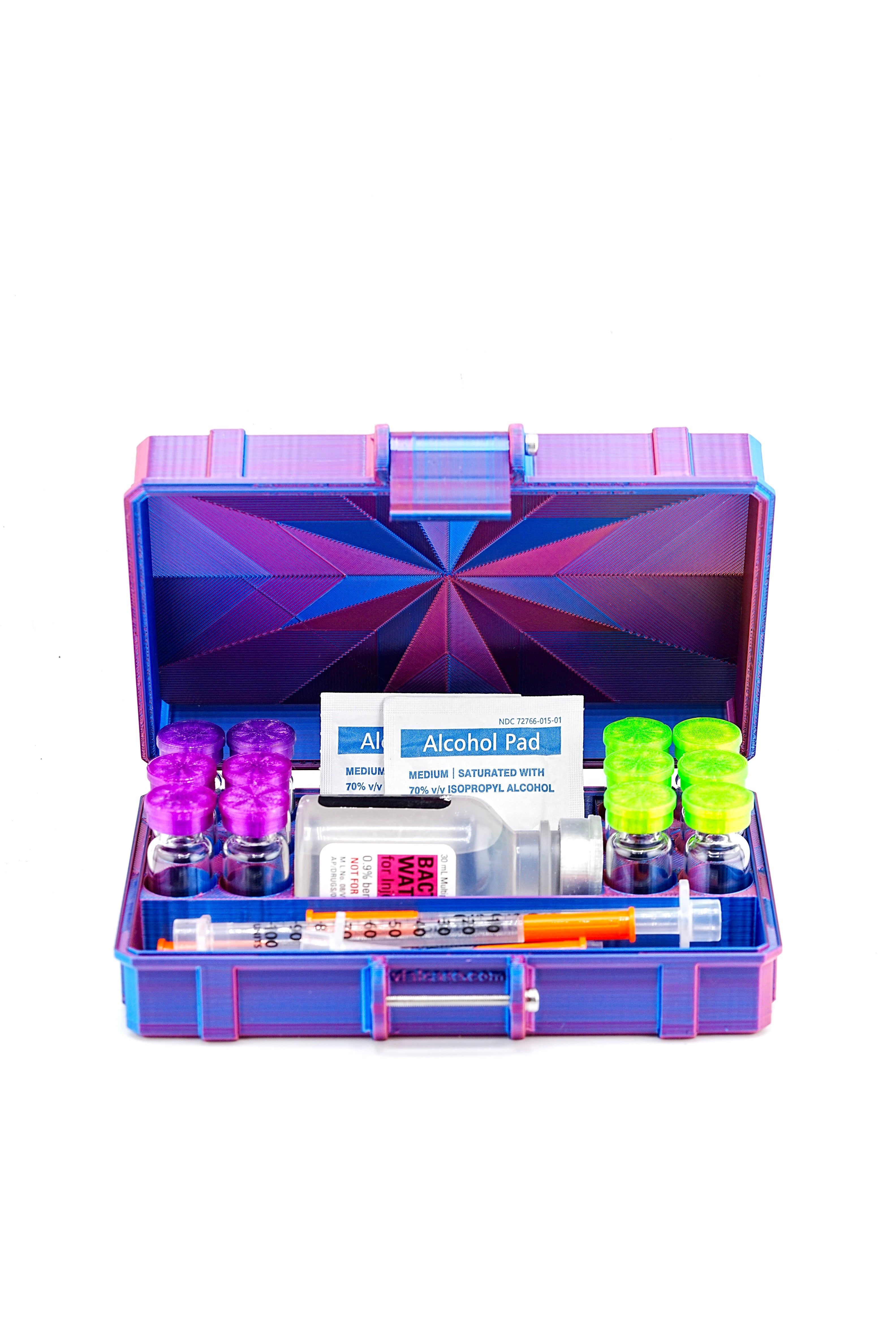
A checklist solves the distraction problem. You don't rely on memory; you work through a list. This one is built around the failure modes that actually cost people vials and peace of mind. A hard-shell vial case is what makes it work: everything lives in one organized unit that moves with you through every stage below.
Design a case around your packing list
Add every vial and supply you travel with, and the builder lays out one compact hard case that fits your carry-on and your cooler sleeve.
Pre-Trip Prep Checklist (Night Before Departure)
Do this the evening before you leave, not the morning of, when you're rushed.
- Count what you need. Work out what the trip requires and pack that plus a small buffer for delays. Don't bring your entire supply; leave backups at home, stored as their labels direct.
- Label every vial clearly. What it holds and the date you opened it, with the original pharmacy or product label readable. If a label is faded or smudged, replace it now. Security may ask what a vial contains, and the label should answer clearly.
- Check vial condition. Inspect every vial you're bringing for cracks, chips and loose caps. Set aside anything questionable now, not at the hotel.
- Freeze your cold pack. Put it in the freezer tonight. A pack frozen overnight stays cold far longer than one frozen for a couple of hours the morning you leave.
- Gather documentation. If you have a prescription or doctor's letter, find it, photograph it as a phone backup, and put the paper copy in your case or travel wallet.
- Confirm your case is packed and closed. Load vials into their assigned pockets and check the latch clicks shut. Don't leave this for the morning.
Pro Tip: Set a phone reminder for 8pm the night before every trip with vials. Five minutes of prep the night before removes most travel-day stress.
What to Pack Checklist
Everything on this list should fit inside or alongside your hard-shell vial case. If it doesn't fit, your case is the wrong size for your kit.
- Vials: the vials you need for the trip, each in its assigned pocket.
- Sterile water bottle: if it's part of your kit, sealed and labeled, in its own space.
- Syringes: what the trip needs plus a few spares, kept sealed in their original packaging.
- Alcohol pads: individually wrapped pads plus spares. Foil packets are compact and easy for security to see.
- Sharps container: a travel-size container (pharmacies carry them) that fits a toiletry bag. Used syringes can't go in hotel trash in most places, and certainly not loose in your bag.
- Cold pack: if your label calls for refrigeration, size it to your travel time. Gel packs stay cold for many hours; phase-change packs last longer. Match it to your door-to-fridge time, not just the flight.
- Doctor's letter or prescription copy: for anything prescribed. For international trips, a signed personal statement listing your medications and quantities helps too.
- Insulating sleeve or small cooler bag: wraps around your case and holds the cold pack. A hard case isn't insulated, so this is the part that keeps things cold.
Packing & Departure Checklist
The moment you're packing your bags to leave:
- Vial case goes in your carry-on, always. Never in checked luggage. Cargo holds can see extreme cold and serious heat depending on the flight, the season and where your bag is loaded, and checked bags get thrown.
- Case in an easy-to-reach spot in your bag. You may need to pull it out at security. Don't bury it under clothes.
- Cold pack goes in the insulated sleeve with the case, not loose in a side pocket.
- Syringes and pads easy to see. In their own space in your case or in a clear pouch, so security can see what they are. Opaque pouches invite more questions.
- Sharps container separate and accessible. If security asks, you want to produce it quickly, not root through your bag.
- Don't let vials touch frozen packs directly. Wrap the cold pack in a thin cloth so nothing presses against the glass.
Airport & TSA Checklist
TSA rules on medications are straightforward once you know them:
- Tell the officer about your medication. Mention that you have medication and a cold pack before placing items on the belt. It isn't required for domestic travel, but it makes screening smoother.
- Take the case out of your bag. Place it in a bin by itself, like a laptop, so the X-ray operator can see it clearly without opening your bag.
- Ice packs are allowed. TSA permits ice packs and gel packs with medication. They may get a quick swab test. Fully frozen packs pass easily; slushy or melted packs may be questioned.
- Syringes are allowed. TSA permits syringes for medical use when they're with your medication. A clear, organized presentation is the cleanest.
- If asked what it is: answer factually, for example "it's my prescribed medication." Having the doctor's letter handy lets you back that up immediately.
- Keep your case close during the flight. Under the seat in front of you is best, so it's never crushed in a bin and you can reach it if the flight is delayed on the tarmac.
Rules change, so check TSA's current guidance before you fly. Our TSA guide covers screening in more detail.
Pro Tip: TSA PreCheck and Global Entry lanes move faster, which means less time on the belt and less handling of your case. If you fly with vials several times a year, they pay for themselves in reduced screening stress alone.
Hotel Arrival Checklist
The handoff from your travel setup to a reliable fridge is the most important moment of the trip. Don't let it become an afterthought.
- Check the fridge right away, before unpacking. Turn it to a cold setting and put your case inside if your label says to refrigerate. Don't wait until bedtime.
- Check the fridge temperature. A small fridge thermometer left inside for half an hour gives you a real reading. Hotel mini-fridges vary a lot; compare the reading with the range on your label.
- If there's no fridge, or it isn't cold enough: call the front desk right away and ask for a room with a working fridge or a medical fridge if they have one. Meanwhile, keep the case in your insulated sleeve or cooler with ice from the ice machine, wrapped so nothing touches the vials, and refresh the ice regularly.
- Keep the case in the fridge, not loose vials. The case keeps every vial in its labeled pocket for the whole trip. Don't unload it onto the fridge shelf.
- Set a checkout reminder. The most common hotel mistake is leaving the case in the fridge. Put a note on the door or a reminder on your phone for checkout morning.
International Travel Checklist
International travel adds legal and logistical layers that domestic trips don't:
- Research your destination's rules before departure. Medication rules vary a lot from country to country; some require a prescription, some limit quantities, and some restrict certain products entirely. Check the current rules for what you're carrying. This is non-negotiable.
- Carry a translated prescription or medication description. Where you might face a customs inspection, a printed document in the local language reduces the chance of misunderstanding.
- Know local contacts. Note a clinic or pharmacy near your hotel in case you need a replacement cold pack or supplies. Look it up before you land.
- Declare at customs if required. Many countries require you to declare medications. Failing to declare when required is a much bigger problem than declaring something that turns out to be allowed.
- Personal-use quantities only. Customs scrutiny scales with quantity. A few vials for personal use are very different from a bag full. Bring only what the trip requires.
- Keep your paperwork together. Prescriptions, pharmacy labels and your provider letter in one place, ideally in or with your case.
For more, see our international travel guide.
Return Trip Checklist
The return leg is where people get sloppy. The trip is almost over and attention drops. Don't let your guard down on the way home:
- Follow US Customs rules on re-entry. Declare anything US Customs and Border Protection requires you to declare, and check CBP's current rules before you travel.
- Keep your documentation handy. The same prescription, labels and letter you used on the way out should be easy to reach on the way back.
- Same cold setup on the return flight. If your label calls for refrigeration, your vials need the same cold pack and sleeve on the way home. Refreeze the pack in the hotel freezer the night before departure.
- Inventory on return. When you get home, check labels and expiration dates on everything that traveled, put each vial back in its usual spot as its label directs, and restock the case for next time.
Bottom Line: Every stage of this checklist, from freezing the cold pack the night before to checking the hotel fridge to clearing customs, is manageable when your vials live in one dedicated hard-shell case. The case isn't just storage; it's the unit that makes the whole checklist work. Build a case for exactly this.
Make your own custom travel kit case
A checklist is only as easy as the case it fills. If your vials, sterile water bottle, syringes and pads don't fit one case, you end up with three pouches and something left behind. The PeptideCase™ builder fixes that by designing the case around your list. Start with an empty case, tap "Add item," and choose what you travel with: 3 mL vials, 10 mL vials, peptide vials, other size vials, syringes, alcohol pads, a BAC water bottle, a pen or pen cartridges, and how many of each. Every item becomes fitted pockets or an open bay sized for that count.
Auto-arrange packs everything into the most compact layout, and the builder shows the exact length, width and height so you know it fits your personal item and your insulated sleeve. Shorter vials stand on a raised floor so every top lines up at the rim, easy to check at a glance before you leave the hotel. It's printed to order in the US. Design your travel kit case