
You pull a vial from the fridge and something feels off. Maybe the cap is loose, maybe the label is smudged, maybe you can't remember whether it spent last weekend in a hot car. The honest answer to "has this gone bad?" is that you usually can't judge what's inside by eye. What you can check is the vial, its label and its history, and those checks catch most problems before they matter.
This guide walks through seven warning signs you can actually check at home, what to do about each one, and how the way you store your vials prevents almost all of them. One rule runs through all seven: when something is in doubt, follow your product label and ask your pharmacist or provider. Don't guess.
Design a case that prevents vial damage
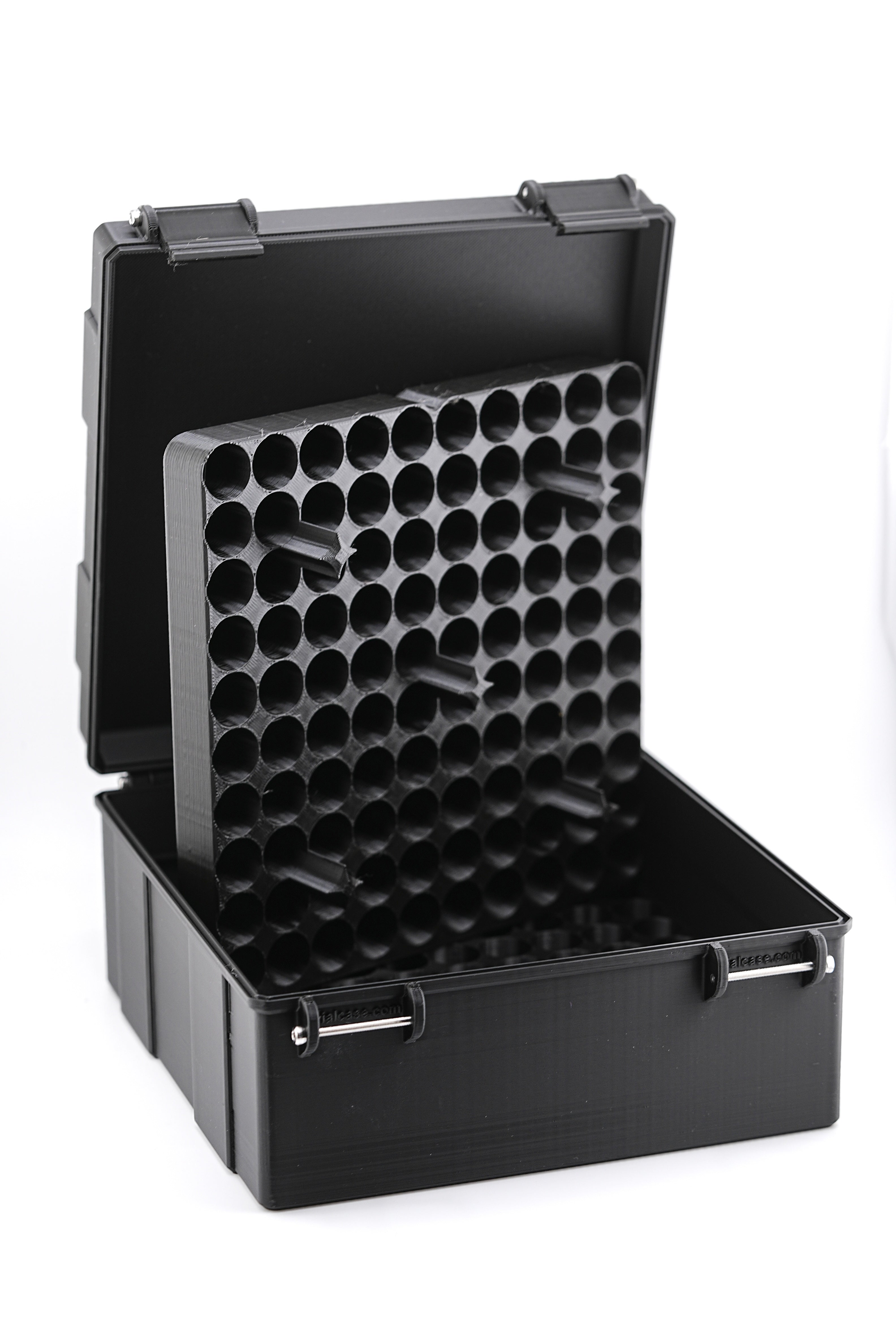
Give every vial its own fitted pocket, with tops lined up at the rim. Add what you keep and the builder plans the most compact case.
Sign #1: It Doesn't Look the Way the Label Says It Should
Many product labels and package inserts describe what the contents should look like and say not to use the product if it doesn't match. That description is your baseline, not a forum post and not another product's photo.
To check, hold the vial against a plain white background in good light. Dim fridge lighting hides a lot. If what you see doesn't match the label, set the vial aside and call your pharmacist or provider before using it.
Prevention: Keep the vial in a closed case in the fridge, away from sunlight and bright light every time the door opens. Many labels say to protect vials from light, and a closed hard case does that without any effort on your part.
Sign #2: Cracks, Chips or Star Fractures in the Glass
Glass vials take more abuse than people realize. A vial that rolls off a shelf, rattles against other vials in a drawer or gets crushed in a bag can develop a hairline crack or a chip at the neck or base. Some cracks are obvious; others only show when you turn the vial in the light.
A cracked or chipped vial is no longer sealed the way it was made. Don't use it; ask your pharmacy about a replacement.
Prevention: Every vial needs its own fitted spot, with no glass touching glass and no room to tip. This is the single biggest thing a hard case does that a bag or a drawer can't.
Sign #3: A Damaged Cap, Stopper or Seal
The cap and rubber stopper are what keep the inside of a vial closed off from everything outside it. Check for:
- A missing or loose flip-off cap, or a crimp ring that spins or has lifted
- A stopper that is split, pushed in, or bulging
- Residue or grime on the stopper surface that wasn't there before
- Cracks in the cap from the vial being dropped or frozen
A damaged seal means you can't be sure what has gotten in. Set it aside and ask your pharmacist or provider.
Prevention: Vials that stand upright and stay put don't bang their caps against each other. A case where every vial stands in its own pocket, with the tops lined up and reachable, keeps the seals out of harm's way.
Sign #4: A Known Heat Event
This sign is about what happened to the vial, not what you can see. Heat damage is invisible, so the history matters. Common scenarios:
- Left in a parked car. A car in warm weather heats up very quickly.
- Packed in checked luggage. Cargo holds are not climate-controlled the way the cabin is. See our guide on traveling with peptides through TSA for what to do instead.
- Left on the counter. You took it out, got distracted, and found it hours later.
- A sunny windowsill or a spot near the stove.
If your vial went through any of these, check your label's storage instructions and call your pharmacist or provider with the details: how long and how warm. Don't rely on a rule of thumb meant for a different product.
Prevention: Give vials one home in the fridge and put them straight back after use. For trips, the closed case goes inside an insulated cooler bag with ice packs. Remember that a hard case is a protective organizer, not a cooler: it keeps vials safe and in order, but the fridge or the cooler does the cooling.
Sign #5: It Froze, or the Fridge Failed
Fridges fail in two directions. Some run cold enough to freeze the back of a shelf, especially near the cooling plate. Others warm up when the power goes out or the door is left ajar.
- A vial that sat against the back wall may have frozen without you noticing.
- A power outage leaves you guessing how warm the fridge got and for how long.
- A fridge with a failing thermostat can drift for days.
Check whether your label says anything about freezing, and ask your pharmacist or provider what to do. A min-max thermometer in the fridge tells you the highest and lowest reading since you last reset it, which turns guesswork into facts. Our power outage guide covers what to do when the lights go out.
Prevention: Keep vials on a main shelf, off the door and away from the back wall, inside a case that keeps them grouped and upright.
Sign #6: It's Past the Date on the Label, or You Don't Know When You Opened It
Your pharmacy or manufacturer prints a date on the label for a reason. If the vial is past it, don't use it. The harder case is the mystery vial: you know you opened it at some point, but not when.
If you can't say when a vial was opened, or the label instructions mention a time limit after opening that you can't confirm, ask your pharmacist or provider rather than estimating.
Prevention: Write the date you open each vial on its label or cap the same day. If you keep several vials, a different cap color for each makes them easy to tell apart at a glance. See how to label vials for simple systems that last.
Color-code your vials
Custom snap-on caps for 3 mL or 10 mL vials, with a cap color plus an icon or letters. Sets from 25 caps.
Sign #7: You're Not Sure Which Vial It Is
This one surprises people, but it's common: two vials that look alike, a label that has rubbed off, a vial that ended up in the wrong spot. If you can't say for certain what a vial holds, that vial has gone bad for practical purposes. Don't guess. Set it aside and ask your pharmacist or provider.
Prevention: Fixed positions. When each vial has its own pocket in the same place every time, and each one is labeled or color-coded, confusion becomes almost impossible.
The Storage Root Cause
Look back at the seven signs and a pattern appears. Most of them trace back to four things you control: heat, light, physical damage and confusion.
- Heat is handled by your fridge (checked with a thermometer) and a cooler bag with ice packs when you travel, following your label.
- Light is handled by keeping vials in a closed case instead of a clear bag or the fridge door. Our fridge organization guide covers placement.
- Physical damage is handled by giving every vial its own fitted spot, so nothing rolls, rattles or tips.
- Confusion is handled by labels, cap colors and fixed positions.
Get those four right and you'll rarely have to ask whether a vial is still good. When you do, the label and your pharmacist have the answer.
Build your own custom vial case
Three of those four root causes come down to the case your vials live in. With the PeptideCase™ builder you start with an empty case, tap "Add item," and choose exactly what you keep: 3 mL or 10 mL vials, peptide vials, other size vials, syringes, alcohol pads, a BAC water bottle or pens. Every item becomes fitted pockets or an open bay sized for that many, so nothing rattles and no glass touches glass.
The tallest item sets the case height, and shorter vials stand on a raised floor so every top lines up at the rim, easy to grab and easy to check. Each space has a finger scoop. Auto-arrange packs everything into the most compact layout, and you see the exact size plus top, lid and 3D views before you order. Pick Black or RGB Metallic, a wide or deep shape, and single or dual latches. It is printed to order in the US.