
Looking for where to get peptides? For anything prescribed, your provider and pharmacy are the right people to ask. We make cases, and we don't give advice on where to get compounds.
What we can answer is the question that comes right after: where do you get a good case to keep your vials in? In 2026 there are three realistic options, generic containers, ready-made vial cases, and a custom case designed around your kit, and they suit very different people. Here's how they compare.
Get a case built around your kit
Add the vials, pens and supplies you keep. The builder plans the most compact hard case and sends it to the vialcase.com cart.
The Three Places People Get a Peptide Case
| Generic container | Ready-made vial case | Custom case | |
|---|---|---|---|
| Fit | Rarely made for vials | Fixed slots in one vial size | A pocket or bay for every item you add |
| 3 mL and 10 mL together | No | Usually one size per case | Yes, side by side |
| Supplies | Loose | Sometimes a compartment | Fitted troughs and slots for what you choose |
| Size | Whatever is on hand | Set by the maker | The most compact layout for your kit |
| Availability | Anywhere | Off the shelf | Made to order |
| Returns | Varies | Varies | Final sale; printing defects replaced |
Option 1: Generic Containers
Pill organizers, foam-lined tool boxes, makeup bags and zip pouches. They're everywhere and they cost little, which is why so many people start here.
- Good for: one or two vials that never leave the fridge.
- The catch: compartments are the wrong shape, plastic is often see-through, latches are weak, and nothing holds a vial upright. Soft pouches offer no crush protection at all.
Option 2: Ready-Made Vial Cases
Purpose-built hard cases with molded slots, sold in standard sizes such as 10, 12, 13 or 20 slots, usually for either 3 mL or 10 mL vials, sometimes with a compartment for syringes or alcohol pads.
- Good for: kits that happen to match a standard slot count in a single vial size.
- The catch: you adapt your kit to the case. Keep both 3 mL and 10 mL vials and you often need two cases. Keep a sterile water bottle or a pen and it may not fit anywhere. Have four vials and you carry around sixteen empty slots.
Option 3: A Custom Case Designed Around Your Kit
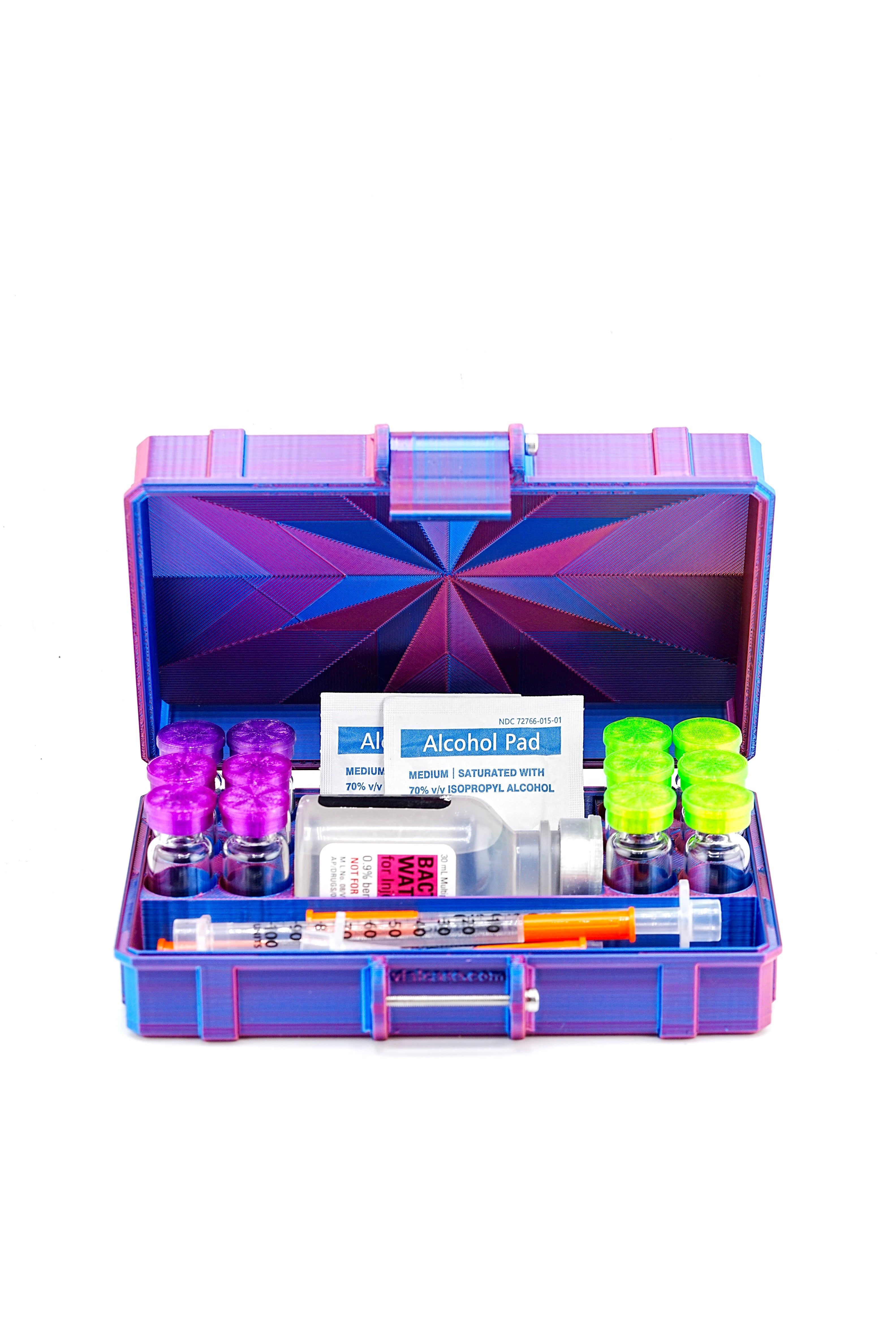
Instead of choosing from fixed sizes, you list what you carry and the case is built to fit it. That's what the PeptideCase™ builder does: you add each vial size, pen and supply, and it plans the most compact case that holds exactly that, printed to order on the maker's own print farm in the US.
- Good for: anyone whose kit doesn't match a standard slot count, anyone with more than one vial size, and anyone who wants the smallest case that holds everything.
- The catch: it's made to order rather than pulled off a shelf, and custom cases are final sale (printing defects are still replaced).
What to Check Before You Buy Any Case
Wherever you get it, a good vial case should pass this checklist:
- Hard shell. Glass needs crush protection; pouches don't count.
- Opaque. Many labels say to protect vials from light, so the inside should be dark when closed.
- Fitted slots for your sizes. 3 mL vials rattle in 10 mL slots; 10 mL vials won't fit 3 mL slots.
- A latch that clicks. Friction-fit and magnetic lids pop open in bags.
- The right footprint. Measure your fridge shelf and your travel bag first.
- Room for supplies. Syringes and alcohol pads should live with the vials.
- Honest about cold. A hard case is a protective organizer, not a cooler. For temperature, follow your labels, and use a cooler bag with ice packs for travel.
Keeping several vials? Colored caps make any case easier to use, and our vial labeling guide covers the rest.
Color-code your vials
Custom snap-on caps for 3 mL or 10 mL vials, with a cap color plus an icon or letters. Sets from 25 caps.
Build your own custom peptide case
In the PeptideCase™ builder you start with an empty case and tap "Add item." Choose what you carry and how many: 3 mL vials, 10 mL vials, peptide vials, TRT vials, glutathione vials, other size vials, syringes, alcohol pads (flat or standing), a BAC water bottle, a peptide pen or injector pen, pen cartridges, a custom space with your own width, depth and height, or a temperature sensor window for a small digital thermometer. Each item becomes fitted pockets or an open bay sized for that many, with a finger scoop in every space.
Auto-arrange finds the most compact layout and shows the case size, height and contents with top, lid and 3D views. Choose Black or RGB Metallic, a wide or deep shape, single or dual latches, and an optional lid design. Add to cart sends your design to the vialcase.com cart for checkout.
The Bottom Line: Matching the Case to Your Situation
One or two vials that never leave the fridge: almost anything that keeps them upright and dark will do. A kit that matches a standard slot count in one vial size: a ready-made vial case is a fine choice. Anything else (two vial sizes, a pen, a sterile water bottle, a lot of supplies, or a need for the smallest possible case): design a custom one. For more on choosing, see our best peptide case guide.