
Why Vial Storage Is Mostly About the Case
Two things decide whether a vial makes it to the last use. One is temperature, and that is set by your product label and your pharmacist or provider — follow their storage instructions exactly. The other is how the vial is handled day to day: whether it gets knocked, left in the light, lost at the back of a shelf, or confused with another vial. That part is where most problems actually happen, and it is the part a good case fixes.
In a TRT setup the small vial rarely lives alone. It usually shares the fridge with larger TRT vials, and the drawer next to it holds syringes, alcohol pads and a water bottle. Spread across three places, that kit invites mistakes. Kept in one organized case, it takes seconds to check and put away.
Design a case for your whole TRT kit
Add your TRT vials, smaller vials and supplies, and get one hard case with a fitted pocket or bay for every item.
Temperature: Your Label and Your Pharmacist Decide
This guide does not print temperature ranges or time limits. The right numbers depend on the exact product, and they are on your label or available from the pharmacy that filled it. If anything about storage is unclear, ask your pharmacist or provider before you guess.
Keep in mind what a case is and is not. A hard case is a protective organizer, not a cooler. It does not keep anything cold by itself. At home it sits wherever your label says the vials belong, usually a fridge shelf. On the road it goes inside an insulated cooler bag with a gel ice pack.
The Challenge of Frequent Fridge Access
Vials you use often get handled often. Every time you open the fridge, dig past the food and pick through loose vials, the door stays open longer and the glass gets another chance to tip or roll. Frequent access is exactly when a fixed system pays off.
- One home for everything. The case sits in the same spot on the same shelf, so you open the fridge, lift the case out, and close the door.
- One pocket per vial. Each vial goes back in its own pocket, upright, so nothing rolls and you can see at a glance what is there.
- Back in the fridge promptly. Follow your label on how long the vial can be out; a case you can carry to the counter and straight back makes that easy.
- Check the fridge itself. Home fridges run wherever the dial was left. A fridge thermometer on the shelf where you keep the case tells you what is really happening, and the case builder offers a temperature sensor item — a clip-in window in the lid or a socket inside the case for a small digital thermometer.
Traveling With Your Vials
Travel adds two risks to everyday storage: heat and rough handling. Plan for both before you leave.
Air Travel
- Always carry on. Keep vials in the cabin with you, never in checked luggage, where you have no control over handling or conditions.
- Tell the officer at screening. Let the TSA officer know you are carrying medication and medical supplies, and expect the case to be inspected separately. Check TSA's current rules before you fly.
- Bring paperwork. Keep vials in their original labeled packaging where possible, and carry a copy of your prescription or a letter from your provider, especially on international trips. Check your airline's and your destination's current rules yourself.
- Cold if your label needs it. Pack the closed case inside an insulated bag with a gel ice pack, wrapped in a cloth so the pack does not sit directly on the glass.
Road Trips
- Never leave the case in a parked car. A closed car heats up fast in the sun. Take the case with you, even for a quick stop.
- Keep it in the cabin, not the trunk. The air-conditioned cabin is the steadiest place in a car.
- Confirm the fridge at your destination. Make sure your hotel or rental has a working fridge before you go, and bring a small thermometer if you want certainty.
For a full packing list, see our peptide travel checklist.
When the Fridge Goes Down
Power outages catch people off guard. Keep the fridge door shut while the power is out — a closed fridge holds its temperature far better than an open one. If the outage drags on, move the closed case into a cooler with ice packs, with the packs wrapped so they do not touch the glass. Once power is back, do not guess about whether your vials are still fine: ask your pharmacist or provider. Our power outage guide has a fuller plan.
Common Storage Mistakes and How to Avoid Them
- Using the door rack. It is the least stable spot in the fridge and the easiest place to knock a vial out. Use a middle shelf toward the back.
- Not dating the vial. If your label or pharmacist gives you a date to track, such as when you opened it, write it on the vial the same day.
- Leaving the vial on the counter. Setting a vial down, getting distracted and leaving it out is common. A case on the counter gives it a place to go straight back to.
- Pushing it against the back wall. Some fridges run coldest near the cooling vent. If your label says not to freeze, keep the case a little off the back wall.
- Assuming the fridge is right. Put a thermometer where the case sits and look at it now and then.
- Loose vials knocking together. Give each vial its own pocket so glass never touches glass.
More in our list of common peptide storage mistakes.
Organizing Your TRT Storage Setup
A typical TRT kit holds larger TRT vials (often 10 mL), one or more smaller vials, a sterile water bottle, syringes and alcohol pads. Managed without a system, it ends up spread across the fridge, a drawer and a bathroom cabinet, and something is always missing when you need it.
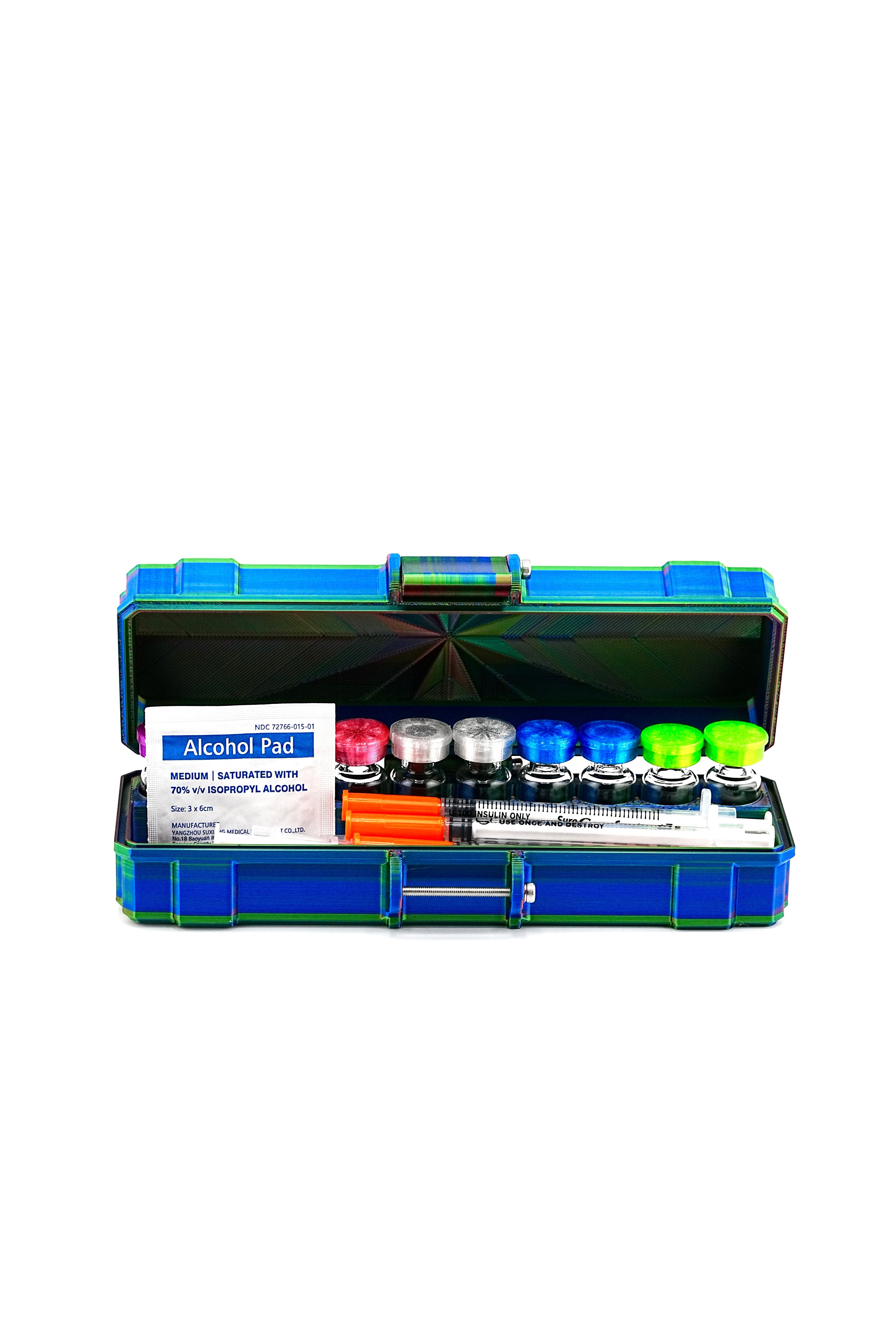
A single case with a fitted space for each item fixes that. The vials stand upright in their own pockets, the supplies sit in their own bays, and the whole kit moves as one piece between the fridge, the counter and your travel bag. If you keep several kinds of vials, color-coded caps make it hard to grab the wrong one. For more layouts, see our roundup of the top 10 TRT storage cases.
Color-code your vials
Custom snap-on caps for 3 mL or 10 mL vials, with a cap color plus an icon or letters. Sets from 25 caps.
Final Checklist
- Follow the storage instructions on your label or from your pharmacist or provider
- Keep vials in a closed case on a middle shelf, not in the door
- Give every vial its own pocket, standing upright
- Label each vial and write down any date your pharmacist tells you to track
- Check your fridge with a thermometer
- Carry on when flying, with original packaging and a prescription copy
- Use a cooler bag and ice pack around the case when your label calls for cold
- Never leave the case in a parked car
- Keep the whole TRT kit in one organized case
Make your own custom TRT vial case
The fastest way to an organized kit is a case designed around it. In the PeptideCase™ builder, start with an empty case, tap "Add item" and add what you carry: TRT vials, 3 mL or 10 mL vials, other size vials, a BAC water bottle, syringes, alcohol pads, or a custom space you size yourself. Set how many of each, and every item becomes fitted pockets or an open bay sized for that many.
The tallest item sets the case height, and the shorter vials stand on a raised floor so every top lines up at the rim, easy to grab. Auto-arrange packs it all into the most compact layout, and the builder shows the length, width and height with top, lid and 3D views. Choose Black or RGB Metallic, Wide or Deep, one or two latches, and print "TRT" or your initials into the lid in a second color so it stands out on the shelf. Want to watch the temperature? Add the sensor item for a small digital thermometer. Build your TRT case