
The Core Problem: Glass Vials Are Fragile and Hard to Replace
Start with what's at stake. If you keep four or five vials plus backups, the contents of your storage case are worth far more than the case, and many of them are slow or difficult to replace. A single broken vial is an expensive, messy morning.
That case will be dropped. Not maybe — will be. It will get squashed in an overhead bin. It will get knocked off a fridge shelf. It will be jostled in a gym bag on a daily commute. Every one of those events is a stress test, and the way your case is built determines whether your vials survive it.
Borosilicate glass — the material most vials are made from — is tough relative to ordinary glass but unforgiving of sharp, concentrated hits. A vial that takes a direct sideways knock against another vial, a hard surface, or even the inside edge of its own case can crack or shatter. A crushing force can push a stopper out of place even when the glass survives. A soft case passes every one of these forces straight through. A hard shell case takes them on its walls instead of on the glass. This isn't theoretical risk management. It's the most predictable failure in vial storage, and it's preventable with the right case. The best version is a hard case built around your exact vials, which you can now design yourself.
Design a hard case around your vials
Pick your vials and supplies and the builder lays out a rigid, latched case with a fitted pocket for every one.
What Hard Shell Actually Means
The term "hard shell" is used loosely, so let's establish what it means in practice. A true hard shell case is made from a rigid plastic that does not flex meaningfully when you squeeze it — you can press the sides with moderate force and the walls do not bend in toward the vials.
The most common materials used in genuine hard shell cases are:
- ABS (Acrylonitrile Butadiene Styrene): What many electronics housings, device casings, and transport cases use. It's impact-resistant, holds its shape, and can be molded to exact dimensions.
- Polycarbonate: Very high impact strength and clear in its natural state, which is why it is usually tinted when used for cases. Some premium cases use polycarbonate shells for extra drop resistance.
- Rigid EVA (Ethylene-Vinyl Acetate): The borderline category. At enough thickness and density, rigid EVA offers real crush resistance. At pouch thickness, it does not. Rigid EVA shells in quality cases perform adequately; the same material used as a flexible pouch performs like a soft case.
What is definitively not hard shell: neoprene, fabric pouches, flexible plastic bags, thin-walled EVA pouches, mesh cases, and anything that visibly bends when you press on the sides. These are soft cases regardless of what the product listing calls them.
The 5 Failure Modes of Soft Cases for Peptides
Soft cases don't fail in one dramatic way — they fail in five distinct ways, each a threat to your vials on its own. Together they add up to a storage failure.
1. No Crush Resistance
A neoprene or fabric case in a gym bag provides essentially zero protection against crushing. Put a water bottle, a set of keys, or a laptop on top of it and that weight goes straight through the soft material to the vials inside. You end up with pushed-in stoppers, chipped vial necks, and broken glass. A hard shell case spreads that load across its rigid walls and away from the vials. This is physics, not marketing.
2. Light Leaks Through Soft Material
Most product labels say to keep vials away from light. Most soft cases — even dark-colored ones — are not fully opaque. Hold a phone flashlight against a neoprene or fabric case and watch the light come through. That's the light your vials see every time the case sits on a lit countertop, in a bag under a window, or in a car on a sunny commute. A solid-walled hard case with a closed lid keeps vials out of sight and out of that light.
3. Vials Shift Inside
A soft case with vial pockets may hold each vial in place while it sits still. The moment you're moving — walking, driving, a bag on your shoulder — the soft walls flex with each motion. Vials rock in their pockets and you get glass-on-glass knocks over and over. Over a daily commute that adds up. A hard case with properly sized pockets holds each vial in its own space regardless of movement.
4. Zipper Failure Over Time
Most soft cases use a zipper as their primary — and often only — closure. Zippers don't love damp fridges. Over time the tracks wear, the slider sticks, and you get partial closures that look closed but aren't. A case that partially unzips in a bag, on a fridge shelf, or in transit can dump its contents. Hard shell cases use mechanical latches — positive-click closures. The latch either engages or it doesn't; there's no half-closed failure mode.
5. Temperature Transmission
Here's the honest version: no case keeps vials cold on its own, soft or hard. A case is a protective organizer, not a cooler. Follow the storage instructions on your product label or from your pharmacist or provider, and when that means keeping things cold on the move, put the case inside an insulated cooler with an ice pack. Where hard shell wins is inside that cooler: rigid walls keep the ice pack and everything else from pressing on the glass, and the closed case keeps condensation off your labels. A soft pouch in a cooler just gets wet and squashed.
What Hard Shell Cases Do Differently
A hard shell vial case solves these failure modes through structure, not workarounds. Rigid walls take impacts and crushing loads instead of the vials. A closed, solid shell keeps vials out of the light. Properly sized pockets hold each vial upright and separate during movement. A mechanical latch holds the lid shut under pressure.
The inside of the case matters as much as the shell. Each vial pocket should match the vial it holds: big enough to slide the vial in and out, snug enough that it can't rattle. Oversized slots let vials move during transport, and a case with one generic slot size forces 3 mL and 10 mL vials into the same holes. That is the functional difference between a real vial case and a generic hard box with foam cutouts — and why a case designed around your own vials beats both.
Hard Shell for Drops: Real-World Scenarios
The abstract argument for hard shell is compelling, but real-world scenarios make it concrete. Here are three common situations and what happens to your vials depending on the case.
Scenario 1: The Dropped Bag
Your gym bag slips off your shoulder and hits the floor. Inside: six vials in a soft neoprene case. The soft case passes that impact straight to the vials. If two vials are touching at the point of impact, or a vial slams into the side of the case, you have at minimum a chipped neck and at worst a broken vial. With a hard shell case inside the same bag, the rigid walls take the hit and spread it to the case edges, and each vial sits in its own pocket instead of against its neighbor.
Scenario 2: Overhead Bin Compression
Your carry-on goes into the overhead bin. Someone else's heavy bag gets placed on top of it for the whole flight. A soft case inside your bag passes that weight straight to the vials, and the ones on top sit under that load for hours. A hard shell case takes the weight on its top wall and holds its shape.
Scenario 3: Knocked Off the Fridge Shelf
A full fridge, a reaching hand, a case on the edge of the shelf. A soft case hitting a tile floor from fridge height leaves the vials with almost no protection. A hard shell case hitting the same floor puts its rigid walls between the floor and the glass, and a latched lid keeps the vials from scattering across the kitchen.
Hard Shell Cases Ranked for Peptide Use
Not all hard shell cases are equally suited to vial storage. Here's an honest ranking of the options people typically consider, from least to most purpose-fit.
Generic Hard Plastic (Pelican-Style Cases)
These cases are genuinely hard shell and genuinely impact-resistant. But they are designed for camera equipment and tools — not 3 mL glass vials. They're oversized for most vial collections, heavy in a bag, and have no vial-specific organization inside. Their foam inserts need custom cutting and often leave too much vial movement. Hard shell material, wrong application.
Generic Hard Shell Makeup Cases
The right size, the wrong design. Hard shell cosmetic cases look promising on paper — compact, rigid, latched. The problem is the interior: mirror-paneled lids, trays and elastic loops designed for lipstick, not vials. No individual vial slots, no height support, and often a gap at the hinge seam. Fine for cosmetics; inadequate for glass vials.
Ready-Made Vial Cases with Fixed Layouts
Purpose-built vial cases are a real step up: rigid shell, a latch, and slots sized for common vial sizes, sometimes with a compartment for supplies. The catch is that the layout is fixed. If you keep both 3 mL and 10 mL vials, a pen, or more syringes than the designer expected, you end up with empty slots in one place and loose items in another.
Best: A Custom Hard Case You Design Yourself (PeptideCase™ Builder)
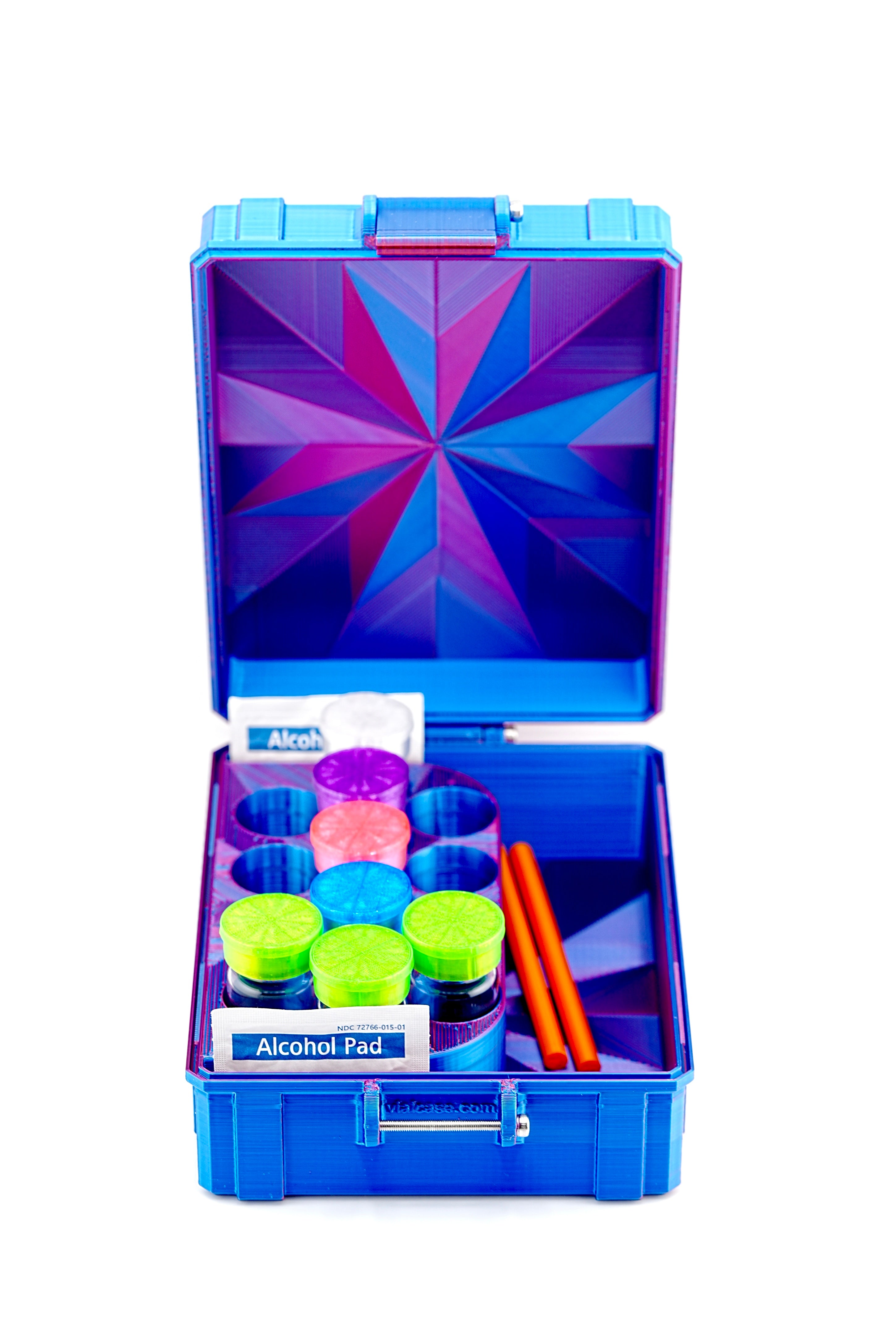
The PeptideCase™ builder flips the process: you start with an empty case, tap "Add item", and add exactly what you carry — 3 mL vials, 10 mL vials, peptide vials, syringes, alcohol pads, a BAC water bottle, a pen or pen cartridges — and how many of each. Every item becomes fitted pockets or an open bay sized for that many, so there are no empty slots to rattle in. The tallest item sets the case height, shorter vials stand on a raised floor so every vial top lines up at the rim, and every storage space has a finger scoop.
It closes with a print-in-place snap hinge and a locking latch; big cases get a 5-knuckle hinge and two latches. Auto-arrange packs everything into the most compact layout, and the builder shows the exact size before you order. Design your hard shell case.
Pro Tip: The squeeze test. Squeeze your current case with both hands and moderate pressure. If the sides flex inward toward the vials, it is not protecting them from impact. A true hard shell case will not flex under hand pressure. If you can squash the walls, so can a heavy bag sitting on top of it.
Hard Shell for Cold Storage
If your label says your vials belong in the fridge, your case lives in a cold, damp place and gets moved in and out of it regularly. It needs to handle that without falling apart.
Soft cases fail this test progressively. Fabric absorbs moisture from fridge humidity, which weakens stitching and glue. Zipper tracks stiffen and stick. Thin EVA pouches crack at their fold lines after enough handling. Paper labels inside a damp pouch smudge and peel.
A hard case has none of those parts: no fabric to soak up moisture, no zipper, no stitching. Wipe it down and it's dry. And remember that in the fridge the case is an organizer, not a cooler: the fridge does the cooling, and the case keeps every vial upright, separated, labeled and out of the way of food. For travel, the same case drops into a cooler.
The Long-Term Case: Why Hard Shell Lasts Longer
The real cost of a case goes beyond its price tag. A soft case that wears out within a year of regular use — zipper failing, foam compressing, fabric fraying — needs to be replaced, usually right after it has let you down.
Consider the failure points of each type. Soft cases fail at zipper tracks, foam (compression and cracking), fabric (abrasion, stitching failure, moisture), and glued seams. A rigid hard case has far fewer weak points: the shell itself, the hinge and the latch. Treat it reasonably and it keeps doing its job long after a soft case would have been retired.
Your vials are worth more than the case protecting them, so the case should last longer than anything you put in it. Hard shell delivers that. Soft cases, by design, do not.
What Hard Shell Cases to Avoid
Not everything marketed as hard shell meets the standard. Here are the red flags to screen for when evaluating any hard shell vial case.
Thin-Walled Cases
The right material is only half the story; wall thickness matters too. A case with very thin walls provides far less protection than one with thick walls. Manufacturers don't always publish wall thickness, so test it physically with the squeeze test above. Cheap hard cases that feel hollow or flimsy when empty usually have thin walls.
Cases That "Look" Rigid But Flex Under Pressure
Some cases are marketed as hard shell but are made from thin, slightly flexible plastics that bend under real loads. A case that passes a fingertip squeeze but flexes under a full hand press is not providing meaningful crush protection. Press both sides with both hands. Any bending toward the vials is a disqualifying failure.
Cases with Moisture-Absorbing Foam
Hard cases with open-cell foam interiors soak up humidity in the fridge over time. That damp foam stays pressed against your vials, stoppers and labels for weeks. Look for cases with closed-cell foam or rigid pockets that don't absorb moisture.
The Complete Case for Going Hard Shell
The argument for a hard shell vial case is not about looks or brand preference. It's about the physics of protecting glass. Glass breaks under sharp impacts that hard shell cases absorb. Stoppers shift under crushing loads that hard shell cases spread away from the vials. Zippers fail where latches hold. Soft materials let light through where a closed, solid shell does not.
Every alternative — neoprene pouches, fabric roll-ups, soft EVA cases, makeup bags — compromises on at least one of these. Most compromise on all of them. The vials inside your case are worth many times the case, so protect them accordingly.
For a full comparison of case options, see our complete peptide cases buyer's guide. For more storage tips, see our guides on the most common peptide storage mistakes and amber vs. clear vials.
Build your own custom hard shell peptide case
If a hard case is the right call, the next question is which one, and the honest answer is the one shaped around your kit. In the builder you tap "Add item" and choose from 3 mL vials, 10 mL vials, peptide vials, TRT vials, glutathione vials, other size vials, syringes, alcohol pads (flat or standing), a BAC water bottle, a peptide pen, an injector pen, pen cartridges, or a custom space where you type in the width, depth and height. Set the quantity of each and Auto-arrange finds the most compact layout.
Before you order, the builder shows the case length and width, its height and what it holds, with a top view, a lid view and a 3D view you can open, unlatch and drag to turn. Choose Black or RGB Metallic, a Wide shape (hinge on the long side) or Deep shape (hinge on the short side), and a single or dual latch. You can add text, an icon or your own logo to the lid in a second color. Every case is printed to order on our print farm in the US, exactly the size shown.