
GLP-1 vials are among the most expensive glass in anyone's fridge. Most labels ask for refrigeration, many ask for protection from light, and every vial needs protection from the knocks and tips that crack glass and damage stoppers. The case you choose either handles all of that or it doesn't.
Here are the 10 most common ways people store 10 mL GLP-1 vials, ranked from worst to best on real-world protection, organization and portability.
Design a case around your GLP-1 vials
Add your 10 mL vials, pens, BAC water bottle and syringes. The builder sizes a fitted pocket for each and shows the case in 3D.
#10: Worst: Loose in the Refrigerator
No container at all, just vials rolling around a fridge shelf. Every door opening floods them with light, every nudge risks tipping one over, and there is no record of which vial was opened when. For vials this valuable, it is simply careless storage. The only acceptable version is the first few minutes between delivery and setting up proper storage.
#9: Zip-Top Freezer Bag
Better than nothing in exactly one way: the vials stay grouped. A clear bag does nothing about light, gives zero impact protection, and the vials rattle against each other on every fridge vibration. It also traps condensation against the labels. As a primary GLP-1 vial container, it is taking on risk you don't need to.
#8: Insulin Pen / Medication Pouch
Soft neoprene or fabric pouches made for insulin pens are popular for GLP-1 storage because the users overlap. The problem: they are designed for pens, not 10 mL vials. A vial either doesn't fit or flops around uselessly in the oversized pocket. No rigid protection, no fitted spot, and most pouches are thin enough that anything dropped on them still reaches the glass.
#7: Original Shipping Packaging
The insert your vial shipped in. For a few days it is legitimately fine: it blocks light, holds the vial upright and was made for that exact vial. The problem is durability. Cardboard in a fridge soaks up moisture and softens, and soon it stops holding anything in place. Transit packaging is not storage packaging.
#6: Repurposed Pharmacy Box
Some people reuse small cardboard boxes from a pharmacy order. Same problem as shipping packaging: cardboard goes soft in a damp fridge. These boxes also rarely fit a 10 mL vial properly, and forcing a vial into a box that is slightly too small can damage the stopper.
#5: Generic Eyeglass Case (Hard Shell)
Creative, and not bad. A hard glasses case is opaque, rigid and compact, and can fit a 10 mL vial with some padding. The real limit is organization: one cavity, no individual pockets, no room for a BAC water bottle or syringes, and no secure way to hold more than one or two vials. If you keep a single GLP-1 vial, it works as a short-term hack. Add anything else and you outgrow it immediately.
Pro tip: Whatever container you use, a small desiccant packet inside keeps condensation from lifting labels and softening any cardboard that sneaks in.
#4: Clear Plastic Food Container
A sealed container is a real step up: contained, stable on the shelf and protected from spills. Clear plastic fails on light, though. Every time the fridge opens, the light shines straight through onto your vials. Amber glass filters some UV, but visible light still gets in. If your vial label says to protect it from light, this isn't enough. Our guide to amber vs. clear vials explains why.
#3: Opaque Hard Container (Generic)
A dark food container or black storage box fixes the main flaw of #4: light protection plus spill protection plus a single home for your vials. Still missing: fitted vial pockets (vials can shift and clink), a spot for the BAC water bottle, and anywhere to keep syringes or alcohol pads. If you already own one and keep only one or two vials, it is a legitimate budget option.
#2: Pelican-Style Foam-Lined Hard Case
A compact hard case with foam you cut yourself. When the foam is cut precisely to a 10 mL vial, this gives excellent impact protection and almost no vial movement. The downside is effort: cutting foam to exact vial size is tedious, most DIY cuts leave some wiggle, and there is no built-in spot for a water bottle or syringes. A solid DIY route if you have the patience; use a firm closed-cell foam, not the soft kind that squashes flat.
#1: Best: A Custom Case You Design Yourself (PeptideCase™ Builder)
The only option on this list that starts from your vials instead of a stock layout. In the PeptideCase™ builder you add exactly what you keep, such as two 10 mL GLP-1 vials, a BAC water bottle, syringes and alcohol pads, and each item gets a fitted pocket or bay of its own. Vials stand upright and can't touch each other, the closed lid keeps them in the dark, and the compact footprint sits flat at the back of a middle fridge shelf.
When your vials are this valuable, improvised storage isn't worth the risk. Design a case for your GLP-1 vials
Pro tip: Label each GLP-1 vial with the date you opened it and the discard date from its label or your pharmacist, using a fine-tip marker on fridge-safe tape. You will never have to guess how old a vial is. Our guide on how to label vials has the full system.
Why GLP-1 Vial Storage Is Especially Unforgiving
Most stored items forgive a little sloppiness. GLP-1 vials don't, for two reasons. First, the label instructions are specific, and a vial that drifts into the door shelf or sits under the fridge light is no longer stored the way its label asks. Second, the cost per vial means one cracked or questionable vial is an expensive mistake.
The three real-world threats, in order of impact: placement (vials stored near the door or in a fridge running warm), light (clear containers, loose vials) and knocks (vials rattling against each other or hard surfaces, especially in transit). Follow the storage instructions on your product label or from your pharmacist or provider, and use a case that solves the other two problems for you. If a vial was ever stored outside its label instructions, ask your pharmacist before using it.
Design your own custom GLP-1 vial case
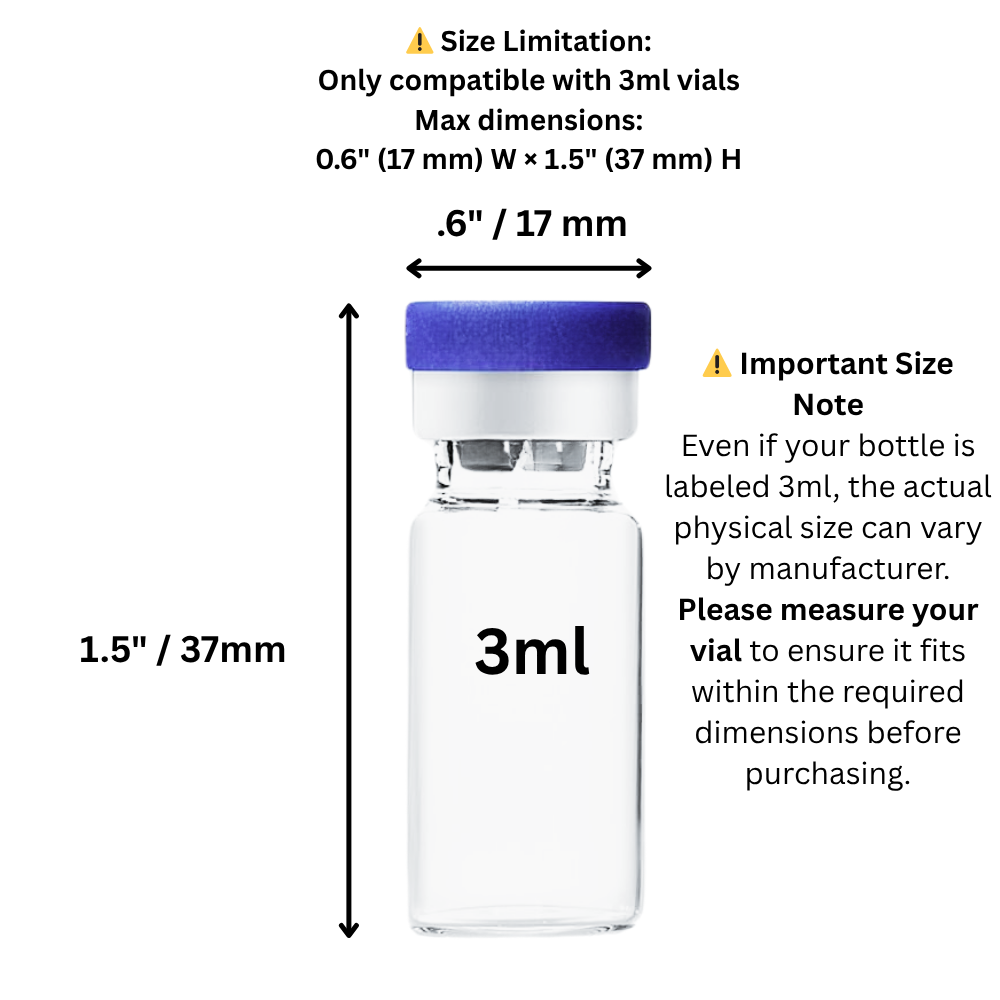
Every case on this list asks you to fit your vials to it. A custom case fits itself to your vials. In the PeptideCase™ builder, start with an empty case and tap "Add item": 10 mL vials for your GLP-1, 3 mL vials if you keep smaller ones, a peptide pen, injector pen or pen cartridges if you use pens, plus a BAC water bottle, syringes and alcohol pads (flat or standing). Each item becomes fitted pockets or an open bay sized for that count, and every space has a finger scoop.
The tallest item sets the case height; shorter vials stand on a raised floor so every top lines up at the rim. Auto-arrange packs everything into the most compact layout, and you see the case size plus top, lid and 3D views before you order. Add a temperature sensor window to keep a small digital thermometer in the lid. Choose Black or RGB Metallic and one or two latches, and the case is printed to order in the US at exactly the size shown. Start your GLP-1 case