
Keeping several peptide vials at once means tracking which vial is which, which one is open, any dates your labels tell you to watch, and how many spares are left. The wrong storage setup turns that into a daily scavenger hunt and raises the odds of grabbing the wrong vial. The right setup makes the whole kit visible and reachable in under 30 seconds.
Here are the 10 most common approaches to storing multiple peptides, ranked worst to best by capacity and organization. For how each vial should be stored, follow its product label or your pharmacist or provider.
Design one case for every vial you keep
Add each kind of vial and supply with its count, and get a hard case where every vial has its own fitted pocket.
#10 — Worst: Multiple Separate Containers (One Per Peptide)
One zip-top bag for the first vial, another for the second, a third for the next. It feels organized but is actually the worst multi-vial system: the biggest fridge footprint, the most chances to confuse unlabeled bags, and a daily ritual of opening several bags to find what you need. Every vial you add makes it worse, and the system soon becomes unmanageable.
#9 — Loose in a Large Tupperware (All Vials Together)
All the vials in one container: at least they’re together. The problem is telling them apart. Unlabeled vials of similar sizes sitting loose in a tub create a guessing game every time you open it, and with several vials opened on different dates, picking up the wrong one is a real mistake. Consolidation without organization is just a different kind of chaos.
#8 — Labeled Zip-Top Bags
A small improvement: individual labeled bags. You know which bag holds which vial. The structural problems remain — no padding, nothing holding the vials, no impact protection — but at least mislabeled vials stop being the problem. Workable for two vials; unworkable for four or more.
#7 — Weekly Pill Organizer (Repurposed)
A seven-day pill organizer with labeled compartments can hold small 3 mL vials with some improvising. The forced structure (one compartment per kind of vial) makes the kit easy to read. Fatal flaws: the compartments aren’t sized for vials, clear plastic keeps out no light, and the open design means a spill in the fridge reaches every compartment. Creative, but not reliable.
#6 — Small Fishing Tackle Box
Tackle boxes have adjustable compartments, a latching lid, and come in opaque versions. For several vials, they work reasonably well: dividers can make vial-sized slots, the opaque lid keeps out light when closed, and the box sits flat in the fridge. The limits are depth (tackle boxes are shallow, which rules out most 10 mL vials) and no padding. Still one of the better non-purpose-built options for four to six vials.
Pro Tip: Keep a simple kit card inside your case. For each vial: what it is, the date you opened it if your label asks you to track that, and how many spares are left. A 3x5 index card works. It takes the memory work out of tracking dates and makes it obvious when a spare needs replacing.
#5 — Tiered Fridge Organizer with Separate Vial Trays
Clear acrylic fridge organizers with tiered trays give excellent visibility and access, and you can give each kind of vial its own tray. That full visibility is both the strength and the weakness: you see everything at a glance, but nothing keeps light off the vials. If your labels say to protect from light, you are trading light protection for organization.
#4 — Opaque Compartmentalized Box (Craft/Art Supply)
Opaque craft boxes with adjustable compartments are a genuinely good multi-vial option. Several compartments handle several kinds of vials, the opaque lid keeps out light, and adjustable dividers can fit different vial sizes. What’s still missing: padding between vials in the same compartment, and no proper space for a water bottle or syringes that need to stay with the kit.
#3 — Two Smaller Cases (Split by Routine)
For larger kits — four to eight vials in use — two smaller hard cases is a legitimate strategy. Split the vials by when you use them, for example a morning case and an evening case, or a home case and a travel case. Each case keeps light off its vials and holds them securely. More organized than any general-purpose box, though less convenient when you need vials from both cases at once.
#2 — Large-Format Foam-Lined Hard Case
A larger Pelican-style case with foam cut for six to ten vials makes excellent multi-vial storage. Individual foam slots stop any contact or movement between vials, and the closed shell keeps light out. Cut the foam right and there’s room for a water bottle, syringes and accessories too. Cutting precise holes for ten different vials takes real effort, and foam cut for one vial size won’t fit another, but done well it’s the most organized setup short of a case built for your kit.
#1 — Best: A Custom Multi-Vial Case You Design Yourself (PeptideCase™ Builder)
A case designed around your exact kit is built for exactly this scenario: several kinds of vials, one organized case. In the PeptideCase™ builder you start with an empty case, tap “Add item,” and add each group with its count — peptide vials, 3 mL vials, 10 mL vials, TRT or glutathione vials, other size vials — plus a BAC water bottle, syringes or alcohol pads if they live with the kit. Every item becomes fitted pockets or an open bay sized for that many, so each vial is fully separated, and every storage space has a finger scoop.
The tallest item sets the case height and shorter vials stand on a raised floor, so every top lines up at the rim and the whole kit is readable the moment you open the lid. The closed shell keeps light off the vials, and Auto-arrange packs everything into the most compact layout for your fridge shelf. For anyone keeping three or more kinds of vials, it’s the most practical setup there is. Design your multi-vial case →
Pro Tip: Use color-coding when you keep several kinds of vials: one cap color per kind. Color lets you grab the right vial in low light, like the fridge at 6 AM, without reading the fine print on a label.
Color-code your vials
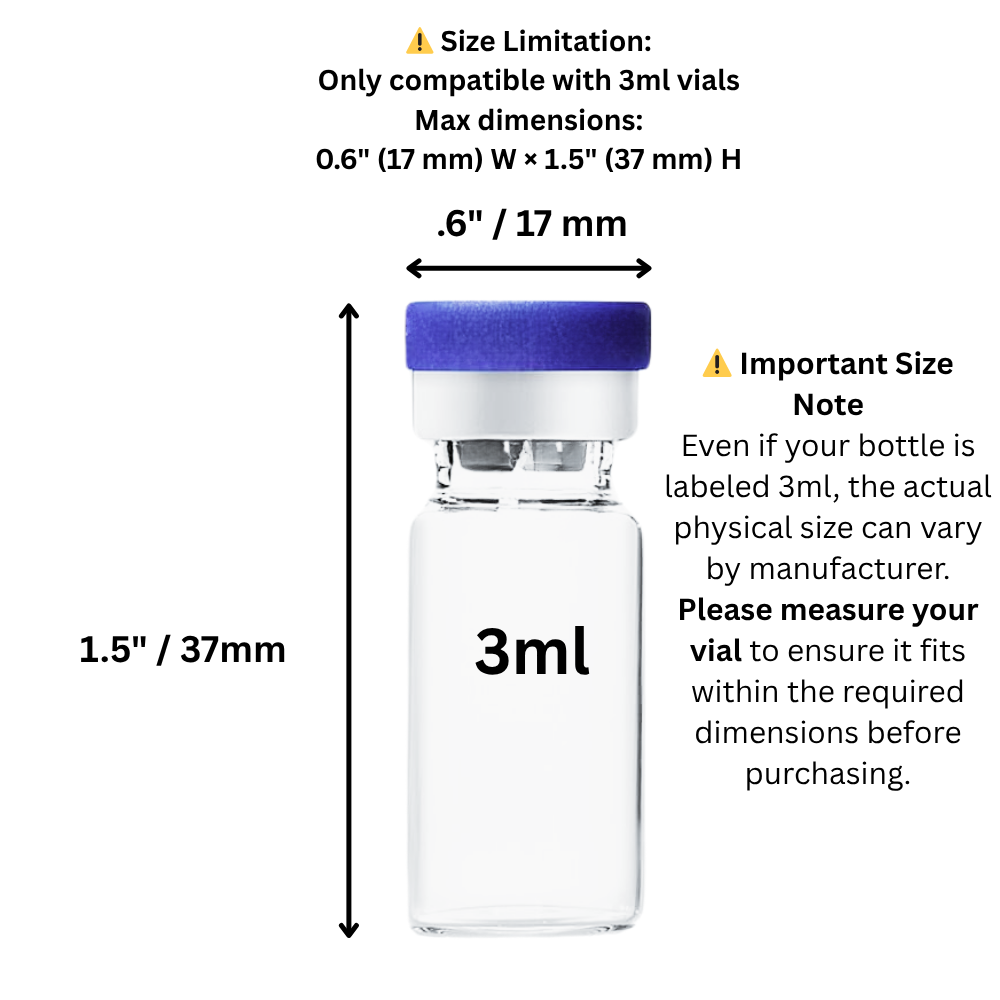
Custom snap-on caps for 3 mL or 10 mL vials, with a cap color plus an icon or letters. Sets from 25 caps.
Organizing a Multi-Vial Kit: The System That Works
Beyond the physical case, a simple tracking habit prevents mistakes. For each vial in use, keep track of: what it is, where it came from (keep the original labeled packaging), the date you opened it if your label asks you to track that, and how many spares you have left. A small card inside the case takes seconds to update and catches most multi-vial errors before they happen. See our full organization guide for templates, and our vial labeling guide for labels that survive the fridge.
Make your own custom multi-peptide storage case
The ranking comes down to one idea: every vial needs its own place, and the place has to fit. The builder does that for whatever combination you keep. Add each kind of vial as its own item with its own count, so each group gets its own block of pockets, then add the supplies that should travel with them. If something doesn’t match a standard item, add a custom space and enter its width, depth and height.
Auto-arrange finds the most compact layout, and you can check the size and contents in the top, lid and 3D views before you order. Choose Black or RGB Metallic, Wide or Deep, single or dual latches, and print a word, icon or logo into the lid in a second color. If your kit is too big to print in one go, the case is printed as two parts, lid and base. Pair it with custom caps so each kind of vial has its own color. Start your multi-peptide case