
What This GLP-1 Vial Storage Guide Covers
GLP-1 vials are small, glass, and often opened only once in a while, which means a single vial can sit in your fridge for a long stretch between uses. That makes the physical side of storage matter: keeping the vial upright, covered, labeled, and in one predictable spot where nobody knocks it over.
This guide covers that physical side: protection from breakage and light, organization, labeling, and travel packing. It doesn't cover what's in the vial or how it's used. Those questions belong to your product label, your pharmacist and your provider.
Temperature: Follow Your Label
For temperature, follow the storage instructions on your product label or from your pharmacist or provider. Unopened and in-use vials can carry different directions, so read the label for each stage rather than relying on a general rule.
A hard vial case is a protective organizer, not a cooler. It doesn't keep anything cold by itself, but it sits inside a fridge or a cooler wherever your label says the vials belong, and it keeps them standing up and separated while they're there.
Design a case around your GLP-1 vials
Add vials, pens, cartridges and supplies, and the builder lays out a compact hard case with a fitted space for each.
Light: Keep Vials Covered
Many products in vials come with a "protect from light" note on the label or carton. If yours does, take it seriously: don't leave the vial on a windowsill, a counter in the sun, or loose in a fridge with a bright interior light.
- Keep the original carton if the label says to store the vial in it.
- Use a closed, opaque case so the vial isn't lit up every time the fridge door opens.
- Don't rely on amber glass alone. Amber vials help, but a closed case or carton adds another layer. Our guide to amber vs clear vials explains the difference.
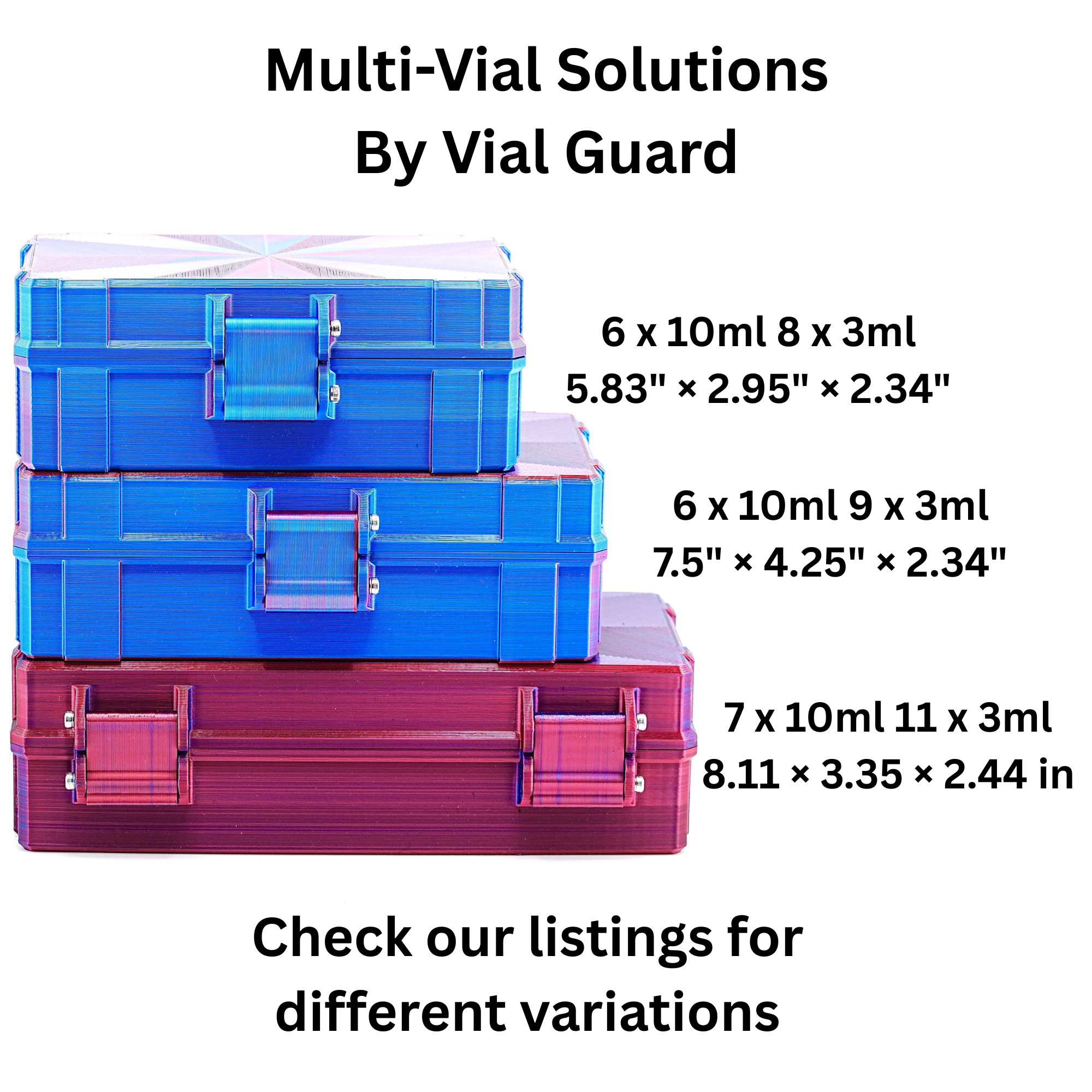
Vials That Sit for Weeks: A Fixed Home and a Clear Label
A vial you reach for only occasionally is easy to lose track of. It drifts to the back of a shelf, gets moved for groceries, or ends up next to a look-alike vial. Two habits prevent that:
- Give it a fixed home. Keep the vial in the same pocket of the same case on an interior shelf, not in the door, where it gets bumped every time the fridge opens.
- Label it clearly. Write what it holds and the date you received or opened it, and keep the pharmacy or product label readable. For how long a vial can be used once opened, follow your label or ask your pharmacist.
If you keep more than one vial, add a color code on the caps so you can tell them apart at a glance. Our vial labeling guide covers labels that survive fridge condensation.
Color-code your vials
Custom snap-on caps for 3 mL or 10 mL vials, with a cap color plus an icon or letters. Sets from 25 caps.
GLP-1 Vials vs. GLP-1 Pens: Storing Both
Some people keep vials, some keep pens, and some keep both at different times. They store very differently in a case:
- Vials are short and need to stand upright in a pocket that fits their diameter.
- Pens are long and lie flat, so they need a trough rather than a pocket.
- Pen cartridges are their own size again.
A case built for one rarely fits the other. If you switch formats or keep both, choose a case that has the right space for each, and follow each product's own label for storage.
Traveling With GLP-1 Vials
Whether you're traveling domestically or internationally, the packing basics are the same:
- Always carry on. Checked bags get thrown, crushed and left in holds and on tarmacs with big temperature swings.
- Use a hard-shell case. It protects against impact and keeps your vials organized if security asks to see them.
- Add a cooler if your label calls for refrigeration. Put the case in an insulated pouch with a cold pack, wrapped so the pack doesn't touch the vials. See our picks for travel coolers.
- Keep vials upright in fitted pockets so they can't roll around the bag.
- Keep medication in its original labeled packaging and bring your prescription or a provider letter. Check your airline's and destination's current rules yourself before you go.
For a detailed walkthrough of screening, see our guide to getting through airport security with vials.
Why a Storage Case Matters for GLP-1 Vials
A single cracked vial is an expensive, frustrating loss. A dedicated hard case solves the everyday problems at once:
- Impact protection: fitted pockets keep glass from knocking against glass.
- Upright storage: nothing tips, rolls or ends up on its side.
- Organization: separate spaces for vials, a sterile water bottle, syringes and alcohol pads.
- Fridge-friendly: one compact box on a shelf instead of loose vials everywhere.
- Travel-ready: a latch that stays closed in a bag.
What a case won't do is keep vials cold. Pair it with your fridge at home and a cooler on the road. Our roundup of the best GLP-1 storage cases compares options.
Make your own custom GLP-1 vial case
Most ready-made cases assume you keep a fixed number of identical vials. Real GLP-1 kits are more varied: a couple of vials, maybe a pen or pen cartridges, a sterile water bottle, syringes and alcohol pads. In the PeptideCase™ builder you start with an empty case, tap "Add item," and choose exactly that: 3 mL vials, 10 mL vials, other size vials, a peptide pen or injector pen, pen cartridges, syringes, alcohol pads, a BAC water bottle, and how many of each.
Every item becomes fitted pockets or an open bay sized for that count, and Auto-arrange packs it into the most compact layout. The tallest item sets the case height, while shorter vials stand on a raised floor so every top lines up at the rim, easy to grab. Choose Black or RGB Metallic, Wide or Deep, and one or two locking latches, then check the 3D view before it's printed to order in the US. It's an organizer, not a cooler, so it goes in your fridge or cooler. Design your GLP-1 case