
Good vial storage comes down to a few habits: keep vials where the label says, keep them in the dark if the label asks, keep them upright with the stopper protected, and keep them from being confused with anything else in the fridge. A case handles most of that for you.
This guide covers the case side: light, the vial seal, fridge placement, organizing alongside other vials, and packing for short and long trips.
Design a case that keeps every vial upright
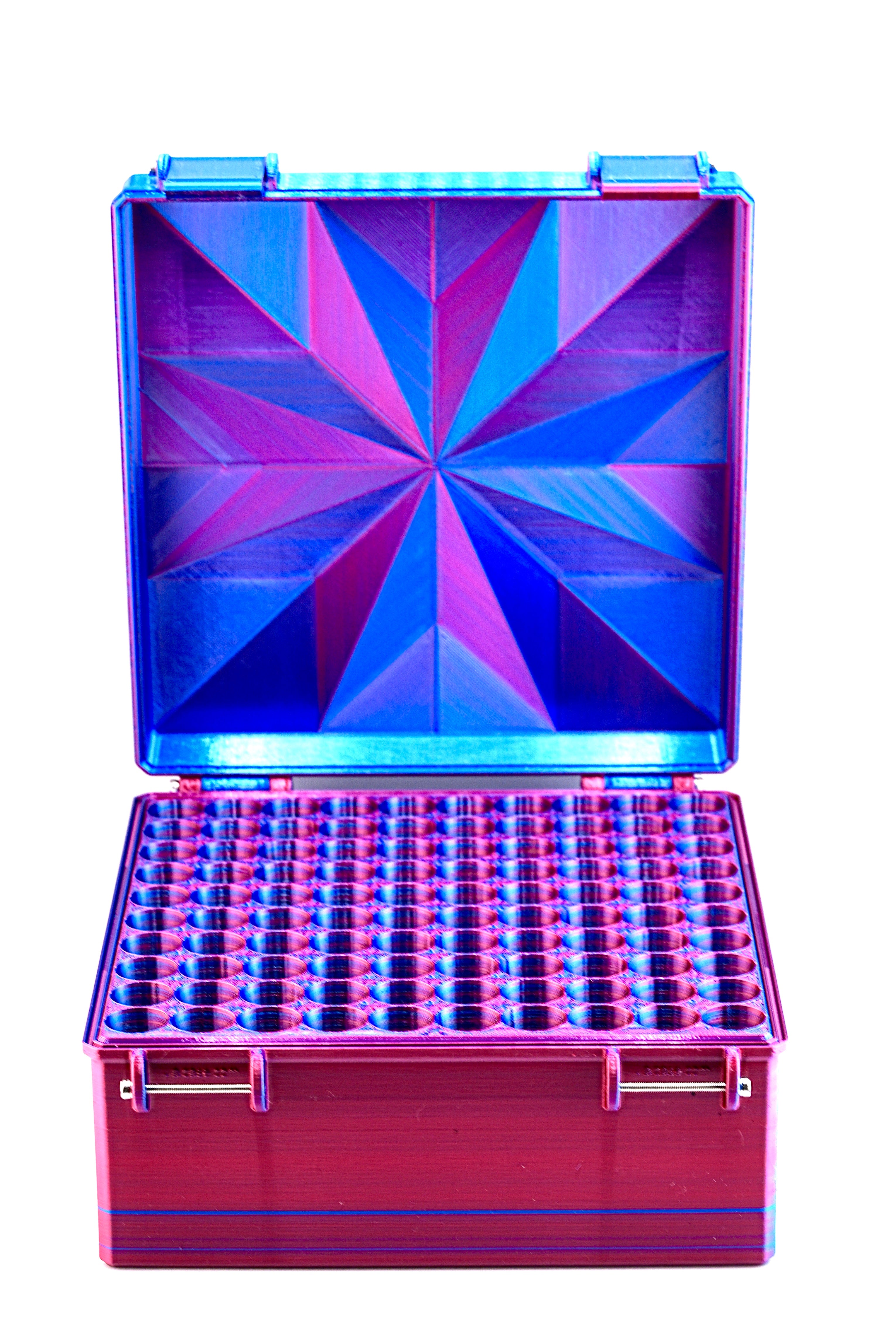
Add your vials and supplies. Every vial gets a fitted pocket, every top lines up at the rim, and the lid closes over all of them.
Temperature: follow your label
We don't publish temperatures, timelines or preparation steps for any compound. For temperature, follow the storage instructions on your product label or from your pharmacist or provider. If a vial was stored outside those instructions, ask them before you use it.
A case doesn't keep anything cold. It is a protective organizer, not a cooler: it sits in your fridge, or in a cooler when you travel, and keeps every vial upright, separated, labeled and out of the light.
Light: why amber glass isn't enough
Many vial labels say "protect from light." Amber glass filters most UV, but it still lets visible light through, and clear glass lets almost everything through. So the glass alone rarely keeps a vial fully in the dark. Our guide on amber vs. clear vials explains the difference.
The reliable solution is an opaque container that closes completely. A hard case with a solid lid keeps vials in the dark while they are stored, and the habit that goes with it is simple: take a vial out, use it, put it back and close the lid. Don't leave vials standing on a sunny windowsill, a bright counter or under overhead lights for longer than you need them.
The fridge light
Most fridges have an interior light that switches on whenever the door opens. A vial standing on an open shelf is lit up every single time, many times a day. Inside a closed case, it isn't. Any opaque barrier is better than none, but a closed hard case is the one that also stops knocks and tipping.
Protect the vial seal: store vials upright
The rubber stopper is the most vulnerable part of a vial. A vial that tips over, rolls around or clinks against its neighbors can chip at the neck or damage the stopper, and a damaged vial is one you shouldn't use.
Storing vials upright, each in its own fitted pocket, protects the stopper and keeps the vial from rolling. Fitted pockets also keep vials from touching each other, so a bump to the case doesn't become glass-on-glass contact.
Where the case goes in the fridge
If your label says refrigerate, put the case on a middle shelf toward the back. The door shelf sees the biggest swings every time it opens and gets bumped the most. The back of a middle shelf is the steadiest spot in most fridges, and keeping the case in the same place every time means you never have to hunt for it. For more, see our guide to peptide fridge organization.
Organizing it alongside other vials
These vials often share a fridge with others: other peptide vials, a BAC water bottle, maybe GLP-1 or TRT vials. Several vials with different dates and labels means a real chance of grabbing the wrong one. A case sorts that out:
- A fixed pocket for each vial, always the same one, so position becomes your first check.
- A color for each kind of vial, on a tape band or a colored cap, so you recognize it before you read the label.
- Opened vials in front, sealed spares behind, so you never open a spare by mistake.
- Supplies in their own spaces: the water bottle in a bay, syringes in a trough, alcohol pads in their own spot.
Color-code your vials
Custom snap-on caps for 3 mL or 10 mL vials, with a cap color plus an icon or letters. Sets from 25 caps.
Label every vial
Every vial gets a label with its name, a vial number if you have more than one, the date you opened it and the discard date from the product label or your pharmacist. Use freezer tape or a waterproof label so condensation can't peel it off. Our guide on how to label peptide vials walks through materials and color-coding.
Traveling with your vials
Short trips
For a day trip or a short drive, the case itself is what matters: vials upright in fitted pockets, lid latched, case in your bag rather than loose in a cup holder. Never leave the case in a parked car, which heats up or cools down fast. If the label says to keep the vials cold, bring a small cooler even for a short trip.
Longer trips and flights
- Carry on, don't check. Keep the case in your carry-on or personal item.
- Cool it if the label says so. Put the case inside a small cooler with a gel ice pack, wrapped in a cloth so it doesn't touch the glass.
- Bring documentation. Keep medication in its original labeled packaging where possible, carry your prescription or a note from your prescriber, and check TSA, airline and destination rules yourself. See our guide to flying with vials.
- Check the hotel fridge before relying on it, and keep the case on one shelf.
What a dedicated case solves
Think about everything good storage asks of you, and which parts a case takes over:
- Keeping vials wherever the label says: the case gives them one consistent spot in the fridge or a cooler
- Keeping light off the vials: a closed, solid lid
- Protecting against knocks and tipping: a rigid shell and fitted pockets
- Preventing wrong-vial grabs: a fixed pocket and a color for each vial
- Traveling safely: one latched case that goes straight into a carry-on or cooler
Quick reference
- Temperature: follow your product label or your pharmacist or provider
- Light: closed case, lid shut between uses
- Vials upright, each in its own pocket
- Middle shelf toward the back, never the door
- Label with name, number, date opened and discard date
- Carry-on only, never in a parked car, cooler if the label calls for cold
Make your own custom case for your vials
The PeptideCase™ builder lets you design a case around exactly what you keep. Start with an empty case, tap "Add item" and choose peptide vials, 3 mL vials, 10 mL vials or other size vials in the quantities you have, plus a BAC water bottle, syringes and alcohol pads if they live in the same case. Every item becomes fitted pockets or an open bay sized for that count, and every space has a finger scoop.
Vials stand upright in their pockets, and shorter vials sit on a raised floor so every top lines up at the rim. The lid closes over all of them. Auto-arrange packs the layout into the smallest footprint, and you see the case size with top, lid and 3D views before you order. Choose Black or RGB Metallic, one or two latches, and add your initials or an icon to the lid. Printed to order in the US. Design your vial case