
Most people start with one kind of vial, one case and one fridge shelf. Then the collection grows: a GLP-1 vial here, a few peptide vials there, sealed spares behind them. Before long you are managing six, eight, ten vials, and a standard 10-slot case no longer cuts it. For anyone keeping reserve stock or managing inventory for a clinic or research setting, the question shifts from "what case should I buy?" to "what storage system do I need?"
This guide covers exactly that, from modest 20-slot expansions all the way up to systems that keep 300 vials organized, labeled and easy to find.
Design a case for every zone of your inventory
Size a daily case and a reserve case to your exact vial counts. The builder shows each case in 3D, with dimensions, before you order.
Who Needs High-Capacity Peptide Storage?
More people than you would expect. High-capacity storage isn't just for labs or clinics; it is for anyone whose vial count has outgrown a single case. Here is who typically reaches this point:
- People who keep reserve stock: if you hold several months of sealed vials alongside the ones you are using, you can easily be managing 30 to 50 vials at once, and they need an organized home.
- Multi-vial kits: several different vials in use, plus a BAC water bottle, spare vials and sealed backups, quickly adds up to 20 or more items that need coordinated storage.
- Clinic and research settings: practices and research groups may store hundreds of vials across many people or projects. The stakes are higher: a storage failure isn't personal, it is operational.
- Households sharing a fridge: two people with their own vials in one fridge need clear separation, not one shared pile.
If you spend more than a couple of minutes finding the right vial each morning, or you have ever picked up the wrong one because of poor organization, you have already outgrown your current setup.
The Problem With Scaling Up (And How to Solve It)
The challenges of a large vial inventory aren't just about space. They are about keeping every vial where it belongs and knowing exactly what it is. Several distinct problems show up as the count climbs:
Fridge placement gets harder. The back of a middle shelf is the steadiest spot in most fridges; the door shelf swings the most every time it opens. With 10 vials, everything fits in the good spot. With 80, vials end up in the door or crammed against the cooling vent, which is not what their labels have in mind.
Identification errors become a real risk. When every vial looks roughly the same (a small glass bottle with a rubber stopper and a tiny label), confusing one with another becomes genuinely possible. At scale, without rigorous labeling and organization, a wrong-vial grab is a matter of when, not if.
Rotation management becomes essential. First in, first out isn't just for grocery stores. With dozens of vials on hand, making sure the oldest stock is used first, and that nothing passes the discard date on its label unnoticed, takes deliberate planning.
Key principle: High-capacity storage is a systems problem, not just a space problem. The goal isn't to cram more vials somewhere; it is to keep the same protection, organization and easy access that a well-run 10-slot case gives you, at 10 to 30 times the scale.
Light exposure adds up. Opening a large storage box over and over to dig for one vial exposes everything inside each time. A well-designed system uses sections, so you open only the part you need and close it again quickly.
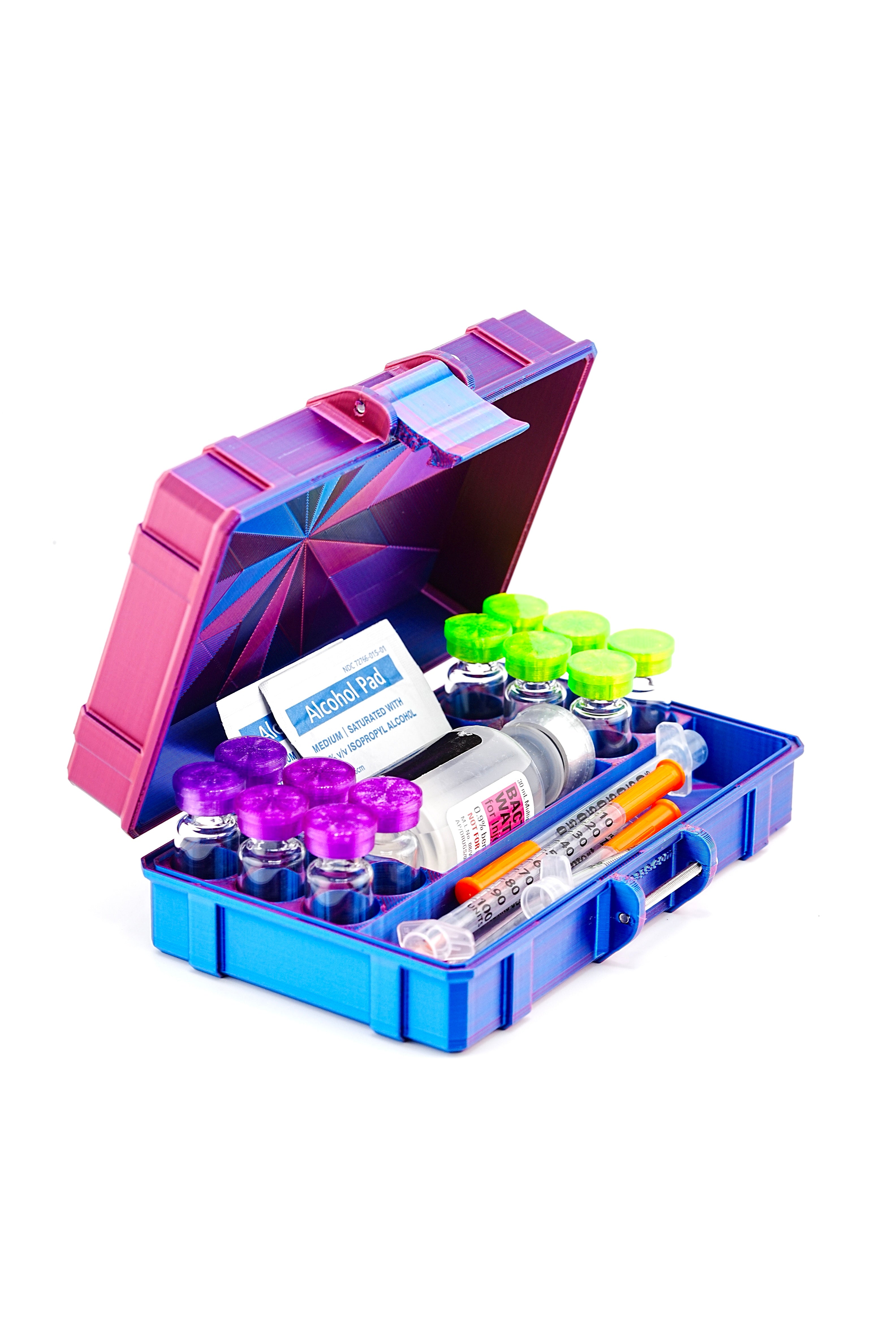
Capacity Options: From 10 Slots to 300 Vials
Knowing the full range of capacity helps you right-size your system before you invest in one. Here is a practical breakdown:
10 to 20 slots: the standard entry point. It handles a handful of different vials plus a BAC water bottle, and it is the best protection per vial: a hard shell, a fitted pocket for each vial, light kept out and easy to carry. This is the right tier for the vials you use every day. See our guide to organizing several peptide vials for setup tips at this scale.
20 to 50 slots: the intermediate tier, often two cases: one for the vials in use and one for sealed stock, each stored where its labels say. At this range, organization becomes the main challenge; the physical storage already exists.
50 to 100 vials: this is where a real system becomes necessary. Larger cases with clear zones, combined with a dedicated fridge shelf or a small mini-fridge used only for vials, handle this range well. Start a tracking log at this point, either a simple spreadsheet or a paper ledger.
100 to 300 vials: the high-capacity tier. This takes a tiered approach: daily-access cases for the vials in use, plus dedicated fridge space for reserve stock in its own clearly labeled cases. Build it as modules, so you can add a case as you grow instead of replacing the whole system.
Pro tip: Count your "active" vials (the ones in use) and your "reserve" vials (sealed backup stock) separately. They are accessed at different rates and may have different storage instructions on their labels, so plan a home for each group instead of lumping them together.
Organization Systems for Large Vial Collections
The case is only half the solution. What makes a high-capacity system work is the method you apply to it. People managing 50 or more vials rely on variations of the same core system:
Zone-based organization. Divide storage into zones: vials in use, vials opened recently and waiting their turn, and sealed reserve stock. Each zone has its own physical place and its own labeling. Moving a vial between zones is a deliberate, logged step, not an accident.
Consistent labeling. At scale, labels are non-negotiable. Every vial needs its name, a vial number, the date opened (if it has been) and the discard date from its label or your pharmacist. Color-coded tape or caps by group speeds up retrieval enormously. For a complete method, see our guide to peptide fridge organization.
A running inventory log. Past 20 vials, memory is no longer enough. A spreadsheet with columns for vial name, size, quantity, date opened and discard date takes five minutes to set up and saves hours of uncertainty. Update it whenever you open a vial or remove one.
Dedicated slots for each vial. Resist putting vials wherever there is space. Assign fixed pockets to fixed vials. Retrieval becomes automatic, and an empty pocket tells you right away that it is time to restock.
First-in, first-out discipline. When new stock arrives, it goes behind existing stock, never in front of it. The oldest vials always come out first, so nothing quietly passes the discard date on its label.
Color-code your vials
Custom snap-on caps for 3 mL or 10 mL vials, with a cap color plus an icon or letters. Sets from 25 caps.
Temperature Management at Scale
Temperature control doesn't get easier as an inventory grows; it gets harder. More vials take more fridge space, the door opens more often, and more vials end up in the wrong spot. Start with the rule that never changes: follow the storage instructions on your product label or from your pharmacist or provider for every vial. Then:
Dedicate a fridge shelf exclusively to vials. A shelf used only for vial cases doesn't have food pushed in and out of it, so nothing gets knocked and nothing drifts. A middle shelf toward the back, away from the door and the cooling vent, is the steadiest spot in most fridges.
Use a dedicated mini-fridge for high-volume setups. Once you are past a few dozen vials, a mini-fridge used only for vials, never for food, removes the fight for space, cuts down on door openings and keeps your inventory away from household traffic.
Keep fridge stock and any freezer stock clearly separated. If any of your labels call for the freezer, give that stock its own labeled, sealed container and its own spot, so nothing that belongs in the fridge ever wanders into the freezer by mistake.
Monitor the temperature. A digital thermometer with min/max memory tells you if the fridge drifted overnight. In clinic and research settings, continuous logging provides documentation that storage conditions held, which matters for liability, quality assurance and compliance.
Critical rule: A storage case is a protective organizer, not a cooler. It keeps vials still, upright, labeled and out of the light; the fridge does the cooling.
Clinic and Research Lab Storage Requirements
High-capacity storage in a clinic or research setting comes with requirements beyond what individuals face. The quantities are larger and the consequences of a failure reach beyond personal inconvenience.
Chain of custody documentation. Clinics and labs need to track not just what is stored, but when it arrived, who accessed it and when it left. Even a simple spreadsheet needs to capture this consistently.
Segregated storage by access level. Not every vial should be equally accessible. Some items may need locked storage, such as a locking fridge or cabinet, within the larger cold-storage setup, while keeping the same organization and light protection inside.
Emergency plans for power outages and equipment failures. What happens when the fridge fails at 2 a.m.? For one person, it is manageable. For a clinic with 300 vials, it is a serious loss. Backup coolers, temperature alarms and a written response plan are not optional at this scale, and the plan should come from your pharmacist or the product labels, not guesswork.
Regulatory considerations. Depending on where you are and what you store, clinical storage may fall under pharmacy regulations or institutional policies, which often set specific standards for temperature logging, access control and disposal.
The Cost Math: Why Organized Storage Pays for Itself
A proper high-capacity system costs something up front. So does not having one. Think about what a large inventory actually represents: every active vial, plus months of sealed reserve stock, sitting in one fridge.
A storage failure, whether a vial knocked off a shelf, a box of stock pushed into the door for weeks, or a fridge that quietly died over a weekend, can cost a few vials or the whole inventory. One prevented loss usually covers the cost of the cases that protect everything else.
Organization also cuts waste. When inventory is organized and tracked, you use vials in order, before their discard dates. When it isn't, vials get pushed to the back of the fridge and forgotten, then found months later and thrown away.
Choosing Between Multiple Small Cases vs. One Large System
This is the most common strategic question when scaling up: several smaller cases, or one large unified system? It depends on how you use your vials. Here is a framework:
Multiple small cases make sense when:
- Your active and reserve vials have different storage instructions or very different access frequencies
- You travel and need a small, carry-on-friendly case for the vials you use while reserve stock stays home
- The vials you keep in rotation change often
- You share storage space with others and need separate, clearly identified cases
A single large system makes sense when:
- Your inventory is fairly stable and the vials share the same storage instructions
- You manage a clinic or research setting where one unified inventory view matters
- You want less overhead than tracking several separate containers
- Your storage location is fixed (a dedicated fridge or room) and portability doesn't matter
Many high-volume users end up with a hybrid: a daily-access case for active vials (10 to 20 pockets, portable) and a larger organized set of cases for reserve stock. That separates access frequency cleanly while keeping each part manageable.
Bottom line: The right system matches the vials you actually keep today, with room to add a module tomorrow.
Build your own custom high-capacity case system
A big inventory rarely fits a stock layout, which is why the PeptideCase™ builder works well for building a system one case at a time. Design a daily case first: tap "Add item" and enter exactly what you use, such as 3 mL vials, 10 mL vials, a BAC water bottle, syringes and pens, and each item becomes fitted pockets or an open bay sized for that count. Then design a separate reserve case sized for your sealed stock, so each zone has its own box.
Auto-arrange packs every case into its most compact layout, and the builder shows the length, width, height and contents before you order, so you can plan how cases will line up on a fridge shelf. Shorter vials stand on a raised floor so every top lines up at the rim, and every space has a finger scoop. Big cases get a 5-knuckle hinge and two latches, and cases too big to print in one go are printed as two parts. Add a lid design, like a zone name or icon, so each case is easy to tell apart at a glance. Start building your case system