
Why Simple Works Better Than Complex
There's a paradox in the peptide and GLP-1 world: the people who build the most elaborate storage systems often make the most costly mistakes. They have a spreadsheet for vial inventory, a dedicated mini-fridge, and a laminated chart on the door — and then they open a new vial without noticing the one already open at the back of the fridge. Complexity creates mental load. Mental load leads to shortcuts. Shortcuts lead to lost, broken or misplaced vials.
The research on habit formation points the same way: simpler routines are easier to stick to. A storage system you follow every time protects your vials far better than a theoretically perfect system you follow most of the time. When your routine requires fewer decisions, you make fewer errors.
The goal of this guide is a system that takes about five minutes to set up and a few seconds to maintain each day. At its center is one thing: a hard case built around the vials you actually keep, which you can design yourself.
Make the case the simple part
Add the vials you keep and the builder designs a hard case with a pocket for each one, sized to fit your fridge shelf.
Key Insight: Storage mistakes are rarely dramatic. They are small and repeated: a vial left on the counter, a label that smudged, a vial that rolled to the back of the shelf. Consistency prevents those far more effectively than any single heroic storage measure.
The 3 Things Your Storage System Must Do
Before we get into the physical setup, it helps to know what you're actually protecting against. Your storage system needs to handle three things:
- Temperature, per your label: Storage temperatures differ from product to product. Follow the storage instructions on your product label or from your pharmacist or provider, and keep vials in one consistent place that matches them. A case doesn't change temperature; it is a protective organizer that sits wherever your label says the vials belong, shelf or fridge.
- Light and knocks: Most labels say to keep vials away from light, and glass vials don't survive being knocked off a shelf. A closed hard case keeps vials out of the fridge light and stops jars and leftovers from hitting them.
- Mix-ups: If you keep more than one kind of vial, the biggest everyday risk is grabbing the wrong one. Your storage needs to be organized enough that every vial has its own spot and its own label.
That's it. A storage system that follows your label, keeps vials protected, and prevents mix-ups is a complete storage system. Everything else is optional.
The 5-Minute Setup (What You Actually Need)
Here is the complete list of physical items you need for a functional peptide or GLP-1 storage setup:
- A dedicated spot. If your label says refrigerate, skip the door shelf — it swings, rattles and warms up with every opening. Choose a shelf in the main body of the fridge, toward the back. A single consistent location means you always know where your vials are.
- A hard-shell vial case. This is the single most useful upgrade you can make. A case with a fitted pocket for each vial solves the organization problem, keeps vials out of the light, and protects the glass from everything else in the fridge. You can design one around your exact vials in a few minutes. You don't need a mini-fridge, a temperature logger, or a special refrigerator tray. You need a case.
- A fine-tip permanent marker and a roll of label tape. That's your entire labeling system. Label each vial the moment you open it. This takes 20 seconds and prevents nearly every mix-up.
- Your product label or pharmacy instructions. Keep them where you can find them. They are the only reliable source for how your specific vials should be stored and for how long.
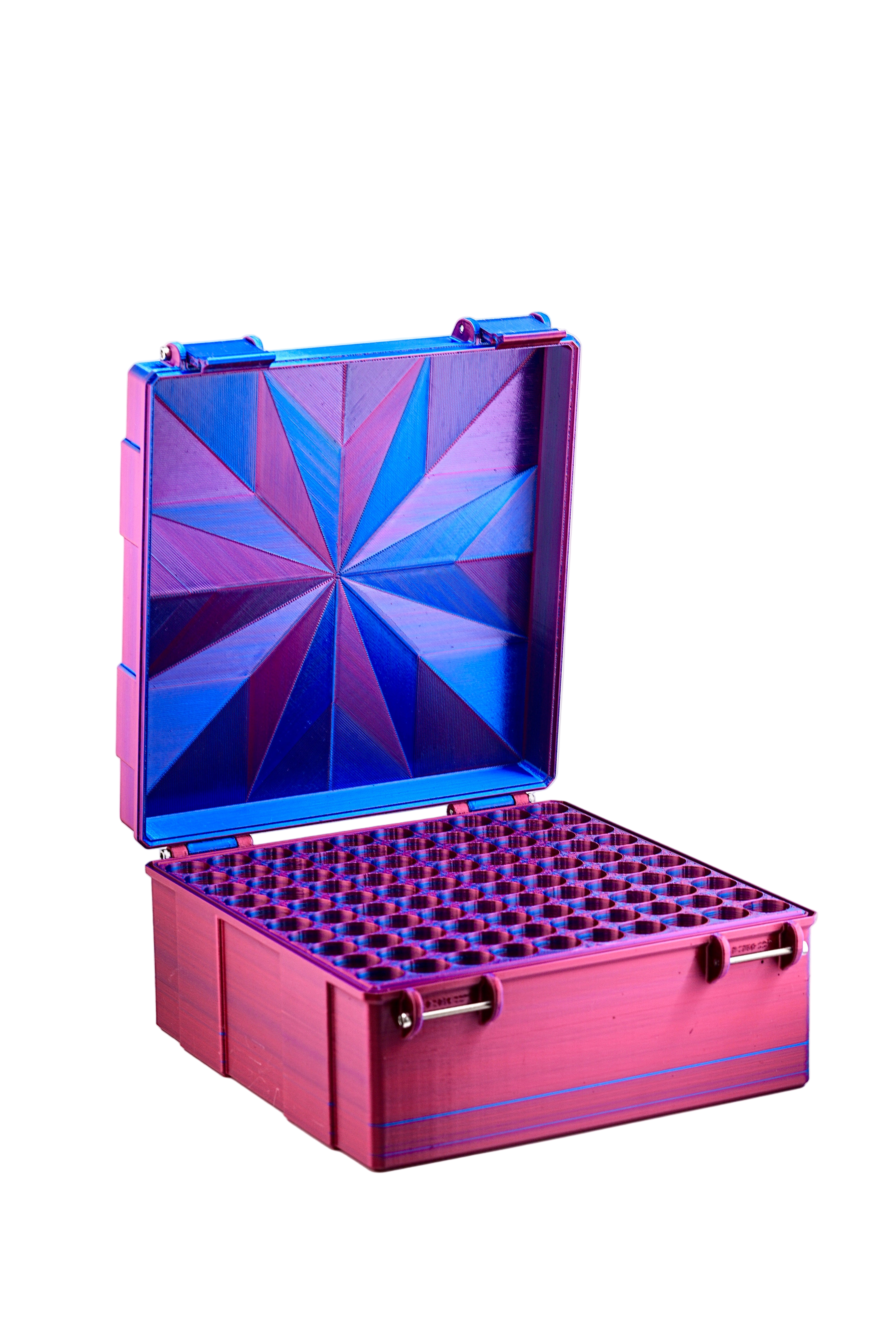
What You Don't Need: A dedicated mini-fridge (unless you keep a lot of vials), a digital temperature logger, amber glass secondary containers, a vacuum sealer, or a tracking spreadsheet. These are nice additions if you have them, but they solve problems that a good case and consistent habits already handle.
Fridge Placement: One Decision That Changes Everything
If your vials go in the fridge, the single most useful placement decision is keeping them away from the door. Door shelves are the warmest, least stable part of most refrigerators, and in an average household the door opens many times a day. Every opening swings and bumps whatever sits there.
The back of a middle shelf is usually ideal: most refrigerators hold their steadiest temperature in the center of the main compartment. The bottom of the fridge is often the coldest zone, and the very top shelf can run warmer.
A few additional placement principles worth knowing:
- Keep vials away from the cooling vents. Air from the vents can create very cold spots right in front of them. Most labels say not to freeze vials, so keep your case a little forward of the back wall.
- Keep vials away from fresh produce drawers. Those compartments are more humid, which is hard on paper labels and tape.
- Keep the case closed. A closed case keeps spills, smells and sticky fingers off your vials and labels.
Once you've picked your spot, put your case there and leave it there. That's the whole decision. For more detail on fridge layout, the complete peptide fridge organization guide goes deeper.
Labeling Without Overthinking It
The labeling system that prevents costly mistakes needs only a few pieces of information on each vial:
- What the vial holds (an abbreviation is fine, as long as everyone in the house can read it)
- The date you opened it (not the date it arrived)
- Any "use by" date your product label or pharmacist gives you
Write directly on a piece of label tape and wrap it around the vial. Do this the moment you open a vial — before it goes back in the case, before you do anything else. The few seconds the vial is in your hand are when labeling happens. Every time.
If you keep vials that look alike, color-code them too: one cap color per vial type, matched to a colored dot on the label. When you pull the case from the fridge, you see what's what at a glance.
Color-code your vials
Custom snap-on caps for 3 mL or 10 mL vials, with a cap color plus an icon or letters. Sets from 25 caps.
Pro Tip: Use a label maker if you want cleaner labels, but don't wait until you get one to start labeling. A marker and tape right now is better than a label maker next week. The labeling habit matters more than the labeling tool.
The Only Rotation Rule You Need
People overthink vial rotation. Here's the simplified answer that covers almost every setup:
Keep one open vial of each type at a time, in the same front pocket of your case. Spares go in the back pockets. Open the next vial only when the current one is finished or has reached the date on your label.
This works because you never have to remember which vial is in use: it's always the one in the front pocket. Your spares stay closed and untouched until they move up.
The one exception is if you keep several different kinds of vials at once. In that case, give each kind its own row in the case and label each vial clearly. Having three vials open at once is fine; having three unlabeled vials is not.
What Happens When You Travel
The simplest travel approach is to treat your travel storage the same way you treat your home storage: same case, same rules, different location. Your hard-shell case protects your vials in the fridge at home and in a hotel mini-fridge equally well. The case travels with you.
The specific rules for traveling with vials:
- Carry on, don't check. Cargo holds can get very hot or cold, and checked bags get thrown around. Your case goes in your carry-on or personal item.
- TSA and airport security. Keep medication in its original labeled packaging, carry any prescription or documentation you have, and expect that screeners may inspect or swab your case. Everything organized in one case makes inspection quicker. Check the current rules yourself before you fly; the TSA peptide travel guide covers the basics.
- Keeping cold in transit. If your label says to keep vials cold, put the closed case inside a small insulated cooler with a gel ice pack (wrapped in a cloth so it doesn't touch the case directly). The case protects the vials; the cooler does the cooling.
- Hotel storage. Most hotel rooms have mini-fridges or can arrange a refrigerator. Request one when booking for multi-night stays. Your case goes in the mini-fridge just as it does at home.
When to Upgrade Your System
The simple system described here works for most people. There are specific situations where an upgrade makes sense:
- Keeping 5+ vials at once. A larger case with more pockets is a direct upgrade — same principle, more capacity. If you keep both 3 mL and 10 mL vials, a custom case can hold both sizes side by side, with the shorter vials raised so every top lines up.
- Frequent travel. If you travel often, design a compact travel case that fits inside your cooler bag, with a pocket for every vial and your supplies.
- Several kinds of vials. Color-coded caps and a clear row for each vial type keep things obvious as your collection grows.
- Multi-user households. If more than one person keeps vials in the same fridge, give each person their own labeled case. A name or icon on the lid ends the "whose is this?" question.
For most people, going from the simple system to anything more elaborate delivers diminishing returns. The system above, followed consistently, works as well as setups that take ten times the effort.
Design your own custom case for simple vial storage
A simple system works best when the case fits your vials exactly, with no empty slots to rattle in and no vial squeezed in sideways. In the PeptideCase™ builder you start with an empty case, tap "Add item" and choose what you keep: 3 mL vials, 10 mL vials, peptide vials, a peptide pen or injector pen, pen cartridges, syringes, alcohol pads or a BAC water bottle. Pick how many of each and every item becomes fitted pockets or an open bay sized for that many.
The tallest item sets the case height, and shorter vials stand on a raised floor so every top lines up at the rim, easy to grab, with a finger scoop in every space. Auto-arrange finds the most compact layout, and you see the exact size, a top view, a lid view and a 3D view before you order. Pick Black or RGB Metallic, a Wide or Deep shape, and one or two latches. It's printed to order in the US.