
If you keep these two peptides, the storage question has two halves. Temperature and handling come from your product: follow the storage instructions on your product label or from your pharmacist or provider. Everything else — protecting the glass, keeping the vials in the dark, and above all keeping two near-identical vials from being confused — is a case and organization problem, and that's what this guide covers.
The short version: one hard case, a fitted slot for every vial, the two products at opposite ends, a different color for each, and a label on every vial.
Design a case for look-alike vials
Add the vials you keep, see exactly where each one sits in the top view, and put the two products at opposite ends of one hard case.
The Real Risk: Two Vials That Look Exactly Alike
Side by side, these two products usually arrive in the same small clear vials, with the same stoppers and the same plain caps. Put them loose on a fridge shelf and the only thing telling them apart is a few handwritten letters that smudge in fridge moisture.
That's how mistakes happen — not from a bad fridge, but from grabbing the wrong vial in a hurry, in poor light, half awake. Good storage makes that close to impossible by giving each product its own place, its own color and its own label, so you'd notice instantly if you reached for the wrong one.
Temperature: Follow the Label, Then Check Your Fridge
We don't publish storage temperatures, because the numbers that count are the ones on your label or from your pharmacist or provider — and they can differ between unopened and opened vials. Read them and follow them.
What you control is whether your fridge actually holds that range. A min/max fridge thermometer tells you in one night. Keep vials away from the door (the warmest, most variable spot) and away from the freezer vent if your label says do not freeze. And remember that a case is a protective organizer, not a cooler: it sits inside the fridge, or inside a cooler with ice packs when you travel. Our fridge organization guide covers placement in detail.
Physical Separation: Opposite Ends of the Case
The single most effective habit with look-alike vials is distance. Don't store them in neighboring slots. Put one product at the left end of the case and the other at the right end, with something different — a larger bottle, a backup row, an empty bay — in between.
- Fixed positions: each product always lives in the same slots, so your hand learns where to go.
- Front for in use, back for backups: the vial you're using now sits in the front row; unopened vials of the same product sit behind it, on the same side.
- One vial per slot: never two in one space, never one lying loose on top.
Separation also protects the glass. Vials that never touch can't knock together, and vials held upright in fitted slots can't tip over or land on their stoppers.
Labeling and Color Coding
Labels and colors are your second and third lines of defense after position:
- Label the vial body, not the cap. Caps come off and get swapped. Write a short code on a small label on the glass itself.
- Add the date you opened it and any use-by date from your pharmacy label, so you never have to guess how old a vial is.
- Give each product a color. Colored caps, colored stickers or a dot of colored tape — one color per product, never shared.
- Match the case to the colors. If the left end is "blue," every vial at the left end has a blue cap.
For more labeling ideas, see our guide on how to label peptide vials.
Color-code your vials
Custom snap-on caps for 3 mL or 10 mL vials, with a cap color plus an icon or letters. Sets from 25 caps.
Keep Unopened Backups Apart From Vials in Use
If you keep several vials of each product, the unopened ones need their own zone. Store them wherever your label says unopened vials belong, and keep them visibly separate from the vials you're using now — a back row, a second small case, or a clearly marked section. That way you never open a new vial by accident, and you always know how many backups are left.
Use the oldest first. When a new vial goes in, it goes to the back of its product's row, and you take from the front.
When the Fridge Is Far From Where You Use Your Vials
If your fridge is in the kitchen and you use your vials somewhere else, it's tempting to leave a vial on a nightstand or bathroom counter. Don't. Take the whole case to where you need it, take out one vial, close the case, and return the case to the fridge as a unit. Vials never sit loose in a room, never sit in daylight, and never end up in the wrong slot because you put them back from memory.
Travel Storage
Travel is where vials break and where look-alike vials get confused in a dim hotel room. A few rules cover it:
- Carry-on only. Checked bags get lost, crushed and left on hot or freezing ramps.
- Case inside a cooler. If your label calls for refrigeration, pack the hard case inside a small cooler or insulated bag with a gel ice pack, and check your label for how long the product may be out of the fridge.
- Keep the same layout. The travel case should mirror your home case: same products at the same ends, same colors.
- Hotel fridge check. On arrival, put the case in the in-room fridge and check it with a thermometer against your label.
- Paperwork. Keep pharmacy labels on vials, carry your prescription or provider letter, and check your airline's and destination's current rules yourself.
See our TSA travel guide for the checkpoint itself.
Keeping Several Similar Vials Organized
Many people keep more than two products, and most peptide vials look alike. The same system scales: a fixed slot for every product, one color per product, labels on the glass, backups behind vials in use. If you keep five or more, write a simple slot map on a card and keep it with the case until the layout is second nature. Our guide to organizing several vials goes further.
Make Your Own Custom Case for Two Look-Alike Vials
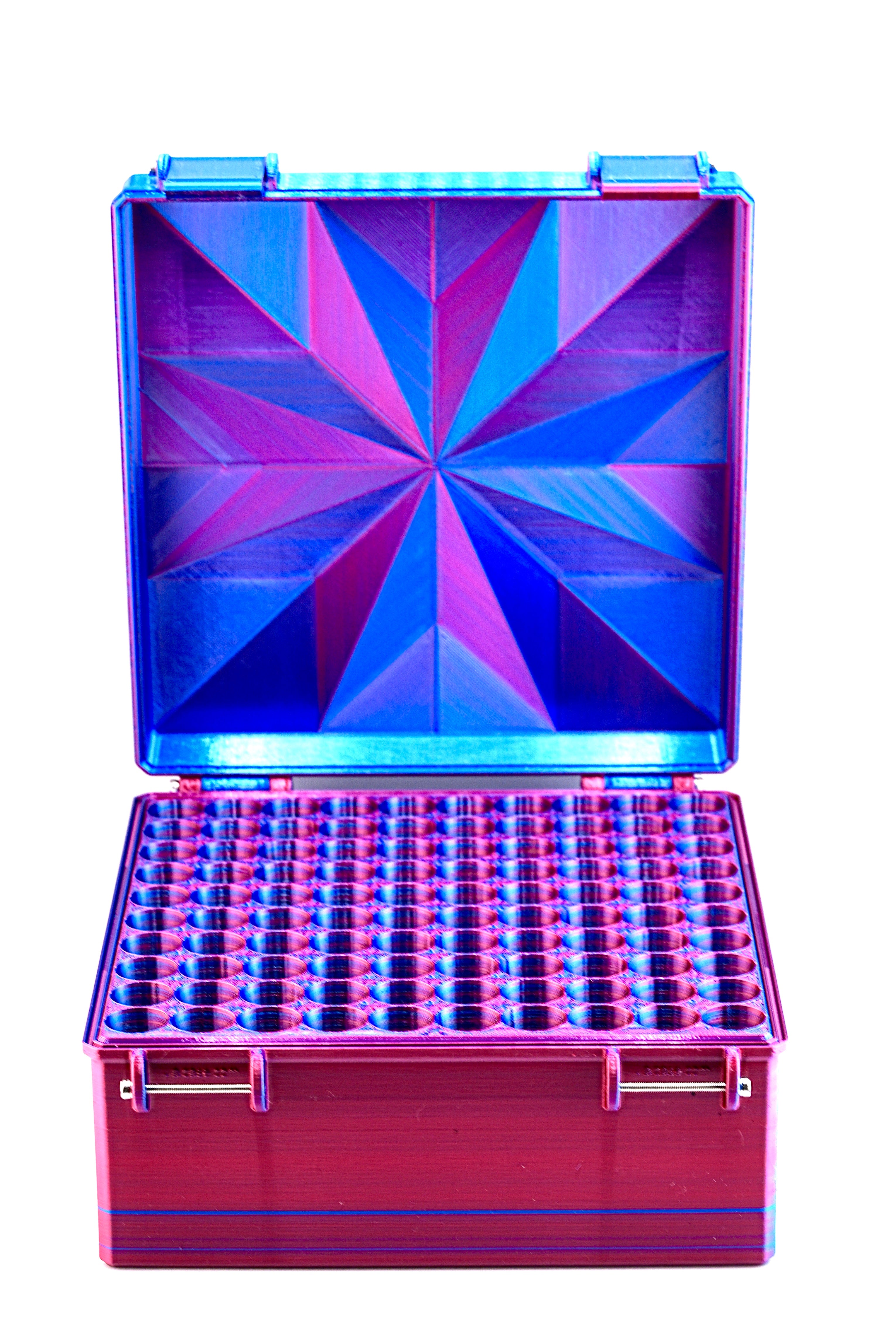
A case designed for your exact vials makes separation automatic. In the PeptideCase™ builder you start with an empty case, tap "Add item" and add peptide vials (or 3 mL vials) in the quantity you keep of each product, plus anything else you store with them — a BAC water bottle, syringes, alcohol pads. Each item becomes fitted pockets or an open bay sized for that many, so every vial stands upright in its own slot.
Auto-arrange packs everything into the most compact layout, and the top view shows exactly where each item sits, so you can plan which end holds which product. Shorter vials stand on a raised floor so every top lines up at the rim, each space with a finger scoop. Pair it with custom vial caps in two colors with letters or icons, and the two products become impossible to confuse.