
What This Guide Covers (and What It Doesn't)
This guide is about the vials and the case they live in: keeping small glass vials from breaking, keeping them out of light, keeping several of them organized, and packing them for a trip. It isn't about what's inside the vials. For anything about the contents themselves, including temperature, how long a vial lasts once opened, and how it's prepared or used, your product label and your pharmacist or provider are the right sources.
That split is deliberate. Storage instructions vary by product and by maker, and the one on your label is the one that applies to you. What doesn't vary is the physical side: glass breaks, loose vials get lost, and a messy fridge leads to grabbing the wrong thing. That's the part a good case solves.
Design a case for your small vials
Add exactly the vials you keep, and the builder lays out a closed hard case with a fitted pocket for each one.
Temperature: Follow the Label, Not a Forum Post
Forums are full of confident temperature charts. Ignore them. Follow the storage instructions on your product label or from your pharmacist or provider, and ask your pharmacist if anything is unclear.
Whatever the label says, keep one thing straight: a vial case is a protective organizer, not a cooler. It doesn't keep anything cold. If your label calls for the fridge, the closed case sits on a fridge shelf and keeps the vials upright and together. If you travel, the case goes inside a cooler. If your label allows room temperature, the case keeps vials in a cool, dark cupboard instead of on a bright bathroom counter.
Light: A Closed Case Beats a Clear Shelf
Many vial labels say to protect the contents from light. Amber glass filters part of the light, but it still lets plenty through, and the fridge light comes on every time the door opens. The easy fix is to keep vials in a case with solid walls and a lid that closes fully. Clear organizers, mesh pouches and open shelves all fail this.
Breakage: Why Small Glass Vials Need Fitted Pockets
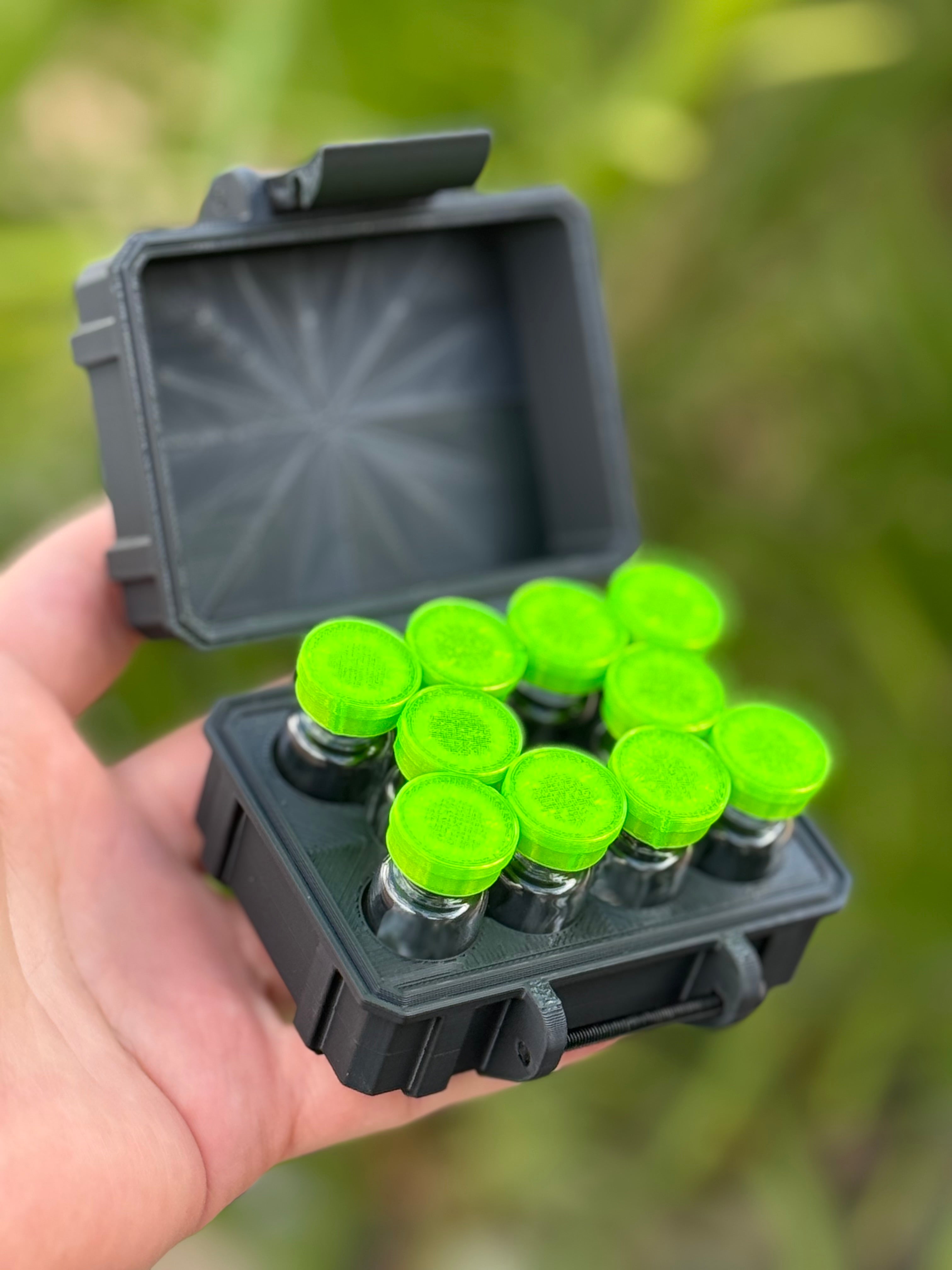
Most peptide vials are small 3 mL glass vials with a rubber stopper and a crimped aluminum cap. They're easy to knock over and easy to chip. Two vials rattling against each other in a drawer or a zip bag will eventually crack one, usually at the neck. A case with a fitted pocket for each vial holds every one upright and apart, so nothing touches and nothing rolls.
Keeping Several Vials Organized
It's common to keep a few different vials at once, plus spares. That's when organization starts to matter. A simple system:
- One case, one shelf. All vials live in the same case in the same spot in the fridge or cupboard.
- Fixed positions. Each kind of vial always goes back into the same pocket, so you can tell what's missing at a glance.
- Labels on every vial. Write the product name and the date you opened it on a small label or a strip of medical tape. Follow your label or pharmacist for how long an opened vial can be used.
- Color coding. Colored vial caps, one color per product, make the right vial obvious even in a dim fridge.
Color-code your vials
Custom snap-on caps for 3 mL or 10 mL vials, with a cap color plus an icon or letters. Sets from 25 caps.
Vials vs. Creams and Serums: Store Them Apart
Some people keep both vials and a topical cream or serum. Store them in separate, clearly labeled places so they never get confused, and follow each product's own label, because the instructions for a jar of cream and a glass vial are rarely the same. The vials go in their case; the tubes and jars go wherever their label says.
Fridge Organization
If your label calls for the fridge, give the case a fixed home on an interior shelf, away from the door. Door shelves get the most jostling and the biggest temperature swings, and a small vial standing in the door rack is one slam away from the floor. Keep the case away from raw food, and make sure everyone in the house knows that spot belongs to it. For more ideas, see our guide to peptide fridge organization.
Travel Packing
- Carry on, don't check. Cargo holds get very hot or very cold, and checked bags go missing.
- Use a hard case. It protects the glass in a packed bag and makes screening faster, because an organized case is quick to inspect.
- Add a cooler if your label calls for cold. Put the closed case inside an insulated travel cooler with gel packs, with a layer between the vials and any frozen pack.
- Keep paperwork handy. Original labeled packaging where possible, plus your prescription or other documentation, and check your airline's and destination's current rules before you go.
Our peptide travel checklist covers the rest.
What to Look for in a Vial Case
- Fitted pockets sized for your vials, so they can't rattle or touch.
- A solid shell and a lid that closes fully, so light stays out.
- A latch that stays shut in the fridge and in a bag.
- The right size for your shelf, your bag and, if you travel, your cooler.
- Room for spares and supplies, so everything stays in one place.
Make your own custom case for small peptide vials
Ready-made cases come in fixed sizes, usually ten or twelve identical slots. If you keep three vials, that's a lot of empty plastic; if you keep fourteen, it's not enough. In the PeptideCase™ builder you start with an empty case, tap "Add item" and choose exactly what you keep: 3 mL vials, peptide vials, 10 mL vials or other size vials, plus alcohol pads or a custom space for a small jar or tube (you enter its width, depth and height). Every item becomes fitted pockets or an open bay sized for that many.
Shorter vials stand on a raised floor so every top lines up at the rim, and every storage space has a finger scoop. Auto-arrange packs it all into the most compact layout, and the builder shows the size, a top view, a lid view and a 3D view. Pick Black or RGB Metallic, add text or an icon to the lid if you like, and it's printed to order in the US at exactly the size shown.