
Keeping several kinds of peptide vials at once is where storage quietly falls apart. Two or three vials are easy to keep track of; six, eight or twelve look-alike vials on a fridge shelf are not. The fix isn't complicated: a hard case with a pocket for every vial, a clear layout, and a few habits that make the right vial obvious every time.
Here are the 10 best ways to organize a multi-vial peptide kit in 2026, followed by how big a case you need and how to design one around your exact combination of vials. For temperature and how long each vial can be used, follow the storage instructions on your product label or from your pharmacist or provider.
Design a case for your whole vial lineup
Add every vial size and supply you keep and the builder lays out one compact hard case with a pocket for each.
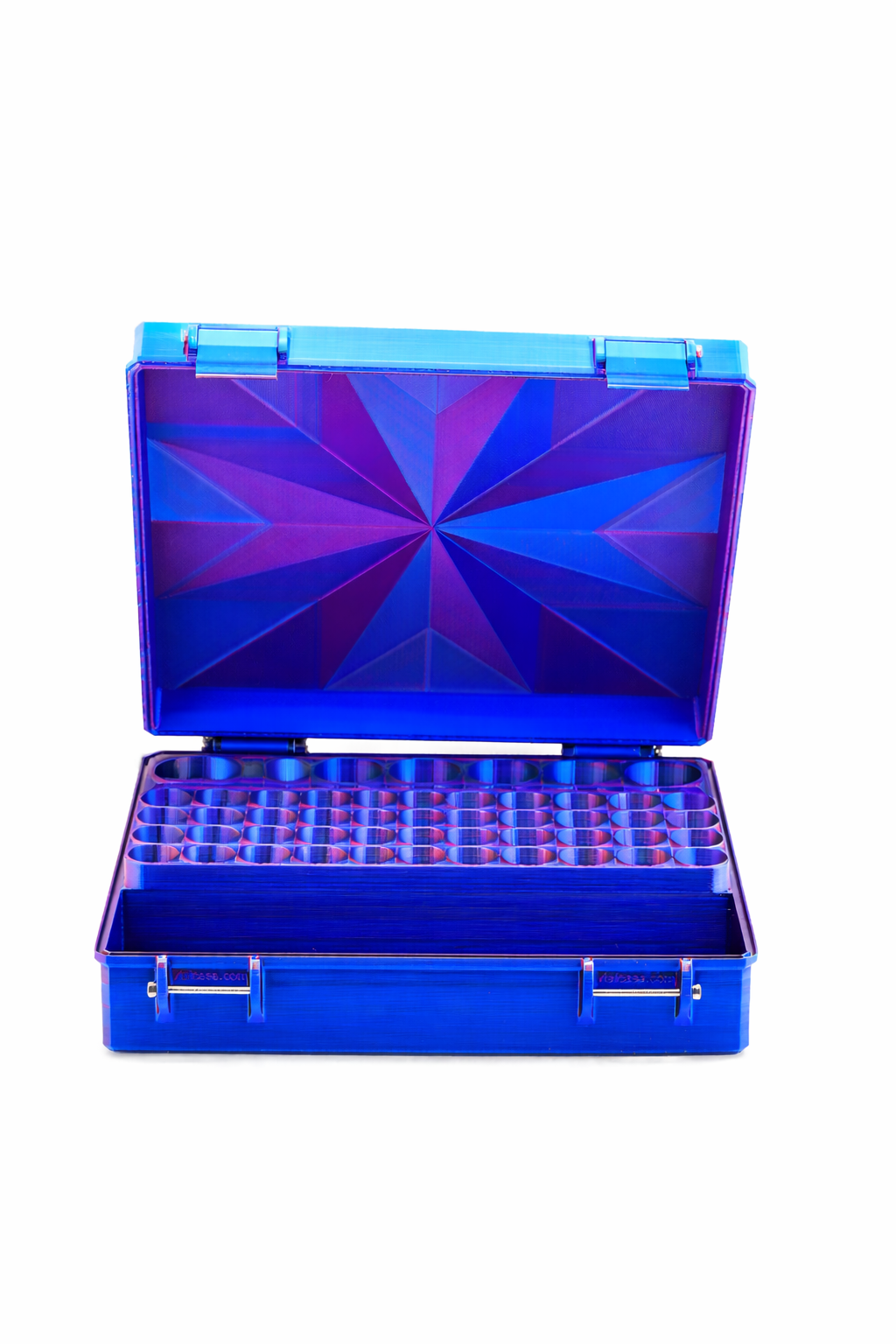
The 10 Best Ways to Organize a Multi-Vial Kit
1. Start with a count
Before you buy or design anything, write down what your kit holds: how many kinds of vials, what sizes (3 mL, 10 mL or both), how many are open at once and how many spares you keep, plus syringes, alcohol pads and any larger bottle. Every other decision follows from this list.
2. Give every vial its own pocket
Loose vials knock together, tip over and roll to the back of the shelf. A hard case with an individual pocket for each vial keeps them upright and apart, and a latched lid keeps them inside if the case gets bumped off the shelf.
3. One row per kind of vial
Give each kind of vial its own row or zone, and keep it there every time. When the layout never changes, you reach for the right row without thinking, even half-awake.
4. Color-code the caps
Vials from different kits often look identical. One cap color per kind of vial makes the layout readable at a glance, even in a dim fridge, and it backs up your labels.
Color-code your vials
Custom snap-on caps for 3 mL or 10 mL vials, with a cap color plus an icon or letters. Sets from 25 caps.
5. Label every vial
What it holds, the date it arrived, the date you opened it, and any use-by date from your label or pharmacist. A fine-tip marker and label tape are enough. "I'll remember" stops working at about the third vial.
6. Open vial in front, spares behind
In each row, the vial in use always sits in the front pocket and spares wait behind it. You never open a second vial by accident, and you can see at a glance when a row is running low.
7. Separate unopened stock from vials in use
Keep unopened spares and open vials in clearly separate zones — different rows, or a second case — each stored where its label says. Keeping them in one jumble is how an unopened vial gets confused with an open one.
8. Give supplies their own spaces
Syringes, alcohol pads and any larger bottle get dedicated spaces, never rattling between glass vials. Keep a small working supply in the case and the rest of the boxes sealed in a dry drawer.
9. One spot, never the door
If your labels say refrigerate, the case lives on a middle shelf toward the back — the steadiest spot in most home fridges — and never on the door, which is the warmest part and swings with every opening. Same spot every time.
10. Build a travel version
Don't haul the whole home kit on every trip. A smaller case that holds only what the trip needs fits inside a cooler bag, goes in your carry-on, and keeps the home layout intact for when you get back.
How Big a Case Do You Need?
Use your count from step 1. As a rough guide:
- 2–3 vials: a compact case with a pocket for each plus a spare. Small enough to tuck onto any shelf.
- 4–6 vials: a medium case with two rows and space for syringes and alcohol pads.
- 7–12 vials: a larger case with one row per kind of vial, a supply bay, and room for spares.
- More than 12 vials: a big case, or two cases (one for vials in use, one for stock). Big builder cases get a 5-knuckle hinge and two latches, and cases too big to print in one go are printed as two parts, lid and base.
- Both 3 mL and 10 mL vials: in a builder case the tallest item sets the height and shorter vials stand on a raised floor, so every vial top lines up at the rim.
Rules That Apply to Every Multi-Vial Kit
- Follow each label. Different vials can have different storage instructions; the label or your pharmacist is the only reliable source.
- A case is not a cooler. It's a protective organizer that sits in the fridge, on a shelf or inside a cooler, wherever your labels say.
- Keep the lid closed. A closed case keeps vials out of the fridge light and away from spills.
- Carry on when you travel. Never check your vials, and use a cooler bag when your labels call for cold.
For more ideas, see our guides to peptide fridge organization and how to label peptide vials.
Design your own custom multi-vial case
Fixed-layout cases rarely match a real multi-vial kit: too many 3 mL slots, no room for the 10 mL vial, nowhere for syringes. The PeptideCase™ builder starts with an empty case. Tap "Add item" and add each part of your kit — 3 mL vials, 10 mL vials, peptide vials, glutathione vials, other size vials, syringes, alcohol pads, a BAC water bottle, pens or pen cartridges — with how many of each. Every item becomes fitted pockets or an open bay sized for that many, with a finger scoop in every space.
Auto-arrange packs everything into the most compact layout, and the builder shows the case size and what it holds with a top view, a lid view and a 3D view you can open and turn. Choose Black or RGB Metallic, Wide or Deep, single or dual latches, and add text or an icon to the lid. Pair it with color-coded caps from the caps builder. It's printed to order in the US.