
Who Decides How Long a Vial Lasts?
Not a blog, and not a chart passed around online. How long a peptide vial is good for is set by the product itself: the date on the label, any "use within" instruction once it is opened, and whatever your pharmacist or provider tells you. Those instructions differ from product to product, so a single number for every vial does not exist. If your label is unclear, ask the pharmacy that filled it.
What you do control is everything that can end a vial early regardless of the date on it: a cracked neck, a loosened stopper, a label that rubbed off so you no longer know what or when, a vial left out on the counter, or one that sat in the light when the label said to keep it covered. Those are handling problems, and handling is where a good case earns its place.
Keep every dated vial in its own pocket
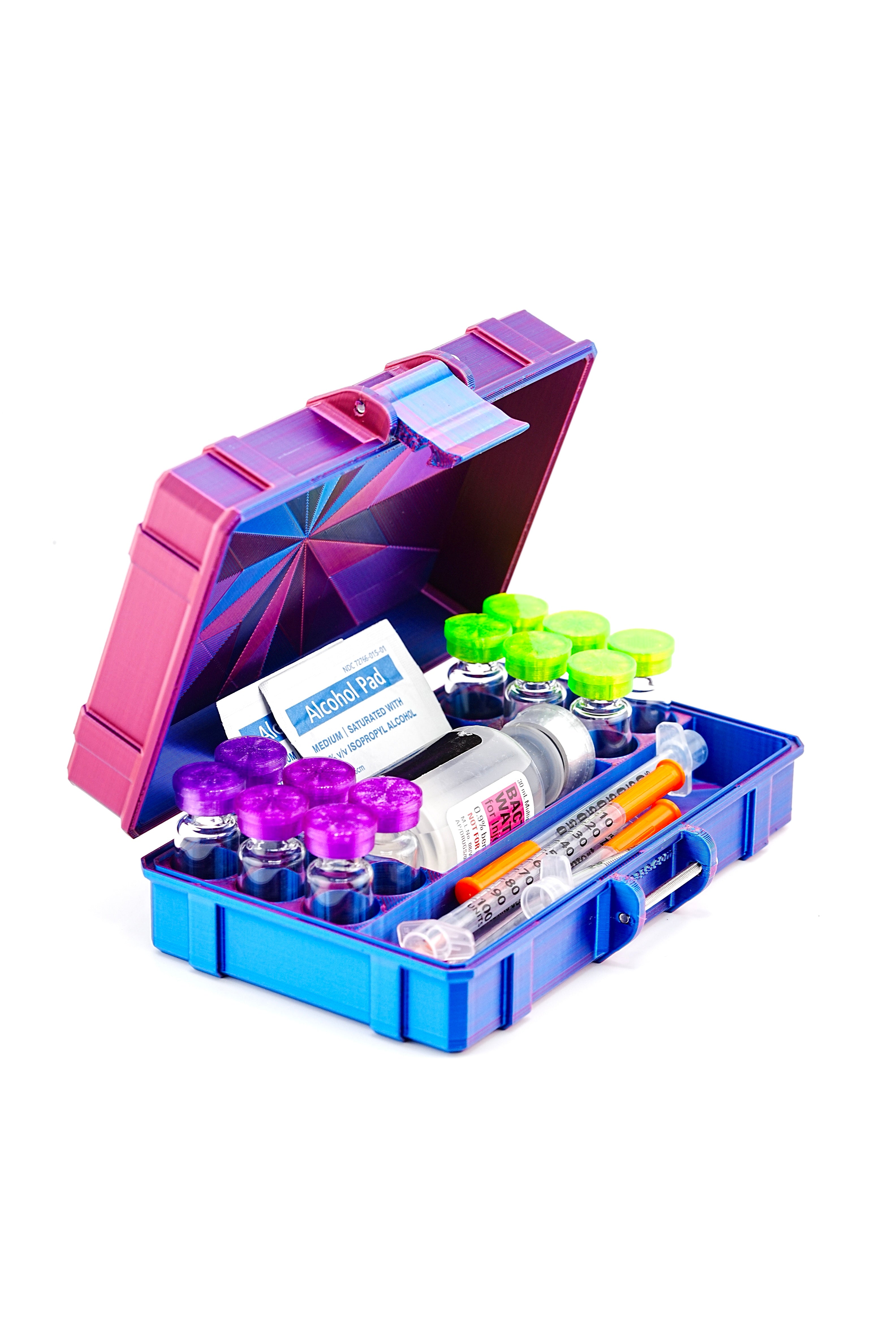
Design a hard case around your vials so each one stands upright, labeled side up, and easy to check at a glance.
Read the Label First
Before a vial goes into the fridge or a case, read its label and packaging for three things:
- The storage condition — refrigerate, room temperature, protect from light, do not freeze. Store it exactly that way.
- The date — an expiration or beyond-use date printed by the maker or pharmacy.
- Any opened-vial instruction — some labels give a time limit once the vial is opened or first used. If yours does, you will need to know the day you opened it.
If any of that is missing or confusing, call your pharmacist or provider. They can tell you what applies to your product; a general article cannot.
Dating and Labeling Every Vial
The single most useful habit is writing dates down. A vial with no date on it forces you to guess, and guessing is how vials get used past their label date or thrown out early.
- Write the date you received it on the vial or its cap label.
- Write the date you opened it the same day, if your label gives an opened-vial instruction.
- Copy the label's use-by date somewhere you can see it without unpacking the box.
- Use oldest first. Keep the oldest vial of each kind where you will reach for it first, and newer ones behind it.
Fridge moisture can smear ink and lift paper labels, so use labels made for cold storage. Our guide on how to label peptide vials covers what holds up. Color-coded caps help too: one color per kind of vial means you can tell them apart before you read a word.
Color-code your vials
Custom snap-on caps for 3 mL or 10 mL vials, with a cap color plus an icon or letters. Sets from 25 caps.
Signs a Vial Is Physically Damaged
Whatever the date says, a damaged vial is a problem. Check each vial when you take it out and when you put it back:
- Cracks or chips in the glass, especially around the neck and shoulder
- A stopper that is loose, pushed in, or torn
- A crimp seal that spins or has lifted
- A label you can no longer read, so you are not sure what the vial is or when it was opened
If you see any of these, or if anything about the vial looks different from when you got it, do not use it until you have asked your pharmacist or provider. Nearly all of this damage comes from vials knocking into each other or into hard objects, which is exactly what separate pockets prevent.
Fridge Habits That Protect Vials
- Keep vials out of the door rack. It is the least stable spot in the fridge and the easiest place to knock a vial out.
- Use a middle shelf, toward the back. It is the steadiest zone in most home refrigerators.
- Keep them in a closed case. A shut lid keeps light off the vials and stops them tipping when the shelf is bumped.
- Check the fridge with a thermometer. Home fridges are set by taste, not for medication. A cheap thermometer where the case sits tells you what is really going on.
More ideas in our peptide fridge organization guide.
Travel Without Surprises
Travel is when vials are most likely to get knocked or left somewhere hot. Keep them in your carry-on, in a hard case so the glass is protected, and put the closed case inside an insulated bag with a gel ice pack when your label calls for cold. Never leave the case in a parked car. Bring the original labeled packaging and any prescription or paperwork, and check your airline's and destination's current rules before you go. Our TSA travel guide walks through screening.
The Vial Care Checklist
- Follow the storage instructions on your label or from your pharmacist or provider
- Write the received date, and the opened date if your label asks for it
- Use the oldest vial of each kind first
- Give every vial its own pocket, standing upright
- Keep the case closed on a middle fridge shelf
- Check vials for cracks, loose stoppers and unreadable labels
- Carry on when flying and use a cooler bag around the case when needed
- When in doubt about a vial, ask your pharmacist before using it
Design your own custom vial case
A case built around your vials makes every habit above easier. In the PeptideCase™ builder you start with an empty case, tap "Add item" and choose what you keep: 3 mL vials, 10 mL vials, peptide vials, other size vials, and any supplies that live with them. Set how many of each, and every item becomes fitted pockets or an open bay sized for that many, each with a finger scoop so a vial lifts out without disturbing its neighbors.
The tallest item sets the case height, and shorter vials stand on a raised floor so all the tops line up at the rim, where you can read the cap labels and dates at a glance. Auto-arrange finds the most compact layout for your fridge shelf, and the builder shows its exact size with top, lid and 3D views. Pick Black or RGB Metallic, add a line of text to the lid, and it is printed to order in the US. Pair it with custom caps for color-coding. Design your vial case now