
Level plotters and schedule calculators try to model how much to take and when. That plan belongs to your prescriber, so it isn't something we model. What we do build is a planning tool for the physical side of a GLP-1 routine: which vials you have on hand, where each one lives, and a case laid out around them.
Think of it as a plotter for your kit. You tell it what you keep, it plots the most compact case, and you see exactly what you'll get before anything is made.
Plot a case around your GLP-1 vials
Add your vials and supplies and the planner plots the most compact case, with its exact size and a 3D view before you order.
What the Case Planner Plots
The PeptideCase™ builder starts with an empty case. You tap "Add item" and pick what you carry: 3 mL vials, 10 mL vials, peptide vials, other size vials, syringes, alcohol pads, a BAC water bottle, pens, pen cartridges, a custom space with your own width, depth and height, or a temperature sensor. Then the planner does the plotting:
- Auto-arrange packs every item into the most compact layout automatically.
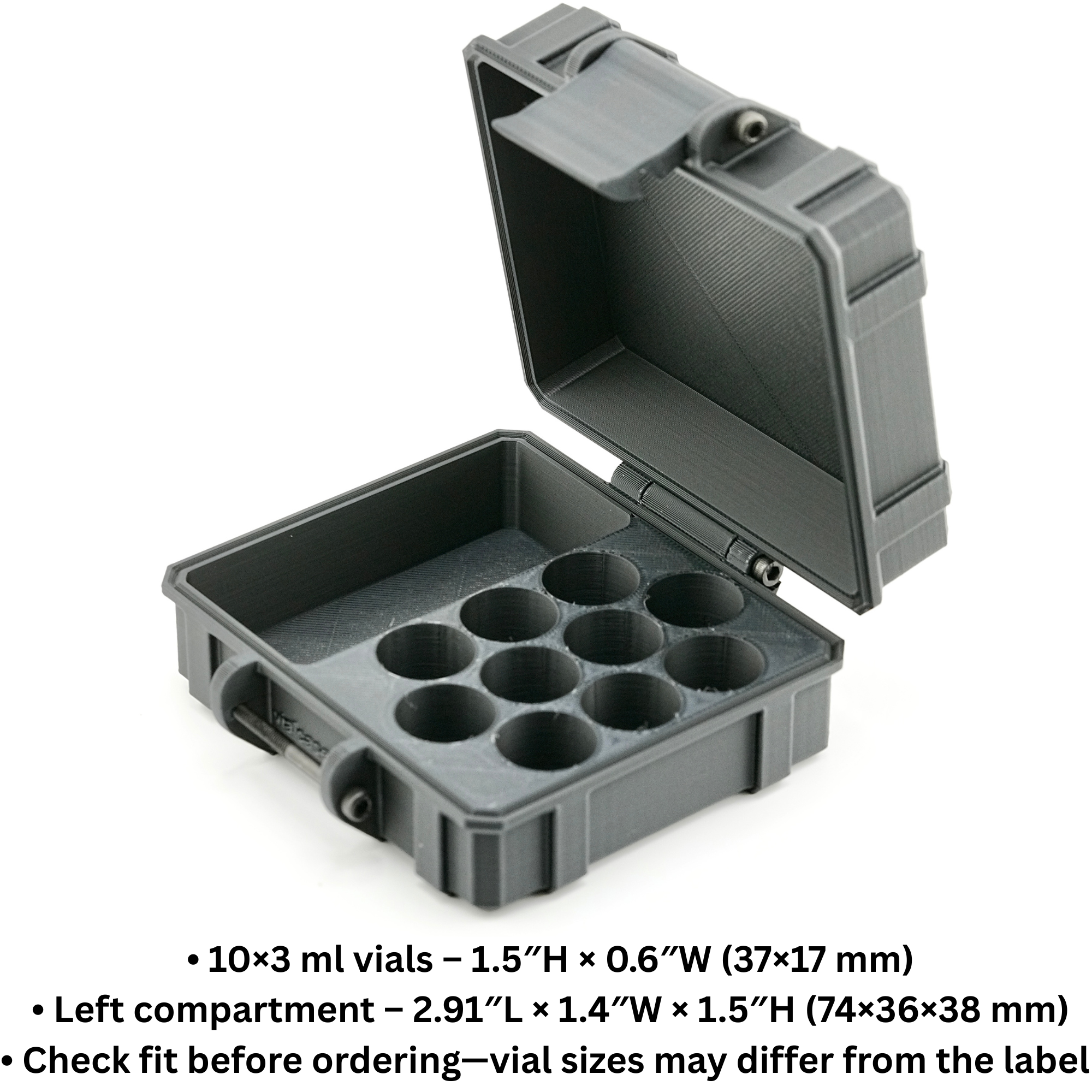
- Fitted pockets: every item becomes fitted pockets or an open bay sized for that many, each with a finger scoop.
- Even vial tops: the tallest item sets the case height, and shorter vials stand on a raised floor so every top lines up at the rim.
- The numbers: the case size (length x width), the height and a list of what it holds.
- The views: a top view, a lid view, and a 3D view you can open, unlatch, close and drag to turn.
The size shown is exactly what gets built, so you can check the plot against your fridge shelf or your bag before you order.
Why Your Vial Count Changes Over Time
A GLP-1 kit rarely stays the same size. Supplies arrive several vials at a time. If your prescriber changes your plan along the way, you can end up with more than one vial in the fridge at once: the one in use, the next one, and maybe a partly used one from before. Small clear vials look alike, and that's when the wrong one gets picked up.
The answer is a layout that gives every vial a role and a fixed place, so you know at a glance which is which without reading tiny print at 6 a.m.
Plot Your Rotation: A Simple Vial Map
Before you build a case, sketch a vial map. It takes two minutes:
- Pocket 1: in use. The vial you're using now, front and center.
- Pocket 2: next. The vial you'll open after that one.
- The rest: backups. Unopened vials, oldest at the front. First in, first out.
- Supplies. A bay for the BAC water bottle if you keep one, and space for syringes and alcohol pads.
Write the map on a small card and keep it in the case lid. Label every vial with a short name, the date it arrived and the date you first opened it. Then add color: one cap color for the vial in use and another for backups makes the map visible from above.
Color-code your vials
Custom snap-on caps for 3 mL or 10 mL vials, with a cap color plus an icon or letters. Sets from 25 caps.
Planning for Travel
Plot your travel kit separately from your home kit. Bring only what you'll use on the trip, in a smaller case, and leave backups at home. Keep the case in your carry-on with the vials in their labeled packaging where you can, and follow your product label for temperature. If it calls for cold, the case rides inside an insulated cooler bag with gel ice packs; the case is a protective organizer, not a cooler. Our guide to traveling with GLP-1 vials covers screening and documentation.
Planning Mistakes the Case Planner Helps You Avoid
- Buying a stock case before you know your count. Plot what you actually keep first, then build around it.
- Forgetting the supplies. A case with vial slots and nowhere for the BAC water bottle or syringes leaves half the kit loose in a drawer.
- A case that doesn't fit the shelf. Measure the gap between fridge shelves, then compare it with the height the builder shows. If the layout runs long, try the Deep shape.
- Look-alike vials with no system. Fixed pockets, labels and cap colors fix it.
- Squeezing a growing kit into last year's case. When the count changes for good, plot a new case and keep the old one for travel.
For more on keeping several vials in order, see our guide to organizing a multi-vial kit and our vial labeling guide.
Make your own custom GLP-1 vial case
Once your vial map is sketched, the case is quick. In the PeptideCase™ builder, start with an empty case and tap "Add item". Add your GLP-1 vials, 10 mL, 3 mL or other size, with a count that covers the vial in use, the next one and your usual backups. Then add a BAC water bottle, syringes and alcohol pads (flat or standing) if they live with the vials, or pens and pen cartridges if that's what you use. Auto-arrange plots the most compact layout and shows the exact size, with top, lid and 3D views so you can check it before ordering. Choose Black or RGB Metallic, Wide or Deep, and one latch or two. If you like, add a line of text or an icon to the lid in a second color. Your case is printed to order in the US. Plot your case in the builder