
Peptide refrigerator storage looks simple until you compare an expensive vial sitting loose on a fridge shelf with that same vial standing in its own pocket in a hard case. Light, moisture from spills, knocks from jars and leftovers, and plain disorganization are the everyday threats in a shared fridge. The container you choose either handles all four or ignores them.
Here are the 10 most common fridge storage approaches for peptide vials, ranked from worst to best. Each one is something real people actually use, and the #1 pick is a custom case you design yourself around your own vials.
Design a case that fits your fridge shelf
Add the vials you keep in the fridge and the builder shows the exact case size before you order, with a fitted pocket for each vial.
#10 — Worst: Loose in the Fridge (No Container)
Rolling directly on a fridge shelf. No organization, no protection, no light blocking. Every time the door opens, the fridge light hits your vials directly. Vials tip over, knock each other, and occasionally fall out entirely. If you spill anything on the shelf, your vials are sitting in it. No redeeming qualities for anything except the most casual short-term use.
#9 — Ziploc Bag
A marginal step up: at least the vials stay grouped and you get a tiny bit of spill protection. But a clear Ziploc blocks zero light. You still have no impact protection and no padding. The bag sits flat and vials roll around inside. Opaque freezer bags are slightly better but still offer no structure or vial-specific slots. Fine as a secondary layer around a real container, not as the primary solution.
#8 — Original Cardboard Packaging
The box your vials shipped in. At first this is actually acceptable — it blocks light and holds vials upright in their foam inserts. The problem is time. Cardboard in a refrigerator absorbs moisture and slowly turns soft and unreliable. The inserts only fit the vials they came with, and stacking multiple boxes quickly becomes disorganized. Good for the first few days, inadequate for long-term storage.
#7 — Generic Pill Organizer
Pill organizers have compartments, which is appealing. The fatal flaw: pill compartments are sized for tablets, not 3 mL or 10 mL vials. Peptide vials will either rattle uselessly in oversized cells or not fit at all. No light blocking (most are translucent), no padding, and the lids don't close reliably. Convenient to find, wrong tool for the job.
#6 — Clear Tupperware Container
A sealed container is a real improvement over a Ziploc — better spill protection, keeps vials from rolling, and gives you one thing to lift out of the fridge. The major problem with clear Tupperware is light. A clear container does nothing to shade your vials, so they are fully exposed every time the fridge door opens. Still, for amber vials and a short stay in the fridge, this is a workable budget option.
Pro Tip: If you already own Tupperware, wrap your vials in a single layer of aluminum foil before placing them inside. You get DIY light blocking for free. It's not elegant, but it works.
#5 — Aluminum Foil Wrapping
Actually effective for its primary purpose — foil blocks light completely. This is why pharmaceutical manufacturers use foil-backed blister packs. The problems are practical: foil tears when you handle it repeatedly, doesn't protect from impact, offers zero organization (which vial is which?), and looks like a science experiment gone wrong when someone opens your fridge. It works; it's just the worst version of a solution that has much better implementations.
#4 — Opaque (Dark-Colored) Tupperware
Swap the clear container for an opaque one and you've solved the light problem. This is a legitimate storage solution on a budget. Vials are in the dark, contained, and protected from spills. What's still missing: padding (vials rattle and can chip against each other), purpose-sized slots (you can't see at a glance what's there), and no dedicated space for syringes or alcohol pads. If you keep a single vial type for a short time, this works.
#3 — Generic Medicine / Travel Case
These are foam-lined hard-shell cases sold for medications or first aid. Better than Tupperware because the hard shell provides impact resistance and most are opaque. The limitation: they're designed for oral medication bottles or small syringes, not 10 mL vials. Slots are often the wrong diameter and depth. A 10 mL vial will either not fit or fit so loosely it still rattles. You'll spend more time making do than actually being organized.
#2 — Custom Foam-Lined Box
Cut-to-fit foam inside a small box or Pelican-style case. When done well — proper foam density, correct hole diameter, snug fit — this is excellent protection. Vials can't move, can't tip, can't rattle. The downsides are the effort required (cutting foam to fit 3 mL vials precisely is finicky) and the lack of integrated storage for syringes, pads and other supplies. A great DIY solution if you have the time.
#1 — Best: A Custom Case You Design Yourself (PeptideCase™ Builder)
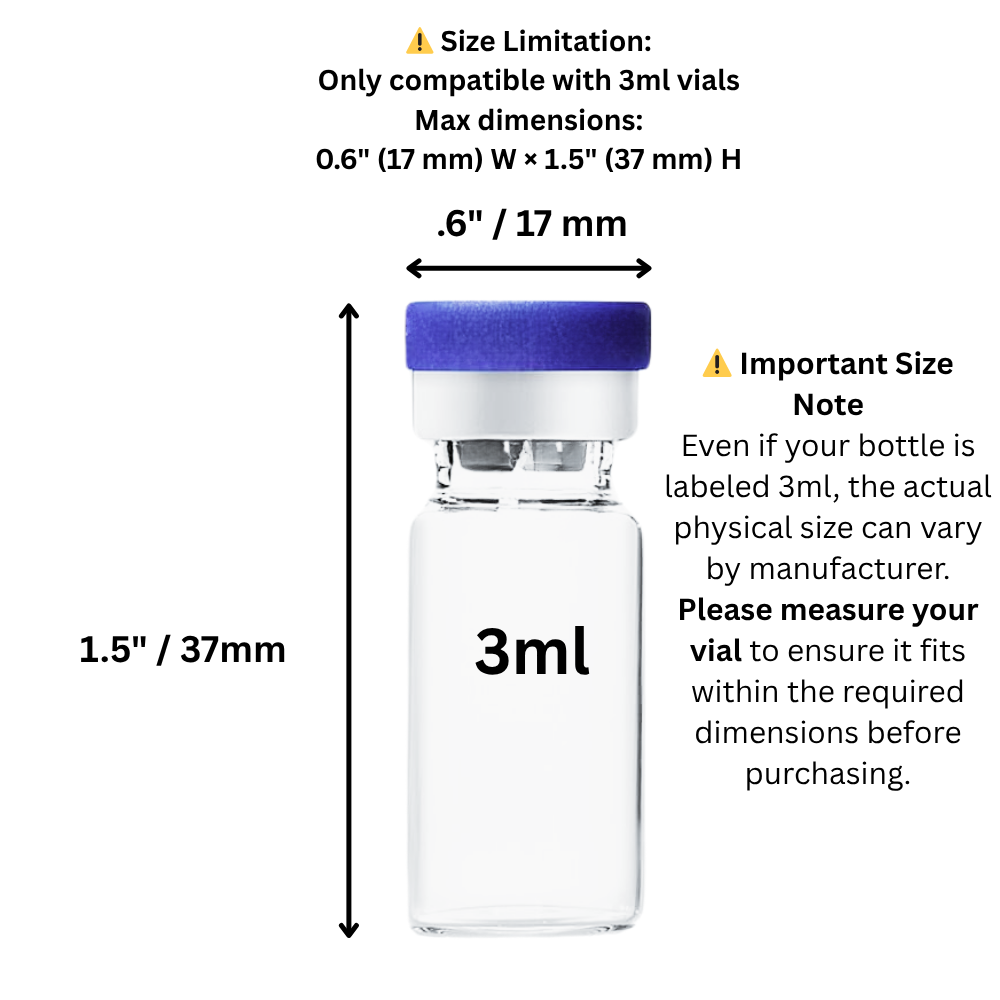
Every other option on this list asks you to fit your vials to someone else's container. With the PeptideCase™ builder you start with an empty case and add exactly what you keep in the fridge: 3 mL vials, 10 mL vials, peptide vials, a BAC water bottle, syringes or alcohol pads. Each item becomes fitted pockets or an open bay sized for that many, so nothing rattles loose. The tallest item sets the case height, and shorter vials stand on a raised floor so every vial top lines up at the rim, easy to grab. Every storage space has a finger scoop.
Auto-arrange packs everything into the most compact layout, and the builder shows the exact length, width and height, so you can check it against your fridge shelf before you order. The hard shell closes with a print-in-place snap hinge and a locking latch. Design your fridge case.
Pro Tip: Label each vial with what it is and the date you opened it, using a fine-tip marker on a small piece of tape. If you keep several kinds of vials, color-coded caps let you tell them apart at a glance.
Color-code your vials
Custom snap-on caps for 3 mL or 10 mL vials, with a cap color plus an icon or letters. Sets from 25 caps.
Why Fridge Placement Matters As Much As the Container
Even the best storage case can't fix bad fridge placement. Temperature inside a standard home refrigerator varies by location, so first follow the storage instructions on your product label or from your pharmacist or provider, then pick the steadiest spot:
- Back of the middle shelf — usually the most stable spot. Air from the back vents keeps this zone closest to the thermostat setting, and nothing bumps it when the door opens. This is where your case belongs.
- Door shelves — the warmest, least stable part of the fridge. The door swings and the shelf rattles every time you open it, so vials there get both warm air and knocks.
- Top shelf — warmer air rises, so the top shelf tends to run warmer than the middle shelf.
- Crisper drawer — an acceptable backup. Steadier than the door, but more humid, so keep vials in a closed case rather than loose.
The ideal setup: a closed hard case at the back of the middle shelf, never on the door. Remember the case itself is a protective organizer, not a cooler; the fridge does the cooling, and the case keeps everything together, upright and out of harm's way.
How Often Should You Check Your Peptide Fridge?
A brief weekly check takes about a minute and catches problems before they become expensive mistakes:
- Fridge temperature — a digital fridge thermometer in the back-middle zone tells you whether the fridge is holding the range your label calls for. If it isn't, the fridge needs adjusting or servicing.
- Labels — make sure every vial label is still dry, readable and dated. Replace any tape label that has smudged.
- Inventory — glance at the case and see what you're running low on before you run out.
- Case integrity — check that the case is fully closed and latched. An open lid means light and knocks every time the door opens.
Make your own custom fridge case for your vials
The best fridge case is one that fits both your vials and your shelf. In the builder you tap "Add item" and pick what you keep: 3 mL vials, 10 mL vials, peptide vials, other size vials, a BAC water bottle, syringes, alcohol pads, or a custom space where you type in the width, depth and height. Set how many of each and Auto-arrange finds the most compact layout.
The builder shows the case length, width and height with a top view, a lid view and a 3D view (open, unlatched or closed, drag to turn), so you know exactly how much shelf it takes. Choose Black or RGB Metallic, a Wide or Deep shape, and one or two latches. Add a temperature sensor window in the lid or a socket inside the case if you want to keep a small digital thermometer with your vials. Add your name or an icon to the lid so nobody in the house mistakes it for leftovers. It is printed to order in the US, exactly the size shown.